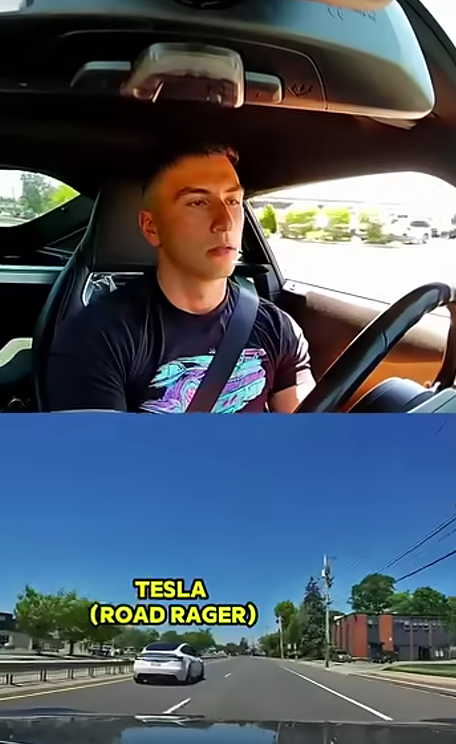
The video captures a fast-developing road rage incident that escalates from a minor traffic frustration into an immediate example of consequences unfolding in real time, showing how quickly aggressive driving behavior can spiral into risky decisions and ultimately lead to enforcement action. What begins as a simple moment of one driver passing another quickly turns into a chain of emotional reactions, reckless choices, and poor judgment that culminates in a police intervention, while the other driver—who was originally the target of aggression—ends up witnessing the situation resolve in his favor. The entire sequence highlights how road rage can distort perception, escalate conflict unnecessarily, and create situations where drivers lose focus on safety in favor of ego-driven reactions.
The incident begins when a driver in a Toyota Supra passes a Tesla that is traveling under the speed limit. In normal driving conditions, this would be an entirely routine maneuver, as faster vehicles frequently overtake slower traffic to maintain flow and avoid congestion. However, in this case, the Tesla driver interprets the pass not as a standard traffic action, but as a personal insult or challenge. This emotional misinterpretation becomes the trigger for the entire chain of escalating behavior that follows.
Rather than continuing calmly on the road, the Tesla driver quickly becomes aggressive. He accelerates to catch up to the Supra, closing the distance rapidly in what appears to be an emotionally charged reaction rather than a controlled driving decision. At this point, the situation shifts from ordinary traffic interaction into road rage behavior, where emotional impulse begins to override safe driving practices. One of the most dangerous aspects of road rage is that it often removes rational decision-making from the driver entirely, replacing it with anger-based reactions that prioritize confrontation over safety.
Once the Tesla catches up, the driver begins shouting expletives out of the window toward the Supra. This verbal aggression adds a psychological layer to the encounter, turning what could have remained a brief traffic disagreement into a sustained confrontation. Alongside the shouting, the Tesla driver throws a plastic bottle at the Supra. While the object itself may seem minor, the act of throwing anything at another moving vehicle significantly increases the danger level of the situation. Even lightweight objects can cause distraction, provoke sudden reactions, or escalate tensions further between drivers.
The Supra driver, meanwhile, attempts to avoid engaging with the aggression. By not responding to the verbal provocation or retaliating, he tries to maintain focus on driving safely and continuing forward. This decision is important because engaging with an aggressive driver often increases risk rather than reducing it. However, despite the lack of response, the Tesla driver continues to escalate the situation by following closely behind and repeatedly laying on the horn. Tailgating and excessive horn use are both forms of aggressive driving that contribute to stress and reduced reaction time for everyone involved on the road.
At this stage, the situation is already dangerous. Close following distances reduce the time available to react to sudden braking or unexpected obstacles, and prolonged honking can create confusion and panic. However, the most critical moment occurs when the Tesla driver attempts to overtake again at an intersection. Intersections are already high-risk zones due to cross traffic, turning vehicles, and changing right-of-way conditions. Attempting an aggressive pass in such an environment significantly increases the chance of missing important visual cues.
As the Tesla driver tries to whip around the Supra, he fails to notice an unmarked police vehicle positioned at the stop sign. Unmarked police vehicles are specifically designed to blend into regular traffic environments in order to monitor driving behavior without being immediately identified. Because the Tesla driver is focused on overtaking and reacting emotionally to the situation, his attention appears narrowed, reducing his awareness of surroundings. This lack of situational awareness becomes the turning point of the entire incident.
Almost instantly, the unmarked police vehicle activates its emergency lights, signaling a traffic stop. The sudden activation immediately shifts the tone of the scene from chaotic road rage to formal law enforcement intervention. In a matter of seconds, the aggressive behavior that began as a reaction to being passed is brought to an abrupt halt by the presence of authority. The timing of the police intervention reinforces one of the central themes of the video: reckless driving behavior often leads directly to consequences, even when the driver believes they are in control of the situation.
The Supra driver, who had been the target of aggression throughout the encounter, continues forward and is effectively removed from the conflict. His reaction—described as laughing in celebration—reflects relief and perhaps disbelief that the situation escalated in such a dramatic and self-inflicted way for the Tesla driver. From his perspective, what began as a simple pass on the road ended with the other driver’s aggressive actions directly attracting police attention and resulting in a traffic stop.
The aftermath highlights how quickly roles can reverse during road rage incidents. The driver who initiates aggression often ends up placing themselves in a worse position than the person they targeted. In this case, the Tesla driver’s decisions—chasing, shouting, throwing objects, tailgating, and attempting a risky overtake—created a pattern of escalating violations that naturally drew law enforcement attention. Meanwhile, the Supra driver remained largely disengaged, avoiding further escalation and ultimately continuing on his route without consequence.
The broader lesson illustrated by the video is how emotional driving dramatically increases the likelihood of negative outcomes. Traffic environments require constant attention, patience, and restraint, especially when other drivers behave unpredictably. Once anger takes control, drivers tend to focus less on safety and more on retaliation or proving a point, which often leads to poor decision-making. In this case, that emotional spiral directly resulted in the Tesla driver being pulled over within moments of his aggressive maneuver.
The presence of the unmarked police vehicle also emphasizes how enforcement can be unpredictable. Drivers engaged in reckless behavior often assume that if they do not immediately see law enforcement, they are free from consequences. However, unmarked units are specifically positioned to observe and respond to exactly this type of behavior. The sudden activation of lights at the critical moment reinforces that violations can be recorded and acted upon even when drivers are not aware they are being watched.
Ultimately, the video stands as a clear example of how road rage undermines safety and judgment. A minor traffic interaction escalates into aggressive pursuit, object throwing, and dangerous overtaking, all triggered by a simple pass on the road. The outcome serves as a reminder that staying calm behind the wheel not only protects everyone involved but also prevents drivers from unintentionally creating their own consequences through reckless emotional decisions.
The situation also becomes more interesting when you look at how quickly perception can shift inside a road rage event. What starts as a simple driving interaction—one car passing another—gets mentally reinterpreted by the aggressive driver as disrespect or provocation, even though there is no real evidence of intent behind the action. This kind of misinterpretation is one of the core psychological drivers of road rage. Drivers often assume meaning where there is none, turning neutral traffic behavior into a personal conflict.
In normal driving conditions, being passed by another vehicle is routine and happens constantly, especially when speed differences exist. However, once emotion enters the equation, the same action can feel like an insult to someone who is already impatient, stressed, or in a heightened emotional state. The Tesla driver’s reaction shows how quickly frustration can escalate into hostility when a driver internalizes another person’s behavior as deliberate disrespect.
Another key aspect of the video is how escalation removes rational decision-making step by step. First comes verbal aggression, which is often the earliest outward sign that a driver has lost emotional control. Shouting at another driver is not just an expression of anger—it also reinforces that emotional state, making it harder to calm down. Then comes the act of throwing the bottle, which represents a shift from emotional expression to physical action. Once a driver begins physically interacting with another vehicle, even indirectly, the situation becomes significantly more dangerous.
The decision to tailgate afterward adds another layer of risk because it shows sustained fixation on the conflict rather than the road. Instead of disengaging after the initial outburst, the Tesla driver continues to follow the Supra closely, essentially prolonging the confrontation. This is where road rage becomes particularly hazardous, because it reduces reaction time and increases the chance of a collision even without intentional harm. The driver is no longer simply traveling—they are actively engaged in a pursuit driven by emotion.
At intersections, this kind of emotional tunnel vision becomes even more dangerous. Intersections require heightened awareness because they combine multiple traffic flows, turning vehicles, and potential obstacles. When the Tesla driver attempts to overtake at this exact moment, his attention is clearly narrowed toward the Supra rather than the environment around him. That split-second failure to scan properly is what leads to missing the unmarked police vehicle.
The presence of the unmarked police car is crucial because it represents how enforcement often works in real traffic environments. Drivers frequently assume that if they don’t see flashing lights, they are not being monitored. However, unmarked vehicles exist specifically to observe behavior without influencing it. This means drivers engaged in reckless behavior often unknowingly place themselves under surveillance long before any intervention happens.
When the police lights activate, the emotional tone of the entire scene collapses instantly. Everything that was building tension—aggressive driving, chasing, horn blasting, confrontation—ends in a moment of sudden consequence. That abrupt shift is part of what makes the clip so impactful. It demonstrates how quickly external authority can intervene when driving behavior crosses into dangerous territory.
From a behavioral standpoint, the Tesla driver essentially creates his own outcome through cumulative decisions. Each step—accelerating to catch up, shouting, throwing an object, tailgating, and attempting a risky pass—adds to the likelihood of attracting attention and receiving a penalty. It is not a single mistake but a chain of escalating actions that ultimately leads to enforcement.
Meanwhile, the Supra driver’s calm response highlights the importance of non-engagement in road rage situations. By not retaliating or escalating the conflict, he avoids becoming part of the dangerous spiral. This is a critical safety principle in defensive driving: disengaging from aggressive drivers reduces risk significantly. Even though the situation is uncomfortable, refusing to participate in escalation often leads to safer outcomes.
The moment of the Supra driver laughing afterward reflects relief more than anything else. From his perspective, he likely experienced a brief but intense period of being targeted by aggression without provoking it. Seeing that the aggressive driver ultimately gets pulled over validates his decision not to engage. It also reinforces a common real-world observation: road rage often harms the person initiating it more than the person being targeted.
Another layer to consider is how quickly public road spaces can turn into emotionally charged environments. Roads are shared spaces where strangers interact indirectly through speed, spacing, and movement. Because there is no verbal communication in normal driving, misunderstandings are more likely when someone interprets behavior through emotion rather than logic. Small frustrations can escalate rapidly because drivers feel anonymous and disconnected from consequences.
The video also highlights how modern traffic enforcement relies on unpredictability. Drivers never fully know when or where police presence might appear, especially with unmarked units. This uncertainty plays an important role in discouraging aggressive behavior, because it removes the assumption that consequences are avoidable simply by not seeing patrol cars.
In a broader sense, the clip reflects a common pattern in road rage incidents: escalation, tunnel vision, and sudden consequence. It begins with a minor trigger, grows through emotional reactions, and ends with an external interruption that resets the situation entirely. What makes this case stand out is how cleanly the consequences align with the behavior, reinforcing the idea that aggressive driving often leads directly to enforcement without needing additional escalation.
Ultimately, the video serves as a reminder that driving is not just about controlling a vehicle but also controlling emotional responses in real time. The Tesla driver’s actions show how quickly anger can override judgment, turning a simple traffic moment into a sequence of dangerous decisions. The Supra driver’s restraint shows the opposite approach—staying focused on safety rather than engagement. And the sudden appearance of law enforcement closes the loop, demonstrating that on public roads, behavior is constantly subject to consequences, even when drivers believe they are acting out of frustration or justification.