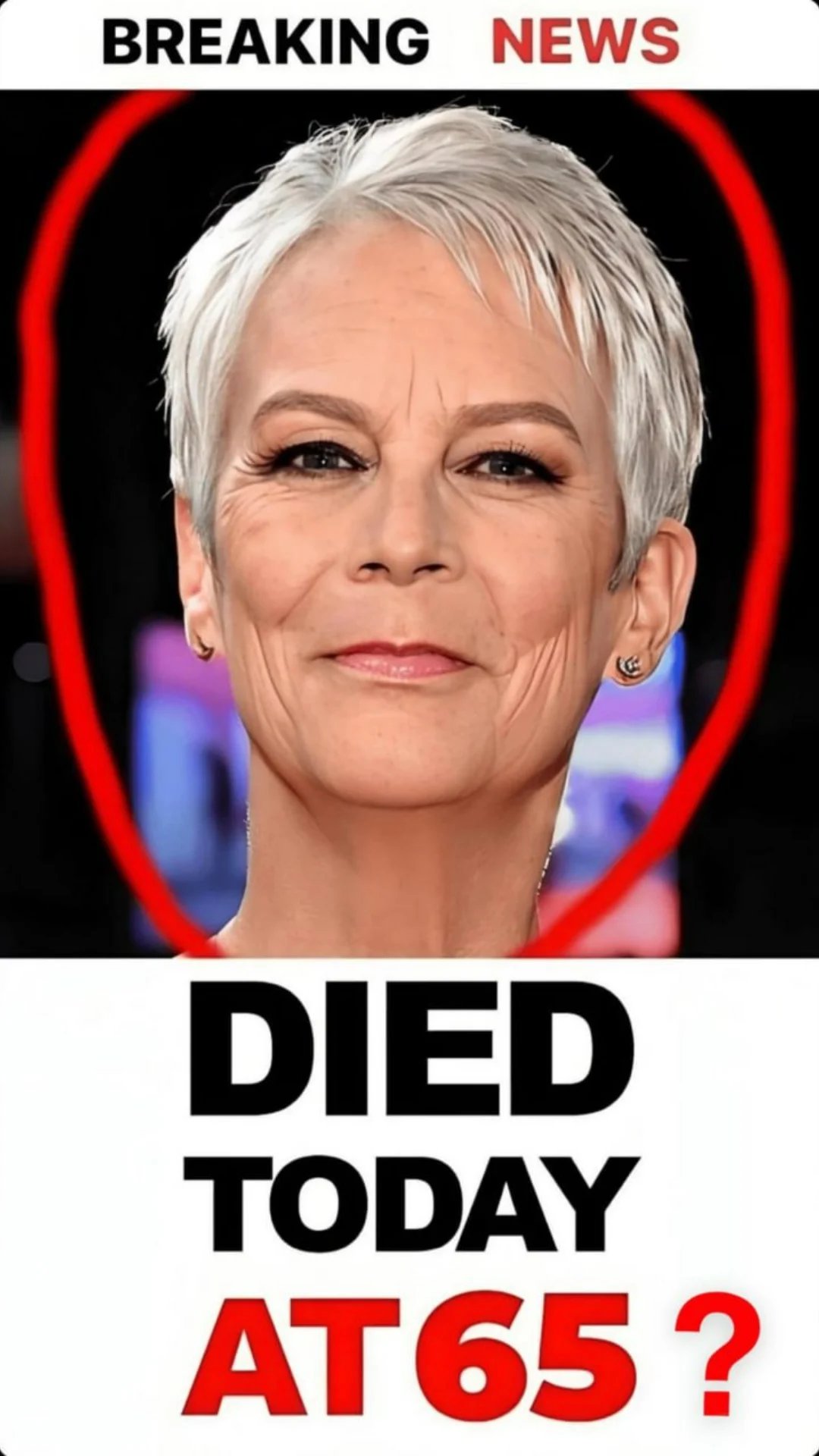
A viral image claiming that Jamie Lee Curtis “died today at 65” has been circulating online, using a dramatic “breaking news” layout and a large portrait of the actress to grab attention. The image is designed to look urgent, emotional, and shocking, but there is no credible evidence that the claim is true. Instead, it appears to be another example of a celebrity death hoax, a type of misleading post that spreads quickly across social media by exploiting public emotion, curiosity, and the trust people often place in familiar faces.
The post shows a close-up image of Jamie Lee Curtis with bold text reading “BREAKING NEWS” at the top and “DIED TODAY AT 65?” underneath. The question mark at the end is important. It gives the post a way to appear dramatic while avoiding a clear, direct statement. This is a common tactic used in clickbait-style misinformation. The image suggests something tragic has happened, but the wording leaves just enough uncertainty to lure people into clicking, sharing, or searching for more.
At first glance, the post may look like a news announcement. It uses the visual language of breaking news: bold letters, red highlights, a cropped celebrity portrait, and urgent wording. But real news outlets do not usually announce the death of a major public figure through vague image posts with no source, no article link, no official statement, and no clear details. When a celebrity of Jamie Lee Curtis’s stature dies, the news is normally confirmed by reputable outlets, representatives, family statements, or official channels.
In this case, credible reporting does not support the claim. Recent public information continues to describe Jamie Lee Curtis as alive and active in her career. She has been connected to ongoing entertainment projects, including reports about a “Murder, She Wrote” reboot and other recent acting and producing work. That directly conflicts with the viral image’s implication that she died.
Jamie Lee Curtis is one of Hollywood’s most recognizable actresses, known for a career that spans decades. She first became widely known through horror films, especially her role in the “Halloween” franchise, and later built a varied career across comedy, drama, television, children’s books, and producing. Biography.com describes her as an actor whose career has stretched from “Halloween” to her Oscar-winning work in “Everything Everywhere All at Once.”
Because Curtis is such a familiar public figure, posts about her naturally attract attention. That is exactly why fake celebrity death posts often target well-known actors, musicians, athletes, and public personalities. The more recognizable the person, the more likely people are to stop scrolling, react emotionally, and share the post before verifying it.
Celebrity death hoaxes are not new. They have existed for years, but social media has made them faster and easier to spread. A misleading image can be created in minutes and shared across Facebook, Instagram, TikTok, YouTube thumbnails, or low-quality websites. Once people begin reacting, the algorithm may push the post to more users, creating the illusion that the story is important or widely confirmed.
The emotional design of this particular image is also worth noting. The words “breaking news” and “died today” are meant to trigger shock. The large portrait creates a personal connection. The red and black color scheme creates urgency and seriousness. The question mark creates curiosity. All of these elements are designed to make someone click or share before they think carefully.
This is why misinformation can spread so effectively. It does not always need to fully convince people. Sometimes it only needs to make them curious enough to engage. A person might share the image with a caption like, “Is this true?” or “I hope this isn’t real.” Even though they are not claiming it is confirmed, the share still helps spread the false or unverified claim.
The use of a question mark is especially common in misleading celebrity posts. Instead of saying, “Jamie Lee Curtis has died,” the image says, “Died today at 65?” This style allows the creator to suggest a shocking claim while pretending they are only asking a question. But to many viewers, the emotional effect is the same. They see the words “died today” next to the celebrity’s face and may assume something terrible has happened.
A responsible article about this image should therefore make one point clear from the beginning: there is no verified evidence that Jamie Lee Curtis has died. The image should not be treated as a reliable news source. It is better understood as a viral rumor or possible clickbait post designed to attract attention.
The danger of posts like this is not only that they mislead people. They can also cause unnecessary distress to fans, friends, and family members. When people see a false death announcement about someone they admire, they may feel sadness, panic, or confusion. In the case of public figures, false death rumors can spread so widely that the person or their representatives may need to publicly correct them.
Jamie Lee Curtis herself has previously spoken out about fake AI content and online misuse of her image. In 2025, reports noted that Meta removed a “totally AI fake” ad involving Curtis after she publicly called attention to it. That situation shows how celebrity images can be manipulated or used without proper context online.
The viral death image fits into a larger pattern of online content that uses celebrities as emotional bait. Sometimes the post may lead to a low-quality article filled with ads. Sometimes it may be part of a scam page. Sometimes it may simply be made for engagement. The goal is usually attention, not accuracy.
When checking whether a celebrity death report is real, the first step is to look for credible confirmation. Major entertainment outlets, respected newspapers, wire services, and official representatives usually report the news quickly. If a claim appears only in random social media posts, blurry thumbnails, or pages with dramatic wording but no evidence, it should be treated with caution.
Another warning sign is the lack of specific details. Real death reports usually include information such as where the person died, who confirmed it, whether a family statement was released, and sometimes the cause of death if it is publicly known. Fake posts often avoid details. They rely on big emotional words and an image, but provide little substance.
This image does not provide a source, date, official statement, publication name, or supporting evidence. It simply uses dramatic text. That alone is a strong reason not to trust it.
It is also important to be careful with the phrase “breaking news.” Online misinformation often borrows the language of journalism without following journalistic standards. Real breaking news is usually tied to a newsroom, reporter, publication, or verified source. A random graphic saying “breaking news” is not enough.
The claim that Curtis “died today at 65” is also suspicious because she was born in November 1958, making her older than 65 as of 2026. Biography.com lists her birth year as 1958, which means a graphic claiming she died “at 65” is already inconsistent with her current age timeline.
That type of inconsistency is common in fake posts. The creators may use outdated templates, copy text from old rumors, or make mistakes because the goal is speed and attention rather than accuracy. Sometimes these posts are recycled with different celebrity names and photos, while the wording remains almost the same.
The best way to write about this photo is not to present it as real news, but as an example of how fake celebrity death rumors spread. A strong article can explain what the image claims, why the claim appears unreliable, how viewers can verify similar posts, and why people should avoid sharing unconfirmed death announcements.
The headline should also avoid repeating the false claim too strongly. Instead of writing, “Jamie Lee Curtis Died Today,” a safer headline would be something like: “Viral Jamie Lee Curtis ‘Death’ Image Sparks Confusion Online” or “Fact Check: No Credible Evidence Supports Viral Jamie Lee Curtis Death Claim.” This avoids misleading readers while still addressing the image.
The story also provides an opportunity to talk about media literacy. Many people scroll quickly and react to emotional posts before checking them. That is understandable, especially when a beloved celebrity is involved. But misinformation thrives on speed. The faster people share, the less time there is for verification.
A simple rule can help: pause before sharing. If a post makes you feel shocked, angry, or sad, that is exactly when you should slow down. Emotional reactions are often used to manipulate engagement. Before reposting, check trusted sources, look for official statements, and search whether reputable outlets have confirmed the news.
In Jamie Lee Curtis’s case, recent reports continue to discuss her professional work. A New York Post entertainment report in 2025 described Curtis confirming involvement in a “Murder, She Wrote” reboot, while People previously reported on her ongoing creative energy and desire to continue creating. These reports support the conclusion that the viral death image is not credible.
The image also reflects a broader problem with the online attention economy. Dramatic false posts often perform well because they trigger immediate emotion. A calm, factual correction may not spread as far as the original rumor. That means misinformation can reach millions before the truth catches up. This is why responsible sharing matters.
For fans of Jamie Lee Curtis, the best response to this image is not panic, but verification. Search for trusted sources. Check her official channels. Look for statements from major outlets. If no credible confirmation exists, do not share the post as fact.
It is also worth remembering that public figures are real people with families, friends, colleagues, and fans. False death rumors are not harmless jokes. They can cause emotional distress and force people to waste time correcting lies. They also reduce trust in real news because audiences become more confused about what is true.
The photo’s design suggests it was made to look like a dramatic announcement, but it lacks the basic qualities of legitimate journalism. There is no named outlet, no reporter, no confirmation, no source, and no context. It is simply a shocking claim placed over a celebrity image. That is not enough to establish truth.
A responsible article can therefore conclude that the viral image should be treated as false or unverified unless credible sources report otherwise. At the time of checking, there is no trustworthy evidence that Jamie Lee Curtis has died. Instead, available information points to her being alive and continuing her public career.
The broader message is clear: not every “breaking news” image is news. Some are designed only to trick people into clicking, reacting, or sharing. When the claim involves a celebrity death, the need for caution is even greater.
In the end, this viral Jamie Lee Curtis image appears to be another misleading celebrity death post. It uses dramatic design, emotional wording, and a familiar face to create shock, but it does not provide evidence. Credible sources do not support the claim, and recent reporting continues to reference Curtis as alive and professionally active. Before believing or sharing images like this, readers should verify through reliable outlets and remember that emotional posts are often the easiest ones to fake.
The spread of this type of image also shows how quickly a false claim can become believable when it is presented with the appearance of urgency. Many people do not stop to ask whether the post comes from a reliable source. They see a familiar face, bold text, and the words “breaking news,” and their first reaction is emotional. That emotional reaction is exactly what these posts are built to create. They are not designed to inform carefully; they are designed to interrupt scrolling and force a reaction.
In the case of Jamie Lee Curtis, the claim is especially easy to question because current public information points in the opposite direction. Recent reporting has described her as active in new projects, including her confirmed involvement in a “Murder, She Wrote” reboot movie, where she is set to take on the role of Jessica Fletcher. That kind of recent professional activity is inconsistent with the idea that a legitimate death announcement had been made and somehow missed by every major outlet.
Another reason the image should be treated skeptically is its lack of context. It does not say where the supposed news came from. It does not name a hospital, family representative, publicist, agency, police department, or official statement. It does not include a date beyond the vague phrase “today.” It does not provide a link to a full article from a recognized newsroom. In real reporting, especially about a major celebrity, those details matter.
A credible report about the death of a famous actor would not usually appear first as a random graphic with no source. It would be reported by entertainment outlets, newspapers, wire services, television networks, and official social media accounts. There would be confirmation from representatives or family. Other public figures would likely begin responding publicly. The absence of that wider confirmation is a major warning sign.
This is one of the simplest ways readers can protect themselves from being misled: check whether multiple reliable sources are reporting the same thing. If only one suspicious post is making the claim, especially if the post uses dramatic design and vague wording, it should not be trusted. Real breaking news spreads quickly, but it also leaves a trail of credible confirmation. Fake news often spreads through recycled images, anonymous pages, and emotional captions.
The image also uses a familiar clickbait pattern: it turns a statement into a question. The phrase “DIED TODAY AT 65?” is not written like responsible reporting. It is written to make people wonder, click, and share. A question mark can make a false or unsupported claim seem less direct, but it still plants the idea in the viewer’s mind. This is a common trick. The creator can suggest something shocking while avoiding the responsibility of clearly stating it as fact.
That kind of wording is especially harmful when it involves death. Death is not ordinary gossip. It is a serious subject that affects families, fans, colleagues, and communities. Using someone’s image to imply they have died, without evidence, is not harmless entertainment. It can cause confusion and distress, and it contributes to a wider online environment where people struggle to know what is real.
Jamie Lee Curtis is also a public figure with a long and respected career, which makes her a frequent target for attention-based posts. She has been part of major film franchises, won major awards, written books, spoken publicly on social issues, and remained culturally visible across generations. Because so many people recognize her, any dramatic claim attached to her name is likely to get engagement. That makes her image valuable to clickbait pages.
These pages often do not care whether the story is true. Their goal may be to drive traffic to websites filled with ads, collect shares, grow social media pages, or trick users into clicking suspicious links. Sometimes the false death post is only the first step. A user clicks the image, lands on a page, and is shown unrelated ads, misleading stories, or even scam-like prompts. The celebrity’s face is used as bait.
The design of the photo is also meant to mimic urgency without providing proof. The words “BREAKING NEWS” appear at the top in bold black and red text. A red circle surrounds the background, drawing attention to the face. The lower section uses large, heavy text to make the phrase “DIED TODAY” impossible to miss. This is not subtle. It is engineered for shock.
A responsible news article would do the opposite. It would use careful language, explain what is confirmed, identify who confirmed it, and avoid sensational visuals unless they serve a clear journalistic purpose. It would not rely only on a dramatic image. It would provide facts.
The age mentioned in the image is another reason to question it. The image claims “at 65,” but Jamie Lee Curtis was born in November 1958, which makes that number inconsistent with her current age timeline. When viral posts get basic details wrong, it is often a sign that the graphic was made carelessly, recycled from older templates, or created by someone more interested in clicks than accuracy.
False celebrity death posts often follow the same formula. They use a well-known person’s photo, add “sad news” or “breaking news,” suggest a sudden death, and provide little or no evidence. Sometimes they include a question mark. Sometimes they include a fake age. Sometimes they use an old photo to create emotional impact. The details may change, but the method stays the same.
Readers should also be cautious when posts ask for emotional reactions before providing evidence. Captions like “We lost a legend,” “Pray for the family,” or “You won’t believe what happened” are designed to trigger sympathy and urgency. They may encourage people to comment before reading anything. More comments can make the post spread further, even if the comments are asking whether the story is true.
This is why commenting “Is this real?” can still help the false post spread. Social media platforms often treat comments as engagement. Even skeptical engagement can increase reach. A better response is to avoid interacting with the original post and instead check credible sources separately. If the post is false, it is better not to boost it.
The best headline for an article about this image should therefore be careful. A headline like “Jamie Lee Curtis Death Rumor Goes Viral, But No Evidence Supports Claim” is safer than repeating the false claim as fact. The article should make clear immediately that the viral image is not confirmed and appears misleading. It should not leave readers confused or make them think the death claim is true.
A strong article can also explain why people believed the post. Many fans have emotional connections to celebrities they grew up watching. Jamie Lee Curtis has been part of pop culture for decades, so a shocking claim about her naturally feels personal to many people. When people care about a public figure, they may react before verifying. That emotional bond is exactly what clickbait creators exploit.
The story also fits into a larger trend of misinformation becoming more visual. In the past, false stories were often spread through text articles or fake headlines. Now, a single image can do the same work. A fake graphic can be screenshot, reposted, cropped, translated, and shared across platforms in seconds. Because it looks like a finished “news card,” people may assume someone else already verified it.
Artificial intelligence and editing tools have made the problem easier to produce. A person no longer needs professional design skills to create a convincing fake news-style image. They can use templates, celebrity photos, bold fonts, and dramatic wording to make something look official. That means readers must judge content by its source and evidence, not only by how polished it appears.
Jamie Lee Curtis has also publicly dealt with misleading or AI-generated uses of her likeness before. That makes this kind of image part of a broader issue involving celebrity identity online. Public figures can have their faces used in fake ads, fake death announcements, fake interviews, and fabricated stories. The more recognizable the person, the easier it is for bad actors to use their image to gain attention.