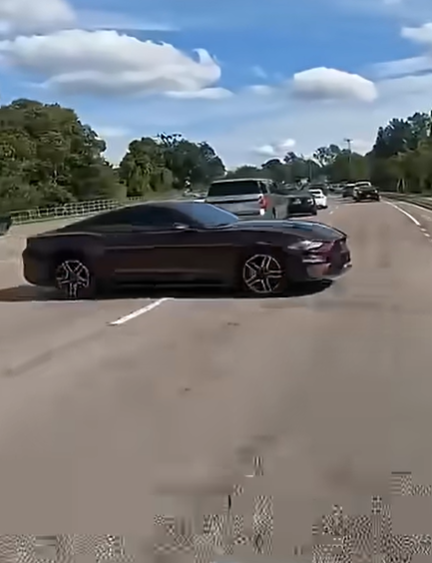
A serious road accident involving a motorcyclist quickly turned into a dispute over fault after a driver pulled out from a line of stopped traffic and cut across his path, causing him to crash. The video captures not only the moment of impact and the immediate disagreement afterward, but also the way bystanders stepped in to help as the injured rider remained on the road with what he described as a severely broken arm.
The incident begins with the motorcyclist riding straight down the road. From his perspective, he is continuing along his lane when traffic beside him appears to be stopped. Suddenly, a driver pulls out from the line of stopped vehicles and enters his path. The move leaves the motorcyclist with little time to avoid the collision. In a moment, what had been a normal ride becomes a dangerous crash.
Motorcyclists are especially vulnerable in situations like this because they do not have the same protection as people inside cars. A driver making a sudden turn or pulling out unexpectedly can cause serious injuries even at speeds that might seem manageable for larger vehicles. For a rider, there is little barrier between their body and the road, another vehicle, or surrounding traffic. That is why sudden lane changes and unexpected pullouts are so dangerous.
After the crash, the driver immediately appears to shift blame onto the motorcyclist. She claims that traffic was stopped and that he “ran into her.” Her argument seems to be that because the other vehicles were not moving, the motorcyclist should not have been moving through the area or should have stopped as well. But the motorcyclist pushes back, explaining that he was riding straight and that she was the one who pulled out in front of him.
The disagreement becomes important because the moments after a crash often shape how the incident is reported. Drivers may be shaken, defensive, or afraid of being held responsible. Sometimes, people immediately try to explain the accident in a way that protects themselves. In this case, the woman’s claim that the rider “ran into her” appears to conflict with the rider’s version that she cut him off.
The motorcyclist then reveals an important detail: he has the entire incident recorded on camera. That changes the nature of the dispute. Instead of relying only on statements from the driver and rider, the footage can show what happened before the collision. The camera can show whether the motorcyclist was traveling straight, whether the driver pulled out from stopped traffic, and whether the rider had a reasonable chance to avoid the crash.
For the motorcyclist, having the crash recorded is crucial. Without video, the situation might become a difficult argument between two competing stories. The driver could claim he caused the crash, while he could claim she cut him off. Witnesses might not have seen everything clearly, especially if the crash happened quickly. Camera footage helps preserve the moment exactly as it unfolded.
The video also captures the aftermath, where the motorcyclist remains injured on the road. A soldier quickly arrives at the scene and tries to help. His first instinct appears to be moving the rider out of the roadway, likely because staying on the road after a crash can be dangerous. Other vehicles may still be nearby, traffic may not be fully stopped, and people may worry about the rider being struck again.
However, the motorcyclist tells him to stop because his arm is severely broken. That moment is important because moving an injured person can sometimes make injuries worse, especially if there may be serious fractures or other trauma. The soldier’s intention is clearly to help, but the rider is aware enough to explain that he cannot be moved that way. The best response in that moment becomes keeping him safe while waiting for emergency responders.
A group of bystanders gathers around to assist. One person calls 911, while another offers to call the motorcyclist’s wife. This part of the video shows a strong community response. After the crash and the dispute over fault, the focus begins to shift toward helping the injured rider. People nearby recognize that he needs medical attention and support.
The person calling 911 plays one of the most important roles. In any crash involving injury, emergency services need to be contacted as quickly as possible. Dispatchers can send police, firefighters, and medical personnel to the scene. They can also guide callers on what to do while waiting. A motorcyclist lying injured on the road needs professional assessment, especially if he believes his arm is severely broken.
The offer to call his wife adds an emotional layer to the scene. After a crash, injured people often worry about their loved ones finding out or not knowing where they are. Having someone offer to contact his wife shows compassion. It recognizes that the rider is not just an accident victim; he is someone with family who may need to be informed and reassured.
The driver’s immediate attempt to blame the motorcyclist may be one of the most frustrating parts of the video. After a crash, especially one involving injury, the priority should be checking whether everyone is okay and calling for help. Arguments over fault can wait until police arrive and evidence is reviewed. But the driver’s first reaction appears to be defending herself, even while the rider is hurt.
The motorcyclist’s response shows that he understands the importance of evidence. By telling her that the crash is on camera, he pushes back against her attempt to control the story. His statement suggests confidence that the footage will show he was riding straight and that she entered his path. In that moment, the camera becomes his protection against being falsely blamed.
The crash also highlights a common danger for motorcyclists: drivers pulling out from stopped or slow traffic without carefully checking for bikes. Motorcycles can be harder to notice than cars, especially in mirrors or gaps between vehicles. Drivers may focus on larger vehicles and fail to see a rider approaching. But that does not remove the responsibility to check carefully before moving into another lane or crossing a path of travel.
When traffic is stopped, some drivers may assume the entire roadway is blocked or that no one is moving. But depending on the road layout, motorcycles, bicycles, or other vehicles may still be traveling legally and safely in an open lane. Pulling out without checking creates a serious hazard. The fact that traffic is stopped in one area does not automatically mean it is safe to move across another path.
The motorcyclist’s injuries make the consequences of that mistake immediate and real. A broken arm is not a small inconvenience. It can involve severe pain, medical treatment, time away from work, difficulty with daily tasks, and a long recovery. For a rider, an injury like that can also affect confidence on the road. Even after healing physically, the memory of being cut off and thrown into a crash may remain.
The soldier’s instinct to help also shows how people often react in emergencies. When someone is injured in the roadway, the first thought may be to move them to safety. That instinct is understandable. But the rider’s request to stop shows why it is important to be careful. Unless there is an immediate danger that requires movement, it is often better to wait for trained responders and avoid moving someone with possible serious injuries.
The bystanders gathering around likely helped protect the rider in other ways. Their presence may have alerted approaching drivers, created a visible scene, and ensured he was not left alone. In the moments after a crash, an injured person can feel vulnerable and disoriented. Having people nearby offering help, making calls, and speaking calmly can make a frightening situation more manageable.
The video’s emotional tension comes from two things happening at once. On one side, there is the practical emergency: an injured motorcyclist on the road who needs help. On the other side, there is the conflict over responsibility, with the driver trying to blame him and the rider defending himself. That combination of pain, shock, and accusation makes the scene especially tense.
The driver’s statement that he “ran into her” may sound simple, but it leaves out the key question of why her vehicle was in his path. In many crashes, the vehicle that is struck is not automatically innocent. If a driver pulls out suddenly and leaves another road user no time to stop, the fact that the other person made contact does not necessarily mean they caused the crash. The camera footage would be essential in clarifying that.
The motorcyclist’s ability to speak after the crash also helps him advocate for himself. Even while injured, he is alert enough to tell people not to move him, explain that his arm is badly hurt, and point out that the incident was recorded. That presence of mind matters. He is protecting both his physical safety and his account of what happened.
The incident also shows why many motorcyclists use helmet cameras or bike-mounted cameras. Riders are often vulnerable not only physically, but also in disputes over fault. Drivers may claim they did not see the motorcycle or that the rider was speeding or weaving. Video evidence can help confirm the rider’s position and show whether another driver created the hazard.
For the bystanders, the situation required quick judgment. They had to help without making things worse. Calling 911 was the clearest and most important action. Offering to contact the rider’s wife was compassionate. Trying to keep him calm and visible while waiting for help would also be important. The soldier’s attempt to move him came from a protective instinct, but the rider’s warning helped redirect the assistance toward waiting for professionals.
The scene also reminds drivers to be extra cautious around motorcycles. A motorcycle may be smaller, but it has the same right to the road as any other vehicle. Before pulling out, changing lanes, crossing traffic, or turning through a gap, drivers need to check mirrors, blind spots, and surrounding lanes carefully. A quick glance is not always enough.
For motorcyclists, the video is a reminder of how quickly danger can appear even when riding straight and doing nothing wrong. A rider can be alert, in control, and following the road, yet still be placed in danger by another driver’s sudden decision. Defensive riding can reduce risk, but it cannot eliminate every hazard caused by someone else.
The crash also demonstrates why the moments after an accident should be handled carefully. Fault can be sorted out later through police reports, insurance claims, witness statements, and video. The immediate priorities are safety, medical care, and preventing further harm. Arguing with an injured person on the road does nothing to help the situation and can make the scene more stressful.
The driver’s defensiveness may have come from shock or fear of consequences, but it still appears poorly timed. A person involved in a crash should first check whether the other person is hurt. If someone is lying injured, the focus should be getting help. Trying to shift blame immediately can make the driver appear more concerned about liability than the injured person’s condition.
The motorcyclist’s camera likely becomes the strongest evidence in the case. It can show the approach, the traffic conditions, the driver’s movement, and the crash. It can also show whether the rider had time to react. If the footage clearly shows the driver pulling out from stopped traffic and cutting him off, it undermines her claim that he simply ran into her.
The accident is a clear example of how video can protect vulnerable road users. Motorcyclists, cyclists, and pedestrians often face situations where larger vehicle drivers claim they did not see them or blame them after a collision. A camera provides an independent record that can help establish the truth.
In the end, the video captures a frightening and painful road incident. A motorcyclist riding straight was cut off by a driver pulling out from stopped traffic, causing a crash that left him injured. The driver immediately tried to blame him, but he revealed that the entire incident had been recorded. A soldier and other bystanders stepped in to help, calling 911 and offering to contact his wife while the rider warned them not to move him because his arm was severely broken.
The broader lesson is that road users must remain aware of motorcycles and that crash scenes should be handled with care and honesty. The driver’s attempt to shift blame was challenged by video evidence, while the bystanders’ response showed the importance of quick assistance. What began as a sudden collision became a scene of pain, dispute, and community help, with the camera likely serving as the key to proving what really happened.