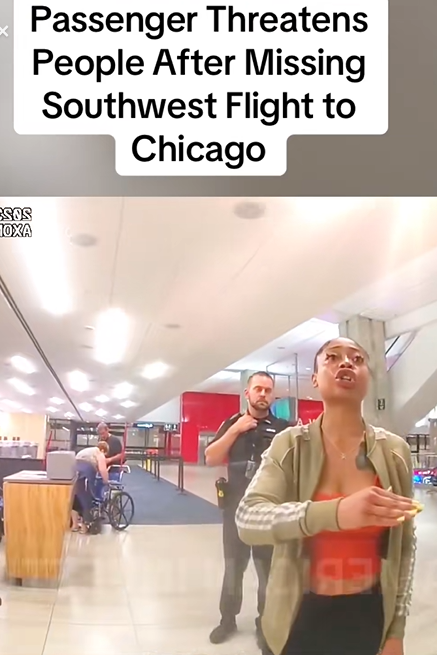
@body.cam.storie #Passenger Threatens People After Missing Southwest Flight to Chicago#Police #cops
The video captures a tense airport incident involving a passenger who missed her Southwest Airlines flight to Chicago and became increasingly confrontational with airport staff and police. What likely began as frustration over travel plans quickly developed into a public disturbance inside the terminal, drawing the attention of airport officers who attempted to calm the situation. Airports are already stressful places, especially when flights are missed, schedules are disrupted, and passengers feel trapped by policies or delays. In this case, however, the situation appears to move far beyond ordinary frustration, as the passenger begins yelling, refusing to leave, and eventually resisting officers who try to escort her away from the area.
At the beginning of the footage, the woman appears to be arguing aggressively with airport staff or security. She insists that she is calm, but her behavior suggests the opposite. She repeatedly raises her voice, tells people to stop talking to her, and refuses to lower the tension of the interaction. A police officer stands nearby and repeatedly asks her to relax. His requests seem focused on de-escalation at first. He is not immediately shown rushing toward an arrest. Instead, he appears to be trying to get her to lower her voice, stop shouting, and calm down enough for the situation to be handled without further conflict.
The woman’s missed flight appears to be the reason for the confrontation. Missing a flight can be extremely frustrating, especially when a passenger has somewhere important to be, has paid for a ticket, or believes the airline should still allow them to board. But airports operate under strict schedules and security procedures. Once a flight is closed, there is often little staff can do to reverse the situation. That can feel unfair to a passenger in the moment, but yelling at employees or security rarely changes the outcome. Instead, it can cause staff to remove the passenger from the area if they believe the behavior is disruptive or unsafe.
The officer’s repeated requests for the woman to relax show that he is trying to manage the situation before it becomes physical. He appears to give her chances to calm down and comply. But she continues shouting and arguing. Her words suggest that she feels misunderstood or disrespected, and she may believe that everyone around her is refusing to listen. That feeling can make a person more defensive, especially in a public place where they already feel embarrassed or upset. Still, the more she raises her voice and refuses to follow instructions, the more likely it becomes that officers will treat the matter as a security issue rather than a customer service dispute.
Airport terminals are sensitive environments. Staff and police are trained to respond quickly when someone becomes threatening, disruptive, or refuses lawful instructions. Unlike many public places, airports have strict safety expectations because large crowds, security checkpoints, airline operations, and restricted areas all exist close together. A loud confrontation can disturb other passengers, delay workers, and create concern for nearby travelers. In the video, the officer appears to decide that the woman cannot remain in the area if she will not calm down. He tells her she must leave and begins trying to guide her away.
The escalation happens when the officer moves from verbal instructions to physically escorting her. This is the point where the situation becomes more serious. The woman does not appear to accept the officer’s direction, and a struggle begins. Once a person resists being escorted by police, officers usually respond with more control measures to prevent the situation from becoming unsafe. Multiple officers then become involved, indicating that the first officer could not safely complete the escort alone. This kind of escalation is common in public arrest situations: what begins as a verbal refusal can quickly become a physical restraint if the person does not comply.
As officers try to restrain and handcuff her, the woman continues to yell. She drops to the floor and shouts that they are hurting her arms. From her perspective, the situation may feel overwhelming and painful. From the officers’ perspective, they are trying to gain control of someone who is resisting in a crowded airport. That contrast is what makes the footage intense to watch. The woman is protesting loudly, while the officers are focused on securing her and moving her out of the area. Each side seems locked into a different reality: she believes she is being treated unfairly, while they believe they need to restore order and remove her from the terminal.
The woman repeatedly says she can walk, but officers eventually place her into a wheelchair to transport her away. This choice may have been made because she was on the ground, resisting movement, or refusing to walk in the direction officers wanted. In a crowded airport, officers may decide that using a wheelchair is safer and more practical than dragging or carrying someone through the terminal. It can also reduce the chance of further struggle while allowing them to move the person out of the public space. Even if the woman insists she can walk, officers may not trust that she will cooperate once standing.
The emotional intensity of the scene comes from the public nature of the incident. Airports are filled with travelers, families, employees, and people waiting for flights. A person shouting and struggling with police in that environment naturally draws attention. Nearby passengers may feel uncomfortable, worried, or curious. Some may stop to watch. Others may move away. For the woman, being restrained in front of strangers may increase her embarrassment and anger. For officers, the public setting adds pressure to resolve the situation quickly and prevent it from spreading into a larger disturbance.
The incident also shows how quickly travel stress can become a legal problem. Missing a flight is not a crime. Being angry about missing a flight is not unusual. But refusing to leave when directed, yelling at staff, threatening people, or physically resisting officers can turn a customer service dispute into an arrest. That is the major lesson of the video. The original problem may have been a missed Southwest flight to Chicago, but the outcome became much more serious because of how the passenger reacted afterward.
The woman’s repeated claim that she is calm while shouting creates a striking contradiction. Many people in heated moments believe they are being reasonable, even when their tone and behavior suggest otherwise. Stress can distort how a person sees their own actions. She may have genuinely felt that others were provoking her and that she was only defending herself. But from the outside, the officer and staff appear to see a passenger who is escalating, refusing directions, and creating a disturbance. In public safety situations, perception matters. If officers believe someone’s behavior is disruptive or threatening, they may act even if the person insists they are calm.
The officer’s role is complicated because he must balance patience with control. At first, he tries to talk her down. He asks her to relax and lower her voice. But once that fails and she continues refusing to leave, he shifts toward removing her. Officers in airports cannot spend unlimited time arguing with someone who is disrupting operations. They may give warnings and opportunities to comply, but if those warnings are ignored, they may move to enforcement. The video appears to show that transition from verbal de-escalation to physical removal.
The woman’s resistance during the arrest makes the situation worse for her. When someone drops to the floor or pulls away during handcuffing, officers often respond with more physical control. That can lead to discomfort, louder protests, and a more chaotic scene. The woman’s cries that her arms hurt may reflect real discomfort, but the officers are still likely focused on completing the restraint safely. The longer the resistance continues, the more difficult it becomes to calm the situation. This is why officers often tell people to stop resisting and cooperate, even if the person disagrees with the arrest.
The video also highlights the limited options passengers have once airport staff or police decide they must leave. A passenger may feel that leaving means giving up their chance to resolve the flight issue, but refusing to leave can create even bigger problems. The better option, even when upset, is usually to step away, ask for a supervisor calmly, contact customer service, or handle the issue through airline support channels. Once police are involved, the priority shifts away from rebooking the flight and toward behavior in the terminal.
The missed flight to Chicago may have been deeply upsetting to the woman. She may have had an important reason to travel, such as family, work, or an emergency. The video summary does not explain why she needed to be on that flight. But whatever the reason, the situation shows that emotional urgency does not give a passenger permission to threaten people or refuse police instructions. Airports must operate with rules, and passengers who become disruptive can be removed, even if their frustration began with a legitimate problem.
There is also a broader issue of communication. Sometimes passengers feel ignored when airline staff cannot give them the answer they want. Airline employees may be following policy, while the passenger hears only rejection. If the passenger already feels stressed, that can lead to shouting, accusations, and refusal to accept the situation. Staff may then call security not because the passenger missed the flight, but because the conversation has become unsafe or unmanageable. That appears to be the pattern in this video.
The police officer standing behind her in the footage suggests that officers had already been called before the most intense part of the encounter. By that point, staff likely felt the situation needed security intervention. The officer’s presence is meant to stabilize the scene, but it can also make the passenger feel more cornered. When someone feels cornered, they may become louder and more defensive. That does not excuse the behavior, but it helps explain why de-escalation in public spaces can be difficult.
The woman’s shouting that people should stop talking to her also suggests she felt overwhelmed by multiple voices. In stressful situations, having several people speaking at once can make a person feel attacked or unable to process instructions. A calm, single voice can sometimes help reduce tension. The officer appears to try that by telling her to relax. However, the woman continues to argue, and the situation moves past the point where simple verbal calming is effective.
The arrest itself becomes the central event because it is the moment when the consequences become unavoidable. Once multiple officers intervene and handcuffs are used, the original airline issue is no longer the main focus. The focus becomes her behavior with police. This is a common pattern in public incidents. A person may begin by arguing over a service problem, but if the argument escalates into resisting police, the final consequences may be based more on the resistance than on the original dispute.
The use of a wheelchair at the end is an unusual and memorable part of the scene. It shows that the officers needed a way to move her through the terminal while she continued protesting. The woman says she can walk, but officers may decide that walking is not realistic if she is still yelling, resisting, or refusing to follow directions. The wheelchair becomes a practical tool for removal, though it may also appear humiliating to the person being transported. In a public setting, any method of forced removal can feel embarrassing, but officers are likely focused on clearing the disturbance safely.
The video also raises questions about how much patience police should show before making an arrest. Some viewers may feel the officer gave her enough chances and that she caused the escalation by refusing to calm down. Others may wonder whether officers could have taken more time or used a different approach. Without the full footage and all prior context, it is hard to judge every decision. But based on the summary, the woman was repeatedly told to relax and leave, continued shouting, and resisted when officers tried to escort her. Those details explain why the incident escalated.
The title overlay says the passenger threatened people after missing her flight. If threats were made, that would significantly increase the seriousness of the situation. In airports, threats are treated with special concern because of security risks. Even statements made in anger can lead to police action. A passenger who threatens staff, officers, or other travelers may be removed quickly, denied travel, or arrested. The summary focuses more on shouting and resisting, but the title suggests that her words may have been part of why officers treated the matter seriously.
Airports are not forgiving environments for aggressive behavior. Security concerns are high, staff are trained to report threats, and police are usually nearby. A person who might only be asked to leave in another setting may face much faster consequences in an airport terminal. This is because the airport must protect travelers, employees, and flight operations. A disturbance near gates, ticket counters, or security areas can affect many people. That environment likely shaped the officers’ response.
The woman’s visible frustration may also reflect the helplessness many passengers feel when travel plans collapse. A missed flight can mean extra costs, missed connections, lost hotel bookings, or being stranded far from home. If the airline cannot immediately fix the problem, a passenger may feel trapped. That feeling can build quickly, especially if they believe the airline caused the issue. However, the video shows that once frustration turns into threats, yelling, or refusal to leave, the passenger loses the ability to resolve the travel issue normally.
The officers’ attempt to escort her out rather than continue debating suggests that the decision had already been made: she could no longer remain in that area. Once an officer tells someone they must leave, continuing to argue may be seen as noncompliance. The woman may have believed she still had the right to continue demanding help for her missed flight, but the officers appear to have shifted the situation into removal mode. That difference in understanding can make the interaction more volatile.
The moment she drops to the floor is especially important because it changes the physical situation. A person on the floor is harder to move and may create a safety hazard in a busy terminal. Officers must then decide whether to lift, drag, carry, or use equipment such as a wheelchair. The woman’s statement that they are hurting her arms adds emotional intensity, but the officers still need to complete the restraint. The scene becomes louder and more chaotic because physical resistance almost always makes an arrest more difficult.
The video also serves as a warning about how public anger can spiral. A person may begin by feeling wronged, but each new action can make the situation worse. Raising the voice leads to security being called. Refusing to calm down leads to being told to leave. Refusing to leave leads to physical escort. Resisting the escort leads to handcuffs. Continuing to resist leads to multiple officers and forced transport. At each step, the consequences become more serious. The incident shows how important it is to pause early, even when upset, before the situation reaches a point of no return.
The woman’s insistence that she is calm may also show a disconnect between intention and impact. She may not have intended to scare anyone. She may have believed her words were justified because she was upset about the flight. But the impact on others is what matters in a public space. If staff feel threatened, officers hear shouting, and passengers are disturbed, then the behavior will be treated as disruptive regardless of how the person describes herself.
The officer’s repeated use of calm instructions is also worth noting. He appears to tell her to relax and lower her voice before the physical escalation begins. These instructions may seem simple, but they are often the first step in de-escalation. The person being addressed has an opportunity to show they can regain control. When that does not happen, officers may decide the person is unwilling or unable to calm down voluntarily. That seems to be the turning point in this video.
The arrest likely had consequences beyond the missed flight. The woman may have faced removal from the airport, possible charges, future travel difficulties, or airline restrictions depending on what happened. What started as missing a Southwest flight to Chicago may have ended with a police record or court appearance. That is why the video feels like an example of a situation where the reaction became more damaging than the original problem.
For airport staff, dealing with angry passengers is unfortunately common. Delays, cancellations, missed flights, baggage issues, and boarding problems can all lead to confrontations. Staff are expected to stay professional, but they also have the right to a safe workplace. If a passenger crosses the line into threats or aggressive conduct, staff may call security. The video shows the point where the situation is no longer simply a complaint at an airline counter. It has become a public safety matter.
The presence of other travelers in the background adds realism to the scene. People nearby are going about their own travel plans while the incident unfolds. Some may be waiting, sitting, or passing through the terminal. For them, the confrontation may be alarming. Airports are places where people are already alert to unusual behavior, so loud shouting can create immediate concern. Officers likely want to prevent the disturbance from spreading or causing panic.
The woman’s protests while on the ground also show how difficult it can be to regain control once a person feels they are being physically restrained. She may feel pain, fear, embarrassment, or anger all at once. Those emotions can make it harder for her to follow instructions, even if following instructions would make the situation easier. This cycle can be seen in many arrest videos: the person resists because they feel mistreated, and officers use more control because the person resists.
The video does not provide the full airline side of the story. It does not explain why she missed the flight, whether she arrived late, whether boarding had already closed, whether she was offered rebooking, or whether she was denied service because of her behavior. Those details would matter for understanding the full travel dispute. But the police interaction captured in the summary focuses on her behavior after the missed flight, especially the yelling, refusal to leave, struggle, and removal.
The incident also shows how important it is for passengers to separate the emotional problem from the practical solution. If a flight is missed, the best path is usually to speak calmly with airline staff, ask about rebooking, request written options, call customer service, or use the airline app. Once a passenger becomes aggressive, staff may stop trying to solve the travel issue and focus on removing the person. Calm behavior keeps more options open. Aggressive behavior closes them.