A Good Deed on the Highway: The Motorcyclist, the Open Gas Cap, and the Undercover Officer
On a busy highway, every second matters. Vehicles move at high speeds, drivers focus on the road ahead, and even the smallest unexpected action can create tension or danger. In such an environment, people usually keep to themselves. They stay in their lanes, watch their mirrors, and try to reach their destination safely. But sometimes, a brief moment on the road becomes more than just another part of the daily commute. Sometimes, it becomes a story about instinct, kindness, misunderstanding, and respect.
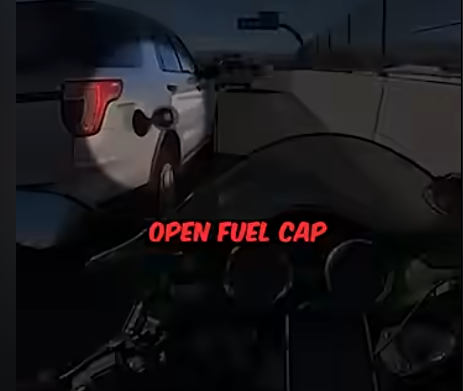
This video captures one of those rare moments. A motorcyclist notices something unusual about a silver SUV driving along the highway. The gas cap of the vehicle is wide open, swinging loosely while the SUV continues down the road. To many people, this might seem like a small issue. Some drivers might ignore it. Others might honk or wave, hoping the driver notices. But this biker decides to take action.
Riding his motorcycle, he speeds up carefully and moves close enough to the SUV to reach out and shut the gas cap. It is a quick gesture, but also a risky one. He is trying to help a stranger, yet he is doing it while both vehicles are moving at highway speed. After closing the cap, he signals to the driver, expecting perhaps a wave of thanks or a simple acknowledgment.
Instead, the situation changes instantly. The silver SUV turns out to be an undercover police vehicle. The officer inside activates the siren and pulls the motorcyclist over. What begins as a helpful act suddenly looks like a possible traffic stop filled with tension. The biker does not know what to expect. The officer, at first, may not fully understand what the biker was doing. For a moment, kindness and suspicion meet on the shoulder of the highway.
However, the encounter does not end badly. Once the officer realizes that the motorcyclist was simply trying to close the open gas cap, the mood softens. The officer thanks him for the good deed, but also warns him that such a maneuver is dangerous. He explains that he was initially concerned because the biker’s movement near the SUV looked risky. In the end, the officer lets him go without a warning or ticket, and the two part on friendly terms.
This simple incident offers more than entertainment. It shows how quickly actions can be misunderstood on the road. It highlights the balance between good intentions and safety. It also reminds viewers that law enforcement officers, like everyone else, can recognize sincerity when they see it. Most importantly, it tells a story about a motorcyclist who chose to help, even when his helpfulness briefly got him pulled over.
A Highway Moment That Could Have Been Ignored
Highways are not usually places where people stop to help each other. Unlike quiet neighborhood streets, highways are fast, loud, and demanding. Drivers have little time to notice details on nearby vehicles. Even when they do notice something wrong, they often continue driving because it feels safer to stay focused on their own path.
In this case, the motorcyclist saw something that many people might have missed. The silver SUV’s gas cap was open. While an open gas cap may not always cause immediate danger, it can still be a problem. It may allow fumes to escape, it may damage the cap or fuel door, and it may distract other drivers. It can also indicate that the driver recently stopped for fuel and forgot to close it. The biker recognized that something was wrong and decided not to ignore it.
That decision is what makes the video stand out. The biker did not simply ride past and forget about it. He did not only point or honk from a distance. He chose to get close enough to fix the problem himself. His action was bold, spontaneous, and clearly motivated by a desire to help.
Yet the highway setting makes the gesture complicated. Helping someone in a parking lot is simple. Helping someone at a traffic light is possible. Helping someone while moving at highway speed is different. The motorcyclist had to control his bike, match the SUV’s speed, position himself close to the vehicle, extend his arm, and close the gas cap without losing balance. Even if he was skilled and confident, the maneuver carried risk.
This is why the video creates such a strong reaction. Viewers can admire the biker’s kindness while also understanding why the officer became concerned. The act is both helpful and dangerous. It is generous, but not necessarily safe. That tension is at the heart of the story.
The Biker’s Instinct to Help
Motorcyclists often have a unique relationship with the road. They are more exposed than drivers inside cars, which means they must pay close attention to everything around them. They notice road surfaces, vehicle movements, blind spots, and small details that other drivers might overlook. A loose item, a sudden lane change, or an open door can become a serious threat to someone on two wheels.
Because of that heightened awareness, it makes sense that the biker noticed the open gas cap. He was scanning the traffic around him, as motorcyclists often do. When he saw the fuel door open, he likely understood that the SUV’s driver was unaware of it. He also likely knew that waving or honking might not work. Drivers inside cars may not hear a motorcycle horn clearly at highway speed. They may not understand hand signals from another vehicle. They may even think the biker is simply being impatient or aggressive.
So the biker chose a direct solution. He moved close, reached out, and closed the cap himself. It was a small act, but it required courage and precision. His intention was not to show off or cause trouble. He was trying to prevent a problem for another road user.
That instinct to help is important. In daily life, many people notice problems but do not act. They assume someone else will handle it. They worry about getting involved. They fear being misunderstood. The biker, however, acted immediately. He saw something wrong and fixed it.
Of course, good intentions do not erase danger. That is one of the main lessons of the encounter. The biker’s heart may have been in the right place, but his method created concern. Even helpful actions must be measured against the safety of everyone nearby. On a highway, a small mistake can quickly become serious.
Still, it is difficult not to respect the biker’s motivation. He did not gain anything from closing the gas cap. He was not looking for attention from the driver. He simply noticed a problem and tried to help.
The Surprise: An Undercover Police Vehicle
The most dramatic twist in the video comes when the silver SUV is revealed to be an undercover police vehicle. To the motorcyclist, it likely looked like any ordinary SUV. There may have been no obvious markings, no visible police lights, and no clear indication that the driver was an officer. The biker probably believed he was helping a regular person who had forgotten to close the gas cap after refueling.
That makes the moment especially memorable. The biker’s act of kindness is immediately followed by sirens. From his perspective, the situation must have been confusing. One second, he is helping. The next, he is being pulled over by the very person he tried to assist.
For the officer, the situation may have looked different. From inside the SUV, the officer may have seen a motorcyclist rapidly approaching the side of the vehicle. The biker moved close enough to reach toward the SUV. Without knowing the biker’s intention, the officer could reasonably interpret the maneuver as unsafe or suspicious. On a highway, a motorcycle coming close to a car and reaching out is not normal behavior.
This difference in perspective is what creates the misunderstanding. The biker knows he is helping. The officer sees a dangerous maneuver. Both reactions make sense from their own point of view.
Undercover or unmarked police vehicles add another layer to the story. Because the SUV did not appear to be a police car, the biker had no reason to behave differently around it. He treated it like any other vehicle. The officer, meanwhile, had the authority and responsibility to respond when he saw behavior that could endanger traffic.
The reveal changes the entire emotional direction of the video. What could have been a simple good deed becomes a police encounter. For a few moments, viewers may wonder whether the biker will be punished for trying to help. That uncertainty gives the video its tension.
The Traffic Stop
Being pulled over can be stressful for anyone. For motorcyclists, it can feel even more intense. They must find a safe place to stop, balance the bike, remove or lift their visor, and communicate clearly with the officer. A rider who has just performed an unusual maneuver may also worry about how the officer interpreted the action.
In this video, the traffic stop begins with uncertainty. The officer activates the sirens and signals the biker to pull over. The biker complies. At that point, the officer likely approaches with a serious concern: the biker had moved close to another vehicle on the highway and reached toward it. From a law enforcement perspective, that could be considered risky behavior.
The biker, however, has an explanation. He was not trying to interfere with the SUV. He was not acting aggressively. He was not attempting to cause damage. He was closing the gas cap because it was open.
Once that explanation becomes clear, the tone changes. The officer realizes that the biker’s action was not hostile or reckless in the way it first appeared. It was a good deed, even if it was performed in a risky way.
This moment is the emotional turning point of the encounter. The officer’s role shifts from suspicion to understanding. The biker’s anxiety likely decreases as he realizes that the officer recognizes his intention. Instead of escalating, the conversation becomes friendly.
The traffic stop could have ended very differently if either person had reacted poorly. If the biker had been defensive or disrespectful, the officer might have taken a stricter approach. If the officer had ignored the biker’s explanation, the stop might have felt unfair. But both sides appear to communicate calmly. That calm communication allows the situation to resolve peacefully.
Good Intentions and Dangerous Methods
One of the strongest lessons from this video is that good intentions do not always make an action safe. The motorcyclist wanted to help, and his kindness is clear. However, the officer was also right to warn him about the danger of the maneuver.
Highways are unpredictable. Vehicles can drift within lanes. Drivers can react suddenly. Road surfaces can change. A gust of wind, a small bump, or a moment of imbalance can create serious consequences for a motorcyclist. Reaching out while riding reduces control. Moving close to another vehicle leaves little room for error. Even a slight movement by the SUV could have caused contact.
The biker may have had enough skill to perform the action successfully, but safety is not only about skill. It is also about what could happen unexpectedly. The SUV driver might have been startled. Another vehicle might have moved into the area. The biker might have misjudged the distance. At highway speed, there is very little time to correct a mistake.
This is why the officer’s warning matters. He does not appear to punish the biker, but he does make the point that the maneuver was dangerous. That response is balanced. It acknowledges the biker’s good heart while still emphasizing road safety.
Many viewers may relate to this conflict. In life, people often want to help quickly. They may rush into action because they see a problem and want to solve it. But sometimes, helping in the wrong way can create new risks. The better choice may be to signal, slow down, wait for a safer moment, or avoid direct physical involvement while vehicles are moving.
The video does not suggest that people should stop caring about others on the road. Instead, it suggests that care should be combined with caution. Helping is valuable, but safety must come first.
The Officer’s Reaction
The officer’s reaction is one of the reasons the video feels positive rather than negative. At first, he pulls the biker over because he is concerned. That is understandable. A motorcycle moving close to a vehicle and reaching toward it on a highway is not something an officer can ignore.
However, once the officer understands the reason, he does not overreact. He does not treat the biker like a criminal. He does not issue a ticket just to prove authority. Instead, he thanks the biker for helping and explains the safety concern.
That kind of response matters. It shows judgment. Law enforcement is not only about enforcing rules; it is also about understanding situations. Not every unusual action comes from bad intent. Sometimes people make risky choices because they are trying to do something good. A fair response recognizes both parts of the situation.
The officer’s warning also feels appropriate. He does not ignore the risk simply because the outcome was positive. He reminds the biker that the highway is not the place for such close maneuvers. In doing so, he protects not only the biker but also other road users.
This balance between appreciation and caution gives the encounter its friendly ending. The officer can say, in effect, “Thank you for helping, but please do not do it that way again.” That message is reasonable, human, and effective.
It also prevents the story from becoming a negative example of someone being punished for kindness. Instead, the story becomes an example of how a misunderstanding can be resolved with communication and common sense.
The Biker’s Perspective
From the biker’s point of view, the encounter must have been surprising. He likely expected the driver to appreciate the gesture. Instead, he heard sirens and had to pull over. For a moment, he may have wondered whether his good deed had become a serious problem.
Motorcyclists are often aware that their actions can be judged harshly. Some riders behave irresponsibly, and that can create stereotypes about bikers in general. A motorcyclist who speeds up, rides close to a vehicle, and reaches toward it could easily be seen as reckless, even if the true reason is innocent.
The biker had to explain himself clearly. He had to show that his action was not meant to be dangerous or disrespectful. Fortunately, the situation allowed him to do that.
His perspective also highlights the vulnerability of good intentions. When people help strangers, they take a small social risk. They may be misunderstood. They may not be thanked. They may even get in trouble. The biker’s experience shows that helping others is not always simple, especially in public spaces where intentions are not immediately visible.
Still, the biker’s calm behavior helps the encounter end well. He does not appear to argue aggressively. He accepts the officer’s warning. He understands that, although he was trying to help, the officer had a reason to be concerned.
That maturity is part of why the story feels satisfying. Both people involved are able to see the situation from the other side.
Why the Video Connects With Viewers
Videos like this often become popular because they contain surprise, tension, and relief. At first, viewers see a biker doing something unusual. Then they realize he is helping. Then the undercover police car activates its siren, creating a twist. Finally, the officer understands and lets the biker go, leaving viewers with a positive ending.
The structure feels almost like a short film. It has a setup, a conflict, a misunderstanding, and a resolution. The biker notices the open gas cap. He takes action. The police officer reacts. The truth is revealed. Everyone leaves safely.
The video also connects emotionally because it challenges expectations. Many people expect police stops to be stressful or negative. Many people expect unusual motorcycle behavior to be reckless. But this video complicates those assumptions. The biker is not causing trouble; he is helping. The officer is not being unfair; he is responding to a safety concern. Both people come across as human.
That human element is powerful. In an online world where traffic videos often show anger, crashes, road rage, or confrontation, this video offers something different. It shows a misunderstanding that does not become a conflict. It shows authority used with restraint. It shows kindness recognized, even when it comes in an imperfect form.
Viewers may also enjoy the irony. The biker unknowingly helps a police officer, then gets pulled over by that same officer. The situation is funny because it is unexpected, but it is also meaningful because it ends with mutual respect.
The Fine Line Between Heroic and Hazardous
The motorcyclist’s action sits on a fine line. On one side, it seems heroic in a small, everyday way. He noticed a problem and fixed it. On the other side, it was hazardous because of where and how it happened.
This is often true in real-life acts of quick thinking. People admire boldness when it succeeds, but the same action could be criticized if something goes wrong. If the biker had lost control, the story would not feel lighthearted. If the SUV had swerved, the outcome could have been serious. If another driver had reacted badly, the situation might have escalated.
The fact that everything ended safely makes the gesture easier to admire. But the officer’s warning reminds viewers not to confuse a successful outcome with a safe choice. Just because something worked once does not mean it should be repeated.
This is an important road safety lesson. Many dangerous habits continue because people survive them. A driver may text once and avoid a crash. A rider may weave through traffic and make it home safely. A person may perform a risky maneuver and feel proud afterward. But safety is not measured only by what happened this time. It is measured by what could happen under slightly different circumstances.
The biker’s gesture was kind, but the safer option may have been to signal from a distance, pull alongside only if traffic slowed, or wait until the SUV exited or stopped. On a highway, physical intervention should be avoided unless there is an immediate emergency.
The video therefore creates a useful discussion. It allows viewers to appreciate the biker without encouraging everyone to copy his exact behavior.
Communication on the Road
One of the challenges shown in the video is how difficult it can be to communicate between vehicles. Drivers and riders do not have an easy way to talk to one another at highway speed. Horns can be misunderstood. Hand signals may not be seen. Flashing lights can mean different things. A helpful gesture can look aggressive depending on the situation.
The biker likely wanted the SUV driver to understand that the gas cap was open. But how could he communicate that safely? Pointing toward the back of the vehicle might not be clear. Honking could sound like impatience. Riding next to the SUV might get the driver’s attention, but it could also create risk.
This communication problem is common on the road. A driver may try to warn another driver about a flat tire, an open trunk, a loose load, or lights that are not working. But getting that message across can be hard. Sometimes the safest approach is to avoid direct action and let the driver discover the issue later. Other times, if the problem is serious, it may be better to call authorities or alert someone at a stop.
The video shows both the importance and difficulty of road communication. The biker’s message was helpful, but the method looked dangerous before the intention was understood.
This is why defensive driving and riding are so important. Road users must not only think about what they intend to do; they must also think about how their actions appear to others. A movement that feels helpful to one person may look threatening or reckless to another.