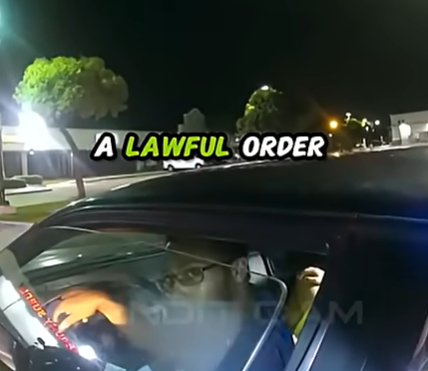
This video shows a tense traffic stop built around one of the most common and complicated themes in police encounters: the difference between knowing your rights and escalating a situation by challenging an officer’s command in real time. The stop begins with what appears to be a minor equipment issue. The officer says the driver’s license plate lights, often called tag lights, are not working. On the surface, that sounds like a routine traffic stop. A burned-out tag light is usually not the kind of violation that feels dramatic or dangerous. But the interaction quickly becomes more serious because the driver does not simply accept the officer’s explanation. He asks to step out of the vehicle and verify the issue for himself, and the officer refuses, ordering him to stay inside the car.
That first disagreement sets the tone for everything that follows. To the driver, the request seems reasonable. If the officer says a light is out, the driver wants to see it. From his point of view, checking the tag lights is a simple way to confirm whether the stop is valid. He may believe that if the officer is mistaken or using the equipment issue as a weak reason for the stop, seeing the lights himself could protect him from being unfairly cited or questioned further. His request is not aggressive on its face. He is asking to observe the alleged problem with his own eyes.
The officer, however, treats the request differently. He wants the driver to remain in the vehicle and frames that instruction as a lawful order. From an officer-safety perspective, traffic stops are unpredictable. Officers often prefer drivers to stay seated, keep their hands visible, and avoid sudden movements unless told otherwise. A driver stepping out without permission can create uncertainty. The officer may not know whether the driver is simply checking the lights, preparing to argue, attempting to flee, or trying to create a physical confrontation. That does not mean every driver who wants to step out is dangerous, but it explains why officers can become firm very quickly when someone reaches for the door or says they intend to exit.
The conflict grows because both sides believe they are standing on principle. The officer believes he is giving a lawful command during a traffic stop. The driver believes he is asserting his rights and refusing to let the officer control the encounter beyond what is necessary. Once both sides take those positions, the stop becomes less about tag lights and more about authority. The officer is no longer only investigating an equipment violation. He is trying to establish control. The driver is no longer only responding to a ticketable issue. He is testing the boundaries of the officer’s power.
The driver’s refusal to immediately provide his license adds another layer. During most traffic stops, officers request a driver’s license, registration, and proof of insurance. Many drivers understand that providing identification is part of the process. In this video, however, the driver appears to delay or refuse immediate compliance because he wants a supervisor called first. He cites a department policy that, according to him, requires a supervisor to come to the scene when a citizen requests one. This changes the stop from a simple exchange of documents into a procedural dispute. The driver is not only challenging what the officer says about the tag lights; he is also challenging how the officer is handling the stop.
The request for a supervisor is a common tactic in “know your rights” videos. People ask for a supervisor because they believe another officer may calm the situation, correct misconduct, or create a more formal record. Sometimes this can help. A supervisor may explain the policy, review the officer’s actions, or provide a clearer path forward. But it can also increase tension if the officer believes the driver is using the request to delay the stop or avoid basic legal obligations. In the video, the driver frames the supervisor request as a right under department policy, while the officer appears focused on immediate compliance.
This kind of interaction shows why legal knowledge and street-level decision-making can collide. A person may have rights, but the practical question is how and when to assert them. A driver may believe an officer is wrong, but refusing commands during the stop can carry risks. Courts and complaint processes exist for challenging unlawful stops or misconduct after the fact. On the roadside, however, officers often have broad authority to control the scene for safety. That does not mean officers are always right, and it does not mean citizens should never ask questions. But it does mean the roadside is a difficult place to win a legal argument in real time.
The video frames the driver as composed, and that matters. He does not appear to be shouting wildly or physically resisting. He keeps returning to his point: he wants to verify the alleged violation, he wants a supervisor, and he believes the officer is overstepping. That calmness is likely why the video presents the interaction as a “win” for him. In many public accountability clips, composure is treated as power. The person who stays calm while asserting rights appears more credible, while the officer who becomes frustrated can appear overly aggressive or controlling. Viewers are often drawn to that dynamic because it creates a clear narrative: the citizen knows the rules, the officer pushes too far, and the citizen refuses to be intimidated.
Still, the situation is more complicated than a simple victory. The officer’s command to stay in the vehicle may be legally supportable in many circumstances, especially during a traffic stop. Officers are often allowed to control whether occupants stay in or exit a vehicle for safety reasons. The driver’s desire to inspect the tag lights may be understandable, but it does not automatically override the officer’s control of the stop. That is why these videos can be misleading if they present every refusal as a guaranteed legal win. The driver may be confident, and the supervisor may eventually arrive, but that does not necessarily mean every part of the driver’s argument is legally correct.
At the same time, the officer’s approach can still be questioned. If a driver calmly asks to verify an alleged equipment violation, an officer could potentially respond in a more explanatory way. For example, the officer could say, “For safety, stay in the car for now. I can show you the issue after I complete the stop,” or “You can check it when we are done, but right now I need your documents.” Clear explanation often reduces tension. Simply repeating “lawful order” and threatening arrest can make the interaction feel more like domination than safety. Even when an officer has authority, how that authority is communicated matters.
The phrase “lawful order” is central because it is powerful but often misunderstood. Not every command from an officer is automatically lawful, but during a traffic stop, many safety-related commands may be treated seriously. Drivers may hear “lawful order” as a threat or a way to shut down discussion. Officers may use it because they believe continued debate is undermining control of the scene. The problem is that when both sides use legal language without trust, the conversation becomes rigid. The driver demands legal justification. The officer demands compliance. Neither side feels heard.
The video also highlights the emotional pressure of being pulled over. Even a minor stop can make someone feel nervous, defensive, or suspicious. If a driver has had bad experiences with police or has watched many videos of questionable stops, they may enter the interaction already prepared to challenge everything. That can be protective in some situations, but it can also make the encounter more tense from the start. The officer, meanwhile, may interpret questioning as resistance rather than concern. The result is a cycle where the driver’s caution makes the officer more forceful, and the officer’s forcefulness makes the driver more cautious.
The alleged tag light issue is important because equipment violations are often viewed by drivers with skepticism. Some people believe minor equipment problems are used as pretexts to investigate something else. Whether that is true in this specific case is not clear from the description, but the suspicion itself shapes the driver’s response. He wants to confirm the reason for the stop because he may believe the officer is creating a reason to detain him. The officer likely sees the stop as straightforward: the lights are out, documents are needed, and the driver should comply. That difference in interpretation fuels the conflict.
The request to step out and check the lights also raises a practical point. A driver does not necessarily need to see the violation immediately in order to dispute it later. If cited, they may be able to take photos, repair the issue, contest the ticket, or request evidence. But from the driver’s point of view, waiting may feel like giving up control. He wants to verify the facts before the officer writes anything or expands the stop. That desire is understandable, especially in videos focused on rights education. But the roadside process does not always give drivers the timing they want.
The supervisor request becomes the driver’s way of slowing the encounter down. Instead of arguing endlessly with the same officer, he asks for someone with higher authority. That can be a reasonable request, especially if department policy supports it. However, policies vary, and a policy requiring a supervisor response may not always mean the original stop pauses completely. The officer may still expect documents and compliance while waiting. This is where many viewers can misunderstand the difference between a legal right, a department policy, and a practical procedure. A department may encourage or require supervisors to respond to complaints, but that does not necessarily mean a driver can refuse all instructions until the supervisor arrives.
The video’s “win” framing likely comes from the fact that the driver stands his ground and does not appear to be arrested. For viewers who enjoy police accountability content, that outcome feels satisfying. It suggests that calm resistance, knowledge of policy, and refusal to be intimidated can change the direction of an encounter. There is truth in that. Remaining calm, asking clear questions, requesting a supervisor, and documenting the interaction can be powerful tools. They can prevent confusion and create accountability. But the lesson should be careful: standing your ground works best when done calmly, legally, and with awareness of risk.
A reckless version of “know your rights” can get people hurt or arrested. A responsible version focuses on clarity and self-protection. That means keeping hands visible, speaking calmly, asking whether you are being detained, asking for a supervisor if appropriate, complying with commands that affect immediate safety, and challenging questionable conduct later through proper channels. The driver in the video appears calm, which is why the situation does not spiral as badly as it could. His tone matters as much as his words.
The officer’s threat of arrest for disobeying also shows how fast a minor traffic stop can become a bigger legal problem. The original issue may be a tag light. But if the officer believes the driver is refusing lawful orders, the situation can turn into obstruction, resisting, or failure to comply allegations depending on local law. That is one of the dangers of roadside legal disputes. A driver may begin by trying to defend against a small ticket and end up facing something more serious. That does not mean people should surrender their rights, but it does mean they should understand the stakes.
The video also reflects a broader social debate about police authority. Some people believe officers should be challenged more often because unchecked authority can lead to abuse. Others believe drivers should comply during stops and fight issues later because roadside arguments can create danger. Both views come from real concerns. Abuse of authority is a real concern. Officer safety and traffic-stop unpredictability are also real concerns. The most useful discussion does not pretend one concern cancels the other. It asks how both safety and rights can be protected at the same time.
In a better version of this encounter, the officer might clearly explain the reason for the stop, ask for documents, and tell the driver when he can safely inspect the lights. The driver might provide required documents while calmly stating that he disputes the violation and wants a supervisor. Both sides could preserve their positions without turning the stop into a battle over control. But real encounters do not always unfold that neatly. Stress, suspicion, tone, and pride can all turn a small disagreement into a standoff.
The video’s educational value comes from showing viewers the importance of composure. The driver’s strongest tool is not anger. It is calm repetition. He does not need to insult the officer or become physically resistant. He simply states what he wants and why. That makes him look more credible. It also gives the officer fewer reasons to escalate. In rights-based encounters, tone can determine whether the public sees someone as informed or combative. Calmness protects the message.
The video also shows that officers should be prepared to explain their authority clearly. If an officer says “lawful order,” they should be able to explain the safety reason behind it. If a driver asks for a supervisor, the officer should know department policy and communicate what will happen next. Confusion creates conflict. Clear explanations can prevent a lot of roadside tension. Even when the driver disagrees, a clear explanation helps the encounter look more professional and less arbitrary.
The question of whether the driver has a right to check the tag lights immediately is not fully answerable from the video description alone. It depends on location, law, officer safety considerations, and the exact circumstances of the stop. What can be said is that the driver has a reasonable interest in verifying the accusation, while the officer has a reasonable interest in controlling movement during the stop. The conflict exists because both interests are real. The challenge is balancing them without escalation.
The video also reminds viewers that recording can influence behavior. If the driver is filming or aware of being recorded, that may encourage him to stay composed and make clear statements. If the officer knows the interaction is being recorded, that may influence how he communicates and whether he waits for a supervisor. Recording can create accountability, but it can also make both sides more performative. The driver may speak for the audience as much as the officer. The officer may become defensive because the encounter is being framed as a challenge. That dynamic is common in viral traffic-stop videos.
By the end, the arrival or expected arrival of a supervisor becomes the symbolic resolution. The driver does not simply drive away, but he succeeds in forcing the encounter into a more formal review. That is why the video frames the outcome as a lesson. It suggests that asking for a supervisor, staying calm, and refusing to be rushed can help protect a citizen from overreach. The important caution is that this strategy should be used carefully. A supervisor request is not a magic shield. It does not automatically cancel commands, stop an investigation, or remove the possibility of arrest. But it can create accountability and help clarify disputed issues.
The deeper lesson from the clip is that rights and responsibilities exist together. The driver has the right to ask questions, remain calm, request a supervisor, and challenge the reason for the stop. The officer has the responsibility to explain the stop, maintain safety, avoid unnecessary escalation, and respect legal limits. The driver also has responsibilities, including avoiding sudden movements and complying with lawful requirements. The officer also has rights to control a potentially unsafe roadside scene. The conflict happens when each side emphasizes only its own authority and not the other side’s concerns.
In the end, this video is compelling because it turns a small equipment stop into a larger debate about power, trust, and legal boundaries. A tag light issue becomes a dispute over whether a driver can exit, whether an officer can order him to stay inside, whether a supervisor must respond, and whether refusal is resistance or rights assertion. The driver is presented as calm and informed, and that is why the video works as a “know your rights” example. But the strongest takeaway is not that drivers should argue every command. It is that calm communication, documentation, and knowledge of procedure matter.
A traffic stop is not a courtroom, but it is still a place where rights matter. An officer’s authority is real, but it is not unlimited. A driver’s rights are real, but they must be asserted wisely. This video sits exactly in that tension. It shows how quickly a minor stop can become a serious confrontation when both sides disagree about what the law allows. It also shows that the best protection in such moments is not panic or aggression, but calm, clear, informed behavior. The driver’s composure is what makes the video feel like a win, and the officer’s insistence on control is what makes it feel like a warning. Together, they create a roadside lesson about how fragile trust can be when authority and rights meet under flashing lighWhat makes this stop especially interesting is that neither side is arguing about a major crime at first. The whole encounter begins with something small: tag lights. That is why the tension feels so disproportionate. A minor equipment issue becomes a test of control because the driver does not fully trust the officer’s claim, and the officer does not want the driver controlling the pace of the stop. That lack of trust turns a simple inspection into a confrontation.
The driver’s strongest point is his calmness. Whether every legal argument he makes is correct or not, his tone helps him. He does not appear to panic, shout, or make sudden aggressive moves. He asks for a supervisor and repeats his position. That matters because when someone asserts their rights in a heated situation, the way they speak can affect how the entire interaction is perceived. Calm speech makes the driver look careful and informed, while anger could make the same words seem confrontational.
The officer’s strongest point is safety. During traffic stops, officers often want to control movement because they do not know what a driver might do next. A person stepping out of a car may only want to check a light, but from the officer’s perspective, it introduces uncertainty. That is why the best solution would have been clearer communication: the officer could have explained that the driver could inspect the lights after the stop was completed, while the driver could have provided documents and still clearly stated that he disputed the violation.
The biggest lesson is that a person can assert rights without turning the roadside into a fight. Asking questions, requesting a supervisor, recording, and staying composed can all be useful. But every choice should be made carefully because the roadside is not the safest place for a legal battle. The driver’s composure is what keeps the video from becoming worse, and that is the real lesson: knowing your rights matters, but knowing how to assert them calmly matters just as much.