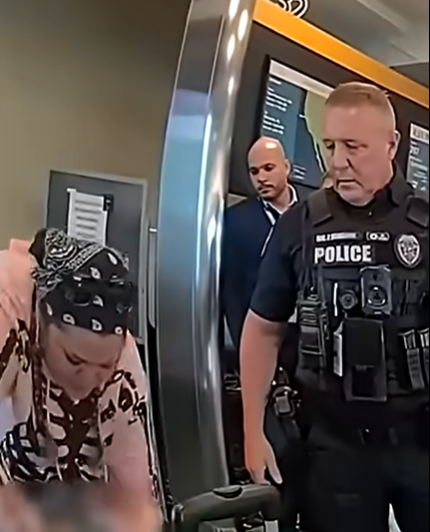
This video captures a tense and uncomfortable airport confrontation between an intoxicated passenger and law enforcement, showing how quickly a travel day can turn into a serious public disturbance when alcohol, frustration, and authority collide. The scene takes place inside an airport terminal, a setting where stress is already high even under normal circumstances. Airports are busy, loud, emotionally charged places where people are trying to catch flights, reunite with family, follow security rules, and manage delays or travel pressure. In that kind of environment, one disruptive passenger can quickly affect not only airline staff and officers, but also everyone nearby.
The woman in the video, wearing a skeleton sweatshirt, appears visibly upset and intoxicated as she argues with an officer. From the beginning, her tone is loud and confrontational. She tells the officer that because she is a taxpayer, he “serves her,” using that statement as if it gives her the right to speak however she wants or ignore instructions. That line becomes one of the central moments of the clip because it reflects a misunderstanding of public service. Police officers do serve the public, but that does not mean they must tolerate disorderly behavior, especially in a sensitive public place like an airport. Public service does not mean an officer becomes personally controlled by any one angry citizen in the moment.
The officer appears to be trying to control the situation without escalating it too quickly. He repeatedly tells her to lower her voice and calm down, making it clear that he will not continue engaging with her while she is screaming. He points out that her yelling can be heard throughout the terminal, which is important because airports are not ordinary public spaces. A loud and unstable confrontation in an airport can alarm other passengers, disrupt airline operations, and create security concerns. Even if the woman believes she is only arguing for herself, her behavior affects the whole environment around her.
As the interaction continues, the woman becomes emotional. She cries about wanting to see her parents, which adds a sad layer to the situation. Her frustration may come from missing a flight, being denied boarding, feeling embarrassed, or simply being overwhelmed. But the officer suggests that her current state is likely connected to excessive drinking, and the airline employee later confirms that she has been denied boarding because she appears intoxicated and disruptive. That confirmation changes the focus of the video from a simple argument to a travel safety issue. Airlines have a responsibility to protect passengers, crew, and the flight itself. If someone appears too intoxicated or too disruptive to travel safely, denying boarding is not just a punishment; it is a safety decision.
The denial of boarding is one of the most important parts of the story. Many travelers think of a plane ticket as a guarantee that they will fly, but that is not always true. Airlines can refuse boarding to passengers who appear intoxicated, aggressive, threatening, or unable to follow crew instructions. Once someone is on an aircraft, their behavior becomes much harder to manage. A disruptive passenger in the air can create danger, delays, diversions, and stress for everyone onboard. That is why staff often make the decision at the gate before the person ever gets on the plane. In this case, the airline employee states that the woman’s intoxication and disrespectful behavior toward staff were the reasons she was not allowed to board.
The woman’s reaction shows how alcohol can intensify emotions and reduce self-control. She may have started the day simply wanting to travel and see her family, but by the time the video is recorded, her behavior is working against that goal. Instead of helping her case, the yelling, accusations, and refusal to calm down make it less likely that anyone will allow her to continue traveling. That is one of the painful ironies of the clip. She wants to get to her parents, but her own behavior becomes the reason she cannot move forward.
The officer’s attempt to de-escalate is direct rather than gentle. He tells her to stop yelling, calls out her behavior, and makes it clear that he will not entertain the conversation while she continues acting that way. Some viewers may see his tone as firm or even harsh, but in the context of a loud public disturbance, firmness can be necessary. De-escalation does not always sound soft. Sometimes it means setting a clear boundary: lower your voice, calm down, stop disrupting the area, or there will be consequences. The officer seems to be giving her chances to regain control before the situation turns into an arrest.
The woman’s accusations against the officer add more tension. During the struggle or restraint attempt, she shouts and accuses him of physical misconduct. In public encounters, especially ones being recorded, accusations like that can immediately raise the emotional temperature. The officer has to remain careful because every movement and word may be judged later. At the same time, he has to maintain control if she is being disruptive or resisting directions. Bodycam or bystander footage becomes especially important in moments like this because it can show what actually happened, how the officer responded, and whether the person’s claims match the visible interaction.
The airport setting makes the incident more serious than it might appear at first. In a bar, a street, or a parking lot, loud intoxicated behavior is still a problem, but in an airport, there are stricter rules and higher security expectations. Passengers must be able to follow instructions, cooperate with staff, and behave in a way that does not threaten the safety or comfort of others. Airline crews are responsible for dozens or hundreds of people in a confined space. If someone is already screaming at staff before boarding, it raises serious concerns about how they might behave once the plane doors close.
The woman’s statement about being a taxpayer also reveals a common tension in police encounters. Some people believe that because public employees are funded by taxpayers, they have to obey or tolerate individual demands. But public servants are responsible to the law and the community as a whole, not to one person’s anger in a specific moment. An officer’s role is to protect public order, respond to safety concerns, and enforce rules when needed. In this situation, the officer is not there to serve her desire to board the plane at all costs. He is there to help manage a disturbance and prevent the situation from affecting the rest of the terminal.
The airline employee’s role is also important because it shows that the officer is not acting alone. The airline staff member confirms that the passenger has been denied boarding due to intoxication and disruptive conduct. That gives context to the officer’s involvement. Police are often called to airports when airline employees can no longer safely handle a passenger on their own. Gate agents and airline staff can deny boarding, but if the passenger refuses to leave, becomes aggressive, or continues disturbing the terminal, law enforcement may need to step in.
The woman’s emotional shift from anger to crying makes the clip feel more complicated. It would be easy to view her only as rude or entitled, but the crying shows that she is also distressed. She wants to see her parents, and in her mind, the officer and airline staff may feel like obstacles standing between her and that emotional goal. But feelings do not erase behavior. Being upset does not give someone the right to scream at staff, disturb a terminal, or ignore lawful instructions. The video is a reminder that emotions may explain a reaction, but they do not automatically excuse it.
The officer’s final question, asking whether she has ever been to jail, functions like a warning. He is signaling that the situation is approaching a point where continued behavior could lead to arrest. That moment is important because it shows the line between being denied boarding and being taken into custody. Missing a flight is already a serious consequence, but if the passenger continues yelling, refusing to comply, or creating a disturbance, the situation can become a criminal matter. The officer appears to be trying to make her understand that she still has a choice. She can calm down and deal with the travel problem, or she can continue escalating and face a much worse outcome.
The video also shows the consequences of drinking too much before or during travel. Many people drink at airports to relax, pass time, or deal with anxiety about flying. But alcohol can quickly create problems when combined with stress, delays, frustration, and public rules. A person may believe they are just having a few drinks, but if they become loud, unstable, or disrespectful, airline staff may decide they are not safe to board. That can lead to missed flights, police involvement, embarrassment, and even arrest. The woman in this video becomes an example of how a travel day can fall apart when intoxication takes over.
There is also a broader lesson about how to handle conflict with airline staff. Even when a passenger feels wronged, yelling rarely helps. Airline employees have limited flexibility when safety rules are involved. If they decide someone is too intoxicated or disruptive to board, arguing aggressively usually confirms their concern. A calmer approach gives a passenger a better chance of receiving help with rebooking, contacting family, or finding another solution. The woman’s behavior does the opposite. Each outburst makes her look less ready to travel.
The clip may spread online because of the dramatic yelling and the “taxpayer” line, but the deeper story is about self-control. In public spaces, especially airports, self-control is not optional. A person can be angry, scared, disappointed, or embarrassed, but they still have to manage their behavior. Once someone loses control loudly enough to involve police, the situation becomes much harder to recover from. The woman’s desire to see her parents may be understandable, but her conduct creates the barrier that keeps her from getting there.
The officer’s patience has limits, and the video shows him trying to communicate that. He does not appear to be interested in a long emotional debate. He wants her to lower her voice, stop the disruption, and recognize the seriousness of the situation. This is often how officers handle intoxicated public disturbances: they give clear commands, repeat them several times, and warn the person before taking stronger action. The goal is to avoid arrest if possible, but only if the person calms down enough for that to be safe.
The woman’s accusation that the officer is mishandling her also highlights why officers must be careful in public interactions. Physical restraint can look intense, especially when someone is yelling or crying. But if a person is resisting, refusing to leave, or behaving unpredictably, officers may still need to use physical control. The key question is whether the control is reasonable and necessary. Without more full context, viewers should be cautious about making broad judgments from a short clip. What is clear from the description is that the officer is trying to stop the disturbance and keep the situation from spreading through the terminal.
There is also a public embarrassment element that should not be ignored. Being intoxicated and emotional in an airport is already a difficult moment. Having it recorded and shared online makes it far worse. Viral videos can follow people long after the legal or travel consequences are over. That does not mean the woman’s behavior should be excused, but it does mean viewers should remember they are watching someone at a very low point. The best takeaway is not simply to laugh at her, but to understand how avoidable the situation was.
The airport employees, the officer, and the other passengers all represent different sides of the same issue. The airline employee is trying to protect the flight. The officer is trying to protect public order. Other travelers are trying to get through the terminal without being pulled into someone else’s crisis. The woman is trying to get to her family but is too intoxicated and upset to act in her own best interest. That combination creates the tension of the video.
In the end, the footage is a clear example of how quickly intoxication can turn inconvenience into consequences. The woman likely wanted one thing: to board her flight and see her parents. But because she appeared drunk, screamed at staff, argued with law enforcement, and refused to calm down, she was denied boarding and placed at risk of arrest. The officer’s message is direct: calm down now, or this will get worse. The airline’s message is equally clear: a disruptive and intoxicated passenger cannot be allowed onto the plane.
The larger lesson is simple but important. Airports require cooperation. Alcohol and emotional stress can make that cooperation much harder. If a person becomes disruptive before boarding, airline staff and law enforcement will prioritize safety over that person’s travel plans. This video may look like a chaotic argument, but underneath it is a basic truth: no flight, no ticket, and no personal frustration gives someone the right to endanger or disturb others. The woman’s situation is unfortunate, but it is also a reminder that the fastest way to lose a travel opportunity is to lose control of yourself in the place where control matters most.
What makes this video especially useful as a cautionary example is that the entire situation appears preventable. Nothing about the scene suggests that the woman set out to create a major airport disturbance. She likely arrived with a simple goal: get on a plane and reach her parents. But travel stress, alcohol, emotional pressure, and refusal to calm down combined into a public scene that ended with police involvement and a denied flight. That is what makes the footage so relatable in an uncomfortable way. Many people have experienced airport frustration, but this video shows what can happen when frustration is allowed to take full control.
The woman’s repeated emotional appeals also reveal how people sometimes try to explain their behavior by focusing on what they want rather than what they are doing. She wants to see her parents. She is upset. She feels wronged. Those feelings may be real, but the airline and officer are responding to her behavior in the moment. They are not judging only her intentions. They are looking at whether she is calm enough, sober enough, and respectful enough to safely continue through the travel process. Wanting to see family does not cancel the responsibility to behave safely in a public terminal.
This is an important distinction because many confrontations escalate when a person believes their emotional reason should override the rules. From her perspective, missing the flight may feel cruel or unfair because it prevents her from reaching people she loves. From the airline’s perspective, allowing someone visibly intoxicated and disruptive onto an aircraft could create an even bigger problem. Once the plane leaves the gate, the options are limited. Flight attendants cannot simply remove someone midair. If a passenger becomes aggressive, refuses instructions, or disturbs others during flight, the consequences can affect everyone onboard. That is why the decision has to be made before boarding.
The officer’s role in this kind of airport incident is also different from an ordinary street encounter. At an airport, law enforcement often acts as the final layer of control after airline staff have already tried to handle the passenger. The officer is not deciding whether the woman gets to fly based on personal preference. He is responding to a situation where staff have already determined she should not board and where her reaction is causing a disturbance. That means his job is to restore order, make sure she leaves the boarding area if required, and prevent the situation from becoming unsafe.
The woman’s “taxpayer” argument also shows how people sometimes misunderstand accountability. Public employees are accountable to the public, but accountability does not mean an individual can command an officer in the middle of a disturbance. The officer is not her personal employee in that moment. He is responsible for enforcing rules that protect the broader public space. Other travelers in the terminal are taxpayers too. Airline employees also have the right to do their jobs without being screamed at. The officer’s responsibility is to the safety and order of everyone, not only to the loudest person in the room.
The video also shows how volume can become its own form of escalation. The officer tells her that she can be heard throughout the terminal, and that detail matters. In an airport, loud yelling can create alarm. Other passengers may not know whether there is a security threat, a medical emergency, a fight, or a person losing control. People may start watching, filming, moving away, or becoming anxious. Airport environments depend on calm communication because confusion can spread quickly. When one person’s voice dominates the space, it can disrupt the sense of safety for everyone nearby.
The officer’s command to lower her voice is therefore not just about politeness. It is about control of the environment. A person who can lower their voice shows at least some ability to regulate themselves. A person who cannot stop shouting may not be able to follow instructions on a plane either. That is likely part of why the airline’s decision becomes easier to understand. If she cannot cooperate with an officer in the terminal, airline staff have reason to doubt that she will cooperate with crew members in the air.
The clip also highlights the difference between embarrassment and accountability. The woman may feel embarrassed, and that embarrassment may fuel more anger. Once people notice they are being watched, they often become more defensive. Instead of calming down, they double down because admitting fault in public feels humiliating. That may be part of what is happening here. She may know, at some level, that the situation is going badly, but instead of stepping back, she argues harder. Unfortunately, that only confirms the concerns about her behavior.
The emotional crying about her parents adds sadness to the situation, but it also shows how alcohol can intensify feelings. Alcohol does not create emotions from nothing, but it can make them harder to manage. A person who is already anxious about travel or desperate to reach family may become overwhelmed after drinking. The result can be crying, yelling, anger, confusion, and poor judgment all at once. That emotional swing is difficult for officers and airline staff because they must respond with care while still enforcing boundaries.
This is why the officer’s warning about jail matters. He is essentially telling her that she is standing at a decision point. She has already lost the flight, at least for the moment. But she does not necessarily have to turn the situation into an arrest. If she calms down, she may be able to leave the area, arrange another flight, call family, or sober up somewhere safe. If she continues yelling and refusing instructions, the consequences may become much more serious. The officer is trying to make the next step clear before taking it.
That warning also shows that consequences can stack quickly. At first, the consequence is being denied boarding. Then it becomes police involvement. Then it can become removal from the terminal. If the behavior continues, it can become arrest. Each stage gives the person a chance to stop the escalation, but it also narrows the room for leniency. The woman’s best option at almost every point would be to stop arguing, lower her voice, and ask what she needs to do next. Instead, her behavior keeps the conflict active.