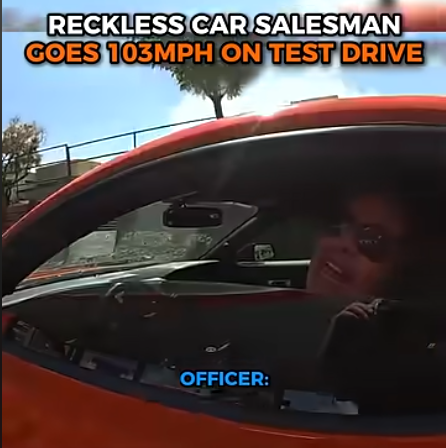
Salesman Arrested After 103 MPH Test Drive in a 45 MPH Zone
A Test Drive That Went Too Far
A routine customer test drive turned into a serious legal situation when a car salesman was stopped for driving a red sports car at a speed far above the posted limit. What began as an attempt to demonstrate the power and performance of a vehicle quickly became an example of how dangerous and costly reckless driving can be, even when someone claims they are only doing their job.
The video captures a traffic stop involving a red sports car that was reportedly traveling at 103 miles per hour in a 45 mile-per-hour zone. The vehicle was being driven by a salesman who said he was taking a customer on a test drive. After being pulled over, the driver tried to explain that he worked at a dealership and was simply showing the customer the vehicle. However, the officer did not accept that explanation as a reason for the excessive speed. The stop ended with the salesman being ordered out of the car, placed in handcuffs, and arrested for reckless driving.
The incident stands out because of the setting. Test drives are a normal part of the car-buying process. Salespeople often ride with customers, explain vehicle features, and sometimes demonstrate acceleration, handling, and comfort. But there is a clear line between demonstrating a car’s abilities and endangering public safety. According to the video, that line was crossed when the salesman drove more than double the posted speed limit.
The Traffic Stop
The traffic stop began after an officer clocked the red sports car traveling at 103 mph in an area where the speed limit was 45 mph. That means the vehicle was moving 58 mph over the legal limit. In almost any situation, such a speed would be considered extremely dangerous, especially on public roads where other drivers, pedestrians, cyclists, intersections, driveways, and unexpected hazards may be present.
When the officer approached the car, the driver appeared to understand that he had been caught committing a serious violation. He identified himself as a car salesman and explained that he was on a test drive with a customer. He apologized and tried to provide his documentation, reportedly attempting to locate information on his phone. His explanation suggested that he believed the circumstances of the test drive might help justify or at least soften the seriousness of what had happened.
However, the officer’s response showed that the situation was being treated as more than a simple speeding ticket. Driving 103 mph in a 45 mph zone is not just a minor traffic mistake. It can be considered reckless driving because of the level of risk involved. The officer made it clear that the driver’s age, profession, and role as a salesman did not excuse the behavior.
The stop quickly shifted from a roadside conversation to an arrest. The officer instructed the salesman to step out of the vehicle. Moments later, he was handcuffed and placed in the back of the patrol car. The customer, who had been along for the test drive, was left witnessing a dramatic and unexpected end to what was supposed to be a normal dealership experience.
The Salesman’s Explanation
The salesman’s main defense was that he was working. He explained that he was a car salesman and that the drive was part of his job. In his view, he may have believed he was demonstrating the performance of the vehicle to a potential buyer. Sports cars are often marketed around speed, acceleration, handling, and excitement. Salespeople may feel pressure to show customers what makes these vehicles special.
Still, being at work does not remove the responsibility to follow traffic laws. A test drive is not a closed track, a professional driving course, or a controlled environment. It takes place on public roads, where the driver must obey the same rules as everyone else. The fact that a customer is in the car may actually increase the responsibility of the salesperson, because the customer has placed trust in the dealership and the employee.
The salesman also apologized during the stop. An apology can show awareness, regret, or nervousness, but it does not erase the violation. Officers often hear explanations during traffic stops, and while some circumstances may influence whether a warning or ticket is issued, extremely high speeds are treated differently. At 103 mph in a 45 mph zone, the officer appeared to view the conduct as dangerous enough to require an arrest.
The driver’s attempt to find documentation on his phone also reflects a modern reality. Many people now keep insurance cards, registration details, dealership documents, or work-related information digitally. But paperwork was not the central issue. The central issue was the speed itself and the danger created by driving at that speed in a zone designed for much slower travel.
Why 103 MPH in a 45 MPH Zone Is So Serious
Speed limits exist because roads are designed with certain conditions in mind. A 45 mph zone is usually not intended for high-speed driving. It may include intersections, businesses, residential access points, traffic signals, curves, pedestrians, and vehicles entering or leaving the roadway. At 103 mph, a driver has far less time to react to anything unexpected.
The faster a vehicle travels, the longer it takes to stop. Reaction time becomes a major factor. Even if a driver reacts quickly, the car continues moving a great distance before the brakes can fully slow it down. At highway speeds, stopping distance increases dramatically. At over 100 mph, the distance needed to recognize a hazard, react, brake, and stop can be enormous.
The danger is not only to the driver. A customer in the passenger seat is also exposed to risk. Other motorists are placed in danger as well. Someone turning onto the road may not expect a vehicle to approach at more than twice the speed limit. A driver changing lanes may misjudge the speed of the sports car. A pedestrian crossing legally may have no way to anticipate how quickly the car is approaching.
High speed also reduces the margin for error. A small steering correction can become more dramatic. A slight road imperfection can matter more. Tires, brakes, suspension, and driver skill all become more important, but public roads are not the place to test those limits. Even a well-built sports car cannot change the basic physics of speed, reaction time, and impact force.
The Officer’s Reaction
The officer in the video appeared shocked by the salesman’s behavior. His disbelief seemed to come from several factors. First, the speed itself was extreme for the posted zone. Second, the driver was not an inexperienced teenager acting impulsively, but an adult professional representing a dealership. Third, there was a customer in the car, meaning the salesman was responsible not only for himself but also for someone who trusted him during the test drive.
The officer reportedly expressed disbelief at the reckless behavior given the salesman’s age and profession. That reaction is important because it shows how the situation was viewed from a law enforcement perspective. A car salesman is expected to understand vehicles, road rules, and professional responsibility. When someone in that position drives at a dangerously high speed, it may be seen as especially irresponsible.
The officer’s decision to arrest the driver rather than simply issue a citation likely came from the severity of the speed. Reckless driving is often treated as a criminal offense, not just a traffic infraction. While laws vary by jurisdiction, extremely excessive speed can lead to arrest, court appearances, fines, license consequences, and possible employment consequences.
The video also highlights how quickly a traffic stop can escalate when the alleged violation is serious. Many speeding stops end with a ticket. But when the speed is extreme enough to suggest disregard for safety, the officer may decide that an arrest is necessary. In this case, the salesman’s explanation did not prevent that outcome.
The Customer’s Uncomfortable Position
One of the most unusual parts of the incident is the presence of the customer. A person who goes to a dealership for a test drive expects to evaluate a vehicle, not become part of a police stop. The customer likely expected a professional sales experience. Instead, they witnessed the person representing the dealership being arrested.
For the customer, the situation could have been frightening, embarrassing, or confusing. Being a passenger in a car traveling over 100 mph in a 45 mph zone is not a normal test drive experience. Even if the customer wanted to feel the vehicle’s performance, they may not have expected the salesman to drive at a speed that could lead to arrest.
The customer may also have had concerns about personal safety. Passengers do not have control over the vehicle. They must trust the driver. When a salesman drives recklessly, the passenger has limited ability to stop the behavior in the moment. This creates a serious ethical issue for dealerships: customers should never be placed in dangerous situations during a sales demonstration.
The incident could also affect the customer’s view of the dealership. A dealership’s reputation depends on professionalism, trust, and safety. A test drive that ends in handcuffs can damage confidence, even if the dealership did not directly instruct the salesman to drive that way. Customers may wonder whether the business trains employees properly, sets safe test drive rules, or supervises performance demonstrations.
Professional Responsibility During Test Drives
Car salespeople have a difficult job. They must answer questions, build trust, explain features, compare models, discuss financing, and help customers feel excited about a purchase. When selling a performance vehicle, they may also need to explain acceleration, braking, steering, and driving modes. But none of that requires breaking the law.
Professional responsibility means knowing where the boundaries are. A salesperson can demonstrate comfort, technology, visibility, braking feel, steering response, and engine sound without driving at extreme speeds. If a customer wants a high-performance experience, the correct answer is not to exceed the speed limit on public roads. The correct answer may be to explain the vehicle’s capabilities, refer to manufacturer specifications, or suggest a legal track event if available.
Dealerships should have clear test drive policies. These policies can include approved routes, speed expectations, seat belt requirements, rules about who drives, and instructions for performance vehicles. Employees should know that they are representing the dealership at all times. A test drive is not a personal joyride. It is a business interaction involving safety, liability, and public trust.
The salesman in the video may have believed that showing the car’s speed would help sell it. But the result was the opposite. Instead of creating excitement, the test drive created a legal problem and a public example of poor judgment. No sale is worth risking injury, arrest, or the reputation of the dealership.
The Difference Between Enthusiasm and Recklessness
Sports cars are designed to create excitement. They often have powerful engines, sharp handling, aggressive styling, and advanced performance features. Enthusiasts appreciate these vehicles because they offer a driving experience beyond ordinary transportation. That enthusiasm is not wrong. Many people love cars, and test drives can be a memorable part of buying one.
However, enthusiasm becomes recklessness when it ignores safety and the law. A driver can appreciate a fast car without driving it at 103 mph in a 45 mph zone. Responsible driving means understanding when and where performance can be used. Public roads are shared spaces. They are not controlled environments designed for top-speed demonstrations.
There is also a difference between acceleration and excessive speed. A salesperson might briefly demonstrate how smoothly a car accelerates while staying within the speed limit. They might explain different drive modes, show how the transmission responds, or point out handling characteristics during normal turns. Those demonstrations can be done safely. Driving more than double the posted speed limit is different.
The video serves as a reminder that the ability of a car does not determine what is acceptable on the road. A sports car may be capable of very high speeds, but that does not mean those speeds belong in everyday traffic. The more powerful the vehicle, the more responsibility the driver has to control it.
Reckless Driving and Public Safety
Reckless driving is generally understood as operating a vehicle with disregard for the safety of people or property. While exact legal definitions vary, the idea is simple: some driving behavior is so dangerous that it goes beyond a normal traffic violation. Extremely excessive speed is one of the clearest examples.
Driving at 103 mph in a 45 mph zone can create a chain of risks. The driver may lose control. Another vehicle may pull out unexpectedly. A traffic light may change. A pedestrian may step into the road. A tire may fail. A small mistake can become catastrophic because the speed leaves little time and space to recover.
Public safety depends on predictable behavior. Other road users make decisions based on expected speeds. If a road is posted at 45 mph, drivers turning, merging, or crossing are likely judging traffic based on that limit. A car traveling at 103 mph disrupts those expectations. It arrives far sooner than others anticipate.
This is why officers often respond strongly to extreme speeding. It is not only about punishing a driver. It is about preventing harm. A ticket after a dangerous moment may not feel sufficient if the officer believes the behavior shows a serious disregard for safety. Arresting a driver can be a way to immediately stop the danger and send a clear message that the conduct is unacceptable.
The Role of Age and Experience
The officer reportedly questioned the salesman’s judgment partly because of his age and profession. This matters because society often expects more maturity from adults with professional responsibilities. A young or inexperienced driver might still be held accountable, but an older adult working in the automotive industry is expected to know better.
Experience can sometimes create confidence, but confidence is not the same as safety. A car salesman may drive many vehicles and may be familiar with powerful cars. That experience can be useful, but it can also lead to overconfidence. Someone who spends time around performance vehicles might become too comfortable with speed and forget how dangerous it can be outside controlled conditions.
Professional experience should lead to better judgment, not riskier behavior. A salesperson who knows cars should understand braking distances, traction limits, and the dangers of excessive speed. They should also understand how one bad decision can affect a customer, a dealership, and everyone nearby.
The officer’s disbelief reflects a broader point: reckless driving is not only a mistake of youth. Adults, professionals, and experienced drivers can all make dangerous choices. The law applies to everyone, regardless of job title or confidence behind the wheel.
The Impact on the Dealership
Although the video focuses on the traffic stop and arrest, the dealership connected to the test drive may also face consequences. Even if the dealership did not approve the salesman’s behavior, the employee was acting in a work-related role. The customer was participating in a dealership test drive, and the vehicle was likely part of the business.
Incidents like this can damage a dealership’s public image. Customers want to feel safe and respected. They want to know that employees are trained and responsible. A viral video of a salesman being arrested during a test drive can create doubt. People may question whether the dealership has proper policies or whether this kind of driving is common.
The dealership may need to review its test drive procedures. It may need to remind employees that speeding, aggressive driving, and risky demonstrations are not acceptable. It may also need to communicate with customers and protect its reputation by showing that safety is a priority.
There may also be internal employment consequences for the salesman. Depending on company policy and the outcome of the case, the employee could face discipline, suspension, or termination. A salesperson’s job depends heavily on trust. If management believes an employee endangered a customer or exposed the business to liability, the consequences may be serious.
Liability and Trust
A test drive involves trust from several parties. The dealership trusts the salesperson to represent the business properly. The customer trusts the salesperson to provide a safe and informative experience. Other drivers trust everyone on the road to follow basic traffic rules. When a salesperson drives recklessly, all of that trust is damaged.
Liability is also a major issue. If a crash had occurred, questions could arise about who was responsible. Was the salesman acting within the scope of employment? Did the dealership have safety policies? Did the customer consent to high-speed driving? Was the route approved? These questions can become complicated and costly.
Even without a crash, an arrest during a test drive can create legal and business problems. The dealership may have to answer questions from management, insurance providers, or the public. The customer may decide not to buy the car. The video may spread online, making the situation more damaging than a private incident would have been years ago.
Trust is difficult to build and easy to lose. A customer may forget a routine test drive, but they will not forget seeing a salesman handcuffed after driving over 100 mph. That memory can define their entire perception of the dealership.
How Test Drives Should Be Handled
A safe test drive should be planned, controlled, and professional. The salesperson should explain the route before leaving the dealership. The driver should obey all speed limits, use turn signals, follow traffic laws, and avoid aggressive maneuvers. The goal should be to help the customer understand the vehicle, not to create a dangerous thrill ride.
If the vehicle is a sports car, the salesperson can still provide a meaningful experience. They can explain performance specifications, demonstrate comfort and technology, discuss drive modes, and allow the customer to feel normal acceleration within legal limits. If the customer asks how fast the car can go, the salesperson can answer based on manufacturer information rather than proving it on a public road.
Dealerships can also require customers and employees to sign test drive agreements. These agreements may outline rules, insurance responsibilities, and safety expectations. However, documents alone are not enough. Employees must be trained to make responsible decisions in real-world situations.
A good salesperson knows that safety builds confidence. Customers are more likely to trust someone who respects the law and protects them. A reckless demonstration may create a moment of excitement, but it can also create fear, legal trouble, and lost business.
The Human Side of the Arrest
The video also shows the human consequences of a bad decision. The salesman apologized and tried to explain himself, but the situation had already moved beyond words. Once the officer decided that the speed amounted to reckless driving, the salesman was placed under arrest. He went from trying to sell a car to sitting handcuffed in the back of a patrol vehicle.
That image is powerful because it shows how quickly a professional day can collapse. One choice behind the wheel can change everything. A person may believe they are in control, but the law, the officer, and the risks on the road can quickly catch up.
The arrest also likely created humiliation. Being handcuffed in front of a customer is not only a legal problem but also a deeply embarrassing moment. For someone whose job depends on confidence and professionalism, it is a dramatic loss of control.
At the same time, the incident could have been much worse. No crash is described in the video summary. No injuries are mentioned. That means the arrest, while serious, may have prevented a worse outcome. Sometimes the most important consequence of enforcement is that it stops dangerous behavior before it leads to tragedy.