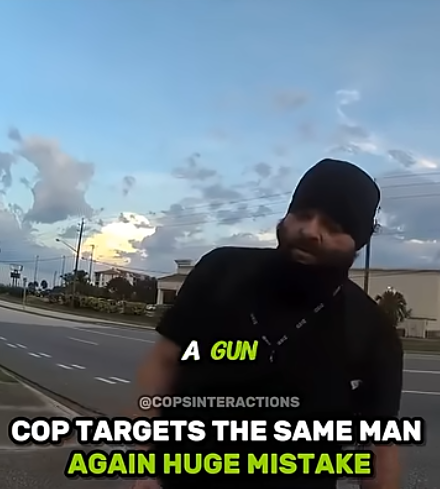
A Jog, a Head Covering, and a Police Stop: When Suspicion Turns Into a Civil Rights Concern
Introduction
A video circulating online shows a tense confrontation between police officers and a man who says he is simply out jogging while wearing a head covering. What begins as a police stop based on a reported firearm quickly turns into a broader dispute over personal freedom, public suspicion, police authority, and the right to move through public space without being treated like a threat.
According to the narration in the video, this was not the first time the man had experienced a similar encounter with the same department. The narrator says the man had previously sued the department over another incident, making this confrontation feel less like an isolated misunderstanding and more like part of a troubling pattern. The video frames the stop as a repeated mistake by officers who allegedly failed to distinguish between a lawful citizen exercising in public and someone who posed an actual danger.
The central conflict is simple but powerful: a man is jogging, wearing a head covering, and carrying a backpack. Police officers stop him after claiming they received a report about a person with a gun who matched a description. The man denies having a weapon. He tells the officers he is exercising. He questions why his clothing has become a reason for suspicion. The officers, in turn, focus on the head covering and say it is “scaring people.” From there, the situation escalates.
The video raises important questions about policing, civil rights, reasonable suspicion, public fear, and the everyday experience of people who are viewed as suspicious because of how they look, dress, or move through a neighborhood. It also highlights how quickly a routine activity, such as jogging, can become a stressful police encounter when assumptions replace evidence.
The Initial Confrontation
The video opens with officers stopping the man while he is out jogging. Their explanation is that they received a report of someone with a gun and that he matches the description. The man immediately denies being armed. He explains that he is not committing a crime, not threatening anyone, and not doing anything unusual beyond exercising in public.
The officers appear to treat the call they received as enough reason to detain him, while the man challenges the basis of the stop. He wants to know what exactly he has done wrong. His frustration is clear because, from his perspective, he is being interrupted during a normal activity and forced to defend his innocence without any evidence that he has done anything illegal.
The encounter reflects a common point of tension in police stops. Officers may believe they are responding to a public safety concern, especially when a firearm is mentioned. But the person being stopped may experience the same moment as an unfair accusation, especially if the suspicion seems to be based on vague descriptions, clothing, or someone else’s fear.
In the video, the man repeatedly emphasizes that he is jogging. His argument is not complicated: he is outside, exercising, and wearing clothing of his choice. He does not see how that creates a lawful reason for officers to treat him as a suspect. The officers, however, continue questioning him and do not appear satisfied with his explanation.
This creates the emotional foundation of the incident. The man feels targeted. The officers claim they are investigating a report. The difference between those two viewpoints is what drives the confrontation forward.
The Head Covering Becomes the Focus
One of the most striking parts of the video is the officers’ focus on the man’s head covering. According to the description, they question why he is wearing it and suggest that it is “scaring people.” This statement changes the tone of the encounter. Instead of focusing only on a specific report of a weapon, the conversation shifts toward appearance, perception, and whether public fear can justify police attention.
The man pushes back strongly. He argues that he has the right to wear what he chooses. He makes the point that simply existing in public while dressed a certain way should not turn him into a suspect. His response reflects a broader civil liberties concern: clothing, by itself, should not be treated as evidence of criminal behavior.
This part of the video is important because it exposes the danger of allowing fear to define suspicion. People can be afraid for many reasons, including bias, unfamiliarity, stereotypes, or misunderstanding. If police treat someone’s clothing as threatening simply because another person finds it unsettling, then ordinary freedom becomes conditional. A person’s right to move through public space becomes dependent on whether strangers feel comfortable with their appearance.
The man’s position is that he does not need to justify his clothing to police. He does not need a special reason to cover his head. He does not need to prove that his outfit is innocent. He is not asking permission to jog. He is asserting a basic right: to be in public without being treated as dangerous based on appearance alone.
The officers’ reference to people being scared is also troubling because it can blur the line between a real threat and a subjective reaction. A report of a gun is serious. But if the only observable facts are that a man is jogging with a head covering and a backpack, then the situation becomes much less clear. The video forces viewers to ask whether the officers had enough specific evidence to continue treating him as a suspect, or whether they were relying too heavily on fear and assumption.
The Demand for Identification
The encounter escalates when officers demand identification. The man explains that he does not have his ID because he is jogging. This is a practical explanation. Many people go running or jogging without carrying a wallet. They may carry water, keys, a phone, or nothing at all. Not having identification during exercise is not unusual.
Despite that, the officers reportedly threaten him with jail for “resistance” when he does not provide ID. This moment is one of the most tense parts of the video because it turns a disagreement into a potential arrest. The man is no longer only being questioned. He is being warned that failure to comply could lead to jail.
The issue of identification during police stops is often misunderstood. In many situations, police may ask for identification, but whether a person is legally required to provide it depends on the circumstances and the law in that jurisdiction. A person who is not driving and is not lawfully arrested may have different obligations than someone pulled over in a vehicle. The key question is usually whether officers have lawful grounds to detain the person and whether local law requires identification during such a detention.
In the video, the man appears to believe the officers do not have a valid reason to demand his ID. He sees the demand as part of an unlawful or unnecessary stop. The officers appear to believe they are conducting a valid investigation and that his refusal or inability to provide ID is resistance. That disagreement creates a dangerous imbalance because the officers have the power to arrest, while the man is left trying to argue his rights in real time.
This is where many police encounters become especially risky. A citizen may be legally correct but still face arrest if officers interpret noncompliance as obstruction or resistance. On the other hand, officers may argue that they need to identify someone while investigating a serious call. The problem is that when the original suspicion is weak or vague, the demand for ID can feel like a way to extend the stop rather than resolve it.
The man’s lack of identification should not automatically make him suspicious. It is consistent with his explanation that he is exercising. Yet the officers’ response appears to treat it as another reason to pressure him. This deepens the sense that the encounter is less about a clear threat and more about forcing compliance.
The Search of the Backpack
Eventually, the man opens his backpack to show the officers what is inside. According to the description, the backpack contains water bottles and personal items. This moment appears to confirm what he has been saying from the beginning: he is jogging, he is unarmed, and his belongings are ordinary.
The search, however, does not erase the harm of the encounter. Even if the officers discover no weapon, the man has already been stopped, questioned, threatened with jail, and made to prove his innocence. For someone who believes he has been targeted before, the experience can feel humiliating and exhausting.
The fact that he opens the backpack also raises questions about consent. Did he freely choose to show the contents, or did he feel pressured because officers were threatening him with arrest? In many police encounters, consent is complicated. A person may technically agree to a search while feeling they have no real choice. When several armed officers are present, and when jail has been mentioned, “consent” can become difficult to separate from coercion.
The video presents the backpack search as a revealing moment. The officers’ suspicion appears to collapse once the contents are shown. There is no gun. There is no threat. There are only items consistent with someone exercising outdoors. But the man’s frustration remains because the search should not have been necessary in the first place if the stop was based mainly on appearance and fear.
This moment also demonstrates the emotional burden placed on people who are repeatedly treated as suspicious. They are expected to remain calm, explain themselves, comply with orders, and sometimes expose their personal belongings to prove they are harmless. Even when they are proven right, they do not necessarily receive an apology or accountability. The encounter simply ends, while the stress remains with them.
A Repeated Mistake
The narration reportedly says the man had previously sued the department over a similar encounter. That detail changes how viewers may understand the video. If accurate, it suggests that the department had already been placed on notice about how its officers interacted with this individual, or at least about similar conduct. A repeated incident can point to a deeper institutional problem rather than a one-time lapse in judgment.
When a department faces a lawsuit over a previous encounter, one might expect additional training, caution, or awareness. Officers should be especially careful not to repeat behavior that could violate rights or create unnecessary conflict. If the same type of stop happens again, it raises questions about whether lessons were learned.
The phrase “repetitive mistake” is important. A mistake can happen when officers misunderstand a situation. But when similar mistakes happen again and again, they begin to look like a pattern. Patterns are harder to dismiss. They suggest that the issue may involve training, culture, supervision, policy, or bias.
For the man in the video, the prior lawsuit makes the encounter more than inconvenient. It may feel like history repeating itself. He appears to recognize the situation as part of a larger struggle to be treated fairly. His frustration is not only about this single stop. It is about having to go through the same kind of confrontation again after already challenging the department before.
For viewers, that context invites a broader question: what does accountability mean if the same type of incident happens again? A lawsuit may produce a settlement, a policy review, or public attention. But if officers continue acting in ways that create the same civil rights concerns, then accountability has not fully reached the street level where citizens actually encounter police.
Public Fear and Police Responsibility
A key issue in the video is the relationship between public fear and police response. Police often receive calls from residents who report suspicious people. Some calls are legitimate and urgent. Others are based on misunderstandings, stereotypes, or discomfort with people who look different. Officers must sort through those calls carefully.
When someone reports a person with a gun, police have a duty to take the call seriously. But taking a call seriously does not mean treating every person who vaguely matches a description as guilty. Officers still need to observe, assess, and distinguish between actual danger and innocent behavior. The law generally requires more than a hunch. It requires specific, articulable facts that suggest criminal activity may be happening.
The video becomes controversial because the observable behavior described is ordinary: a man jogging with a head covering and a backpack. The officers’ comment that the head covering was “scaring people” suggests that fear itself became part of the justification. That is a dangerous standard if not handled carefully.
Public fear can be wrong. Public fear can be biased. Public fear can be influenced by race, religion, clothing, neighborhood demographics, or assumptions about poverty and crime. If police automatically validate fear without questioning its basis, they risk becoming agents of private prejudice. A person who looks unfamiliar or dresses differently could be subjected to police stops simply because someone else feels uncomfortable.
Police responsibility requires more than responding quickly. It requires responding wisely. Officers must protect public safety while also protecting constitutional rights. Those duties are not opposites. In fact, good policing depends on both. A community cannot feel safe if innocent people are treated as suspects because of appearance.
The Right to Exist in Public
The man’s argument in the video can be understood as a defense of the right to exist in public. He is not asking for special treatment. He is asking not to be stopped, questioned, threatened, and searched because of how he looks while exercising.
Public space is supposed to belong to everyone. Streets, sidewalks, parks, and neighborhoods are places where people should be able to walk, jog, commute, gather, and live without constantly proving they belong. When police stops are based on vague suspicion, that freedom becomes unevenly distributed. Some people move freely. Others move under watch.
The right to wear a head covering is part of personal liberty. People cover their heads for many reasons: weather, exercise, religion, medical conditions, style, privacy, comfort, or personal preference. None of those reasons should require police approval. Clothing may become relevant if it clearly connects to a specific crime, but clothing alone should not be enough to turn a person into a suspect.
The video shows how quickly ordinary choices can be reinterpreted as suspicious. A backpack becomes a possible hiding place for a weapon. A head covering becomes something that scares people. Jogging becomes movement that officers want explained. The man’s entire presence is placed under suspicion.
That is why the encounter resonates beyond the individuals involved. Many people understand the fear of being misread in public. They know what it means to be watched in stores, questioned in neighborhoods, or treated as suspicious for reasons that have little to do with their actions. The video captures that experience in real time.
The Pressure to Prove Innocence
One of the most troubling aspects of the encounter is the pressure placed on the man to prove he is not dangerous. In principle, people are not supposed to have to prove innocence before being allowed to continue their day. Suspicion is supposed to be based on evidence, not on a person’s inability to immediately disprove an accusation.
Yet in the video, the man is pushed into exactly that position. He denies having a weapon. He explains that he is jogging. He says he has no ID because he is exercising. He eventually opens his backpack to show water bottles and personal belongings. Each step places the burden on him to satisfy the officers.
This burden is not only legal; it is emotional. The man has to manage his tone, defend his rights, avoid escalating the situation, and respond to accusations while knowing that the officers have the power to arrest him. His frustration is understandable, but any visible anger can be interpreted as hostility. This creates a nearly impossible situation: he must be firm enough to defend himself but calm enough not to be punished for his reaction.
The pressure to prove innocence can also normalize intrusive policing. If officers can stop someone based on vague fear and then demand that the person show their belongings to clear things up, the search becomes a routine shortcut. Instead of officers needing strong justification, citizens are expected to surrender privacy to end the encounter.
That approach weakens civil liberties. Rights matter most during uncomfortable moments, not only when everyone agrees. A person’s refusal to give up privacy should not automatically be treated as suspicious. Otherwise, the right becomes meaningless.
Escalation and the Language of “Resistance”
The officers’ alleged threat of jail for “resistance” is another important part of the incident. The term “resistance” can be powerful and dangerous in police encounters. It can describe genuine physical obstruction or violence, but it can also be used loosely when a person questions authority, refuses consent, or does not immediately comply with demands.
In the video, the man’s “resistance” appears to involve his inability or unwillingness to provide ID and his challenge to the stop. If that is the case, the use of the term raises concerns. Citizens have the right to ask why they are being detained. They have the right to state that they are not doing anything wrong. They have the right to question police actions, as long as they are not physically interfering or violating a lawful order.
When officers treat verbal disagreement as resistance, the balance of power shifts dramatically. The encounter stops being a conversation and becomes a compliance test. The citizen must obey first and challenge later, even if the stop itself is questionable. That may reduce conflict in the moment, but it can also allow unlawful or unnecessary stops to continue unchecked.
The language of resistance can also make a situation more dangerous. Once arrest is threatened, the person stopped may feel trapped. They may become more anxious or upset. Officers may interpret that anxiety as further noncompliance. The cycle can escalate quickly.
The video appears to show the man trying to avoid that outcome while still standing up for himself. He voices frustration, but he also eventually opens the backpack. This suggests he may have decided that proving he had no weapon was the safest way to end the encounter, even if he believed the stop was wrong.