A Quiet Moment Turned Into a Confrontation
The video begins with a situation that, on its surface, should never have become a major police incident. A 69-year-old man is seen with a golf club, an object he insists he has owned and carried for many years. To him, the club is not a threat, not a weapon, and not evidence of any crime. It is simply his property, something familiar, something he says he has had for around two decades. Yet within minutes, that ordinary object becomes the center of a confrontation between him and a police officer who repeatedly insists that the golf club is a weapon and that the man must set it down.
What makes the video so disturbing is not merely that an officer gave a command. Police officers often give commands during tense encounters, and sometimes those commands are necessary for safety. The deeper problem is that the officer appears to build the encounter around a claim that later does not hold up: that the elderly man swung the golf club at her. According to the video’s conclusion, none of the cameras in the area supported that accusation. That single point changes the entire meaning of the incident. If the man had truly swung the club at the officer, the response would be seen in a different light. But if the claim was false, then the officer’s commands, threats, escalation, and detention become part of a much larger issue involving truth, authority, accountability, and the power imbalance between police and civilians.
The man does not appear to understand why he is being treated like a criminal. He refuses to set the golf club down, not because he is trying to attack anyone, but because he believes he has done nothing wrong. He tells the officer that he has had the club for 20 years. That statement matters because it shows how he sees the situation. He is not thinking of the club as a dangerous weapon. He is thinking of it as a personal item, a long-owned possession, and perhaps even something connected to routine, comfort, or habit. From his perspective, being ordered to drop it may feel like being forced to admit that he is doing something suspicious when he believes he is innocent.
The officer, however, does not treat his explanation as meaningful. She continues to insist that the golf club is a weapon and that he must obey her commands. She tells him he is being recorded and claims she has evidence that he swung the club at her. This moment is especially significant because the officer uses the existence of recording devices as a form of pressure. In many police encounters, body cameras and surveillance cameras are supposed to protect both officers and citizens. They can verify facts, reduce false claims, and provide a record when memories conflict. But in this case, the officer’s reference to recording appears to be used not as a neutral safeguard, but as a warning: she says there is evidence against him.
The irony is that the video later states the cameras did not support her version of events. If that is true, then the recording equipment did exactly what it was supposed to do. It preserved reality against an accusation. It prevented the officer’s statement from becoming the only official story. Without cameras, the man’s word may have been weighed against the officer’s, and in many cases, an officer’s version can carry enormous power. The man might have faced arrest, charges, or public suspicion based on an allegation that video evidence did not confirm.
That is why this incident matters beyond the individuals involved. It shows how quickly an ordinary encounter can be transformed into a serious accusation when authority is misused. It also shows why video evidence has become so important in modern policing. A camera does not solve every problem. It does not prevent every bad decision. It does not automatically create justice. But it can expose contradictions. It can show whether an officer’s claim matches the visible facts. In this case, the video’s message is clear: the officer said she had evidence, but the available camera footage did not support her claim.
The Power of a Police Command
One of the most important themes in the video is the power behind a police command. When an officer tells a person to do something, the command carries the force of law, the threat of arrest, and sometimes the possibility of physical force. For a civilian, especially an older person, refusing a police order can feel risky even when the person believes the order is unfair. The 69-year-old man is placed in exactly that position. He believes he has done nothing wrong, yet he is told that his golf club is a weapon and that he must put it down.
The officer’s repeated commands create pressure. She is not simply making a request. She is asserting control over the scene. The man’s refusal is then framed as defiance. That framing matters because once an officer defines a person’s behavior as noncompliance, the encounter can escalate quickly. A person who initially appears confused or defensive can suddenly be treated as obstructive. The situation shifts from a question of whether there was any real danger to a question of whether the person obeyed quickly enough.
This is one of the most difficult issues in police-civilian encounters. Officers often argue that immediate compliance is necessary because they do not know what a person might do. Civilians, however, may feel that they should not be forced to obey commands that are based on false assumptions. In a perfect world, both sides would be able to calmly clarify the facts. But in real life, the person with the badge, the weapon, and the legal authority often controls the pace of the encounter. That imbalance is especially troubling when the officer’s claim is inaccurate.
The man’s age also adds weight to the situation. A 69-year-old man may not be physically powerless, but he is still an older civilian facing an armed law enforcement officer. The officer’s accusation that he swung a golf club at her creates a serious implication: that he threatened or attempted to assault an officer. Such a claim can lead to harsh consequences. It can justify detention, arrest, or criminal charges. It can also shape how other officers respond if they arrive on scene. Once the allegation is made, the man may be treated not as someone who needs clarification, but as someone who has already acted dangerously.
The golf club itself becomes symbolic. In ordinary life, a golf club is a sporting item. In another context, it could certainly be used as a weapon. Many everyday objects can be used as weapons if someone uses them violently. But that does not mean every object is automatically a threat. A walking stick, a cane, a baseball bat, a tool, or a golf club can be innocent or dangerous depending on the facts. The key issue is behavior. Did the man threaten anyone? Did he swing the club at the officer? Did he move toward her aggressively? According to the video’s conclusion, the cameras did not support the officer’s accusation.
That distinction is essential. Calling the golf club a weapon may have allowed the officer to justify her commands, but the label alone does not prove danger. The man’s possession of the club was not enough. The officer needed a factual basis for treating him as a threat. If the factual basis was the alleged swing, and that allegation was unsupported by the cameras, then the entire foundation of the encounter becomes questionable.
The officer also threatens the man with arrest for obstruction if he does not comply. This is another critical point. Obstruction charges can sometimes be used when a person interferes with police duties, refuses lawful orders, or prevents an investigation. But the legitimacy of such a threat depends heavily on whether the officer’s orders are lawful and reasonable in the first place. If an officer creates a false emergency or exaggerates a threat, then uses a person’s resistance to that false framing as a basis for arrest, the charge can become a tool of control rather than justice.
The video therefore raises a serious question: when does refusal to comply become obstruction, and when is it simply a person standing up against an unfounded accusation? The answer depends on the facts, but the facts in this case appear to undermine the officer’s position. The cameras did not support the claim that the man swung the club. That means the man’s insistence that he had done nothing wrong was not merely stubbornness. It may have been accurate.
The Claim That Changed Everything
The officer’s statement that the man swung the golf club at her is the central claim in the incident. It is the accusation that transforms the situation from a disagreement over an object into a potential assault or threat against a police officer. Without that claim, the man is simply holding a golf club. With that claim, he becomes someone who allegedly used the club in a threatening way. That is why the accuracy of the statement is so important.
In any police encounter, facts matter. They determine whether an officer has reasonable suspicion, probable cause, or justification for detention. They determine whether force is appropriate. They determine whether a person’s refusal to comply is unlawful or understandable. When the facts are distorted, the entire process can become unjust. A false accusation by an officer is not a small mistake. It can take away a person’s freedom, damage their reputation, and expose them to criminal prosecution.
The officer tells the man that he is being recorded and that she has evidence of him swinging the club. This statement appears designed to convince him that resistance is pointless. It suggests that the truth is already established and that the cameras will prove his guilt. But the later revelation that none of the cameras supported the claim creates a powerful reversal. The technology the officer invoked as proof instead becomes evidence against her account.
This is one reason the video is likely to provoke strong reactions. Viewers are not just watching a disagreement. They are watching an officer assert a version of reality that the available footage does not confirm. That can feel deeply unsettling because police authority depends on public trust. Citizens are expected to follow lawful commands, respect investigations, and accept that officers are acting in good faith. When an officer makes a serious claim that is not supported by evidence, that trust is damaged.
The man’s repeated insistence that he has done nothing wrong becomes more meaningful in this light. At first, viewers might wonder why he does not simply set down the club to calm the situation. But as the encounter develops, his refusal appears tied to a basic demand for fairness. He does not want to be treated as dangerous when he believes he has not behaved dangerously. He does not want his property redefined as a weapon because an officer says so. He does not want to comply with a narrative that he believes is false.
That does not mean every refusal to comply is wise. In real-world encounters, civilians often face a difficult choice: comply first and challenge later, or resist in the moment and risk escalation. Many legal experts advise people to comply with police commands even when they believe the officer is wrong, then pursue complaints or lawsuits afterward. But this advice, while practical, does not erase the emotional and moral reality of the situation. It is humiliating to be falsely accused. It is frightening to be threatened with arrest. It is especially upsetting when the person making the accusation has the power to detain you.
The officer’s conduct also raises questions about training and judgment. Good policing requires more than authority. It requires observation, patience, communication, and the ability to reassess. If an officer believes someone is armed or dangerous, caution is understandable. But if the person is not behaving aggressively, and if the situation is not supported by visible facts, the officer should be able to slow down, clarify, and avoid unnecessary escalation. Instead, the video shows repeated commands, a threat of arrest, and eventual detention.
The situation also demonstrates how dangerous it can be when an officer becomes committed to a claim. Once the officer states that the man swung the club, backing away from that accusation may feel difficult. The officer may feel that her authority, credibility, or safety assessment is on the line. Rather than reassessing, she may double down. That is a common problem in confrontations. People in authority can become invested in their first interpretation, even when evidence begins to point another way. In policing, that tendency can have serious consequences because the officer’s interpretation can become the basis for detention or arrest.
The claim that the man swung the golf club did not merely describe the encounter. It shaped the encounter. It gave the officer a reason to order him to drop the club. It gave her a reason to treat his refusal as obstruction. It gave her a reason to detain him. If that claim was false, then the man was not only wrongly accused; he was pulled into a chain of consequences created by a false premise.
Cameras, Accountability, and the Search for Truth
The presence of cameras is one of the most important parts of this story. The officer tells the man that he is being recorded and claims that the recordings show him swinging the golf club at her. In many cases, such a statement from an officer would be intimidating. A person might assume that if an officer says the camera captured something, then the evidence must exist. But the video’s conclusion states the opposite: none of the cameras in the area supported the officer’s claim.
This matters because video evidence has become one of the strongest tools for accountability in police encounters. Before widespread body cameras, dash cameras, surveillance cameras, and cell phone recordings, many disputed incidents came down to conflicting testimony. An officer might say one thing, a civilian might say another, and the official system often gave greater weight to the officer. That imbalance created situations where civilians felt powerless to prove what really happened.
Cameras do not eliminate bias, but they can reduce uncertainty. They can show timing, distance, gestures, tone, and physical movements. They can reveal whether an officer’s fear was reasonable or exaggerated. They can confirm whether a person made a threatening motion or simply stood still. In this case, the question was straightforward: did the man swing the golf club at the officer? According to the video, the cameras did not support that accusation.
The failure of the camera evidence to support the officer’s claim is not a minor technical detail. It is the heart of the matter. If an officer says there is video evidence of a threatening act, and that evidence does not exist, then the public is left to ask why the claim was made. Was it a mistake? Was it a misunderstanding? Was it an exaggeration? Was it intentional? The video presents the accusation as false, and the consequences described at the end suggest that the officer’s conduct was taken seriously.
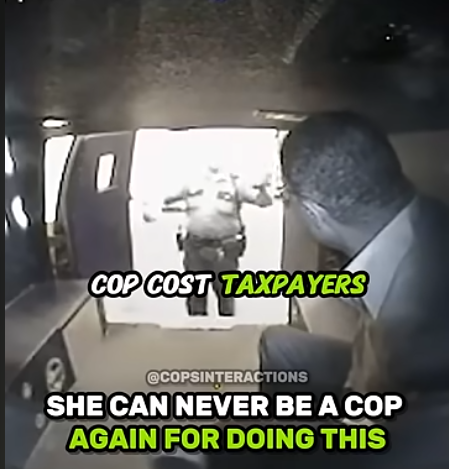
The ending states that the officer’s actions cost taxpayers $1.3 million and that she can never be a cop again. Those two outcomes show that the incident was not treated as harmless. A $1.3 million cost to taxpayers suggests a major legal or civil consequence. When public money is paid because of official misconduct, the burden does not fall only on the individual officer. It falls on the community. Taxpayers pay for the failure. The money could have gone toward public services, infrastructure, training, or community programs. Instead, it becomes the price of an encounter that should have been handled differently.
The statement that the officer can never be a cop again is also significant. It suggests a professional consequence beyond money. For many critics of police misconduct, financial settlements are not enough. They argue that if an officer violates someone’s rights or makes false claims, the officer should not simply move to another department and continue working in law enforcement. Preventing such an officer from serving again is a form of accountability that goes beyond compensation. It addresses future risk.
At the same time, the fact that taxpayers paid the price raises a familiar concern. When officers make harmful decisions, the public often pays financially while the individual officer may face limited personal financial responsibility. This can create frustration. People may ask why communities must pay for the actions of officers who misuse their authority. They may also ask whether police departments have strong enough systems to prevent such incidents before they happen.
The video therefore becomes more than a record of one confrontation. It becomes an example of why accountability systems matter. Body cameras matter. Independent review matters. Honest reporting matters. Training matters. Discipline matters. Civil lawsuits matter when internal systems fail. But the goal should not be only to pay after harm is done. The goal should be to prevent harm in the first place.
A camera can reveal the truth after an incident, but it cannot undo the fear, humiliation, and loss of dignity experienced by the person detained. It cannot erase the moment when an elderly man was told he had used his golf club as a weapon. It cannot remove the stress of being threatened with arrest. It cannot give back the sense of safety that may be lost when a citizen learns that an officer’s word can be used against them even when the evidence does not support it.
That is why accountability must be paired with prevention. Officers must be trained not only to record encounters, but to act in ways that would withstand review. They must understand that cameras are not just tools for gathering evidence against civilians. They are also tools for measuring officer honesty and professionalism. When an officer knows that a recording exists, the proper response should be greater accuracy, not greater confidence in making unsupported claims.
The Human Cost of Being Falsely Accused
The legal and financial consequences of the incident are important, but the human impact should not be overlooked. For the man at the center of the video, this was not an abstract debate about policing. It was a personal experience. He was confronted, accused, threatened with arrest, and detained. He was told that an object he considered his own long-held property was a weapon. He was told that there was evidence against him. He was placed in a situation where his words did not seem to matter.
False accusations can be deeply damaging, especially when they come from someone in authority. A police officer’s accusation carries a weight that an ordinary person’s accusation does not. It can lead to handcuffs, jail, court dates, legal expenses, public embarrassment, and emotional distress. Even if the accusation is later disproven, the experience can leave lasting harm. A person may become anxious around police, less trusting of public institutions, and more fearful in everyday situations.
For an older adult, the stress may be even greater. A 69-year-old man who has lived for decades without such an encounter may suddenly feel that his age, history, and dignity mean little in the face of police authority. His statement that he had owned the club for 20 years can be read as an attempt to explain himself as a normal person with a normal life. He is not presenting himself as a threat. He is saying, in effect, that this object has been part of his life for a long time and that there is nothing criminal about it.
The officer’s response does not appear to honor that explanation. Instead, she continues to press her version of the situation. This creates a sense of powerlessness. The man can speak, but his words do not change the officer’s actions. He can insist that he has done nothing wrong, but the officer still threatens obstruction. He can refuse to accept the accusation, but he is eventually detained.
The moment when he is told to put his hands on the car is especially powerful because it represents the physical reality of police control. Until then, the encounter is verbal: commands, refusals, accusations, explanations. But once the man is detained and ordered to place his hands on the vehicle, the situation becomes unmistakably coercive. His freedom of movement is restricted. His body is controlled. The accusation has become action.