The Escape
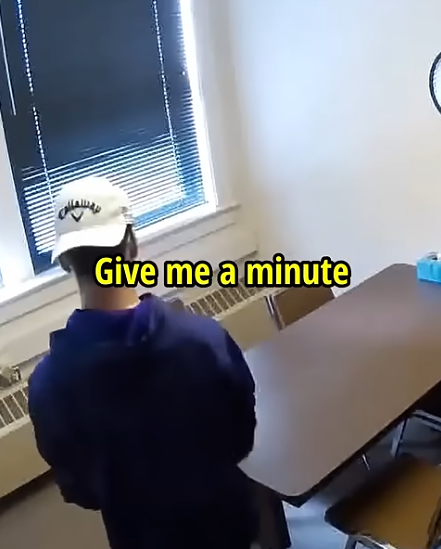
The footage opens with an almost mundane stillness, the kind that often precedes moments of unexpected consequence. A small, sparsely furnished holding room sits under the watchful eye of a fixed surveillance camera, its slightly grainy quality adding a layer of detachment to what is about to unfold. Fluorescent lights hum faintly overhead, casting a sterile glow across the walls and the lone figure seated at the center of the frame. The teen, slight in build and appearing no older than seventeen, sits with his hands cuffed in front of him, his posture somewhere between resignation and restless anticipation. His gaze shifts intermittently—first to the door, then to the floor, and finally to the window positioned just off to the side. The window itself does not initially appear remarkable, a standard feature in many such rooms, likely intended for ventilation or minimal natural light, but as the seconds pass, its presence becomes increasingly significant. When the officer enters the frame, the dynamic shifts subtly but noticeably. The officer, dressed in uniform and carrying the air of routine authority, speaks briefly with the teen. Their exchange is short, almost dismissively so. The teen asks if the cuffs can be removed, his tone measured, neither pleading nor confrontational, simply asking. The officer responds with a casual, “Give me a minute,” a phrase that, in retrospect, carries far more weight than intended. Without securing the environment further, without reassessing the conditions of the room, the officer exits, pulling the door shut behind him with a soft but definitive click. It is in that precise moment—when the door closes and the teen is left alone—that the tone of the footage shifts from ordinary to extraordinary.
What follows happens quickly, yet not recklessly. The teen does not panic or hesitate; instead, his movements suggest a decision already made, a plan perhaps contemplated during those quiet moments of observation. He rises immediately, the cuffs limiting but not preventing his mobility, and moves directly toward the window. There is no wasted motion, no second-guessing. The way he approaches the window indicates prior attention—he knows where to go and what to attempt. The window, though presumably secured, proves less resistant than expected. With a combination of urgency and determination, he manipulates it open, the blinds catching awkwardly as he forces a gap large enough to pass through. The sound is inaudible in the footage, but visually, the struggle is evident in the jerking motion of the blinds and the slight delay as he positions himself. Then, in one decisive movement, he climbs and leaps outward, disappearing from the frame entirely. The room, once occupied, is suddenly empty, the blinds swaying slightly as the only evidence of his exit. The primary camera continues to record the now-vacant space, emphasizing the abruptness of his disappearance.
A secondary surveillance angle provides continuity, picking up the teen’s movement outside the building. This camera, positioned to monitor the exterior, captures him landing and immediately transitioning into a run. Despite the constraints of the handcuffs, he moves with surprising speed, crossing a parking lot that appears largely empty. The environment outside contrasts sharply with the enclosed stillness of the holding room—open space, natural light, and the absence of immediate barriers. His path is not erratic; rather, it suggests urgency paired with a clear objective: distance. He does not look back, does not pause to reorient himself. Each stride carries him farther from the building, from the oversight that had briefly contained him. Within seconds, he exits the camera’s field of view, leaving behind only the empty expanse of asphalt and the quiet implication of what has just occurred. The escape, while visually simple, underscores a profound breakdown in procedural control. It is not the result of force or confrontation but of opportunity—an opportunity created by a combination of oversight, assumption, and perhaps routine complacency.
The footage then shifts forward in time, marked clearly by an overlay indicating “14 minutes later.” This temporal jump introduces a new layer of tension, not through action but through anticipation. The room reappears, unchanged except for the disturbed blinds and the open window, subtle indicators of the breach that has taken place. When the officer returns, his demeanor initially mirrors his earlier casualness, suggesting he expects nothing out of the ordinary. He opens the door without hesitation, stepping into the room with the same sense of control he exhibited before. That sense dissolves almost instantly. His body language shifts sharply as he takes in the scene—the empty chair, the absence of the teen, the disheveled blinds. There is a brief moment where his posture freezes, as though his mind is catching up with what his eyes are telling him. Shock registers first, followed quickly by frustration. The realization is immediate and unavoidable: the teen has escaped, and the responsibility for that lapse is now impossible to ignore.
The officer’s reaction, though not accompanied by audio, is visually expressive enough to convey a mixture of disbelief and exasperation. He moves toward the window, inspecting the point of exit, perhaps retracing in his mind the sequence of events that led to this outcome. The blinds, bent and hanging unevenly, serve as a silent testament to the vulnerability that was overlooked. It is not just the physical escape that is striking but the simplicity of it—the fact that such a breach could occur in a controlled environment highlights systemic weaknesses. The room, intended as a secure holding space, was compromised not by extraordinary means but by a failure to anticipate basic risk. Leaving a detainee unattended, even briefly, introduces variables that can escalate quickly, especially when environmental features like accessible windows are present. The footage, in its starkness, does not dramatize these failures; it simply presents them, allowing the implications to speak for themselves.
From a broader perspective, the incident raises critical questions about procedure, training, and accountability. Holding areas are designed with security in mind, yet their effectiveness depends heavily on consistent adherence to protocol. In this case, the officer’s decision to leave the room—even for a minute—created a window of opportunity that the teen exploited fully. It is a reminder that security is not solely a function of physical barriers but of human vigilance. The presence of a window, while not inherently problematic, becomes a liability when combined with inattention. Whether the window was intended to open or whether it malfunctioned is secondary to the fact that it was accessible enough to facilitate an escape. Such vulnerabilities, once exposed, demand reevaluation, not just of the physical space but of the practices governing its use.
The teen’s actions, while clearly driven by a desire to evade custody, also reflect a level of situational awareness that cannot be ignored. His ability to act quickly and decisively suggests he had been assessing his surroundings from the moment he entered the room. This is not unusual; individuals in custody often seek opportunities for escape, especially when they perceive weaknesses. What is notable here is the absence of deterrents. There were no immediate checks in place to prevent or even delay his actions. The cuffs, intended to restrict movement, proved insufficient when not paired with active supervision. This interplay between restraint and oversight is crucial; one without the other creates gaps that can be exploited.
As the footage concludes, the focus remains on the aftermath rather than the escape itself. The empty room, the officer’s reaction, and the lingering evidence of the breach collectively underscore the gravity of the situation. It is not just a story of a teen fleeing custody but of a system momentarily failing to uphold its own standards. The implications extend beyond the immediate incident, touching on issues of trust, responsibility, and the need for continual reassessment of security measures. In environments where control is paramount, even small lapses can have significant consequences. This event, captured in its entirety by surveillance, serves as a case study in how quickly control can be lost and how difficult it can be to regain once it is.
The narrative, while centered on a single moment, resonates on multiple levels. It speaks to the unpredictability of human behavior, the importance of diligence in routine tasks, and the ever-present potential for oversight to evolve into failure. The simplicity of the escape does not diminish its significance; rather, it amplifies it. When systems fail in obvious ways, the solutions are often clear. But when they fail quietly, through assumptions and small oversights, the lessons are more nuanced and, perhaps, more valuable. This footage, in its unembellished presentation, captures such a moment—a moment where routine gave way to consequence, and where a single decision set in motion a chain of events that could not be undone.
Continuing from that moment of realization, the atmosphere within the room seems to shift even further, as though the absence of the teen has created a vacuum not just physically, but procedurally and psychologically as well. The officer lingers for a few seconds longer than expected, scanning the room again, perhaps hoping that what he is seeing is somehow incomplete or misleading. But the reality is unmistakable. The chair remains empty, the cuffs no longer restraining anyone, and the window—now clearly the focal point of the entire incident—stands as both an exit and an indictment of the circumstances that allowed such an escape to occur. The officer’s next movements, though not fully captured in detail, suggest a transition from shock to action. He turns abruptly, likely to alert others, his posture tightening as the weight of the situation settles in. In environments such as this, every second following an escape becomes critical, not only for the possibility of recapture but also for documenting and understanding exactly what went wrong.
Outside, although the cameras no longer track the teen, it is easy to imagine the continuation of his flight. The parking lot, which initially served as a transitional space between confinement and freedom, likely gave way to streets, alleys, or nearby structures—anywhere that could provide cover or distance. The fact that he managed to clear the immediate perimeter without interception suggests that the exterior security measures were either limited or not actively monitored in real time. This adds another layer to the incident, pointing not just to a lapse inside the holding room but to a broader gap in situational awareness across the facility. Surveillance cameras, while useful for documentation, are only as effective as the systems and personnel that monitor them. In this case, the cameras recorded the escape, but they did not prevent it, nor did they trigger an immediate response that could have curtailed the teen’s movement beyond the property.
Back inside, the unfolding response would likely involve multiple steps, each governed by established protocols but now complicated by the urgency of the situation. Notifications would need to be sent, descriptions relayed, and surrounding areas potentially secured. Yet beneath these procedural responses lies an undercurrent of accountability. Questions would inevitably arise: Why was the teen left unattended? Was the room properly assessed for vulnerabilities? Were standard operating procedures followed, or were they bypassed in favor of convenience or routine? These questions, while administrative in nature, carry significant implications for both individual responsibility and institutional integrity. An escape of this nature is rarely viewed as an isolated incident; rather, it is examined as a symptom of deeper issues that may require correction.
The physical environment of the holding room itself becomes a subject of scrutiny. Details that might have seemed insignificant before—the height of the window, the type of latch used, the condition of the blinds—are now reinterpreted through the lens of failure. Investigators or supervisors reviewing the footage would likely pause at key moments, analyzing the teen’s movements frame by frame. How easily did the window open? Did it require force, or was it simply unsecured? How long did the entire escape process take? These granular details matter because they help reconstruct not just what happened, but how preventable it might have been. In many cases, such reviews lead to changes in infrastructure: windows reinforced, blinds removed or replaced, access points secured more rigorously. But physical changes alone are seldom sufficient without corresponding adjustments in behavior and oversight.
Equally important is the human element—the interaction between the officer and the teen prior to the escape. The brief exchange, while seemingly inconsequential at the time, now takes on added significance. The officer’s assurance of “a minute” implies a temporary absence, one that may have felt routine and harmless. However, in the context of custody, even a minute can be enough for circumstances to shift dramatically. The decision to leave, whether driven by distraction, confidence, or competing responsibilities, becomes a focal point in understanding the lapse. It is a reminder that in controlled environments, consistency is critical. Deviations, even small ones, can introduce unpredictability that undermines the entire system.
The teen’s perspective, while not directly captured beyond his actions, invites its own set of considerations. His behavior suggests a calculated awareness of opportunity. He did not test the door or attempt to call out; instead, he went straight to the window, indicating that he had already identified it as a viable exit. This level of observation is not uncommon, particularly among individuals who find themselves in unfamiliar or high-stakes situations. The instinct to assess and exploit weaknesses can be heightened by the desire to avoid whatever consequences lie ahead. In this sense, the escape is not just a reaction but a deliberate choice, one facilitated by the conditions present at that moment.
As time progresses beyond the immediate aftermath, the incident would likely trigger a cascade of administrative and operational responses. Reports would be filed, footage reviewed, and personnel debriefed. The goal of such processes is not only to document the event but to extract lessons that can prevent recurrence. Training protocols might be revisited, emphasizing the importance of constant supervision and environmental awareness. Supervisors might reinforce guidelines regarding detainee handling, particularly in situations where individuals are restrained but not fully secured. These responses, while procedural, are essential in restoring confidence and ensuring that the lapse does not become a pattern.
At a broader level, the escape underscores the delicate balance between control and oversight in custodial settings. Facilities are designed to manage risk, but they rely heavily on the individuals operating within them to maintain that control. Technology, such as surveillance cameras, plays a supporting role, but it cannot replace the need for active, attentive supervision. The incident illustrates how quickly that balance can be disrupted when assumptions replace vigilance. It also highlights the importance of redundancy—having multiple layers of security that can compensate when one fails. In this case, the absence of such layers allowed a single point of failure to cascade into a full escape.
Public perception of such incidents can also be significant. Even without widespread attention, events like this can influence how institutions are viewed, particularly in terms of competence and reliability. Transparency in addressing the issue, coupled with demonstrable corrective actions, becomes crucial in maintaining trust. While the footage itself presents a straightforward sequence of events, the narrative that emerges from it is more complex, involving not just what happened but what it represents in terms of systemic performance.
In reflecting on the entirety of the footage, one is struck by its simplicity and its implications. There are no dramatic confrontations, no elaborate योजन or external вмеш interventions—just a series of ordinary decisions and conditions aligning in a way that produces an extraordinary outcome. The teen’s escape is, in many ways, a convergence of timing, opportunity, and oversight. Each element on its own might not have been sufficient, but together they created a pathway that was both accessible and effective.
Ultimately, the incident serves as a powerful reminder of the importance of attention to detail in environments where the margin for error is minimal. It demonstrates how quickly control can be lost when vigilance lapses, and how even well-intentioned actions can have unintended consequences. The footage, while silent and observational, conveys these lessons with clarity, leaving little room for ambiguity. It is not just a record of an escape, but a case study in the dynamics of security, responsibility, and the ever-present need for awareness in situations where oversight is paramount.
As the implications of the escape continue to unfold, attention inevitably shifts toward what happens next—not just in terms of immediate response, but in how the incident reshapes procedures moving forward. Within minutes of the officer realizing the teen is gone, the environment likely transforms from routine calm to controlled urgency. Radios would crackle with updates, descriptions would be relayed, and personnel both inside and outside the facility would begin coordinating efforts to locate the escapee. The previously quiet corridors and monitored spaces would suddenly feel more active, more alert, as the awareness of a breach sharpens everyone’s focus. Yet even amid that urgency, there is an unavoidable understanding that the first and most critical opportunity to prevent the escape has already passed.
In reviewing the footage, supervisors and investigators would likely pay close attention to the timeline. The fourteen-minute gap between the officer leaving and returning becomes a central detail, not just because of its length, but because of what it represents—a window of time in which no supervision occurred. That duration, while perhaps unremarkable in other contexts, becomes significant here because it allowed the teen not only to execute his escape but to gain enough distance to reduce the chances of immediate recapture. It highlights how time, when combined with opportunity, can quickly shift the balance from control to vulnerability.
There is also a broader institutional lesson embedded in the incident, one that extends beyond this single room or this specific officer. It reinforces the idea that security is a continuous process, not a static condition. A room is not secure simply because it is designated as such; it remains secure only through consistent adherence to procedures and constant awareness of potential risks. The presence of restraints, surveillance, and physical barriers all contribute to that security, but none of them are foolproof in isolation. When one element is relied upon too heavily—such as assuming handcuffs alone are sufficient—the system becomes more susceptible to failure.
In the end, the escape stands as a stark illustration of how quickly circumstances can change when even a small lapse occurs. It is not defined by complexity or sophistication, but by its simplicity—a reminder that in controlled environments, the most basic precautions are often the most important. The footage captures that reality with quiet clarity, leaving behind a sequence of events that, while brief, carries lasting significance for anyone tasked with maintaining oversight and control.