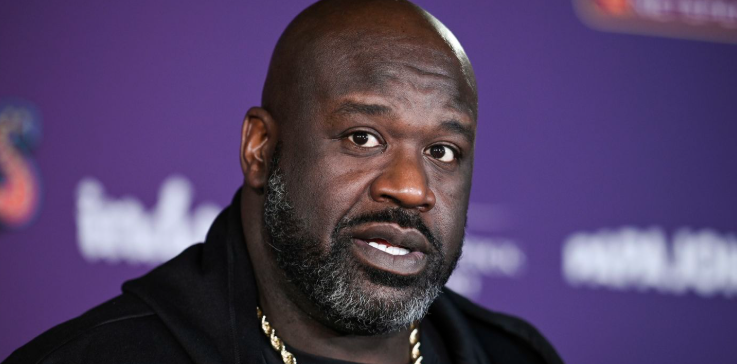
The world of luxury vehicles has always carried a certain aura—precision engineering, exclusivity, and the promise that every detail, from design to delivery, will be handled with care. But in recent years, that expectation has been increasingly challenged by a new kind of threat, one that doesn’t rely on force or visibility, but on access. In a case that quickly caught widespread attention, a custom-built $300,000 Range Rover—designed specifically for one of the most recognizable figures in sports—was stolen not through a dramatic heist, but through a highly coordinated act involving digital manipulation, impersonation, and precise timing. The intended recipient was none other than Shaquille O’Neal, a man whose size and personality have made him a larger-than-life presence both on and off the court. Yet despite his success and resources, even he found himself caught in a situation that highlights how sophisticated modern vehicle theft has become.
The story begins with a simple goal. Shaquille O’Neal, standing at an imposing 7’1”, has long faced a challenge that most people never have to consider: finding vehicles that actually fit him comfortably. Standard cars, even high-end luxury models, are often not designed with someone of his stature in mind. Over the years, this has led him to seek out custom solutions, modifying and tailoring vehicles to suit his needs. It is not just about comfort—it is about functionality. A car that doesn’t fit properly isn’t just inconvenient; it limits usability entirely. So when he decided to acquire a Range Rover, the process was never going to be straightforward. It required customization, planning, and collaboration with specialists who understood what it meant to build a vehicle around someone of his size.
That is where Effortless Motors entered the picture. Based in California, the company specializes in sourcing and customizing luxury vehicles for clients who want something beyond the standard offering. For Shaq, this meant working with a team that could ensure the Range Rover would meet his specific requirements—adjusted seating, modified interior space, and the kind of attention to detail that transforms a standard SUV into something uniquely personal. The process itself was handled with care, from the selection of the vehicle to the modifications needed to accommodate his frame. By all accounts, everything was progressing as expected. The vehicle was prepared, finalized, and scheduled for delivery.
And then, somewhere along the journey, something went wrong.
The theft did not happen in a way that most people would imagine. There was no break-in at a dealership, no dramatic scene involving masked individuals or high-speed escapes. Instead, the incident unfolded during transit—a phase of the process that is often overlooked, but critically important. Transporting a high-value vehicle across states involves coordination between multiple parties, including logistics providers, carriers, and tracking systems. It is a process that relies heavily on trust and communication, both of which can become vulnerabilities if not properly secured.
According to reports, hackers or individuals with access to sensitive information managed to infiltrate details related to the shipment. This access allowed them to understand not just where the vehicle was, but how it was being transported, who was responsible for it, and when it would be most vulnerable. Armed with that information, they were able to execute a plan that relied less on force and more on deception. Authorities believe that an individual or group impersonated a legitimate shipping or towing company, presenting themselves as authorized to take possession of the vehicle. With the right documentation—or convincing imitations of it—they were able to gain access without raising immediate suspicion.
This is what makes the case particularly striking. It was not just theft—it was coordination. Every step required precision: obtaining the shipment details, timing the interception, presenting a believable identity, and then moving the vehicle without drawing attention. It is the kind of operation that reflects a shift in how high-value theft is carried out. Instead of relying on physical confrontation, criminals are increasingly turning to information—using data, systems, and communication channels as tools to bypass traditional security measures.
By the time the vehicle was expected to arrive, it was already gone.
The discovery of the theft triggered immediate action. Effortless Motors issued a statement confirming that their internal systems had been compromised, leading to the unauthorized removal of the vehicle during transit. The company emphasized the seriousness of the situation, noting that they take the security of their clients and their assets very seriously. In an effort to recover the SUV, they announced a $10,000 reward for information leading to its return. It was a significant step, reflecting both the value of the vehicle and the urgency of the situation.
Law enforcement quickly became involved, with the Lumpkin County Sheriff’s Office providing details about the investigation. Preliminary findings suggested that the vehicle had been taken under false pretenses, likely by someone posing as a legitimate transport provider. Further inquiries revealed that a tow truck, registered to Griffin Wrecker Service LLC and bearing a specific Georgia tag, had been involved in moving the vehicle to an address in Atlanta. However, the individual believed to have coordinated the operation had not yet been fully identified, adding another layer of complexity to the case.
For Shaquille O’Neal, the incident was more than just a financial loss—it was another chapter in what has become a surprisingly consistent theme in his relationship with cars. Despite his success and his ability to access some of the most exclusive vehicles in the world, he has often found himself facing challenges that go beyond typical ownership. His size alone creates limitations that most manufacturers do not account for, forcing him to seek out custom solutions that are both time-consuming and expensive.
Over the years, his passion for cars has led him to experiment with a wide range of models, from Ferraris and Lamborghinis to more practical options like the Lucid Air. Each purchase reflects a desire to find something that works—not just in terms of performance or aesthetics, but in terms of usability. And yet, even with customization, the process is not always smooth.
One of the most well-known examples of this struggle dates back decades, when Shaq attempted to modify a Ferrari F355 to better suit his size. The solution was as unconventional as it was ambitious. He purchased two versions of the same model—one with a clean title and another with a salvage title—and used parts from the latter to extend the former. The goal was simple: create more space without compromising the overall design of the car. The result, however, came with its own set of challenges. The modification left the vehicle without a proper roof, turning it into a permanently open-top design. While this might seem manageable in certain climates, it introduced new vulnerabilities, particularly when it came to weather. A rainstorm eventually caused significant damage, serving as a reminder that even carefully planned solutions can have unintended consequences.
This pattern—of seeking solutions, encountering obstacles, and adapting again—has become a defining aspect of Shaq’s automotive journey. The stolen Range Rover fits into that narrative, not because it reflects a mistake on his part, but because it highlights the unpredictable nature of owning and customizing high-value vehicles in an increasingly complex environment.
Beyond the personal impact, the case also raises broader questions about security in the luxury vehicle market. As customization becomes more common and transportation networks become more interconnected, the risk of data breaches and impersonation increases. Companies that handle high-value assets must not only focus on physical security, but also on protecting the information that governs those assets. A single vulnerability—whether in a system, a communication channel, or a verification process—can be enough to compromise the entire operation.
For consumers, especially those investing in custom vehicles, this incident serves as a reminder of the importance of due diligence. Understanding how a vehicle will be transported, who is responsible at each stage, and what safeguards are in place can make a significant difference. While not every risk can be eliminated, awareness and transparency can reduce the likelihood of something going wrong.
As the investigation continues, the focus remains on recovering the vehicle and identifying those responsible. Cases like this are rarely resolved quickly, particularly when they involve multiple layers of coordination and potential digital interference. But each step forward—each piece of information, each lead—brings authorities closer to understanding how the theft was carried out and how similar incidents can be prevented in the future.
In the meantime, the story continues to resonate, not just because of the individual involved, but because of what it represents. It is a reminder that even in a world defined by luxury and access, there are vulnerabilities that cannot be ignored. It is a reflection of how crime evolves alongside technology, adapting to new systems and finding ways to exploit them. And it is, in a more personal sense, another example of how even the most carefully planned endeavors can take unexpected turns.
For Shaquille O’Neal, the loss of the custom Range Rover is undoubtedly frustrating. But if his history with cars is any indication, it is unlikely to deter him. His approach has always been one of persistence—finding solutions, adapting to challenges, and continuing to pursue what works for him. Whether it is through another customization, another model, or another attempt to create the perfect fit, his journey in the automotive world is far from over.