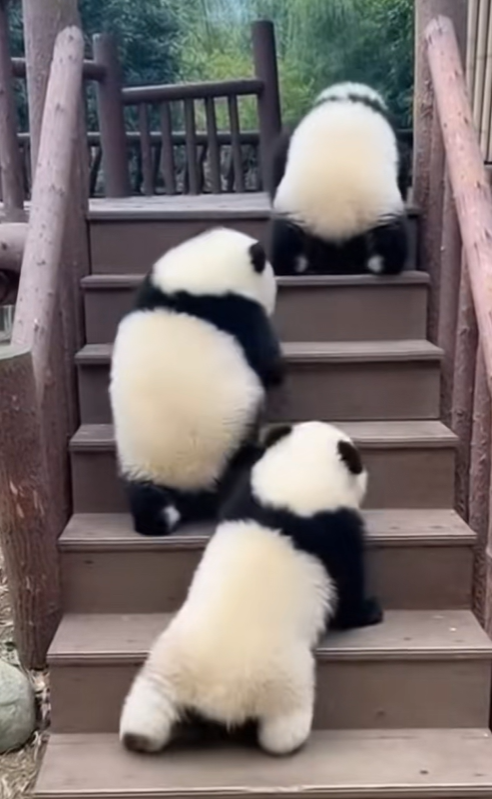
@fursonic_asmr “Perfect Panda Domino Fail 🐼😂 | You Won’t Believe This Timing! #Panda #FunnyAnimals #AnimalFails #CuteMoments #ViralVideo
Their round bodies, black-and-white fur, and slightly clumsy steps make the moment look lighthearted and cute. Each panda moves at its own pace—one already ahead, one carefully following, and the smallest still trying to push itself up the first steps. It feels like a simple scene of curiosity and exploration, as if they are just discovering the world around them.
But behind this gentle and adorable moment lies a much bigger story—one that stretches far beyond these steps and into the forests of China, where pandas have spent decades fighting for survival.
Giant pandas, known scientifically as Ailuropoda melanoleuca, are one of the most recognizable animals in the world. Yet for many years, they were also one of the most endangered. Their population once dropped dangerously low due to habitat loss, human expansion, and their own unique biological challenges. Unlike many animals, pandas reproduce slowly, and their dependence on bamboo makes them extremely sensitive to environmental changes.
In recent years, however, there has been a surprising and hopeful shift. After decades of conservation efforts, giant pandas are no longer officially classified as “endangered” but instead as “vulnerable.” This change reflects a real improvement in their numbers, with the wild population increasing to around 1,800–1,900 individuals.
This progress did not happen by chance. It is the result of years of dedicated work—creating protected reserves, restoring forests, banning poaching, and carefully managing panda populations. China established dozens of nature reserves and even created a massive national park specifically to protect panda habitats. These efforts helped reconnect fragmented forests, giving pandas more space to live, find food, and reproduce.
Yet, despite this success, pandas are still far from safe.
The biggest threat they face today is habitat loss. Pandas rely almost entirely on bamboo, which grows in specific mountainous regions. As human development expands—through roads, farming, and cities—these bamboo forests become smaller and more separated. When habitats are broken into pieces, panda populations become isolated, making it harder for them to find mates and maintain healthy genetic diversity.
Climate change adds another layer of danger. Scientists warn that a significant portion of bamboo forests could disappear in the future due to rising temperatures. In fact, studies suggest that more than one-third of panda habitat could be lost over time if climate trends continue. If bamboo disappears, pandas cannot easily adapt to other food sources, making them especially vulnerable.
Even their biology works against them. Pandas have a very low birth rate, and females are only fertile for a short period each year. In captivity, breeding often requires careful management, and even in the wild, successful reproduction is not guaranteed. This makes every new cub incredibly important for the survival of the species.
Looking back at the image of the three small pandas climbing the stairs, this reality becomes more meaningful. Each of those young pandas represents hope—not just a cute moment, but a continuation of a species that has struggled to survive. Their playful movements hide a deeper truth: without ongoing protection, scenes like this could become much rarer.
At the same time, pandas have become a global symbol of conservation. They are not just animals living in forests—they represent what can happen when humans decide to protect nature instead of harm it. The success in increasing panda populations shows that conservation can work when there is commitment, science, and cooperation.
However, this success also comes with responsibility. Being downgraded from “endangered” to “vulnerable” does not mean pandas are safe forever. It simply means they are no longer at immediate risk of extinction—but they are still at risk. If conservation efforts slow down, the progress made over decades could be reversed.
Another interesting aspect of pandas is how their protection helps other species as well. When forests are preserved for pandas, many other animals benefit from the same environment. Birds, mammals, and even smaller creatures all depend on these ecosystems. In this way, saving pandas helps protect entire habitats, not just one species.
There is also a global effort to support panda conservation beyond China. Zoos and research centers around the world participate in breeding programs and educational initiatives. These programs help raise awareness and ensure that pandas continue to receive attention and care on an international level.
The image of the pandas climbing the stairs can also be seen as a quiet metaphor. Step by step, slowly and sometimes clumsily, they move forward. In many ways, this reflects the journey of their species. Progress has not been fast or easy, but it has been steady. Each small step—each conservation effort, each protected forest, each newborn cub—has helped move pandas further away from extinction.
Still, the journey is not over.
Pandas remain dependent on human decisions. Their future will be shaped by how well forests are protected, how climate change is addressed, and how seriously conservation continues to be taken. Without ongoing effort, the balance could shift again, putting them back in danger.
In the end, the image captures more than just three adorable animals. It captures a moment in a much larger story—a story of survival, effort, and fragile hope. The pandas may look playful and carefree as they climb, but their existence is the result of years of struggle and protection.
And perhaps that is what makes the scene so meaningful.
Because behind every small step they take, there is a reminder that even the most vulnerable species can survive—if given the chance.
As the three young pandas continue their slow climb, the image becomes even more symbolic the longer you look at it. Each small movement—each step upward—mirrors something much larger than the moment itself. It reflects the gradual, sometimes uncertain, but persistent progress that defines the survival of their species. Just like these cubs, pandas as a whole have not moved forward in a straight or easy path. Their journey has been slow, fragile, and dependent on careful support at every stage.
One of the most fascinating aspects of pandas is how specialized they are. Unlike many other bears, pandas rely almost entirely on bamboo for their diet. This creates a unique challenge, because bamboo is not particularly rich in nutrients. As a result, pandas must spend a large portion of their day eating—sometimes up to 12 to 14 hours—just to maintain their energy. This dependence makes them incredibly vulnerable to changes in their environment. If bamboo forests decline or shift due to climate or human activity, pandas cannot easily adapt to new food sources.
This extreme specialization is both a strength and a weakness. It allows pandas to thrive in a niche that few other animals compete for, but it also means that any disruption to that niche can have serious consequences. In the past, large areas of bamboo forest were cleared for agriculture, infrastructure, and development. As these forests disappeared, panda populations became fragmented, with groups isolated from one another. This isolation made it harder for them to reproduce and maintain healthy genetic diversity.
In recent years, conservation efforts have focused not just on protecting pandas themselves, but on restoring and connecting their habitats. Wildlife corridors—areas of forest that link separate habitats—have been created to allow pandas to move more freely between regions. This helps them find mates and access different food sources, improving their chances of survival. These efforts are complex and require long-term planning, but they are essential for maintaining a stable population.
Looking again at the image, the three cubs climbing together also highlight another important factor in panda survival: early development and care. In the wild, panda mothers invest a significant amount of time and energy into raising their cubs. Newborn pandas are incredibly small—almost the size of a stick of butter—and completely dependent on their mother. The survival rate of cubs can be low, which makes every successful birth and upbringing incredibly valuable for the species.
In captivity, breeding programs have played a major role in increasing panda numbers. Scientists and conservationists have worked for decades to understand panda behavior, reproduction, and health. Techniques such as artificial insemination, careful monitoring, and controlled environments have helped improve breeding success. However, raising pandas in captivity is only part of the solution. The ultimate goal is to ensure that they can survive and thrive in the wild, where they belong.
This is why reintroduction programs have become an important part of panda conservation. Some pandas born in captivity are gradually trained to live in natural environments, learning how to find food, avoid danger, and adapt to life outside human care. This process is slow and challenging, but it represents a crucial step toward creating a self-sustaining wild population.
The pandas in the image, though likely in a protected or managed environment, still carry the same instincts and behaviors as their wild counterparts. Their curiosity, their cautious steps, and their playful determination all reflect the natural traits that have allowed their species to endure. Even in a simple act like climbing stairs, there is a glimpse of their resilience.
At the same time, climate change continues to pose a serious threat to panda habitats. Bamboo forests are sensitive to temperature and environmental conditions. As global temperatures rise, the regions where bamboo can grow may shift, potentially reducing the areas where pandas can survive. This creates uncertainty for the future, as conservation efforts must now consider not only current habitats but also how these habitats might change over time.
Scientists are actively studying these patterns, using data and models to predict how bamboo forests may evolve in the coming decades. This information helps guide conservation strategies, ensuring that protected areas are established in regions that will remain suitable for pandas in the future. It is a reminder that conservation is not static—it must adapt to changing conditions and new challenges.
Another layer to the panda story is the role they play in global awareness. Pandas have become ambassadors for wildlife conservation, capturing the attention and empathy of people around the world. Their distinctive appearance and gentle behavior make them easy to connect with, which has helped generate support for conservation efforts. Organizations like the World Wide Fund for Nature (WWF) have even used the panda as their symbol, representing the broader mission of protecting endangered species and ecosystems.
This global recognition has brought both benefits and responsibilities. On one hand, it has helped secure funding, research, and international cooperation. On the other, it has placed pandas in the spotlight, making their conservation a visible measure of success or failure. The progress made so far shows what can be achieved, but it also highlights how much work remains to be done.
Returning to the image, the sense of movement—of going upward—continues to resonate. The pandas are not rushing; they are not moving in perfect coordination. Each one finds its own way, its own rhythm. This individuality within a shared journey reflects how conservation works in reality. It involves many different efforts, from local forest protection to global policy decisions, all contributing to a common goal.
There is also something deeply reassuring about seeing multiple cubs together. It suggests continuity, a future generation that will carry the species forward. For a species that once faced the brink of extinction, this is a powerful image. It shows that recovery is possible, that life can continue, and that efforts to protect nature can have real, visible results.
Yet, it is important not to let this image create a false sense of security. Pandas may no longer be classified as endangered, but they remain dependent on human protection. Without continued conservation, their population could decline again. The challenges they face—habitat loss, climate change, low reproduction rates—have not disappeared. They have only been managed, not eliminated.
This is why ongoing awareness is essential. People must continue to support conservation efforts, whether through education, sustainable practices, or direct involvement in environmental initiatives. The story of pandas is not just about one species—it is about how humans interact with nature and the responsibility that comes with that interaction.
In many ways, the pandas climbing the stairs can be seen as a symbol of progress, but also of fragility. Each step forward is meaningful, but it requires balance, support, and care. A misstep could set things back, just as neglect or inaction could undo years of conservation work.
There is also a sense of innocence in the image that contrasts with the complexity of the issues surrounding panda survival. The cubs are simply exploring, unaware of the global efforts that have made their existence possible. This contrast highlights a fundamental truth: animals live in the present, while humans carry the responsibility of shaping the future.
As the pandas reach higher steps, the image naturally leads to a feeling of hope. It suggests that progress, even when slow and uncertain, is possible. It reminds us that positive change often happens gradually, through consistent effort and dedication.
At the same time, it encourages reflection. What steps are being taken today to ensure that future generations of pandas—and other species—can continue to exist? What role do individuals, communities, and governments play in that process? These questions extend beyond pandas, touching on the broader challenge of preserving biodiversity in a rapidly changing world.
Ultimately, the scene of the three pandas climbing together becomes more than just a visual moment. It becomes a story—one that connects the past struggles of the species with its present progress and future possibilities. It is a reminder that conservation is not just about preventing loss, but about creating conditions where life can thrive.
And perhaps that is the most important takeaway.
Because just like those small pandas, moving carefully step by step, the path forward for their species—and for many others—depends on steady progress, thoughtful action, and a continued commitment to protecting the natural world.
As the pandas near the top of the staircase, there is a quiet sense of completion in their movement, but not in their story. Reaching the next level does not mean the journey is over—it simply opens the door to what comes next. In many ways, this reflects the current state of panda conservation. Progress has been made, milestones have been reached, but the path ahead still requires attention, care, and persistence.
One important aspect that continues to shape the future of pandas is how their habitats are managed over time. Conservation is no longer just about protecting isolated areas; it is about creating entire ecosystems that can support life sustainably. This includes maintaining healthy bamboo forests, protecting water sources, and ensuring that human activity does not disrupt the delicate balance of these environments. It is a long-term commitment that requires coordination between scientists, governments, and local communities.
Local communities, in particular, play a crucial role in this process. Many of the regions where pandas live are also home to people who depend on the land for their livelihoods. Successful conservation efforts often involve working closely with these communities, finding ways to balance environmental protection with economic needs. This can include sustainable farming practices, eco-tourism, and education programs that raise awareness about the importance of preserving wildlife.
The presence of pandas has, in some cases, brought new opportunities to these regions. Eco-tourism, for example, allows people to experience the beauty of panda habitats while contributing to their protection. Visitors from around the world are drawn to the idea of seeing pandas, even if only from a distance or in controlled environments. This interest generates support for conservation and helps fund ongoing efforts.
At the same time, technology is becoming an increasingly valuable tool in protecting pandas. Researchers use tracking devices, camera traps, and satellite data to monitor panda movements and study their behavior. This information provides insights into how pandas use their habitats, how they respond to changes, and what measures can best support their survival. It is a blend of tradition and innovation—combining respect for nature with modern science.
Despite these advancements, uncertainty remains a constant factor. Environmental conditions continue to change, sometimes in unpredictable ways. Conservation plans must remain flexible, ready to adapt as new challenges arise. This requires not only scientific knowledge but also a willingness to respond quickly and effectively when situations shift.
Looking back at the image, the pandas’ steady climb becomes even more meaningful in this context. They do not rush, and they do not move in perfect harmony. Each one takes its own path, adjusting to the step in front of it. This mirrors how progress in conservation often happens—not in large, dramatic leaps, but in small, consistent actions that build over time.
There is also a quiet lesson in their persistence. Even when a step seems large compared to their size, they continue to try, pushing forward with determination. This resilience is something that defines not only pandas but many species that have faced challenges and adapted to survive. It is a reminder that strength does not always appear as power—it often appears as the ability to keep going, even when conditions are not ideal.
The emotional connection people feel toward pandas also continues to play a role in their survival. Because they are so recognizable and widely loved, they inspire a level of care and attention that many other species do not receive. This connection can motivate action, encouraging individuals to support conservation efforts in ways that extend beyond pandas themselves.
In the broader picture, pandas have become part of a larger conversation about biodiversity and environmental responsibility. Their story is often used as an example of what can be achieved when effort is focused and sustained. At the same time, it highlights the importance of not becoming complacent. Success in one area does not mean the overall challenge is solved.
As the pandas reach the final steps, there is a sense of quiet achievement—not just in their movement, but in what they represent. They are living proof that recovery is possible, that a species can move away from the edge of extinction when given the chance. But they are also a reminder that this chance must be protected, again and again, through continued effort.
The image, simple as it may seem, carries a deeper message. It shows that progress is not always dramatic or obvious. Sometimes it is slow, careful, and almost unnoticed. But over time, those small steps add up, creating change that is both meaningful and lasting.
And in that sense, the pandas climbing the stairs are not just moving upward—they are carrying a story with them. A story of struggle, protection, resilience, and hope. A story that continues to unfold, one step at a time.