The Flashpoint: A Morning in West Babylon
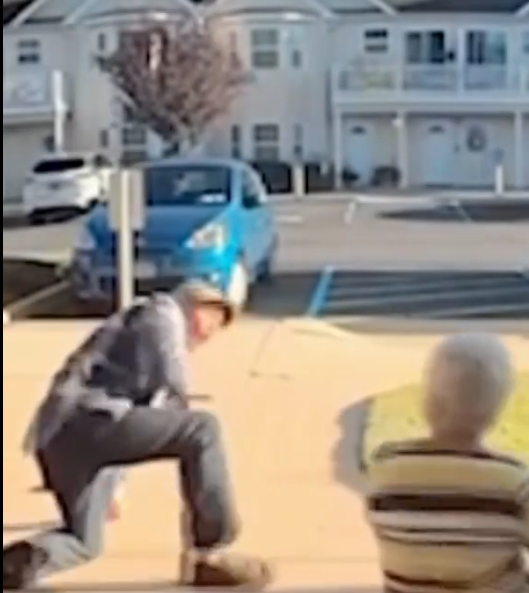
The video begins not with a bang, but with the mundane visual of a Long Island sidewalk. It is a setting we all recognize: quiet, residential, and seemingly safe. But the atmosphere is thick with a tension that has clearly been brewing for far longer than the duration of the clip. A 76-year-old woman, standing on what appears to be her own property or a common walkway, faces off against her neighbor. Within seconds, the verbal sparring escalates into a moment of literal combustion.
The flash of the flare gun is blinding, followed by a plume of acrid smoke that momentarily obscures the camera’s view. The neighbor’s reaction—a mix of shock, pain, and immediate fury—punctuates the silence of the neighborhood. “You idiot! What is wrong with you!” he screams, a sentiment that echoed through the millions of screens this video eventually touched. It is a scene that feels more like a fragment of a dark satire than a Monday morning in West Babylon, yet the legal consequences that followed were very real.
The Weapon of Choice: Why a Flare Gun?
The use of a flare gun in a domestic dispute is particularly chilling because of what it represents. Flare guns are, by design, tools of distress. They are meant to signal for help from the middle of an ocean or a wilderness. They are built to be seen from miles away, ejecting a pyrotechnic charge that burns at temperatures high enough to melt through flesh and bone. When aimed at a human face, a flare gun is no longer a signal for help; it is a weapon of horrific potential.
From a legal standpoint, the choice of weapon complicates the narrative. In many jurisdictions, a flare gun is not technically classified as a “firearm” under traditional statutes because it is a signaling device. However, the moment it is used as an instrument of harm, it enters the territory of “deadly weapons.” Firing a flare gun at someone’s face isn’t just an assault; it is an act that carries the high probability of permanent disfigurement, blindness, or death. The sheer unpredictability of a flare—which can bounce, stick, and continue to burn—makes it an exceptionally cruel choice for a neighborhood dispute.
The Psychology of the Property Line: A Deep-Seated Spite
Neighborhood disputes are unique in the world of conflict because they lack a “reset” button. Unlike an argument with a stranger at a grocery store, a dispute with a neighbor is geographically locked. You see the person every morning. You hear their car. You see their trash cans. Over years, small grievances—a bush that grows too high, a dog that barks too much, or a property line that is off by three inches—can metastasize into a deep, irrational hatred.
Psychologists often refer to this as “the narcissism of small differences.” Because the parties are so close in proximity and social standing, the friction between them becomes a central part of their identity. For a 76-year-old woman to reach the point where she pulls the trigger on a signaling device, there is almost certainly a backstory of years, perhaps decades, of perceived slights and escalating hostilities. The flare gun wasn’t just a reaction to that morning; it was the explosive culmination of a long-term psychological siege.
The Age Factor: Geriatric Aggression and the Public Eye
There is a specific kind of societal shock that occurs when the “attacker” is a senior citizen. We have a collective archetype of the elderly as fragile, wise, or at worst, mildly cantankerous. When that archetype is replaced by a woman firing a ballistic device at point-blank range, it forces a painful recalibration of our expectations.
However, geriatric aggression is a documented phenomenon. Whether driven by cognitive decline, chronic pain, or simply the erosion of social filters that comes with age, the “angry senior” is a real-world dynamic that the legal system is increasingly forced to address. In the courtroom, age often acts as a double-edged sword. A defense attorney might argue for leniency based on frailty or mental state, while the prosecution argues that the defendant’s age makes their cold, calculated use of a weapon even more egregious. The video evidence in this case, however, leaves very little room for a narrative of “accidental” discharge.
The Digital Witness: How Video Changes the Verdict
In decades past, this incident would have been a “he-said, she-said” battle in a small-claims court or a local precinct. The man would have claimed she shot him; she would have claimed self-defense or that he was the aggressor. But in 2026, the camera is the ultimate arbiter. The existence of high-fidelity video changes everything from the police response to the jury’s perception.
The video captures the physical distance between the two, the lack of an immediate physical threat from the neighbor prior to the shot, and the deliberate nature of her aim. For the prosecution, this video is a “golden ticket.” It removes the need for unreliable eyewitness testimony and places the judge and jury directly on the sidewalk in West Babylon. This “Digital Panopticon” means that our worst moments are no longer private; they are evidentiary, permanent, and subject to the court of public opinion before they ever reach a legal one.
The Legal Fallout: From Dispute to Felony
The charges following such an incident are typically severe. When a flare gun is fired at a person, the defendant is often looking at:
-
Assault in the Second or First Degree: Depending on the level of injury sustained by the neighbor.
-
Criminal Possession of a Weapon: Even if the device is a flare gun, using it in this manner reclassifies it legally.
-
Reckless Endangerment: The risk of fire in a residential area adds another layer of criminality.
The courtroom footage mentioned in the video shows a woman who must now face the reality that her golden years may be spent under the supervision of the state. The legal system is notoriously slow, but when presented with a video that is this visceral, the path to a plea deal or a conviction is often expedited.
The Suburban “Cold War” and the Erosion of Civility
This incident is a symptom of a broader erosion of civic grace. We are living in an era where the threshold for violence seems to be lowering. The “Flare Gun Woman” is an extreme example of a trend where people feel entitled to use “any means necessary” to settle minor personal grievances.
When we lose the ability to mediate with our neighbors—when we stop seeing them as fellow humans and start seeing them as obstacles to be removed—the flare gun becomes the inevitable conclusion. The video serves as a warning to all of us about the dangers of unchecked resentment. It asks us: At what point did we decide that winning a neighborhood argument was worth a felony charge and a life-altering injury?
By the time the smoke cleared on that West Babylon sidewalk, two lives were effectively ruined. The neighbor is left with the physical and psychological trauma of a ballistic attack, and the 76-year-old woman is left with a legal nightmare that will likely define the rest of her life.
The video is a tragedy in 4K. It is a reminder that while our technology has advanced to the point of capturing every moment in high-fidelity detail, our capacity for conflict resolution remains stuck in a much more primitive state. As the legal proceedings move forward, the “West Babylon Flare Incident” will remain a cornerstone of viral history—a cautionary tale about the high cost of suburban spite and the devastating speed with which a neighborhood can turn into a battlefield.
The Pyrotechnic Payload: A Medical and Ballistic Nightmare
To understand the sheer gravity of the moment the trigger was pulled in West Babylon, one must look past the grainy pixels of the social media clip and into the terrifying physics of the weapon itself. A flare gun is not a firearm in the traditional sense; it does not propel a solid lead projectile designed to pierce. Instead, it launches a chemical payload—often a mixture of magnesium, strontium nitrate, and potassium perchlorate—designed to burn with an intensity that can be seen through heavy fog or from miles away at sea. These projectiles are engineered to burn at temperatures exceeding 1,600°C, a heat so fierce that it doesn’t just burn skin; it vaporizes it. When this woman aimed that orange plastic barrel at her neighbor’s face, she wasn’t just committing an assault; she was unleashing a miniature sun.
The medical implications of a flare strike to the face are catastrophic and often irreversible. Unlike a bullet wound, which creates a specific track of trauma, a flare creates a “splash” of thermal and chemical destruction. The phosphorus or magnesium components of a flare can continue to burn even when deprived of oxygen, meaning that if a fragment of the flare becomes embedded in the victim’s skin or eye, it continues to consume the surrounding tissue until the chemical reaction is complete. For the victim in this video, the immediate screams weren’t just of shock, but of a specific, agonizing type of chemical cauterization. The long-term recovery for such an injury involves months of debridement, skin grafts, and the very real possibility of permanent blindness or systemic toxicity. By choosing this specific tool, the assailant bypassed the “standard” violence of a fistfight or even a traditional handgun, opting instead for a weapon that inflicts a primitive, elemental form of torture.
The Architecture of Aggression: The Condominium Pressure Cooker
The setting of West Babylon provides a crucial, often overlooked context for why this dispute reached a ballistic climax. This isn’t the sprawling acreage of rural America where neighbors are separated by miles of forest and cornfields; this is the high-density, shared-wall reality of Long Island suburbia. In these environments, the “home” is a sanctuary that feels perpetually under siege by the proximity of others. When you share a driveway, a walkway, or a thin strip of grass, every minor annoyance is amplified. The sound of a neighbor’s television, the smell of their cooking, or the placement of their trash cans becomes a personal affront. Over decades, this creates a psychological “pressure cooker” effect where the lack of physical distance leads to an erosion of emotional distance.
In West Babylon specifically, where middle-class stressors—rising property taxes, aging infrastructure, and the general frantic pace of the New York metropolitan area—are omnipresent, the neighborhood becomes the only place where residents feel they can exert control. For a 76-year-old woman who may feel the world changing around her in ways she cannot stop, her property line becomes her Alamo. The neighbor, in her mind, isn’t just a person who disagrees with her; he is an invader of the only sovereign territory she has left. The flare gun, in this distorted worldview, becomes a border defense weapon. This “condo-culture” violence is a growing trend in American legal circles, where the lack of “buffer zones” between private lives leads to explosive confrontations over issues that would be laughed out of a courtroom if they weren’t so tragic.
The Geriatric “Stand Your Ground” Delusion
One of the most complex layers of this case is the intersection of age and the “Stand Your Ground” mentality that has permeated American culture. There is a pervasive, and often legally incorrect, belief that if someone is on your property or “threatening” your peace, you have a unilateral right to use force. For the elderly, this is compounded by a visceral sense of physical vulnerability. A 76-year-old woman knows she cannot win a physical altercation with a younger, stronger man. In her mind, the weapon doesn’t just “level the playing field”—it is the only field she has left to play on.
This creates a dangerous “pre-emptive strike” logic. If a person feels that an assault is inevitable because of their perceived frailty, they may feel justified in using lethal force far earlier than the law actually allows. In the West Babylon video, the neighbor is clearly agitated and shouting, but he is not physically attacking her at the moment the flare is fired. The legal standard for self-defense requires an “imminent threat of deadly force or serious bodily harm.” Being called an “idiot” or being yelled at on a sidewalk does not meet that threshold. However, in the psychological landscape of an aging resident who feels “harassed,” the line between a verbal insult and a physical threat becomes blurred. The defense in this case will almost certainly lean on this sense of “perceived threat,” attempting to paint the 76-year-old as a victim of “elderly bullying” who was forced to defend herself with the only tool she had. Whether a jury will accept that a flare to the face is a “proportionate” response to a verbal argument is the multi-million dollar question that will determine the rest of her life.
The “Karen” Archetype and the Weaponization of Social Infamy
We cannot ignore the cultural environment in which this video was consumed. Within hours of the incident being uploaded, the woman was branded with the “Karen” label—a modern shorthand for a specific type of entitled, aggressive, and often racially or socially motivated female antagonist. While the “Karen” meme began as a way to highlight suburban entitlement, it has evolved into a digital pillory. For the woman in West Babylon, the “trial by social media” was over before she even sat in the back of a police cruiser. The video was sliced, edited, and set to music, turning a life-altering act of violence into “content” for a global audience.
This viral infamy adds a layer of complexity to the judicial process. How does a woman like this get a fair trial when millions of people have already watched her pull the trigger from three different angles? The digital record creates a “permanent present.” Every time the victim’s family or the defendant’s neighbors go online, the trauma is replayed. It also creates a feedback loop of aggression. Other “disgruntled neighbors” watch these videos and, depending on their own biases, either see her as a cautionary tale or, terrifyingly, as a sort of folk hero for “standing up” to a neighbor. The weaponization of these videos ensures that the conflict never actually ends; it just migrates from the sidewalk to the comment section, where it continues to radicalize and divide.
The Legislative Loophole: Is a Flare Gun a Firearm?
The West Babylon incident exposes a massive, gaping hole in our current legislative framework regarding “alternative” weapons. Most gun control debates center on handguns, AR-15s, and high-capacity magazines. Very few people are talking about the regulation of 12-gauge marine signaling kits. You can walk into many sporting goods stores or maritime supply shops and purchase a flare gun with no background check, no waiting period, and no permit. They are categorized as safety equipment, not ordnance.
Yet, as this video proves, in the hands of a motivated assailant, a flare gun is arguably more terrifying than a small-caliber pistol. It is a “one-shot” weapon that inflicts maximum, horrific damage. If the 76-year-old woman had used a .22 caliber handgun, she would be facing specific, well-defined firearm charges. By using a flare gun, her defense team can argue that she didn’t intend to “kill” but merely to “signal” or “scare,” exploiting the ambiguity of the device’s intended use. This case should serve as a catalyst for a serious conversation about the classification of pyrotechnic launchers. When a “safety device” is used to shoot a neighbor in the face, it is a failure of both social grace and legislative foresight. We are currently allowing people to carry “fire-breathing” weapons under the guise of boating safety, and the residents of West Babylon are the ones paying the price for that oversight.
The Victim’s Odyssey: The Long Shadow of Phosphorus
While the public fixates on the woman and the judge, the man who took the hit is entering a world of pain that most cannot imagine. A flare gun injury is a “gift that keeps on giving.” The phosphorus used in many flares is known for its ability to cause deep, necrotic burns that are prone to infection and delayed healing. Even if he survived the initial blast without losing his life, his life as he knew it is over. There is the “social disfigurement”—the reality of walking through the world with a face scarred by a pyrotechnic blast. There is the “psychological hyper-vigilance”—the inability to walk out his own front door without scanning the bushes for his neighbor.
The “victim impact” in these neighborhood disputes is often more profound than in “random” crimes. If you are mugged in a park, you can avoid that park. If your neighbor shoots you, your trauma is located exactly where you sleep. This is “geographic PTSD.” The man in the video is now tethered to his attacker by the very property they fought over. Every time he sees her house, every time he sees a flare in a movie, or even just smells smoke from a backyard BBQ, the amygdala will fire. The legal system often focuses on “punishing the perpetrator,” but it rarely has the tools to “repair the victim.” No amount of jail time for a 76-year-old woman will give this man his unscarred face or his sense of suburban peace back.
The Judge’s Dilemma: Justice vs. Optics
When this case finally reaches the sentencing phase, the judge will face an impossible task. On one side, you have a 76-year-old woman with no prior criminal record (presumably) and the physical frailty of age. Sending an octogenarian to a state penitentiary is often seen as a “death sentence” in all but name. It is expensive, logistically difficult for the prison system, and can appear “cruel” to a certain segment of the public.
On the other side, the judge has a video of an unprovoked (in the immediate sense) ballistic attack that could have easily resulted in a gruesome death. If the judge is too lenient because of her age, it sends a message that “seniors get one free shot.” It tells every other disgruntled neighbor in New York that if you’re old enough, you can settle your scores with a flare gun and get off with house arrest. The judge must balance the “humanity” of the defendant against the “gravity” of the act. The West Babylon video forces the court to decide if justice is about the person or the deed. In a world where every such decision is scrutinized by a viral audience, the pressure to “make an example” out of her is immense.
The Death of the “Good Neighbor” Policy
Ultimately, the West Babylon flare gun incident is a obituary for the concept of the “Good Neighbor.” For a society to function, there must be a baseline of “unwritten rules.” You don’t have to like your neighbor, but you agree not to kill them. You agree that the sidewalk is a neutral zone. You agree that words, no matter how hateful, are met with words, not fire.
When those unwritten rules are incinerated by a 76-year-old woman with a flare gun, the entire community suffers a “loss of innocence.” The residents of that street will now look at each other with suspicion. They will install more cameras. They will build higher fences. They will stop talking. This is how a community dies—not through a single explosion, but through the slow, cold withdrawal that follows it. The flare gun was just the match; the “suburban cold war” was the fuel.
As we look at the woman facing the judge, we aren’t just looking at a criminal defendant. We are looking at a mirror of our own escalating tensions. We are looking at what happens when the “social contract” is replaced by “ballistic solutions.” The West Babylon incident is a 4K warning that if we don’t find a way to lower the temperature of our neighborhood disputes, someone else is going to reach for the flare gun, and the next time, the smoke might not clear so easily.
The story of the West Babylon flare gun woman will eventually fade from the “trending” tabs, replaced by the next shocking clip of human failure. But for the people involved, the “final verdict” isn’t something that happens in a courtroom. It happens in the quiet moments of the victim’s recovery and the long, silent hours of the defendant’s incarceration or house arrest.
It is a story with no winners. The neighbor lost his health and his peace. The woman lost her freedom and her legacy. The community lost its sense of safety. And the rest of us? We lost a little bit more of our faith in the idea that “common sense” will prevail in the face of a heated argument. The flare gun in West Babylon didn’t just light up the sky for a second; it cast a long, dark shadow over the American suburban dream, proving that even in the quietest neighborhoods, the threat of a “hot war” is only one bad morning away. We must demand more—more from our neighbors, more from our laws, and more from ourselves—before the “fire next time” claims more than just our attention.