Skip to content

Best lifestory

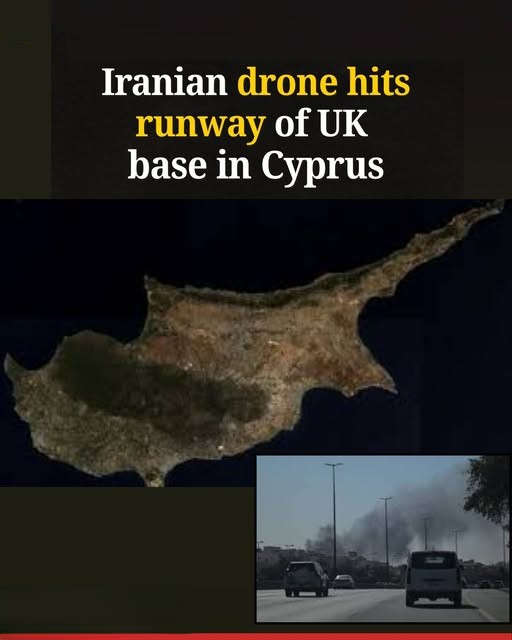
Iranian drone hits runway of UK base in Cyprus

Posted on March 2, 2026 By admin No Comments on Iranian drone hits runway of UK base in Cyprus

An Iranian drone hit the runway of a UK military base in Cyprus on Monday, prompting the EU to vow solid backing for member states as the US-Israeli conflict with Iran spread.

Cyprus President Nikos Christodoulides said that just after midnight (2200 GMT), “a Shahed unmanned aerial vehicle crashed into the military facilities of the British Bases in Akrotiri, causing minor material damage.”

Britain’s foreign minister said the drone had hit a runway.

“This is an unmanned drone strike specifically on the airport runway… we’re not able to provide further information and detail at this point, but obviously all of the precautionary measures are being taken around the base,” Yvette Cooper told Sky News.

The European Union, of which Cyprus is a member state, reacted immediately.

“While the Republic of Cyprus was not the target, let me be clear: we stand collectively, firmly and unequivocally with our Member States in the face of any threat,” EU chief Ursula von der Leyen said after talks with Christodoulis.

“We are in a region of particular geopolitical instability with many challenges and problems, which is going through an unprecedented crisis. Our homeland does not participate in any way and does not intend to be part of any military operation,” Christodoulides said earlier.

Britain agreed on Sunday to allow the United States to use British military bases to fire “defensive” strikes aimed at destroying Iranian missiles and their launchers.

The Royal Air Force Akrotiri base is a British overseas territory near the southern coastal city of Limassol.

While announcing that British bases can be used by US forces for defensive strikes, Prime Minister Keir Starmer stressed that Britain was “not involved in the initial strikes on Iran and we will not join offensive action now.”

“But Iran is pursuing a scorched-earth strategy, so we are supporting the collective self-defense of our allies and our people in the region,” he said in a post on X.

Strategic Significance of the Cyprus Incident


The reported drone strike on the runway of a British military base in Cyprus marks a critical moment in the widening scope of Middle Eastern tensions. Although the physical damage was described as minor, the political and strategic implications are substantial.

Cyprus occupies a uniquely sensitive position in the Eastern Mediterranean. As a European Union member state hosting British sovereign bases, it functions as a bridge between Europe and the Middle East. Any attack on installations located there carries symbolic weight beyond its immediate military effect.

President Nikos Christodoulides emphasized that Cyprus does not wish to be drawn into active military operations. His statement reflects a broader concern among smaller states in volatile regions: being pulled into conflicts that originate elsewhere but spill across borders through alliances and geography.

Why RAF Akrotiri Matters

The Royal Air Force base at RAF Akrotiri is not simply a local installation. It is one of the most important British military facilities outside the United Kingdom. From there, surveillance aircraft, refueling planes, and reconnaissance missions operate across the Middle East.

Because of its role in intelligence and logistical support, any strike on the base—even symbolic—sends a message. It demonstrates that distant infrastructure can become a target when regional wars escalate.

While officials stated that the drone caused only limited material damage, the psychological impact on personnel and civilians nearby cannot be discounted. Runways are critical assets. Even temporary disruption can affect response times and readiness.

The Nature of the Drone Attack

The drone was identified as a Shahed unmanned aerial vehicle, a platform Iran has used or supplied in various theaters, including Ukraine and the Middle East. These drones are relatively inexpensive, difficult to detect, and capable of long-range travel.

This reflects a broader trend in modern warfare: the use of drones as strategic signaling tools. They do not need to cause mass destruction to alter political calculations. Their presence alone demonstrates reach and intent.

By striking a runway rather than a civilian target, the attack appeared calculated. It conveyed a warning without crossing into mass-casualty territory, suggesting a deliberate attempt to escalate pressure while avoiding immediate large-scale retaliation.

Europe’s Immediate Political Response

The European Union reacted quickly. EU Commission President Ursula von der Leyen declared solidarity with Cyprus, stressing that threats to one member state concern the entire bloc.

This response underscores the EU’s evolving role as not just an economic union but a political and security actor. Though Cyprus was reportedly not the intended target, the fact that the drone struck EU territory raises questions about collective defense and deterrence.

European leaders now face difficult choices: how to support allies without deepening military involvement, and how to balance diplomacy with visible strength.

Britain’s Position and Strategic Tightrope

The United Kingdom occupies a complicated position in this crisis. On one hand, it allowed U.S. forces to use British bases for defensive strikes against Iranian missiles. On the other, Prime Minister Keir Starmer publicly insisted that Britain is not participating in offensive action.

This distinction between “defensive” and “offensive” operations is politically crucial but operationally blurry. From Iran’s perspective, any base facilitating military activity may be viewed as complicit.

Home Secretary Yvette Cooper confirmed the strike but avoided operational details, emphasizing precautionary measures. Such restraint reflects the need to avoid public panic while reassuring allies and citizens.

Cyprus’s Delicate Balancing Act

Cyprus has historically tried to maintain neutrality in regional conflicts. Its geography, however, makes neutrality increasingly difficult. British bases are sovereign territory, but they exist within Cypriot borders.

President Christodoulides’ insistence that Cyprus does not intend to take part in military operations reflects domestic political pressure. Cypriot citizens are concerned about tourism, trade, and safety—all of which depend on stability.

If Cyprus becomes perceived as a military staging ground, it risks being drawn deeper into a conflict it did not initiate.

Implications for NATO and Regional Security

Although Cyprus is not a NATO member, the British bases link it indirectly to NATO operations. Any attack on those facilities raises questions about alliance responsibilities and proportional response.

If similar incidents continue, NATO and EU planners may be forced to increase defensive deployments in the Eastern Mediterranean, potentially escalating tensions with Iran and its allies.

This could result in:

  • Enhanced air defense systems

  • Increased naval patrols

  • Heightened intelligence activity

  • Expanded cyber defense operations

Such measures, while defensive, can appear provocative to adversaries.

Energy and Economic Consequences

The Eastern Mediterranean lies near critical shipping lanes and energy corridors. Any instability threatens oil and gas transport routes.

Markets react not only to physical damage but to uncertainty. Even a single drone strike can influence insurance rates for shipping companies and investment confidence in the region.

For European consumers, the implications are tangible:

  • Potential increases in fuel prices

  • Supply chain disruptions

  • Higher costs of goods

These ripple effects illustrate how regional conflicts quickly become global economic concerns.

Information Warfare and Public Perception

Beyond physical damage, the incident also unfolded in the digital space. Statements from officials, social media posts, and leaked videos shape narratives.

Iranian-aligned outlets may frame the strike as justified retaliation. Western officials frame it as an unacceptable escalation. Each side uses language to mobilize support and legitimacy.

Public trust becomes another battleground. Governments must reassure citizens without revealing sensitive military details, a balance that is difficult to maintain in an age of instant communication.

Legal and Diplomatic Questions

Under international law, attacking military installations on foreign territory raises questions of sovereignty and proportionality.

Diplomats will likely debate:

  • Whether this constituted an act of war

  • Whether the strike violated Cyprus’s neutrality

  • How to respond without violating international norms

The United Nations may become a forum for competing narratives, though practical enforcement remains limited.

Risks of Escalation

One of the most concerning aspects of this incident is the risk of miscalculation. A drone strike that causes no casualties today could result in deaths tomorrow if defenses fail or targets shift.

Escalation can occur unintentionally:

  • A defensive interception goes wrong

  • A retaliatory strike hits civilians

  • A naval encounter spirals out of control

History shows that wars often begin not with formal declarations but with chains of reaction.

The Human Dimension

While much analysis focuses on states and strategies, the human dimension remains central. British service members stationed at RAF Akrotiri, Cypriot civilians living nearby, and families across Europe all feel the consequences of instability.

Fear, uncertainty, and anxiety are as real as missiles and drones. Governments must consider not only deterrence but the psychological toll of prolonged crisis.

Broader Geopolitical Meaning

This strike illustrates how the Israel-Iran confrontation is no longer confined to a single geographic theater. It has expanded into a network of alliances and territories stretching from the Middle East into Europe.

What once might have been seen as a distant conflict now directly touches EU soil. This changes calculations in Brussels, London, and Washington.

The question is no longer whether Europe is affected, but how deeply it will become involved.

Conclusion: A Warning Sign, Not an Isolated Event

The drone strike on the British base in Cyprus should not be viewed as a standalone incident. It is part of a pattern of widening confrontation that blends military action, political messaging, and strategic ambiguity.

Statements from leaders such as Keir Starmer and Ursula von der Leyen highlight an effort to project unity and restraint simultaneously—a difficult balance in moments of crisis.

Ultimately, this event underscores how fragile regional stability has become. A single drone crossing airspace can shift diplomatic conversations, market behavior, and public sentiment.

The long-term outcome will depend on whether leaders choose escalation or containment. History suggests that restraint, clear communication, and diplomacy remain the only sustainable path to prevent localized incidents from becoming broader wars.

In that sense, the Cyprus drone strike serves as both a warning and a test: a warning of how interconnected modern conflicts have become, and a test of whether international institutions and alliances can manage crisis without allowing it to spiral into catastrophe.

Intelligence and Security Implications

Beyond the immediate political shock, the drone strike on the Cyprus base raises significant questions about intelligence failures and defensive preparedness. Modern military installations rely on layered systems of radar, satellite surveillance, and electronic warfare. A single drone penetrating these defenses suggests either a gap in detection or a deliberate test of response capabilities.

Security analysts believe such incidents often serve dual purposes: operational impact and intelligence gathering. By observing how quickly the base responded, what defenses were activated, and how authorities communicated afterward, adversaries can refine future tactics.

This transforms the event into more than an isolated strike. It becomes part of a long-term strategic chess game where each move reveals information about vulnerabilities and thresholds of tolerance.

In this sense, Cyprus may have become an unintended laboratory for testing Western military readiness in a rapidly evolving drone warfare environment.

Cyber and Hybrid Warfare Dimensions

Modern conflict rarely unfolds only in physical space. Almost immediately after the strike, online platforms became flooded with competing narratives, images, and interpretations. This is a hallmark of hybrid warfare, in which cyber operations and information campaigns complement kinetic actions.

Cybersecurity agencies across Europe are likely assessing whether the drone incident coincided with probing attacks on communications networks, transportation systems, or energy infrastructure. Even small disruptions can amplify public anxiety and undermine confidence in government control.

Hybrid tactics blur the boundary between war and peace. A drone strike may be followed by hacking attempts, disinformation, or propaganda campaigns aimed at weakening political cohesion. The strategic goal is not simply to damage a runway, but to create uncertainty and division among allies.

Domestic Political Pressures in Europe

While the strike occurred on military property, its consequences extend into domestic politics. Leaders across Europe now face difficult questions from voters who fear being dragged into a conflict far from their borders.

Opposition parties may demand inquiries into:

  • Why defenses failed to prevent the strike

  • Whether hosting foreign bases increases national risk

  • If governments are being transparent about security threats

For countries already dealing with inflation, migration, and social unrest, a new security crisis can become politically destabilizing. Citizens may ask whether alliances that once guaranteed protection now bring danger.

This tension between alliance commitments and public opinion is one of the defining political challenges of the current era.

The Legal Debate: Sovereignty and Responsibility

International law provides only partial clarity in cases like this. While the base is British sovereign territory, it sits on Cypriot soil. The drone strike therefore touches both British and Cypriot legal frameworks.

Key legal questions include:

  • Does the strike constitute an armed attack under international law?

  • Who bears responsibility for retaliation or defense?

  • Is Cyprus legally exposed despite claiming neutrality?

Legal scholars warn that ambiguity can be dangerous. If lines of responsibility are unclear, misinterpretation becomes more likely. A retaliatory act justified by one party may be seen as illegal escalation by another.

This legal gray zone reinforces the importance of diplomacy and multilateral consultation rather than unilateral military responses.

The Role of Deterrence in the Drone Age

Traditional deterrence relied on large-scale weapons systems: missiles, tanks, aircraft carriers. Drones change this calculus. They are cheap, expendable, and difficult to attribute with certainty.

Deterrence now depends not only on military strength but on signaling intent and restraint. If every drone strike leads to disproportionate retaliation, escalation becomes almost inevitable. Conversely, if such strikes go unanswered, they may multiply.

This creates a strategic dilemma: how to respond firmly enough to discourage repetition without triggering broader conflict.

Some experts suggest that future deterrence will rely heavily on defensive systems and cyber countermeasures rather than overt retaliation.

Regional Ripple Effects in the Middle East

Although the strike occurred in Europe, its roots lie in Middle Eastern tensions. Militant groups aligned with regional powers may interpret the event as a signal that Western infrastructure is now a legitimate battlefield.

This perception could influence behavior in:

  • Lebanon

  • Iraq

  • Syria

  • Yemen

Proxy actors may feel emboldened to strike foreign interests beyond the immediate conflict zone. The geography of war expands, and with it the number of actors involved.

This is one of the most dangerous aspects of proxy warfare: actions in one theater inspire responses in another, creating a chain reaction that is difficult to contain.

The Energy Security Angle

Energy security remains one of the most sensitive vulnerabilities in Europe. Any instability in the Eastern Mediterranean raises fears about supply routes and infrastructure.

Even if oil and gas installations are not targeted directly, insurance costs rise when conflict spreads. Shipping companies reroute vessels. Investors hesitate. Prices fluctuate.

For households, this can mean:

  • Higher heating bills

  • Increased transportation costs

  • Inflationary pressure on food and goods

Thus, a drone hitting a runway can ultimately affect daily life thousands of kilometers away.

Psychological Warfare and Public Morale

One of the least discussed consequences of such incidents is psychological. Warfare is not only about territory and weapons; it is about perception and morale.

A strike on a European base communicates that no place is entirely safe from distant conflicts. This can foster fear and insecurity among populations unused to feeling directly exposed.

Governments must therefore manage not only military response but emotional stability. Clear communication, calm messaging, and transparency become tools of national defense.

Failure to address public fear can erode trust in institutions and weaken social cohesion.

The Media’s Role in Escalation or Restraint

Media coverage plays a powerful role in shaping interpretation. Sensational headlines can inflame tensions, while measured analysis can encourage restraint.

Responsible journalism requires distinguishing between:

  • Confirmed facts

  • Official statements

  • Speculation and analysis

In an era of instant news and viral clips, misinformation spreads faster than verification. This places an ethical burden on media outlets and social platforms to avoid becoming tools of escalation.

The way this incident is framed—either as an isolated security breach or as a sign of imminent war—will influence how publics and policymakers respond.

Strategic Scenarios Moving Forward

Several scenarios may now unfold:

1. De-escalation Through Diplomacy

Quiet diplomatic channels reduce tensions, and no further strikes occur. The incident becomes a warning rather than a turning point.

2. Limited Retaliation

Symbolic responses are taken without expanding conflict. This risks tit-for-tat exchanges but may stop short of war.

3. Proxy Escalation

Allied militias increase activity in multiple regions, spreading instability without direct confrontation between major powers.

4. Broader Regional Conflict

Missteps lead to sustained military engagement involving multiple states and alliances.

Which path emerges will depend on leadership decisions in the coming weeks.

Lessons for Military Planning

The strike highlights several lessons for modern defense strategy:

  • Bases far from front lines are still vulnerable

  • Drone defense must be prioritized alongside missile defense

  • Civil-military coordination is essential for crisis response

  • Public communication is as important as tactical readiness

Armed forces will likely review security protocols and expand air defense coverage around strategic installations.

Ethical and Humanitarian Concerns

Even when damage is limited, the normalization of strikes on infrastructure raises ethical issues. Once such actions become routine, the threshold for violence lowers.

Humanitarian organizations warn that prolonged instability increases risks for civilians, refugees, and vulnerable populations. Every escalation compounds existing crises in the region.

The challenge is preventing military logic from eclipsing human considerations.

Long-Term Geopolitical Meaning

The Cyprus incident reflects a broader shift in world order. Conflicts are no longer contained by geography. Technology, alliances, and communication networks create a single interconnected battlefield.

Europe, once largely insulated from Middle Eastern wars, now feels their proximity more directly. This may reshape defense policy, foreign relations, and public attitudes toward intervention.

In the long run, the event may be remembered not for the physical damage it caused but for what it revealed: the fragility of stability in an age of hybrid conflict.

Conclusion: A Moment That Demands Restraint

The drone strike on the British base in Cyprus stands as a reminder that modern conflict rarely announces itself with formal declarations. It emerges through small, symbolic actions that carry large strategic meaning.

This incident tests:

  • Alliance unity

  • Legal frameworks

  • Public trust

  • Military preparedness

Whether it becomes a footnote or a prelude depends on how leaders respond.

The challenge now is not simply to defend infrastructure, but to defend the principle that conflict should not spiral uncontrollably. Diplomacy, caution, and collective responsibility remain the most powerful tools available.

In an era defined by uncertainty, the Cyprus strike serves as both a warning and an opportunity: a warning of how easily tensions can spread, and an opportunity to prove that restraint and cooperation still have a place in global politics.

Uncategorized

Post navigation

Previous Post: Late-Night Inferno Near Downtown Austin Leaves Residents Shaken
Next Post: Reports Claim Iran’s Supreme Leader Was Killed — Unverified Rumors Fuel Confusion and Conflict

Leave a Reply Cancel reply

Your email address will not be published. Required fields are marked *

Recent Posts

  • A Heated Argument Turns Dangerous on the Road — and Why State Law Required Police to Act
  • Inside the Bodycam Footage That Sparked Debate Over Authority, Emotion, and Leadership in Policing
  • Trump says combat operations in Iran will continue until all objectives achieved
  • Reports Claim Iran’s Supreme Leader Was Killed — Unverified Rumors Fuel Confusion and Conflict
  • Iranian drone hits runway of UK base in Cyprus

Copyright © 2026 Best lifestory.

Powered by PressBook WordPress theme