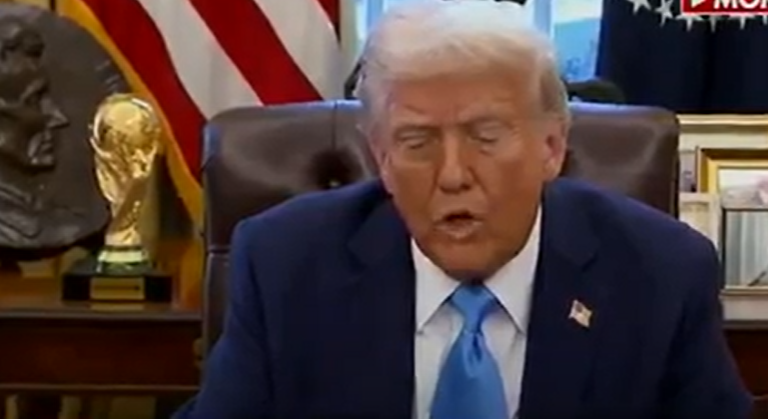
President Donald Trump has brushed aside criticism from several prominent conservative media figures regarding his administration’s military campaign against Iran, insisting that his actions align with the fundamental goals of the “Make America Great Again” movement.
Speaking in an interview with the independent Washington, D.C., newsletter The Inner Circle, Trump framed the controversy not as a division within his political base but as a misunderstanding by certain commentators who, he believes, are out of step with the broader movement.
“I have to do what’s right, number one — and you can’t have Iran getting a nuclear weapon. That’s predominant to me,” Trump said.
According to the former president, preventing Iran from obtaining nuclear weapons remains one of the most critical national security priorities for the United States and its allies.
Trump argued that the recent airstrikes targeting Iranian military facilities and infrastructure are part of a necessary strategy to deter Iran from advancing its nuclear ambitions and destabilizing the region.
Despite mounting criticism from some of his traditional allies in conservative media, Trump appeared confident that the broader MAGA movement continues to support his approach.
“I think that MAGA is Trump — MAGA’s not the other two,” he said, referencing critics such as media personalities Megyn Kelly and Tucker Carlson.
“MAGA wants to see our country thrive and be safe. And MAGA loves what I’m doing — every aspect of it.”
Trump also described the conflict as a necessary strategic detour.
“This is a detour that we have to take in order to keep our country safe and keep other countries safe, frankly,” he said.
His comments highlight an increasingly visible divide within the conservative political ecosystem over the question of military intervention abroad.
Conservative Media Voices Express Concern
Several influential figures within conservative media have voiced skepticism or outright criticism of the administration’s escalating military actions against Iran.
Among the most notable critics is talk radio host and former Fox News anchor Megyn Kelly, who raised concerns about the strategic justification for the strikes and their potential cost in American lives.
Speaking on her SiriusXM program, Kelly said she had “serious doubts” about the operation and questioned whether the military campaign served U.S. interests.
At the time of her comments, casualty reports indicated that four U.S. service members had been killed in retaliatory Iranian strikes on a U.S. military base in Kuwait. Later updates confirmed the number had risen to six.
“I don’t think those four [now six] service members died for the United States,” Kelly said during her broadcast.
“I think they died for Iran or for Israel.”
Her remarks reflected a broader debate among some conservative commentators who believe the United States should avoid becoming deeply involved in another prolonged conflict in the Middle East.
Kelly suggested the conflict appeared to be closely tied to regional dynamics involving Israel.
“This feels very much to me like it is clearly Israel’s war,” she said.
Despite her criticism, Kelly emphasized that her questioning of the military campaign did not represent a rejection of Trump or the broader conservative movement.
“I support the president. I voted for the president. I campaigned for the president,” she said.
“But that doesn’t mean you have to accept another Middle East war without questions.”
Kelly argued that asking questions about the strategic value of military action should not be viewed as disloyalty.
“There is nothing unpatriotic, or unsupportive of one’s conservatism, to say ‘I would like to be better convinced that this is worth the sacrifice of American blood and treasure.’”
Her comments captured the tension many conservatives feel between supporting a political leader and evaluating the consequences of military action.
Tucker Carlson’s Strong Opposition
Another prominent voice expressing concern is political commentator Tucker Carlson, who criticized the bombing campaign in particularly strong terms.
Carlson described the strikes as “absolutely disgusting and evil,” reflecting a viewpoint that the United States should avoid entanglement in another Middle Eastern conflict.
Carlson has long been associated with a more isolationist wing of conservative politics — one that favors limiting foreign military involvement and focusing primarily on domestic priorities.
This perspective gained significant traction during Trump’s initial presidential campaign, when he criticized previous administrations for what he called “endless wars.”
Carlson’s criticism reflects a broader ideological tension within the conservative movement between traditional hawkish foreign policy and the more nationalist, anti-interventionist approach that has grown in popularity among certain segments of the Republican base.
While Carlson did not address Trump directly in all of his remarks, the tone of his criticism made clear that he believed the military campaign represented a dangerous escalation.
His comments resonated with many viewers who fear the United States could be drawn into another prolonged conflict in the region.
Concerns From Major Trump Donors
Criticism has not been limited to media personalities.
Businessman and security contractor Erik Prince, a longtime supporter and donor to Trump’s political efforts, also expressed reservations about the military campaign.
Prince reportedly said he was “not happy about the whole thing,” signaling concern among some figures within Trump’s extended political network.
While Prince did not elaborate extensively on his position, his comments reflect unease among certain conservative donors and policy advocates who worry that escalating tensions with Iran could lead to a broader regional war.
Military engagements in the Middle East have historically proven difficult to control once they begin, often expanding into complex conflicts involving multiple regional powers.
For critics, the concern is not only about the immediate strikes but about what might follow if tensions continue to escalate.
Trump Pushes Back Against Critics
Despite the criticism, Trump has dismissed the concerns raised by commentators like Kelly and Carlson.
In his interview with The Inner Circle, he emphasized that the MAGA movement remains strongly aligned with his leadership.
“I think that MAGA is Trump,” he said.
By framing the movement as synonymous with his leadership, Trump signaled confidence that his core supporters remain loyal despite disagreements from media personalities.
He also addressed Kelly’s criticism directly.
Trump noted that Kelly had opposed him during earlier phases of his political career.
“She was opposed to me for years when I ran the first time and nothing stopped me,” he said.
“They always come back.”
The comment reflects Trump’s longstanding confidence in his ability to maintain support even when influential figures within the conservative media ecosystem express doubts.
Operation Epic Fury: The Military Campaign
The airstrikes targeting Iran have been conducted under the operation name “Operation Epic Fury.”
The campaign reportedly focuses on strategic military targets believed to be linked to Iran’s nuclear and missile programs.
According to administration officials, the strikes are intended to disrupt Iran’s ability to advance nuclear weapons capabilities and to deter further aggressive actions in the region.
However, details about the full scope of the operation remain limited.
Trump has provided mixed signals about whether the United States might escalate its involvement beyond airstrikes.
At times, he has suggested that deploying “boots on the ground” remains a possibility.
At other moments, he has indicated that the air campaign alone may achieve the desired objectives.
This uncertainty has contributed to anxiety among both supporters and critics about the long-term trajectory of the conflict.
Public Opinion Shows Growing Skepticism
Polling data suggests that public opinion regarding the strikes is divided.
Recent surveys indicate that only about one in four Americans currently support the military operation against Iran.
Even among Republicans — traditionally more supportive of strong military action — a notable percentage expressed reservations.
According to polling cited by analysts, 23 percent of Republicans believe Trump may have been too quick to resort to military force.
These numbers suggest that while Trump retains strong support within his base, the issue of military intervention remains politically sensitive.
American public opinion toward Middle Eastern conflicts has evolved significantly over the past two decades.
After years of military involvement in Iraq and Afghanistan, many voters across the political spectrum have grown wary of new conflicts in the region.
This broader context may explain why even some Trump supporters have expressed caution regarding the current campaign.
The Cost of Escalation
As of Monday evening, the human cost of the conflict had already begun to emerge.
Six U.S. service members were killed in retaliatory Iranian strikes targeting a military base in Kuwait.
The casualties marked one of the most significant escalations since the operation began.
Military officials have warned that additional retaliatory actions by Iran or allied militia groups remain possible.
The deaths of American service members often shift public perception of military conflicts, intensifying scrutiny of the decisions that led to the engagement.
For families of those serving overseas, such developments carry profound emotional consequences.
The sacrifices made by military personnel inevitably shape public debate about whether the strategic goals of a conflict justify the risks involved.
A Broader Debate Within the MAGA Movement
The disagreement among conservative commentators highlights a broader ideological debate within the MAGA movement.
Some supporters view strong military action as a necessary component of national security strategy.
Others believe that Trump’s original promise to avoid “endless wars” should guide current policy decisions.
This tension reflects competing visions for America’s role in global affairs.
One vision emphasizes assertive military power to deter adversaries.
The other prioritizes restraint and a focus on domestic priorities.
Trump himself has attempted to balance these perspectives throughout his political career.
During his first presidential campaign, he criticized previous administrations for engaging in prolonged wars.
At the same time, he frequently advocated for a strong military and decisive action against perceived threats.
The current conflict with Iran has brought those tensions into sharper focus.
The Road Ahead
For now, the future trajectory of the conflict remains uncertain.
Military analysts say several factors could influence the next phase of events.
These include Iran’s response, diplomatic efforts by international allies, and domestic political pressure within the United States.
Trump has continued to emphasize that preventing Iran from obtaining nuclear weapons remains his top priority.
Supporters argue that strong action now could prevent a larger conflict in the future.
Critics worry that the strikes could instead trigger a broader regional war.
As debate continues, the issue is likely to remain a central topic in American political discourse.
A Defining Moment for Trump’s Leadership
The controversy surrounding the Iran strikes may ultimately become a defining moment in Trump’s political legacy.
How the conflict unfolds — and how the public responds — could shape the future of the MAGA movement and the broader Republican Party.
For Trump, the stakes are both political and strategic.
He has framed the operation as a necessary step to protect American security and prevent nuclear proliferation.
At the same time, he faces questions from allies and critics alike about whether the risks of escalation outweigh the potential benefits.
As the debate continues, one thing remains clear:
The issue has exposed significant divisions within the conservative media landscape — divisions that reflect deeper questions about America’s role in the world.
Whether those divisions widen or eventually close may depend on how the conflict develops in the weeks and months ahead.