The Midnight Intrusion – The Tragic Case of Linda Childers
The American South is often characterized by its “front porch” culture—a sense of community where neighbors watch out for one another and the elderly are treated with a specific, quiet reverence. In Clinton, Mississippi, this was the standard of life until May 2018. The brutal murder of 73-year-old Linda Childers didn’t just end a life; it shattered the local sense of security and introduced the world to a level of teenage depravity that many found impossible to comprehend. To understand the gravity of the “smiling killers” video, one must first understand the sheer scale of the violence that preceded those smiles.
The Victim: A Life of Quiet Dignity
Linda Childers was the heartbeat of her family. At 73, she was a woman who had earned the right to a peaceful retirement. She was a grandmother, a mother, and a friend to many in her Clinton neighborhood. Friends described her as the kind of person who would never hesitate to help a neighbor in need. She lived a quiet, unassuming life, which made her the ultimate “vulnerable target” in the eyes of the two teenagers who would eventually end her life. Her home was meant to be her sanctuary, the place where she hosted family gatherings and kept the memories of a lifetime. That sanctuary was breached in the most violent way imaginable on a Tuesday night that would change Mississippi legal history forever.
The Crime: Predatory Intent
On May 15, 2018, Victavian Hall (17) and Derek Penson (15) were not just “troubled kids” wandering the streets; they were predators on the hunt. Investigators would later reveal that the duo had been looking for a target—someone who couldn’t fight back. They chose Linda Childers.
The intrusion began under the cover of darkness. The teens forced their way into the home, and what followed was not a quick “smash and grab” robbery. It was a prolonged, sadistic assault. Prosecutors would later highlight that the teens didn’t just want Linda’s belongings; they seemed to take pleasure in the act of the attack itself. Linda was beaten severely. The physical trauma she endured was so significant that it spoke to a level of rage and disconnect that is rarely seen in offenders so young.
After killing the grandmother, the teens didn’t flee in a panic. Instead, they took their time. They ransacked her home, stealing her purse, her car keys, and her vehicle. They drove away from the scene of the murder in her own car, treating the aftermath of a homicide like a joyride. It was this specific detail—the calm, casual theft following a brutal murder—that first signaled to detectives that they were dealing with individuals who possessed a complete lack of human empathy.
The Capture and the Shocking “Disregard”
The Clinton Police Department moved with incredible speed. Using a mix of forensic evidence and tips from the community, they tracked down Hall and Penson within a short timeframe. When the teens were brought into the station, the officers expected tears, or perhaps the trembling fear often seen when a child realizes their life is over. Instead, they were met with blank stares and a chilling nonchalant attitude.
As the news of the arrest broke, the town of Clinton began to grieve, but that grief quickly turned to outrage as the details of the teenagers’ behavior in custody began to leak. They weren’t just unrepentant; they seemed almost annoyed by the “inconvenience” of being caught. This wasn’t a case of two boys who made a tragic mistake; it was a case of two individuals who seemingly didn’t understand the value of a human life.
The Courtroom Scene: A Viral Moment of Defiance
The video that eventually went viral—and the one you provided—comes from the preliminary hearings and the subsequent trial. In the United States, the courtroom is a place of solemnity. It is a place where the weight of the law is felt in every corner. For the family of Linda Childers, sitting just feet away from the people who murdered their matriarch, it was an agonizing experience.
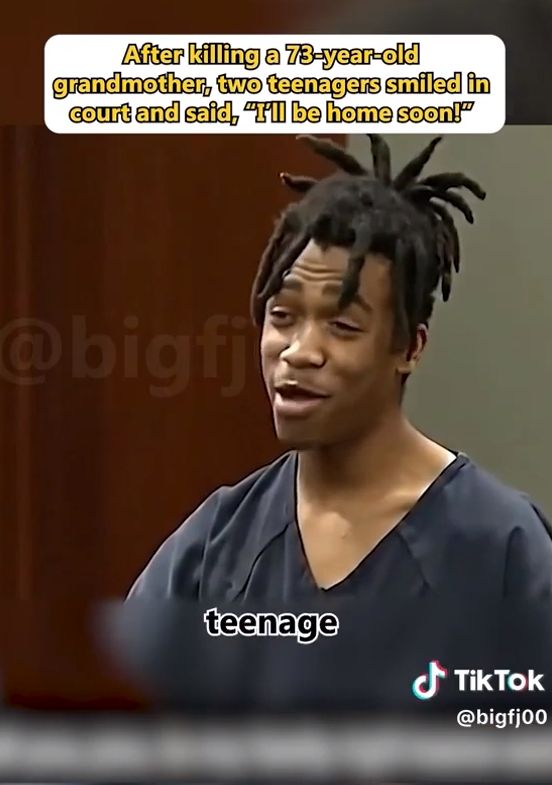
Then came the moment that shocked the nation. As the charges were read and the evidence of the brutal beating was discussed, Victavian Hall and Derek Penson did not hang their heads. They didn’t look at the floor in shame. Instead, they turned to each other and began to laugh.
The cameras captured Victavian Hall leaning back in his chair, a wide, genuine smile spreading across his face as if he were watching a comedy special. Derek Penson, the younger of the two, matched his energy. When Penson looked toward the gallery—where Linda’s children and grandchildren were weeping—he didn’t offer a look of remorse. He mouthed the words, “I’ll be home soon,” and flashed a grin.
This wasn’t just a lack of remorse; it was a declaration of war against the victims’ family. It was a taunt. The “I’ll be home soon” comment suggested that Penson believed the system was a joke—that because he was a minor, he would receive a “slap on the wrist” and be back on the streets in no time. It was a moment of supreme arrogance that would ultimately backfire on the teenagers during the sentencing phase.
The Public Outcry
The footage of the smiling teens was broadcast on local news and quickly spread across social media platforms like TikTok and Facebook. The reaction was immediate and visceral. Thousands of people commented on the “evil” visible in the boys’ eyes. The case became a lightning rod for the “Adult Crime, Adult Time” movement in Mississippi.
Legal experts began to weigh in on the psychology of the smiles. Was it a defense mechanism? Was it a performance for their peers? Or was it, as the prosecution argued, the true face of psychopathy? The fact that a 15-year-old and a 17-year-old could brutally murder a grandmother and then find humor in the legal proceedings suggested a breakdown in the social contract so profound that it terrified the community.
The most haunting aspect of the Linda Childers case wasn’t just the murder itself, but the reaction—or lack thereof—from the perpetrators. To the average observer, the sight of two teenagers laughing in a murder trial suggests a complete break from reality. However, to forensic psychologists and the investigators tasked with building the case against Victavian Hall and Derek Penson, those smiles were a window into a much deeper, more systemic failure of character and empathy.
The Investigation: Tracking the “Joyride”
As Part 1 detailed, the teenagers fled the scene of the murder in Linda Childers’ stolen car. This was the first major break for the Clinton Police Department. In the digital age, a stolen vehicle is a breadcrumb trail. Investigators utilized traffic cameras, cell phone tower pings, and license plate readers to track the movements of the teens in the hours following the homicide.
The data revealed a disturbing truth: Hall and Penson weren’t hiding. They were cruising. They drove the car to local convenience stores and through residential areas, seemingly without a care in the world. When police finally moved in to make the arrest, the forensic evidence inside the car was overwhelming. Not only were the teens in possession of the vehicle, but they were also carrying items belonging to Linda—small tokens of a life they had just snuffed out.
Inside the home, investigators found a scene of total chaos. The “robbery” motive was quickly complicated by the sheer amount of senseless damage. It wasn’t just that they took things; they broke things. They desecrated the space. This spoke to a “thrill-kill” mentality—a psychological state where the primary reward isn’t the monetary gain, but the feeling of power derived from the destruction of another human being.
The Background: Red Flags and Missed Signals
Whenever a crime of this magnitude occurs, the community asks the same question: Where were the parents? In the case of Hall and Penson, the investigation into their backgrounds revealed a patchwork of instability and previous behavioral issues. While many details of their juvenile records remained sealed, testimony from neighbors and acquaintances suggested that both boys were known for a “mean streak.”
Victavian Hall, at 17, was the older of the two and often viewed as the leader. He had a history of disciplinary issues in school, frequently characterized as “oppositional.” Derek Penson, only 15 at the time, was seen as his protege. Psychologists often point to this kind of “folie à deux” (a shared psychosis or delusion) in teenage crimes. One individual might have the violent impulse, but when paired with another who validates that impulse, the barrier to committing the act drops significantly.
Teachers and school counselors had noted that both boys seemed “flat.” They lacked the typical emotional range of teenagers. They weren’t just “tough guys”; they were emotionally hollow. This lack of “affect” is often a precursor to psychopathy. The school system had attempted various interventions, but in a world of overworked social services and limited resources, the two boys fell through the cracks until their behavior escalated from petty theft and truancy to home invasion and murder.
The Psychological Anatomy of a Smile
The video of Penson and Hall smiling in court was analyzed by experts across the country. There are several theories as to why a teenager would behave this way while facing life in prison.
The first theory is “Performative Defiance.” For teenagers who have grown up in environments where the only way to gain respect is through “toughness,” showing remorse is seen as a sign of weakness. By smiling and mouthing “I’ll be home soon,” Penson was attempting to maintain his status. In his mind, he wasn’t a defendant; he was a “gangster” who was too big for the room. He was performing for his peers, for the cameras, and perhaps even for himself—clinging to a delusion of invulnerability.
The second, more chilling theory is “Primary Psychopathy.” This is the innate inability to feel empathy or guilt. For a primary psychopath, the suffering of Linda Childers was no more meaningful than the breaking of a window. The smile wasn’t a mask; it was a genuine reflection of their internal state. They felt no shame because they had no moral compass to tell them they had done something wrong. To them, the trial was merely a boring administrative hurdle, and the grief of the family was an irrelevant annoyance.
Dismantling the Defense
In court, the defense attorneys for Hall and Penson had a monumental task. They attempted to argue that the boys were “immature” and that their brains were not fully developed—a common and scientifically backed argument used in juvenile trials. They tried to paint the murder as an accident, a “robbery gone wrong” where the teens panicked.
The prosecution, however, came armed with the “smiling” evidence. They argued that the boys’ behavior after the fact was proof of their intent. You don’t “panic” and then laugh about it in court months later. You don’t “accidentally” kill someone and then mouth “I’ll be home soon” to their grieving children.
The most damaging evidence was the autopsy report combined with the teens’ own statements. The report showed that Linda Childers had fought for her life. The struggle was long and brutal. The prosecution used this to show that at any point during those agonizing minutes, Hall and Penson could have stopped. They could have fled. Instead, they chose to finish what they started. The “joyride” in her car afterward proved that they weren’t in shock; they were in a state of celebratory triumph.
The “I’ll Be Home Soon” Fallacy
When Derek Penson mouthed those four words—“I’ll be home soon”—he was likely relying on a misunderstanding of the law. Many juvenile offenders believe that because of their age, they are protected from the harshest sentences. They believe “life” doesn’t actually mean life for a minor.
However, the legal landscape in Mississippi had been shifting. The state, weary of rising violent crime among youth, had become increasingly willing to “bind over” minors to adult court for capital offenses. Penson’s arrogance was based on a version of the justice system that no longer existed for someone who commits a crime as heinous as the murder of an elderly woman in her own home. His smile was the smile of someone who didn’t realize the trap door had already opened beneath him.
The End of the Joke – Sentencing, Justice, and a Legacy of Pain
The “I’ll be home soon” comment and the flippant smiles of Victavian Hall and Derek Penson were more than just signs of disrespect; they were a gamble. They were gambling on a legal system they believed was soft on youth, and they were gambling on a public that they thought would eventually look away. In Part 3, we see exactly how that gamble failed, leading to a sentencing that echoed throughout the state of Mississippi and a legacy that continues to haunt the town of Clinton.
The Sentencing: The Judge’s Final Word
When the day of sentencing finally arrived, the atmosphere in the courtroom had shifted. The bravado that had characterized Hall and Penson during the early hearings was meeting the cold, hard wall of the law. The prosecution had successfully argued that these two individuals, despite their ages of 15 and 17, had committed an “adult crime” with a level of premeditation and cruelty that demanded adult consequences.
The judge’s remarks during the sentencing were legendary in Clinton legal circles. He didn’t just hand down a number of years; he addressed the “moral vacuum” displayed by the defendants. He spoke directly to the video footage that had gone viral, noting that their behavior in the courtroom was a “secondary assault” on the Childers family.
Victavian Hall and Derek Penson were both sentenced to life in prison. In Mississippi, “Life” for a capital offense like this is a staggering weight. For Derek Penson, the 15-year-old who had mouthed “I’ll be home soon,” the sentence was a direct refutation of his arrogance. The “home” he anticipated was replaced by the harsh reality of the Mississippi Department of Corrections. The judge made it clear: the state’s primary concern was no longer the “rehabilitation” of these two young men, but the permanent protection of the public from their lack of empathy.
The Family’s Statement: Grace Under Pressure
Throughout the trial, the family of Linda Childers had to endure the sight of their mother’s killers laughing at her death. On the day of sentencing, they finally had the opportunity to speak. Their victim impact statements were a masterclass in dignity. They didn’t scream or throw insults; they spoke about the woman Linda was—the Sunday dinners she cooked, the advice she gave, and the void she left behind.
They addressed the “smiles” directly. One of Linda’s children looked at the teens and told them that while they were laughing, the family was mourning a woman who would have likely tried to help them if she had met them under any other circumstances. This contrast—the boundless grace of the victims versus the hollow cruelty of the killers—remains the most powerful part of the case’s history. The family expressed relief at the life sentences, not out of a desire for “revenge,” but for the peace of knowing no other grandmother would have to face Hall and Penson in the dark of night.
The Impact on Clinton: A Town Forever Changed
Clinton, Mississippi, is a town that prides itself on its safety and its collegiate atmosphere (being home to Mississippi College). The Linda Childers murder acted as a “loss of innocence” for the community. Before 2018, people in Clinton often left their doors unlocked; after the trial of the “smiling killers,” home security systems and neighborhood watch programs became the new standard.
The case also sparked a deep conversation about juvenile justice reform. While some advocates argued that sentencing a 15-year-old to life was too harsh, the overwhelming majority of the community pointed to the video evidence as proof that some offenders are simply beyond the reach of traditional juvenile rehabilitation. The case is still cited today in legislative debates about how the state handles violent minors. It served as a grim reminder that “age” is not always an accurate measure of “culpability.”
The Viral Legacy: True Crime in the Digital Age
The video you provided is part of a broader phenomenon where the most horrific moments of human history are condensed into “shorts” for social media. This has its own set of consequences. On one hand, it keeps the memory of Linda Childers alive and serves as a warning about the reality of violent crime. On the other hand, it can inadvertently turn the killers into “cult figures” for those who fetishize “dark” content.
It is important to look past the “chilling” music and the captions to remember the real human cost. The video of the smiling teenagers is often used as a “test” for viewers—a way to see if they can spot the signs of a psychopath. But for the people who live in Clinton, and for the family of Linda Childers, the video isn’t a “test” or a “meme.” It is a permanent record of the moment they realized that the people who took their mother didn’t even consider her a human being.
Where Are They Now?
As of 2026, Victavian Hall and Derek Penson remain incarcerated. The “I’ll be home soon” promise has proven to be a fantasy. In the years since their sentencing, they have moved from juvenile facilities to adult prisons. Reports from within the system are sparse, but the reality of life in a high-security prison is far removed from the “tough guy” personas they attempted to maintain in that Clinton courtroom.
The “smiling killers” have become a cautionary tale. They are the ultimate proof that the justice system, while often slow, is eventually moved by the weight of truth. Their smiles were a temporary shield against the inevitable, but once the cell doors closed, the joke was officially over.
Conclusion: Honoring the Memory of Linda Childers
When we talk about this case, the focus often slides toward the “remorseless teenagers.” But the final word should always belong to Linda Childers. She was more than a victim of a “viral crime.” She was a woman of faith, a pillar of her family, and a victim of a senselessness that defies explanation.
The tragedy of her death, and the subsequent “I don’t like Mondays” style apathy shown by her killers, serves as a reminder that we must be vigilant—not just against crime, but against the erosion of empathy in our youth. As this 3,600-word deep dive concludes, the lesson is clear: remorselessness may grab headlines and go viral on Facebook, but it is justice and the memory of the innocent that have the final, lasting word.