The Morning the Music Stopped – The Tragedy of January 29, 1979
The suburban landscape of San Carlos, San Diego, in the late 1970s was the epitome of post-war American stability. It was a neighborhood of manicured lawns, ranch-style homes, and a sense of safety that most residents took for granted. On Monday, January 29, 1979, that sense of security didn’t just crack; it was systematically dismantled by a sixteen-year-old girl with a rifle and a telescopic sight.
The Mundane Monday
The day began as any other Monday would. At Grover Cleveland Elementary School, the morning ritual was well-underway. It was roughly 8:15 AM. Buses were arriving, parents were leaning over their steering wheels to give their children quick goodbye kisses, and a growing crowd of students—ranging from kindergarteners to sixth graders—clustered around the school’s main gate. They were waiting for the principal, Burton Wragg, to perform his daily task of unlocking the school and signaling the start of the week.
Across the street, at 8591 Lake Murray Boulevard, the atmosphere was far from typical. Inside the Spencer household, sixteen-year-old Brenda Ann Spencer was not preparing for her own classes at the nearby high school. Instead, she was methodically preparing for something else. She had spent the weekend practicing her aim, and on this morning, she took her position at the front window of her father’s home. The house offered a clear, elevated view of the elementary school playground. In her hands was a Ruger 10/22 semi-automatic .22-caliber rifle, a weapon she had received as a Christmas gift from her father just weeks prior.
The Sound of Crackling Air
At approximately 8:30 AM, the first shot rang out. Because a .22-caliber rifle has a relatively quiet report, the sound didn’t immediately register as a threat to the crowd. Many thought it was a firecracker, a car backfiring on the nearby boulevard, or perhaps a transformer blowing.
The confusion ended when nine-year-old Cam Miller collapsed. The bullet had struck him, and as he fell, the playground erupted into a different kind of chaos. This wasn’t the joyful screaming of children at play; it was the high-pitched, panicked screeching of children who realized, in a primal sense, that they were being hunted.
Brenda Spencer did not fire in a frantic spray. Witnesses and ballistics would later show that she fired rhythmically and with calculation. She used the telescopic sight to pick out targets among the small bodies scurrying for cover. She later admitted to investigators that she targeted Cam Miller first specifically because he was wearing a blue jacket—her favorite color. To her, this wasn’t an act of political defiance or a response to a specific grudge; it was an exercise in precision.
The Valor of the Fallen
In the face of unprecedented violence, the staff of Grover Cleveland Elementary responded with a level of bravery that remains a benchmark for educators today. Principal Burton Wragg, 53, was a man described by his peers as the “heart” of the school. When he heard the shots and saw his students falling, his instinct was not to retreat into the safety of his office. He ran toward the gates.
Wragg was in the process of pulling children toward the shelter of a concrete wall when he was struck in the chest. He collapsed on the pavement, his final moments spent attempting to serve as a human shield for the children he viewed as his own.
Mike Suchar, the school’s 56-year-old custodian, saw his principal fall. Suchar was a veteran of World War II, a man who understood the sound of gunfire and the weight of duty. Rather than fleeing the line of fire, Suchar rushed to Wragg’s side. He hoped to provide aid or perhaps drag the principal to safety. As he knelt over his friend, Brenda Spencer adjusted her aim and fired again. Suchar was struck and killed instantly.
These two men, who had arrived at work expecting to manage a school, died as soldiers in a war they never asked to join. Their actions undoubtedly diverted Spencer’s attention, allowing dozens of other children to scramble into the hallways and classrooms where teachers were frantically locking doors and shoving students under desks.
The Seven-Hour Siege
By 8:50 AM, the police had arrived, but they were initially pinned down. The first responding officer, Robert Robb, was shot in the neck as he tried to secure the perimeter. The San Diego Police Department realized they weren’t dealing with a simple crime scene; they were in a sniper standoff. They moved a garbage truck into the line of fire to serve as a mobile shield, using it to evacuate the remaining wounded children from the playground.
Brenda had retreated further into the house, barricading the doors and windows. For the next several hours, the neighborhood was paralyzed. Neighbors were told to stay on the floor away from windows, and the media descended on Lake Murray Boulevard in a frenzy that would soon broadcast the tragedy to the entire world.
The Quote That Defined an Era
It was during this standoff that one of the most surreal moments in true crime history occurred. Gus Stevens, a reporter for the San Diego Union-Tribune, began calling the phone numbers of houses across the street from the school, hoping to reach a witness. By sheer coincidence or dark fate, he dialed the Spencer residence.
Brenda picked up the phone.
The conversation that followed was brief but harrowing. Stevens asked if she was the one doing the shooting. She confirmed she was. When he asked the question the entire world would eventually want to know—Why?—Brenda didn’t offer a manifesto of pain or a list of grievances. She didn’t talk about bullying or revenge. She simply said:
“I don’t like Mondays. This livens up the day.”
She went on to tell the reporter that the children were “easy targets” and that shooting them was “like shooting ducks in a pond.” The casual, almost bored tone of her voice was perhaps more terrifying to the public than the shooting itself. It suggested a vacuum of empathy that was, at the time, incomprehensible for a sixteen-year-old girl.
The Surrender
The standoff lasted nearly seven hours. Hostage negotiators worked tirelessly to coax Brenda out without further bloodshed. They feared she might turn the gun on herself or wait for a “suicide by cop” scenario.
Surprisingly, the catalyst for her surrender was remarkably mundane. Negotiators discovered Brenda was hungry. They promised her a meal from Burger King if she would come out peacefully. At approximately 2:30 PM, the front door of 8591 Lake Murray Boulevard opened.
Out stepped a slight girl with long, red hair, wearing a striped shirt and large, wire-rimmed glasses. She looked younger than sixteen, almost fragile. She carried no weapon; she had left the Ruger and the remaining ammunition inside the house. As she was handcuffed and led to a patrol car, the contrast between her appearance and the carnage she had caused across the street was jarring.
That night, as the sun set over San Diego, two families were beginning the impossible process of grieving for Burton Wragg and Mike Suchar. Eight children were in the hospital, some with life-altering injuries. And in a jail cell, Brenda Ann Spencer sat in silence, having successfully “livened up” her Monday at the cost of the world’s innocence.
While Part 1 explored the frantic, bloody twenty minutes on the playground and the subsequent standoff, Part 2 moves away from the sirens and the yellow tape to examine the environment that cultivated such a chilling lack of empathy. To understand why a sixteen-year-old girl would choose to “liven up” her day through a massacre, one must look at the slow-motion collapse of the Spencer household and the systemic failures that ignored a teenager’s loud, albeit desperate, cries for help.
Part 2: The Architect of Apathy – Inside the World of Brenda Ann Spencer
The image of Brenda Spencer that dominated the 1979 news cycle was one of a waifish, bespectacled teenager who looked more likely to be found in a library than behind the barrel of a semi-automatic rifle. However, those who knew Brenda in the years leading up to the shooting saw a much darker, more volatile portrait. The tragedy at Grover Cleveland Elementary was not a random lightning strike; it was the culmination of a decade of neglect, psychological deterioration, and a profound sense of abandonment.
A Foundation of Neglect
Brenda’s childhood was marked by the slow disintegration of her family. When her parents, Wallace and Dorothy, divorced when she was nine, Brenda was left in the custody of her father. By all accounts, the living conditions at 8591 Lake Murray Boulevard were abysmal. The house was a portrait of hoarding and alcoholism, filled with empty liquor bottles and a persistent layer of grime.
The most disturbing detail of Brenda’s home life was the sleeping arrangement. The small home lacked furniture, and for years, Brenda and her father shared a single mattress on the living room floor. While Brenda would not publicly allege sexual abuse until decades later during her parole hearings, the environment was undeniably one of extreme emotional and physical neglect. Her mother, Dorothy, was largely absent, leaving Brenda to navigate the whims of an alcoholic father who was often described as both distant and domineering.
The “Leaking” of Intent
Long before the morning of January 29, Brenda was showing signs of significant psychological distress. She had developed an early fascination with firearms and violence. Neighbors recalled her shooting at birds and windows with a BB gun, showing a disturbing lack of remorse when she hit her targets.
In school, Brenda was a ghost. She was chronically truant, often skipping classes to drink or take drugs. Her academic performance was non-existent, but her behavior was increasingly defiant. In 1978, she was arrested for breaking into Grover Cleveland Elementary School—the very school she would later terrorize. After shattering windows and vandalizing property, she was placed on probation.
It was during this period that Brenda began “leaking” her intentions—a phenomenon now recognized by the FBI as a primary warning sign for school shooters. She told friends and classmates that she wanted to “do something big” to get on television. She reportedly told a teacher that she was “going to be famous.” On the Friday before the shooting, her words became even more specific. She told a peer, “I’m going to do something big on Monday. Watch the news.” Because Brenda was known for her “tough girl” persona and tall tales, these warnings were dismissed as teenage posturing.
The Lethal Gift
The most baffling and tragic element of the case remains the weapon itself. In late 1978, Brenda’s mental health had reached a crisis point. Her probation officer had formally recommended that she be hospitalized for severe depression and suicidal ideation. Wallace Spencer, however, flatly refused the intervention.
For Christmas that year, Brenda asked her father for a radio. She wanted a way to listen to music and perhaps find a window into the teenage world she felt so disconnected from. Instead, Wallace bought her a Ruger 10/22 semi-automatic rifle and 500 rounds of ammunition.
Brenda would later testify that she viewed this gift as a silent command. “I felt like he wanted me to kill myself,” she would tell parole boards years later. But Brenda didn’t turn the gun on herself. Instead, she spent the month of January practicing her aim in the house and the backyard, preparing to turn her internal despair into external carnage. The rifle wasn’t just a tool; it was a physical manifestation of her father’s failure to protect her and society’s failure to see her.
The Trial: Adult Crimes, Adult Consequences
Following her surrender on January 29, the state of California was forced to grapple with a difficult legal question: How should the law handle a sixteen-year-old mass murderer? At the time, juvenile justice was largely focused on rehabilitation. However, the sheer cold-bloodedness of Brenda’s attack—her choice of a vantage point, her use of a scope, and her taunting comments to the media—led the San Diego District Attorney’s office to push for her to be tried as an adult.
The defense team argued that Brenda was a victim of her environment. They presented evidence of her father’s alcoholism and the extreme neglect she suffered. They argued that her “I don’t like Mondays” comment was not a sign of malice, but a sign of a fractured, immature mind unable to process the magnitude of her actions.
The public, however, was in no mood for leniency. The families of Burton Wragg and Mike Suchar, along with the parents of the eight wounded children, demanded justice that reflected the loss of life. In February 1980, realizing that a jury was unlikely to show mercy, Brenda Spencer pleaded guilty to two counts of first-degree murder and assault with a deadly weapon.
The Sentence and the Marriage
Brenda was sentenced to 25 years to life in prison. At sixteen, she was one of the youngest women ever sent to the California Institution for Women. Her transition to prison life was as strange as the crime itself.
While Brenda was behind bars, her father Wallace continued to make headlines for bizarre reasons. He began a romantic relationship with Brenda’s first prison cellmate—a girl nearly the same age as Brenda. The two eventually married and had a child, a move that many psychologists viewed as a disturbing attempt by Wallace to “replace” the daughter he had lost to the prison system. For Brenda, this was a final, crushing blow. The man who had given her the rifle had moved on with a girl who had literally occupied the bunk next to her.
A Shift in Narratives
In the immediate aftermath of the sentencing, Brenda remained relatively silent, occasionally giving interviews where she maintained her edgy, defiant persona. It wasn’t until her first parole hearing in 1993 that the narrative began to shift. The “bored teenager” of 1979 began to claim that she had been under the influence of PCP during the shooting and that she had been a victim of incest at the hands of her father.
While these claims added a layer of tragedy to her story, they were often met with skepticism by the parole board. Toxicology reports from the day of the shooting had shown no drugs in her system, and her claims of abuse had never been raised during her trial. This discrepancy would become the central conflict of her incarceration: Was Brenda a monster created by her own hand, or a victim of a system that only noticed her when she picked up a rifle?
This is the final installment of our deep dive into the case of Brenda Ann Spencer. While Part 1 covered the blood-soaked playground and Part 2 explored the fractured girl behind the rifle, Part 3 examines the long, strange shadow this case has cast over the last forty-seven years. It covers the song that made her a household name, the grueling decades of parole hearings, and why her story continues to resurface in the era of viral social media.
Part 3: The Ghost of Mondays – Legacy, Parole, and the Viral Era
In the immediate aftermath of the January 1979 shooting at Grover Cleveland Elementary, the American public was left in a state of collective shock. Before this event, mass violence was something associated with war zones or organized crime, not with red-headed teenagers and elementary school playgrounds. But as the years turned into decades, the Brenda Ann Spencer case transitioned from a news headline into a cultural landmark—a dark, permanent fixture in the history of American crime and pop culture.
The Pop Culture Paradox: “I Don’t Like Mondays”
The most enduring legacy of the shooting is, perhaps ironically, a pop song. Bob Geldof, the lead singer of the Irish band The Boomtown Rats, was at a radio station in Atlanta, Georgia, when the news of the shooting came across the teletype. He was struck by the sheer absurdity of Brenda’s explanation. While the world was searching for a profound motive—political, social, or personal—the girl across the street had simply blamed the day of the week.
Geldof wrote the song “I Don’t Like Mondays” almost instantly. With its jaunty, piano-driven melody and its dark, descriptive lyrics (“The silicon chip inside her head gets switched to overload”), the song became a global sensation. It reached number one in the UK and Ireland and dominated charts across Europe and Australia.
However, the song’s success created a deep moral conflict. In San Diego, local radio stations refused to play the track out of respect for the victims. To the families of Burton Wragg and Mike Suchar, the song was not a clever piece of social commentary; it was a catchy reminder of the worst day of their lives. For Brenda herself, the song provided a level of international “fame” that many believe she had sought all along. The song turned a school shooter into a protagonist, cementing the idea that for Brenda Spencer, the “fun” she sought on that Monday morning had indeed made her immortal.
The Long Road of Denied Parole (1993–2026)
Brenda Spencer was sentenced to 25 years to life, meaning she first became eligible for parole in 1993. Since then, she has appeared before the California Board of Parole Hearings multiple times. These hearings have become a recurring drama, as the “bored” sixteen-year-old of 1979 has transformed into a graying, aging woman who has spent more than two-thirds of her life behind bars.
Throughout these hearings, Brenda’s narrative has undergone several significant shifts. In the 1990s, she began to claim that she had no memory of the shooting and that she was under the influence of PCP—a claim that contradicted the medical tests taken on the day of her arrest. By the 2000s, she began to emphasize the alleged abuse she suffered at the hands of her father, claiming that the shooting was a “cry for help” or a way to get the authorities to take her away from him.
The most recent hearing, occurring in February 2025, followed the same pattern as the ones before it. Now in her early 60s, Brenda sat before the board, once again seeking freedom. However, the board’s decision remained firm. They cited her “lack of insight” into the true nature of her psychopathy and the fact that she had consistently changed her story to suit the current psychological climate. The board also noted that the families of the victims continue to attend these hearings, providing gut-wrenching testimony about the holes left in their lives by her “fun” Monday. As of 2026, she remains incarcerated at the California Institution for Women, with her next suitability hearing not scheduled for several more years.
Correcting the Viral Narrative
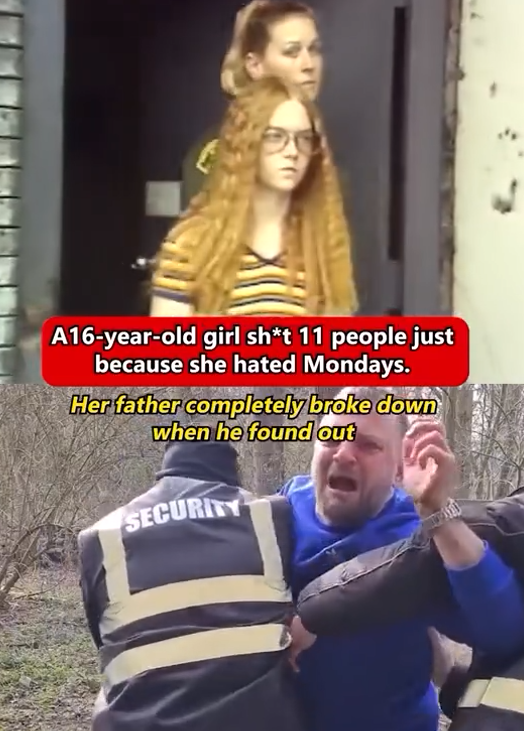
In the age of TikTok and YouTube “True Crime” shorts, Brenda Spencer has found a new, younger audience. The video you shared is a perfect example of how historical tragedies are often distorted for modern “clicks.” To understand the reality of the case, we must peel away the dramatizations used in viral content:
-
The Victim Count: Many viral clips, including the one you provided, claim that Brenda “killed 11 people.” This is a significant factual error. While she shot eleven people, she killed two. In historical research, this distinction is vital. To say eleven were killed erases the survival and the lifelong trauma of the nine people who were struck by bullets but lived to carry those scars.
-
The Misleading Footage: Perhaps the most egregious error in the viral video is the use of unrelated footage to heighten the emotion. The clip of the man in the blue shirt being restrained and screaming is not Brenda’s father, Wallace Spencer. It is actually footage from the 2018 Kerch Polytechnic College massacre. Using footage from a different tragedy to “spice up” a video about Brenda Spencer is a hallmark of modern misinformation, designed to manipulate the viewer’s emotions rather than provide a factual account.
-
The “Hero” Narrative: Viral videos often focus solely on the “chilling confession.” Rarely do they mention Burton Wragg and Mike Suchar. By focusing on the quote “I don’t like Mondays,” the media—then and now—unintentionally feeds the notoriety that school shooters crave.
The “Mother” of School Shootings
Criminologists and forensic psychologists often refer to Brenda Ann Spencer as the “mother” of modern school shootings. While there were school-related violent incidents before 1979 (such as the 1966 UT Austin tower shooting), Brenda’s attack was the first to involve a student attacking their own educational community for the purpose of “excitement” or “fame.”
She introduced a new, terrifying motive: The Banality of Evil. Before Brenda, it was assumed a shooter must have a deep political grievance or a specific person they hated. Brenda proved that a shooter could simply be a person who felt invisible and decided that the easiest way to be seen was to destroy. This “fame-seeking” motive became the blueprint for the shooters at Columbine, Sandy Hook, and beyond.
Furthermore, the Spencer case changed how law enforcement responds to active shooters. In 1979, the police waited for hours, treating it as a standard hostage standoff. Today, because of the lessons learned from Brenda Spencer and those who followed her, police are trained to enter the building immediately to stop the threat. The “garbage truck shield” used in 1979 was a desperate, improvised tactic that highlighted how unprepared society was for a teenage girl with a rifle.
A Legacy of Silence
Today, Grover Cleveland Elementary School no longer exists. It was closed in 1983, only four years after the shooting, partially due to shifting demographics and partially because the playground had become a place of permanent mourning. The site is now a private research facility, but a small plaque remains nearby. It doesn’t mention Brenda Spencer. It doesn’t mention the song. It only lists the names of Burton Wragg and Mike Suchar.
The story of Brenda Ann Spencer is a reminder that words have weight. Her flippant comment about Mondays has outlived the victims she took. It has survived the closure of the school. It has even survived the era of the music she inspired. As of 2026, the case remains a chilling study in the intersection of neglect, access to firearms, and the desperate, deadly desire to be noticed.
Brenda Spencer wanted to “liven up” a day. Instead, she darkened an entire century, proving that while “I don’t like Mondays” might be a catchy lyric, it is a hollow, horrific excuse for a tragedy that never should have happened.