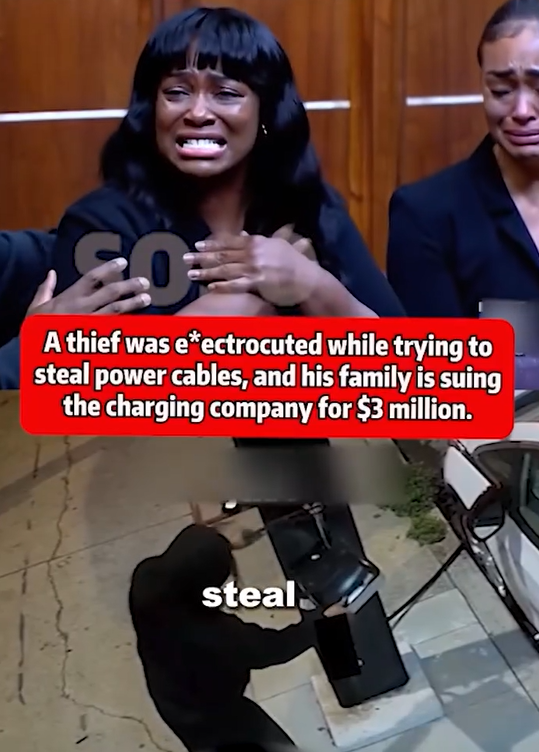
In a heart-wrenching case that has captivated public attention, a family is suing a charging company for $3 million after their loved one was electrocuted while attempting to steal power cables. The thief, whose identity has been obscured by the media, tragically lost his life in an attempt to tamper with electric cables that were intended for powering an electric vehicle charging station. The incident has left the family grieving and shocked, as they now seek legal justice for their loss.
The courtroom, where the family presented their case, became a space of raw emotion, with relatives expressing not just sorrow but also outrage. The family members have launched a legal battle, demanding compensation for the emotional distress, loss, and pain they have endured since the incident.
How the Attempted Theft Turned Fatal
The tragedy unfolded one night at an electric vehicle charging station located in a quiet urban neighborhood. Surveillance footage showed the thief, dressed in dark clothing, attempting to steal power cables. These cables, which were connected to charging equipment, were meant to power electric cars and were placed in a vulnerable position near the street. The thief, in what appeared to be a hasty and poorly thought-out move, tried to cut and remove the cables to sell them for scrap.
However, things took a fatal turn when he came into contact with live wires during the act of cutting. The electrical shock caused him to fall, and the situation quickly escalated. Witnesses, though few, reported seeing sparks fly and hearing a loud crackle. The charging station, which was not well-lit at that hour, made it difficult for anyone to immediately spot the danger the thief had put himself in.
Emergency responders were called to the scene, but by the time they arrived, the thief had already passed away from the electrocution. Investigators quickly ruled out foul play, concluding that the death was accidental. However, the circumstances of the death have raised many questions regarding both the thief’s actions and the company’s safety measures.
A Courtroom Filled with Tears
As the legal proceedings began, the courtroom was filled with emotion. The family members of the deceased thief were present, visibly overwhelmed by the events that led to the loss of their loved one. Some family members were seen holding each other for support, while others wiped away tears, trying to manage their emotions as they prepared to present their case. The grief was evident as they spoke about their loved one’s life and the circumstances surrounding the tragic accident.
One family member spoke to the court, her voice trembling with sadness, “He was just a boy, with so much potential. He made a mistake, but we never imagined it would end this way. He was our son, our brother, and he was loved.”
The pain was palpable as they recounted memories of the deceased, describing him as someone who had dreams and aspirations, though those dreams were tragically cut short. It was a reminder that, despite his actions, he was a human being, and his family felt the loss deeply.
Seeking Justice and Compensation
In the wake of the incident, the family decided to take legal action, filing a lawsuit against the charging company for $3 million. The family claims that the company’s negligence in securing the charging station and preventing unauthorized access to the power cables directly led to their loved one’s death.
According to the lawsuit, the charging station was poorly maintained, and safety measures that could have prevented the theft—and ultimately the fatal electrocution—were inadequate. The family argues that if the cables had been better secured or if proper safeguards had been in place, their loved one would not have been able to access them so easily.
The family’s legal team has pointed to the fact that electric vehicle charging stations, which are increasingly common in urban areas, often operate in open public spaces with minimal security. They have argued that businesses running these stations must take responsibility for ensuring that their infrastructure is safe and properly guarded against potential threats, including theft and injury.
Who is Responsible?
As the lawsuit moves forward, legal experts are debating whether the charging company can be held liable for the death. The defense argues that the thief was engaging in criminal activity, and as such, the company should not be held accountable for his actions. They point out that, like any theft, the individual was responsible for the risks he took.
On the other hand, the plaintiff’s legal team is focusing on the broader issue of safety. They argue that businesses operating in public spaces have a duty to protect not only their property but also the safety of those who interact with it. They believe that the company should have done more to prevent unauthorized access to the electrical cables and ensure that adequate warning signs or security measures were in place.
The Family’s Claim: Emotional Distress and Financial Impact
In their lawsuit, the family has outlined the significant emotional distress they have endured since the death of their loved one. They claim that the unexpected and violent nature of the death has had a profound impact on their mental health, leading to feelings of grief, anger, and helplessness. The family’s legal representatives have emphasized the emotional toll of the incident, arguing that no amount of money can ever replace the life of their loved one but that compensation is necessary to help them move forward.
Additionally, the family has mentioned the financial strain the loss has caused. The deceased was reportedly the primary breadwinner for the household, and the family has struggled to make ends meet since his death. They have argued that the $3 million lawsuit is not only for emotional distress but also for the financial hardship that has followed the tragic incident.
Public Reaction: Mixed Responses to the Lawsuit
The lawsuit has sparked a wide range of reactions from the public. Some people have expressed sympathy for the family, understanding the grief and emotional pain they are experiencing. These individuals argue that while the deceased may have made a poor choice, the company could have taken more steps to ensure the safety of its infrastructure and prevent such an incident.
However, other members of the public have criticized the family’s lawsuit, suggesting that they are attempting to profit from the tragedy of their loved one’s death. Critics argue that the thief was engaged in illegal activity, and therefore the company should not be held responsible for his actions. They contend that the company should not be expected to foresee and prevent every potential risk, especially when it comes to criminal behavior.
In addition to public debates, some legal experts have weighed in on the case. Some have supported the family’s argument, suggesting that charging companies must prioritize safety and be held accountable for lapses in security. Others have questioned the validity of the claim, pointing to legal precedents that may limit the liability of businesses in such situations.
Legal Precedents: What Does the Law Say About Liability?
Legal experts point to several cases involving corporate responsibility and theft-related incidents. In some instances, businesses have been held liable for injuries or deaths that occurred due to their failure to secure dangerous equipment or hazardous areas. However, the specifics of each case vary, and courts often need to determine whether the company’s actions were negligent or whether the individual involved was solely responsible for the incident.
In cases of electrocution, liability can be complicated. In some cases, courts have sided with the victim’s family, holding companies accountable for unsafe equipment. In other cases, courts have ruled that the victim’s actions were the primary cause of the accident, absolving the company of responsibility.
Corporate Responsibility: What Should Charging Stations Do?
As electric vehicles continue to become more common, the issue of charging station safety has become an increasingly important topic. Many businesses that operate these stations are now reevaluating their safety protocols to ensure they are preventing potential risks like theft, tampering, or accidents.
Experts agree that charging stations should implement stronger security measures, such as better fencing, surveillance cameras, and warning signs. Additionally, they argue that charging companies should regularly inspect their stations for potential hazards, such as exposed wires or faulty equipment, which could pose a risk to public safety.
Some experts believe that charging companies should take steps to educate the public on the risks associated with tampering with electrical equipment. They argue that preventative measures, such as increased public awareness campaigns or visible safety warnings, could reduce the likelihood of future accidents.
The Role of Insurance: Could the Company Be Covered?
As the case continues to unfold, questions about insurance coverage and whether the charging company’s insurance policy will cover the family’s lawsuit have emerged. Many businesses carry liability insurance to protect themselves in case of accidents or lawsuits. However, some policies may limit coverage in cases of theft or criminal activity.
If the family is successful in their lawsuit, it remains to be seen whether the charging company’s insurance will cover the payout, or if the company itself will have to bear the full financial burden. Legal experts have pointed out that even if the company is found not to be at fault, they could still be required to settle the case in order to avoid prolonged litigation or negative publicity.
A Complex Case with Lasting Implications
As the family’s lawsuit continues to progress through the legal system, it highlights the complex issues surrounding corporate responsibility, safety measures, and personal accountability. It also raises important questions about the security of public infrastructure and the risks associated with criminal activity.
While the family seeks justice for their loss, the case will likely have broader implications for the future of electric vehicle charging stations and how they are regulated. It remains to be seen whether the charging company will be held liable for the incident, but one thing is clear—the case has sparked important conversations about safety, accountability, and the consequences of theft.
The Importance of Safety Protocols at Public Charging Stations
The incident has brought into focus the vital importance of safety measures at public charging stations. As electric vehicles (EVs) become more popular and charging stations proliferate across cities, it’s crucial that businesses operating these stations prioritize not only customer experience but also public safety. Unlike traditional gas stations, where dangers are more apparent due to fuel volatility, charging stations come with their own set of risks, many of which might not be as obvious to the average person.
These risks are especially pronounced when stations are located in poorly lit or less secure areas, which could tempt individuals to engage in illegal activities such as theft. According to experts, many public charging stations are vulnerable to unauthorized access, and tampering with electrical components is one of the most dangerous activities that could occur.
While the risk of theft might seem like a manageable problem to some, the reality is that electric cables and charging stations are often highly energized, and tampering with them without proper knowledge or tools can lead to tragic accidents like the one that occurred. These stations also contain high-voltage wires, transformers, and other equipment that can result in fatal electrocution when mishandled.
The argument presented by the family’s legal team hinges on the belief that the charging station was not adequately secured, and that the company had failed in its responsibility to ensure a safe public space. While this case is tragic, it is a wake-up call for businesses involved in the installation and operation of electric vehicle charging infrastructure. In addition to cameras and locks, safety protocols such as electrical cut-offs or “kill switches” that deactivate power when unauthorized tampering is detected should become the norm.
The Growing Expectations
As the legal case against the charging company unfolds, the broader question of corporate accountability is also at play. In a world where public safety is increasingly regulated by governments and institutions, corporations are expected to implement safety measures that not only protect their assets but also safeguard the general public.
Corporations, especially those involved in the energy sector, have a duty of care to prevent harm, not just to their customers but to any individual who might come into contact with their products or services. This duty of care, often referred to as corporate social responsibility (CSR), is an evolving concept that holds companies accountable for the impact they have on their surroundings.
The family’s lawsuit seeks to hold the charging company to account for its failure to protect an individual who was clearly engaged in criminal activity. However, their case also touches on a larger issue: when it comes to matters of public safety, should corporations be financially liable for acts of theft or vandalism on their property?
Public opinion on the matter is divided. Some argue that the company should not be held responsible for actions taken by individuals who were intentionally trying to steal from them, while others feel that businesses should be more proactive in preventing such incidents, especially when lives are at stake. In this context, this lawsuit may serve as a precedent for future cases that involve accidents occurring during the commission of crimes.
Rising Legal Challenges for Corporations in Public Safety Cases
This lawsuit may not be an isolated case. In recent years, there has been an increase in legal challenges faced by companies accused of failing to protect public safety on their property. Many high-profile cases have involved businesses that were held liable for not ensuring adequate safety measures were in place, resulting in accidents, injuries, or even deaths.
One such example is the growing number of lawsuits filed against companies involved in the production and distribution of electric equipment. In many cases, these companies have been held accountable for injuries sustained by consumers who mishandled poorly designed or poorly maintained equipment. Similarly, businesses that operate in public spaces, such as amusement parks or shopping malls, have often been required to answer for accidents that occurred due to negligence or lack of proper safety measures.
The success of the family’s lawsuit could potentially open the door for more such legal actions. As electric vehicles become more mainstream and charging stations become increasingly ubiquitous, legal teams and advocacy groups might begin to push for stricter safety standards across the industry. In the long term, this could result in tighter regulations for charging infrastructure, with businesses held accountable for any breaches in public safety.
Exploring the Broader Issue: The Vulnerability of Public Spaces
While this case is focused on a specific tragedy, it raises important questions about the vulnerability of public spaces. With more people relying on electric vehicles, and with charging stations appearing in public areas such as parking lots, streets, and near apartment buildings, the risk of similar incidents occurring at these locations is significant.
Many of these charging stations are installed in areas that are not fully secured or monitored 24/7. Some stations, particularly those in urban environments, lack proper fencing or protective barriers. Others are equipped with basic security cameras, but these may not be enough to deter theft or vandalism. While most electric vehicle owners use the stations responsibly, this case highlights how easily a charging station could become a target for theft, and the potential risks for anyone in the vicinity.
This is not just an issue for the charging company involved in the lawsuit but for the industry as a whole. Governments, municipalities, and private businesses must consider the safety of individuals who may unknowingly be exposed to dangerous situations at public charging stations. Increased regulation, perhaps in the form of mandatory safety audits or safety certification for charging stations, could be one way to mitigate these risks.
The Impact on the Electric Vehicle Industry
This case could have far-reaching effects on the electric vehicle (EV) industry. As governments push for greener energy solutions and as EVs become more popular, charging stations are expected to become a ubiquitous part of the urban landscape.
However, with the increase in the number of stations, concerns regarding their safety are likely to grow. Public charging infrastructure needs to be equipped not only with high-end technology but also with the necessary safeguards to protect against theft and tampering. The ability to install secure, tamper-resistant stations will play a crucial role in the future of the industry. If this case results in new safety standards, it will raise the bar for all players in the industry, pushing them to adopt more robust safety protocols.
Additionally, as the legal landscape surrounding charging station safety continues to develop, it’s possible that future lawsuits could shape the way electric vehicle infrastructure is built and operated. Charging companies may have to take on new responsibilities, such as monitoring for criminal activity or incorporating more advanced safety measures into their stations.
The potential long-term effects of this case could change how charging stations are perceived by the public and by businesses. While many individuals rely on these stations every day, the tragic incident underscores how vulnerable certain parts of our public infrastructure can be when not properly protected.
The Role of Public Awareness Campaigns in Preventing Similar Incidents
One aspect that has not been fully explored in this case is the role of public education and awareness campaigns. The family’s lawsuit may raise awareness about the dangers of tampering with electrical equipment, especially for people who may not fully understand the risks involved.
Educational campaigns could help prevent similar incidents in the future by informing the public about the hazards of unauthorized tampering with electric vehicle charging stations. Warning signs or even public service announcements could alert individuals to the serious consequences of interacting with high-voltage equipment, especially in situations where there is a criminal intent involved.
Additionally, these campaigns could emphasize the importance of reporting suspicious activity around charging stations and encourage greater vigilance in ensuring public safety. In some cities, local law enforcement could collaborate with charging companies to create safety initiatives that provide clear guidelines for handling criminal activity around electric vehicle infrastructure.