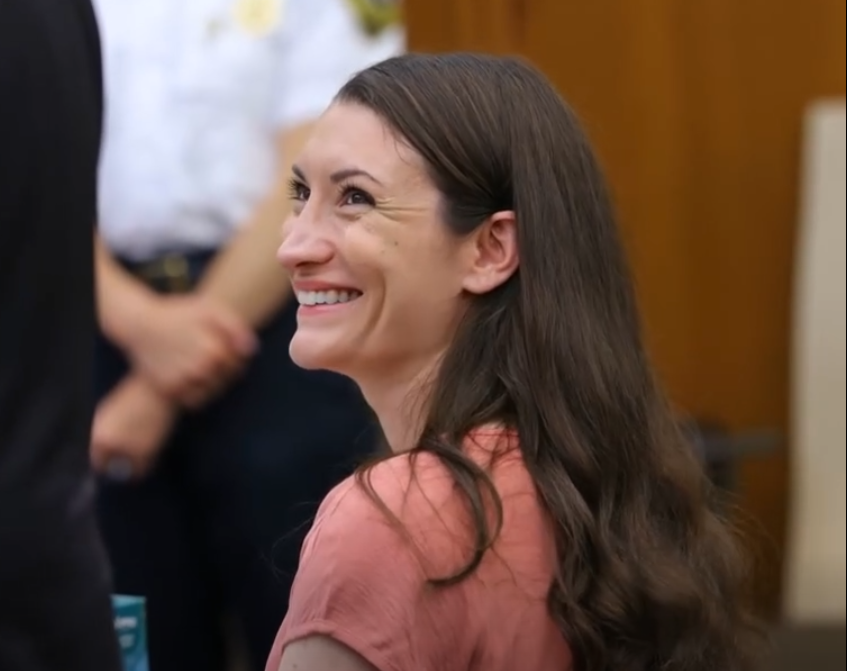
The closely watched murder trial of Lindsay Clancy has entered a dramatic new phase as jurors hear deeply emotional testimony about her mental condition in the months and weeks before the deaths of her three young children. After weeks in which prosecutors sought to portray the killings as deliberate and carefully carried out, the defense has begun presenting witnesses who describe a very different picture: a mother whose family says she was experiencing an increasingly severe mental health crisis, repeatedly expressing fear, suicidal thoughts, anxiety, and disturbing thoughts about harming her children before the tragedy that devastated the Clancy family.
Clancy is charged with three counts of first-degree murder in connection with the January 24, 2023 deaths of her children, 5-year-old Cora, 3-year-old Dawson, and 8-month-old Callan, at the family’s home in Duxbury, Massachusetts. Her defense does not dispute that Clancy killed the children. Instead, the central question confronting jurors is whether she was criminally responsible for her actions or whether severe mental illness prevented her from understanding the nature or wrongfulness of what she was doing.
That distinction has transformed the trial into a complicated examination of mental health, criminal responsibility, medical treatment, digital evidence, and the events leading up to one of Massachusetts’ most heartbreaking criminal cases in recent years.
Prosecutors rested their case after 14 days of testimony, allowing the defense to begin calling witnesses. Among the first people to take the witness stand for Clancy’s defense were two people who knew her particularly well: her mother, Paula Musgrove, and her sister, Allison Ozga. Their testimony offered jurors an intimate account of what they said was a dramatic deterioration in Clancy’s mental condition during the final months of 2022.
Musgrove described her daughter as a loving and devoted mother before her mental health began to change. According to testimony reported from the courtroom, Clancy became increasingly anxious and fearful during the months preceding the children’s deaths. Her family described behavior that they believed was significantly different from the person they had known previously.
One of the most consequential moments came when Musgrove testified that her daughter had disclosed thoughts about harming her children before their deaths.
That revelation is particularly significant because the trial revolves largely around Clancy’s state of mind. The prosecution and defense agree about the central physical fact of the case—that Clancy caused the deaths of her children—but disagree fundamentally over what was happening psychologically when she did so.
The defense argues that Clancy was suffering from severe postpartum mental illness and was not criminally responsible. Prosecutors, however, contend that the evidence demonstrates planning, awareness, and deliberate actions rather than legal insanity.
Those competing interpretations have forced jurors to examine months of Clancy’s behavior, medical treatment, internet searches, communications with family members, and actions on the day of the killings.
According to her mother’s testimony, Clancy’s struggles became increasingly noticeable in the fall of 2022. She reportedly experienced significant anxiety and became fearful of being alone. Family members described providing increasing amounts of support as her condition worsened.
Her sister similarly testified about changes she observed.
Ozga, a social worker, told jurors that by late 2022 her sister’s condition appeared to have deteriorated considerably. She described a period during which Clancy was reportedly experiencing suicidal thoughts on a frequent basis.
The testimony is important to the defense because attorneys are attempting to establish that the events of January 24 did not emerge from an otherwise normal psychological state. Instead, they are presenting a timeline of escalating mental distress that they argue eventually culminated in catastrophe.
The prosecution has approached that timeline differently.
Prosecutors have introduced evidence they say demonstrates that Clancy remained capable of organized thinking and intentional behavior. They have focused on her actions immediately before the children’s deaths, including the fact that her husband Patrick Clancy left the family home to pick up food and medication.
The prosecution’s theory is that Lindsay intentionally created an opportunity to be alone with the children.
The defense disputes the broader interpretation prosecutors attach to those actions and argues that apparently organized behavior does not necessarily establish that Clancy was legally sane.
This disagreement is crucial because severe psychiatric illness does not always present itself through obvious confusion or complete inability to perform ordinary tasks. Someone can potentially carry out routine activities while experiencing profound psychiatric symptoms. The jury therefore must evaluate not simply whether Clancy could perform ordinary tasks, but whether the evidence satisfies Massachusetts’ legal standard concerning criminal responsibility.
Digital evidence has become another major part of the trial.
Jurors have heard about searches conducted on Clancy’s devices before the killings. Investigators testified about searches involving depression, hallucinations, psychosis, medication side effects, suicide and other mental-health subjects.
Some searches occurred remarkably close to the day her children died.
Four days before the killings, evidence presented in court showed that Clancy searched online about whether a sociopath could be treated. Other searches concerned hallucinations and psychiatric symptoms.
These searches can be interpreted in sharply different ways.
For prosecutors, portions of Clancy’s digital history can potentially provide insight into what she knew, what she was thinking about, and whether she understood her condition.
For the defense, those same searches can support the argument that Clancy recognized that something was seriously wrong and was desperately trying to understand what was happening inside her mind.
The internet history therefore does not necessarily provide a simple answer. Instead, like much of the evidence in the case, its meaning depends heavily on context.
Jurors have also heard evidence involving Clancy’s Apple Watch and phone activity. Digital forensic analysis provided investigators with information about her movement, device use, communications and searches surrounding the period before the deaths.
Modern criminal trials increasingly rely on this kind of evidence because smartphones and wearable devices can create extraordinarily detailed digital timelines. Messages, searches, location information, activity measurements and timestamps can allow investigators to reconstruct portions of a person’s day even years after an event.
But digital evidence still requires interpretation.
A timestamp can establish when something occurred on a device, but it cannot automatically explain why someone performed an action or what that person was experiencing psychologically.
That difference has become particularly important in the Clancy trial.
The case is not primarily a mystery about who caused the children’s deaths. The defense acknowledges Clancy’s responsibility for the physical acts. The dispute concerns her mental state and criminal responsibility.
Her medical history consequently occupies an enormous part of the case.
Before the killings, Clancy had sought psychiatric treatment and received multiple medications while struggling with her mental health. The defense has argued that her treatment failed to adequately address what was happening and that medication complicated her psychiatric condition.
Prosecutors have challenged aspects of that narrative.
Medical professionals who interacted with Clancy before the killings did not uniformly identify psychosis. That fact has become important for the prosecution because the defense’s case relies heavily on the argument that postpartum psychosis or another severe mental condition affected Clancy’s ability to understand reality.
The defense, however, argues that the absence of a documented psychosis diagnosis before the deaths does not prove that psychosis was absent.
Mental illness can be extraordinarily difficult to diagnose, particularly when symptoms fluctuate or when patients do not fully communicate what they are experiencing. The defense is expected to continue presenting evidence intended to explain how Clancy’s symptoms developed and how psychiatric illness may have affected her thinking.
Her family’s testimony gives that argument a deeply personal dimension.
Rather than discussing Clancy exclusively through medical records, diagnostic terminology or electronic evidence, her mother and sister described the person they watched change.
They recalled anxiety.
They recalled fear.
They recalled suicidal thinking.
They recalled a growing need for support.
And most significantly, jurors heard testimony that before the killings Clancy had expressed thoughts about harming her children.
That disclosure creates one of the trial’s most complicated questions.
Prosecutors may argue that awareness of violent thoughts demonstrates that Clancy recognized a danger and potentially understood what those thoughts meant.
The defense can argue the opposite—that the disclosure demonstrates she was frightened by thoughts she did not want and was attempting to seek help before her condition deteriorated further.
The difference between an unwanted intrusive thought and an intention to act is medically and legally significant.
People experiencing severe anxiety, obsessive thoughts, depression or other psychiatric conditions can experience disturbing thoughts without wanting to act on them. In other situations, thoughts can signal a genuine risk of harm. Determining which situation existed requires careful evaluation of the complete clinical context.
That is why testimony concerning Clancy’s statements cannot responsibly be interpreted in isolation.
Her sister’s testimony added another troubling element to the timeline.
According to courtroom reporting, Ozga described Clancy as experiencing persistent suicidal thoughts during the period before the deaths. As a social worker, Ozga was questioned about what she observed and what actions she took.
Cross-examination of family witnesses is likely to remain significant because prosecutors have an opportunity to challenge their recollections and interpretations.
Family members can provide uniquely detailed observations, but prosecutors can also question whether their understanding changed after the tragedy or whether certain behaviors appeared more significant in retrospect.
That tension exists throughout criminal trials involving mental health.
After a catastrophic event, previous conversations and behaviors can take on entirely different meanings. Statements that seemed concerning but manageable at the time can appear ominous afterward. Jurors must determine what those statements actually demonstrate without allowing hindsight alone to determine their interpretation.
Patrick Clancy’s testimony has been another emotionally difficult part of the proceedings.
He described the events surrounding January 24 and the horrifying discovery after returning home.
Jurors also heard his 911 call, capturing the immediate aftermath of finding his children unresponsive.
The recording brought an intensely personal reality into a courtroom otherwise filled with medical records, forensic evidence and legal arguments.
Behind every dispute about psychiatric diagnoses and criminal responsibility are three children whose lives ended.
Cora was five.
Dawson was three.
Callan was eight months old.
Their deaths remain the central tragedy regardless of the verdict ultimately reached.
According to the prosecution, Clancy deliberately strangled the children while Patrick was away from the home. Prosecutors contend that she took steps that provided her with an opportunity to be alone with them and then attempted to take her own life.
After the killings, Clancy went out of a second-story window at the home.
She survived but sustained devastating injuries that left her paralyzed. She now appears in court using a wheelchair.
The sequence of events after the children’s deaths is another area where prosecution and defense interpretations diverge.
The defense points to Clancy’s suicide attempt as evidence of catastrophic psychological collapse.
Prosecutors have questioned aspects of the circumstances surrounding her fall and whether they demonstrate what the defense claims.
Jurors must therefore evaluate not one piece of evidence but a large and sometimes contradictory collection of facts.
The prosecution spent weeks building its case.
More than 70 witnesses reportedly appeared during the state’s presentation. They included medical professionals, investigators, first responders, family acquaintances and forensic specialists.
The state’s case sought to demonstrate that although Clancy was undeniably struggling with mental-health problems, psychiatric illness alone does not automatically eliminate criminal responsibility.
That principle is fundamental.
A person can have a diagnosed mental illness and still be legally responsible for a crime. The legal question is narrower and more demanding than simply determining whether someone was mentally ill.
The defense therefore faces the task of demonstrating that Clancy’s psychiatric condition reached the threshold required under Massachusetts law for her to be found not criminally responsible.
Expert testimony will be especially important.
Psychiatrists and other specialists can help jurors understand postpartum psychiatric disorders, medication effects, psychosis, depression and how severe mental illness can affect perception and decision-making.
Postpartum psychosis is rare but serious. It can involve delusions, hallucinations, confusion, paranoia, severe mood disturbances and dramatically altered thinking. It is considered a psychiatric emergency requiring immediate treatment.
However, whether Clancy actually experienced postpartum psychosis at the time of the killings is precisely one of the disputed issues in the trial.
It should therefore not be presented as an established diagnosis explaining the crime simply because the defense argues it.
Prosecutors have emphasized that clinicians who evaluated Clancy before the killings did not necessarily observe psychosis.
The defense maintains that her condition was misunderstood and that her treatment was inadequate or inappropriate.
The jury ultimately has to decide which interpretation is better supported by the evidence.
Clancy’s medication history has received particular attention.
Her defense has described a period involving numerous psychiatric prescriptions and changes in treatment. Family testimony portrayed Clancy as worried about what the medications were doing to her.
Her mother testified that Clancy complained about the effect medication was having on her mind.
That statement supports one of the defense’s central narratives: that Clancy knew she was deteriorating, sought professional help and nevertheless continued to become more psychologically unstable.
Prosecutors can counter that seeking treatment and discussing symptoms may also demonstrate awareness and rational decision-making.
Again, the same evidence can support competing narratives.
This is why the Clancy trial is far more complicated than determining whether postpartum mental illness exists.
No serious participant in the case needs to dispute that postpartum psychiatric disorders are real.
Instead, jurors must determine what was happening to this particular defendant at a particular moment.
They must evaluate her medical records.
They must evaluate expert opinions.
They must consider her statements.
They must examine her internet searches.
They must consider what family members observed.
They must evaluate her actions before, during and after the children’s deaths.
Then they must apply the law.
The emotional weight of that task is enormous.
The testimony from Clancy’s mother and sister marks a major transition because the jury is now hearing the defense’s affirmative explanation for how the tragedy occurred.
During the prosecution’s presentation, jurors were shown evidence designed to demonstrate intentional action.
Now they are hearing evidence intended to show psychiatric deterioration.
Neither side’s characterization should be confused with a verdict.
Clancy has pleaded not guilty, and the jury has not yet decided whether prosecutors have established criminal responsibility beyond the required legal standard.
If she is convicted of first-degree murder, she faces life imprisonment without the possibility of parole.
If she is found not guilty by reason of insanity, that would not necessarily mean she simply walks free. Such a finding can result in commitment to a psychiatric facility under procedures designed to determine whether continued hospitalization is necessary.
That distinction is sometimes lost in public discussion surrounding insanity defenses.
A verdict of not guilty by reason of insanity means the law has concluded that the defendant cannot be held criminally responsible under the applicable standard because of mental disease or defect at the time of the offense. It does not mean that the deaths did not happen or that the conduct was considered acceptable.
For the Clancy family, however, legal terminology can hardly capture what has been lost.
Three children are dead.
Their father has had to testify publicly about the worst moments of his life.
Their mother sits in a wheelchair facing the possibility of spending the rest of her life either incarcerated or under psychiatric confinement.
Extended family members are being asked to revisit conversations they had during the months before the tragedy and explain them before a courtroom full of strangers.
The testimony also raises broader questions about how families and medical systems respond when a new mother begins experiencing severe psychiatric symptoms.
Clancy reportedly sought help repeatedly.
She interacted with healthcare professionals.
She received psychiatric medications.
She was hospitalized for treatment.
She communicated her distress to family members.
Yet the crisis continued.
The defense argues that this history demonstrates a woman desperately seeking treatment while becoming progressively more ill.
The prosecution maintains that access to treatment and mental-health struggles do not establish legal insanity and that Clancy’s actions reveal deliberation.
The jury will have to decide.
One particularly important distinction likely to emerge during expert testimony is the difference between postpartum depression and postpartum psychosis.
Postpartum depression can involve persistent sadness, anxiety, hopelessness, guilt, exhaustion and difficulty functioning.
Postpartum psychosis is different and considerably rarer. It can involve losing contact with reality through hallucinations, delusions, paranoia or severe confusion.
The defense argues that Clancy’s condition ultimately reached a level that affected her perception of reality and criminal responsibility.
The prosecution disputes that characterization.
Testimony concerning what Clancy allegedly said after the killings is also likely to receive significant attention.
Patrick previously testified about statements Lindsay made following the deaths, including an account involving a male voice.
Such evidence could become highly important because hallucinations—particularly hearing voices—can be associated with psychotic conditions.
But prosecutors are expected to challenge when those statements were made, how they should be interpreted, and whether other evidence is consistent with them.
The timeline matters enormously.
A psychiatric symptom documented before an offense may carry different evidentiary weight than an account given afterward.
That is why the defense’s new family testimony matters so much.
Clancy’s mother and sister are describing concerning behavior that they say occurred before January 24, 2023.
They are not merely describing what Clancy said after she was accused of murder.
According to their testimony, her mental health had been visibly deteriorating for months.
Jurors must decide how much weight those observations deserve.
The trial has consequently become a painful reconstruction of a family crisis that unfolded slowly before ending catastrophically.
There was no single piece of evidence explaining everything.
There were appointments.
Prescriptions.
Messages.
Internet searches.
Conversations.
Expressions of fear.
Suicidal thoughts.
Concerns about parenting.
Family members trying to help.
Medical professionals attempting to determine what was happening.
And ultimately three deaths.
The prosecution asks jurors to focus on evidence of planning and deliberate action.
The defense asks them to view those actions through the lens of severe psychiatric disease.
Those narratives are now colliding directly as the defense presents its witnesses.
The dramatic testimony from Clancy’s family does not decide the case by itself, but it adds important evidence concerning her condition before the children’s deaths.
Her mother’s statement that Clancy disclosed thoughts of harming the children will likely remain one of the most discussed moments of the defense case.
Whether jurors interpret that disclosure as evidence of dangerous awareness, severe mental illness, a plea for help, or some combination of those possibilities remains unknown.
The same uncertainty surrounds her suicidal thinking.
The same uncertainty surrounds her internet searches.
The same uncertainty surrounds her medication complaints.
And that uncertainty is exactly why the jury’s job is so difficult.
Criminal trials demand answers that psychiatric illness does not always provide neatly.
Human behavior can be contradictory.
A severely ill person can sometimes appear calm.
Someone experiencing delusions can perform ordinary tasks.
A person can recognize that something feels wrong without understanding the nature of the illness.