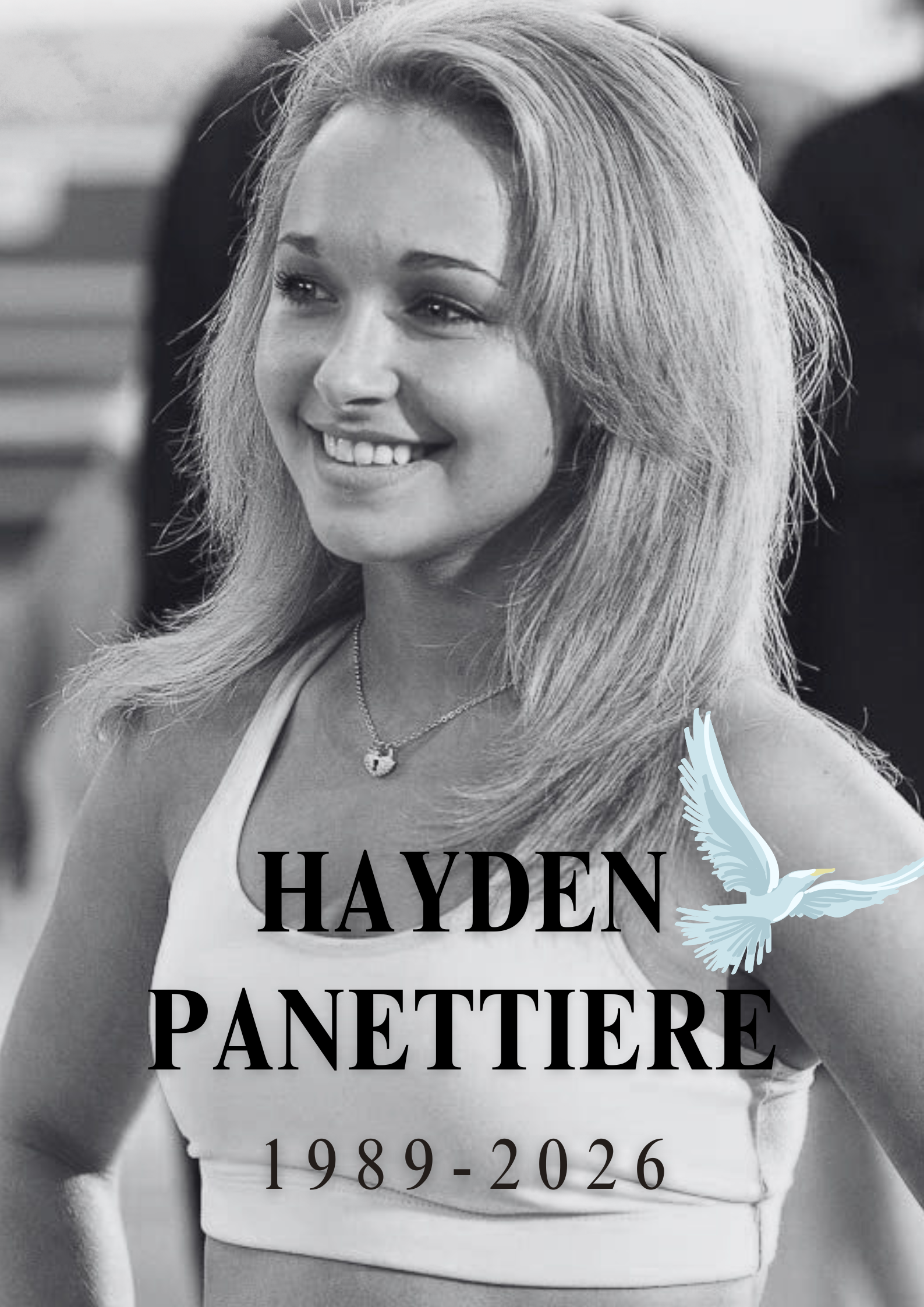
Hayden Panettiere, the actress who grew up before the eyes of millions and became known for memorable roles in Remember the Titans, Heroes, Nashville and the Scream franchise, has died at the age of 36. Her death was confirmed by her family through her publicist, bringing an abrupt end to a career that stretched across more than three decades and encompassed television, film, music and voice acting.
Panettiere’s father, Skip Panettiere, announced the news in a statement released through publicist Kasey Kitchen, describing the actress as an extraordinary presence whose warmth and energy touched both those who knew her personally and the audiences who followed her work. Her family also requested privacy as they dealt with the loss. Kitchen told CBS News that an investigation into the circumstances surrounding Panettiere’s death was ongoing.
As news of her death spread, it prompted renewed attention not only to the roles that made Panettiere famous but also to the unusual trajectory of a life spent almost entirely in the public eye. She was only 36, yet her professional career had already lasted more than 35 years. She began appearing in commercials before she could form memories of the experience and ultimately became one of the most recognizable child actors of her generation before making the difficult transition into adult stardom.
Born Hayden Lesley Panettiere on August 21, 1989, in New York, she entered the entertainment business when she was still a baby. According to the Television Academy, she began acting in commercials at only 11 months old and appeared in more than 50 commercials during her childhood. At the age of four, she began working in daytime television, appearing as Sarah Roberts on One Life to Live. She later portrayed Lizzie Spaulding on Guiding Light, establishing herself as a working television actress years before she reached adolescence.
Her early career was remarkably prolific. In addition to soap operas, Panettiere appeared in television series and lent her voice to animated projects. She voiced Dot in Pixar’s A Bug’s Life and was also involved in Disney’s Dinosaur. Those early performances demonstrated the range that would eventually become a defining feature of her career. She could move between live-action drama, family entertainment, animation and later horror and musical television with relative ease.
One of Panettiere’s most widely remembered childhood roles came in the 2000 sports drama Remember the Titans. She played Sheryl Yoast, the football-loving daughter of assistant coach Bill Yoast, portrayed by Will Patton. The film, led by Denzel Washington as coach Herman Boone, became a lasting favorite among audiences and helped introduce Panettiere to viewers far beyond the world of daytime television.
Her performance stood out because Sheryl was not simply written as a background child character. She was confident, outspoken and deeply knowledgeable about football, frequently observing the adults and players around her with an intensity that made the character memorable. Panettiere was still a child herself, yet she displayed the kind of screen presence that suggested a much more experienced performer.
More film work followed as she entered her teenage years. Her credits included Joe Somebody, Raising Helen, Racing Stripes, Ice Princess, Bring It On: All or Nothing, Fireflies in the Garden and I Love You, Beth Cooper, among other projects.
The range of those films reflected the unusual position Panettiere occupied in Hollywood. She could appear in family movies and teen comedies while also taking on increasingly mature dramatic roles. Unlike many performers who become closely associated with a single childhood character, she continued reinventing herself as she grew older.
Her biggest television breakthrough arrived in 2006 when she was cast as Claire Bennet in NBC’s science-fiction drama Heroes. Claire was a high school cheerleader who discovered that she possessed the ability to rapidly regenerate after suffering otherwise catastrophic injuries. The character became central to the show’s mythology and one of its most recognizable figures.
Heroes premiered at a moment when serialized television dramas were increasingly becoming major cultural events. Its interconnected storylines followed seemingly ordinary people who discovered extraordinary abilities, and Panettiere quickly became one of the faces of the series. Claire’s struggle to understand her powers, protect her identity and determine where she belonged gave the show an emotional center that connected its supernatural premise to the experience of adolescence.
The series transformed Panettiere from a successful former child actor into an internationally recognizable television star. The image of Claire Bennet in her cheerleading uniform became closely associated with the show’s early years, while the series’ famous phrase “Save the cheerleader, save the world” helped make the character a fixture of 2000s pop culture.
Panettiere appeared on Heroes from 2006 until 2010. The role came at a pivotal moment in her life: she was still a teenager when the show began, but she was becoming an adult while simultaneously experiencing a new level of fame.
Her next major television role would reveal a very different side of her abilities. In 2012, Panettiere began playing country music star Juliette Barnes in the ABC musical drama Nashville. The series centered on the lives, relationships and careers of people within the Nashville country music industry, with Panettiere starring opposite Connie Britton.
Juliette Barnes was ambitious, volatile, charismatic and vulnerable. She could be calculating in one scene and emotionally devastated in the next. The character’s desire for success often collided with insecurity, family trauma, romantic difficulties and the demands of fame. Over the course of the series, Panettiere was given storylines that required both dramatic acting and musical performance.
The role became one of the defining achievements of her adult career. Panettiere received two Golden Globe nominations for her performance as Juliette Barnes, in 2013 and 2014, according to the Golden Globes.
Nashville also allowed her to combine acting with singing. Panettiere recorded and performed music associated with the series, giving audiences another view of her talents. She later spoke about her appreciation for country music and its storytelling qualities, saying that the opportunity to act while singing songs that helped tell a character’s story was particularly meaningful to her.
Her career also included an important place in modern horror. Panettiere played Kirby Reed in Wes Craven’s Scream 4 in 2011. Kirby, a sharp and horror-knowledgeable teenager, became a fan favorite. For years after the movie’s release, fans debated the character’s fate and hoped she might eventually return to the franchise.
More than a decade later, Panettiere did exactly that. She returned as Kirby in Scream VI in 2023, bringing the character into a new generation of the franchise. The return was significant because it also marked a major step in Panettiere’s return to acting following a period in which her personal struggles had taken precedence over her career.
Away from the screen, Panettiere’s life became increasingly complicated, and in later years she chose to speak openly about experiences that had previously remained hidden behind her public image.
She became a mother in December 2014, when she welcomed her daughter, Kaya, with then-partner Wladimir Klitschko, the former heavyweight boxing champion. Panettiere subsequently experienced postpartum depression and publicly sought treatment. In October 2015, she entered a treatment facility to receive professional help.
Her decision to discuss postpartum depression was notable at a time when the condition was still frequently misunderstood or minimized in public conversation. Rather than presenting motherhood as an uncomplicated period of happiness, Panettiere acknowledged that serious mental health difficulties can accompany pregnancy and childbirth and that seeking treatment should not be a source of shame.
Her relationship with Klitschko eventually ended, and Kaya primarily lived with her father. Panettiere later discussed the emotional difficulty surrounding the custody arrangement and the separation from her daughter.
Her private struggles extended beyond postpartum depression. Over the years, Panettiere spoke about addiction and the pressures that accompanied growing up in entertainment. The polished public image associated with her years as a successful young actress concealed a much more complicated personal reality.
She also spoke publicly about experiencing domestic abuse during her relationship with Brian Hickerson. Her willingness to address those experiences later became part of a broader effort to reclaim control over a personal story that had often been told through tabloid headlines and outside speculation.
Another devastating chapter came in February 2023 when her younger brother, actor and artist Jansen Panettiere, died at the age of 28. His family said at the time that his death was caused by an enlarged heart. The loss deeply affected Panettiere, who had shared a close relationship with her brother.
The combination of grief, addiction, difficult relationships, motherhood, fame and recovery became central to the story Panettiere eventually chose to tell in her own words.
Only months before her death, she published the memoir This Is Me: A Reckoning. Released by Grand Central Publishing on May 19, 2026, the 320-page book examined a life in entertainment that had begun before she was old enough to walk. The publisher described it as Panettiere’s attempt to reclaim her story after decades in which her public identity had often been shaped by other people. The memoir became a New York Times and USA Today bestseller.
The timing now gives the memoir additional significance. Rather than simply serving as a celebrity autobiography written in the middle of a continuing career, it stands among Panettiere’s final major public statements about her life.
In the book and interviews surrounding its release, she reflected on what it meant to begin working so young. Her career had effectively started before she had the ability to decide whether acting was something she wanted for herself. By the age of five, she had already appeared in dozens of commercials.
Speaking with Gayle King for CBS News in May, Panettiere reflected on being brought into audition rooms as a baby and the pressure she felt as a child performer. She explained that her mother’s reaction to her work carried enormous emotional weight for her and that the boundaries between childhood, family life and professional performance were often difficult to distinguish.
Those reflections added another dimension to the familiar story of a successful child star. From the outside, Panettiere’s early career could appear extraordinary: television roles, major films, red carpets and international fame before adulthood. From her perspective, however, that success also came with pressure and expectations at an age when most children were still discovering who they were.
Her memoir explored the difference between the public version of Hayden Panettiere and the person living behind it. The book’s description emphasized how her tremendous early success existed alongside the growing pressures associated with being treated as one of Hollywood’s young stars. As she entered adulthood, the entertainment industry became less innocent and increasingly difficult to navigate.
That complexity is essential to understanding her legacy. Panettiere’s life cannot easily be reduced to either a story of Hollywood success or one of personal struggle. Both existed simultaneously.
She achieved the rare feat of building recognizable characters during several different stages of her life. For one generation, she was the young girl from Remember the Titans. For another, she would always be Claire Bennet, the seemingly indestructible cheerleader at the center of Heroes. Fans of Nashville knew her as Juliette Barnes, while horror audiences embraced her as Kirby Reed in the Scream franchise.
Each of those characters demanded something different from her. Sheryl Yoast relied on youthful confidence and comedic timing. Claire Bennet required her to balance vulnerability with the heightened world of science fiction. Juliette Barnes called for sustained dramatic and musical performances across multiple seasons. Kirby Reed allowed her to display the wit and self-awareness that have long defined the Scream films.
That versatility explains why Panettiere remained recognizable long after her childhood stardom. Many young performers struggle to move beyond the roles that first made them famous. Panettiere repeatedly managed to do so.
Her career also unfolded during a period when the relationship between celebrities and audiences changed dramatically. She began working before social media existed, became a teenage star during the explosion of online celebrity culture and entered adulthood as increasingly intense public scrutiny became part of everyday fame.
That meant the public saw many stages of her life unfold in real time. Her relationships, motherhood, health struggles, treatment and recovery were frequently discussed alongside her professional work.
In later years, Panettiere increasingly rejected the expectation that she should present a flawless version of herself. She spoke more directly about addiction, treatment, postpartum depression, abuse and grief. That openness became an important part of how she connected with audiences outside her acting roles.
Her story was particularly striking because her most famous fictional characters often appeared exceptionally strong. Claire Bennet could physically recover from almost anything. Juliette Barnes repeatedly fought to regain control after professional and personal crises. Kirby Reed survived violence and eventually returned years later as an adult.
Panettiere’s real life, however, demonstrated that resilience is far more complicated than the versions presented on screen. Recovery was not a single triumphant moment but an ongoing process involving setbacks, difficult choices and public vulnerability.
The final months of her life appeared to mark another period of reflection. With the publication of This Is Me: A Reckoning, she revisited experiences spanning virtually her entire life, from early childhood auditions to adult fame and personal trauma. The memoir’s central message emphasized her determination not to allow tragedy to completely define her identity and her belief that people can rebuild after being knocked down.
That message now carries particular poignancy.
At the time her death was announced, authorities had not publicly established a cause, and her publicist said the investigation remained ongoing. That distinction is important. Until officials or her representatives release additional verified information, speculation about the circumstances of her death should not be presented as fact.
What is already clear is the scale of the career she leaves behind.
Panettiere spent almost her entire life performing. She worked in commercials before her first birthday, appeared on major soap operas as a young child, moved into feature films, became one of television’s most recognizable young stars, established herself as a dramatic and musical performer and eventually returned to a beloved horror role more than a decade after first playing it.
Her two Golden Globe nominations for Nashville stand as formal recognition of her acting abilities, but her cultural impact extended beyond awards. Her characters became part of several different eras of popular culture, from the enduring popularity of Remember the Titans to the superhero television boom represented by Heroes and the devoted audiences surrounding Nashville and Scream.
She also leaves behind a more personal legacy through the conversations she helped encourage around postpartum depression, addiction, domestic abuse and the consequences of childhood fame.
For viewers who watched her grow up, her death at 36 is especially difficult to reconcile with the length of her career. Panettiere had been appearing on screens for so long that she seemed to belong to several generations of entertainment at once. Yet she had not even reached her 37th birthday.
She is survived by her daughter, Kaya, as well as members of her family. Her death also comes only a few years after the loss of her younger brother Jansen, adding another tragedy to a family that had already endured profound grief.
The roles remain: the football-obsessed little girl confidently discussing the game in Remember the Titans; Claire Bennet discovering that she could survive the impossible in Heroes; Juliette Barnes standing under the lights of the country music stage in Nashville; and Kirby Reed facing danger with humor and determination in Scream.
But beyond those performances, Panettiere spent the final period of her public life asking audiences to see the person behind them.
After decades of being photographed, interviewed, cast into roles and discussed by strangers, This Is Me: A Reckoning represented an effort to tell her life in her own voice. It acknowledged that extraordinary professional success did not protect her from pain and that fame itself could sometimes become part of that pain.
Her death closes a career that began almost before her life outside the entertainment industry had begun. From baby commercials to soap operas, Disney films, network television, country music drama and horror movies, Hayden Panettiere built a body of work that reached millions of viewers around the world.
For those who knew her only through the screen, she will be remembered through characters who were spirited, complicated, funny, vulnerable and determined. For those closest to her, the loss is far more personal than any list of credits or awards could capture.
At 36, Hayden Panettiere leaves behind more than three decades of performances and an unusually public record of growing from a child actor into an adult woman attempting to understand and reclaim the story of her own life. Her final chapter arrived far earlier than anyone expected, but the work she created — and the candor with which she ultimately chose to speak about what happened beyond the camera — ensures that her story will not be remembered solely through the circumstances of her death.
Panettiere’s influence can also be understood through the unusual longevity of her connection with audiences. Viewers who first encountered her as a child were able to follow her into adolescence and adulthood, watching her take on increasingly complicated characters. Few performers begin working before their first birthday and remain recognizable decades later. That continuity made her career distinctive, particularly in an industry where child actors often struggle to establish adult identities separate from their earliest roles.
Her performances frequently carried a combination of toughness and vulnerability. Whether she was playing the outspoken Sheryl Yoast in Remember the Titans, the seemingly indestructible Claire Bennet in Heroes, the ambitious Juliette Barnes in Nashville or the quick-witted Kirby Reed in the Scream franchise, Panettiere had an ability to portray characters who appeared strong while carrying emotional struggles beneath the surface. That quality became increasingly meaningful as she began speaking more openly about the difficulties in her own life.
Her return to the Scream franchise was particularly welcomed by longtime fans. Kirby Reed had developed a passionate following after Scream 4, and Panettiere’s appearance in Scream VI more than a decade later gave audiences an opportunity to reconnect with both the character and the actress. It also demonstrated that despite periods away from Hollywood, Panettiere remained capable of returning to a major franchise and immediately reconnecting with audiences.
In her later interviews, however, Panettiere appeared increasingly interested in discussing more than acting. She wanted to address what had happened behind the carefully managed images of premieres, television appearances and celebrity photographs. Her decision to speak about childhood fame, addiction, motherhood, postpartum depression, abusive relationships and recovery offered a more complicated picture of a woman many viewers had watched since she was a little girl.
That willingness to speak publicly about painful experiences became another important part of her legacy. Rather than allowing her career achievements to erase the difficulties she had endured, Panettiere acknowledged both. Her story became a reminder that professional success and personal suffering can exist at the same time, even when someone’s public life appears glamorous.
Following confirmation of her death, attention will inevitably return to the television episodes, films, interviews and performances that defined different stages of her career. Yet those closest to Panettiere knew someone beyond the celebrity recognized around the world: a daughter, sister, mother, friend and colleague whose life could never be fully represented by headlines.
Hayden Panettiere’s career began extraordinarily early and ultimately encompassed more professional experiences by 36 than many performers accumulate over an entire lifetime. Her death leaves behind an unfinished story, but also an extensive body of work that will continue introducing her to audiences who may not have been old enough to witness her rise from child actor to international television star.