The video begins with a surprisingly simple action: a person standing inside what appears to be a room reaches toward a set of light-colored curtains and slowly pulls them apart. At first, the scene looks completely ordinary, almost like the beginning of a peaceful travel or nature video. Bright daylight can be seen coming through the narrow opening, and the viewer has no immediate indication of what is waiting on the other side. But as the curtains open wider, the scene changes dramatically. Instead of an ordinary outdoor view, the camera reveals a tropical landscape filled with large animals, creating an unusual and visually striking moment that immediately becomes the focus of the video.
Beyond the doorway or window is a lush tropical environment dominated by tall palm trees and dense green vegetation. The setting appears warm, bright and peaceful, with sunlight filtering through the leaves. What makes the scene extraordinary is the number of animals gathered just outside. Several elephants are visible among the trees, while large cats that appear to be lions can also be seen nearby. The animals are positioned remarkably close to the building, creating the impression that the person filming is standing only a short distance away from an entire group of wild animals.
The opening moments of the video are especially effective because they create a strong contrast between expectation and surprise. Someone opening curtains normally expects to see a garden, a street, a beach, a pool or perhaps another building. Instead, the person appears to discover elephants and lions outside. The transition from a quiet indoor environment to a scene filled with large animals is what gives the clip much of its visual appeal. Within only a few seconds, the viewer is taken from an ordinary interior setting into a tropical landscape that looks almost unreal.
As the curtains continue opening, more of the outdoor scene becomes visible. The camera reveals a wooden or paved area immediately outside, followed by vegetation and a pathway running through the tropical landscape. The elephants are standing among the palm trees, while several smaller animals can be seen closer to the ground. The composition makes it appear as though the animals are freely moving through the area rather than being separated from the person by a conventional enclosure.
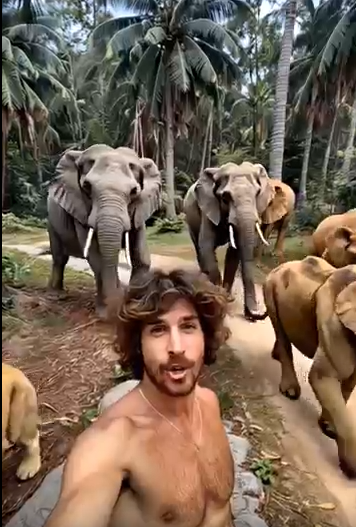
The scene then transitions into an even more unusual perspective. The person filming is suddenly shown outside, holding a camera at arm’s length in a selfie-style shot. He is standing on a narrow path surrounded by tropical vegetation, with elephants and what appear to be lions moving behind and around him. The change in perspective makes the video feel more personal because the viewer is no longer simply watching the animals from a distance. Instead, the person appears to be walking directly among them.
Several elephants are visible in the background, including large adults with prominent ears and tusks. They are moving along the pathway and appear to be approaching the area where the person is standing. Other elephants are positioned farther back among the trees. Their size is immediately noticeable, particularly when they are compared with the human figure in the foreground. The contrast between the relatively small person and the enormous animals creates one of the most visually dramatic elements of the footage.
The elephants appear calm in the visible portions of the video. Their trunks move naturally as they walk, while their ears and bodies shift as they approach. There is no obvious sign of an aggressive charge in the frames that can be seen. However, their close proximity to the person creates an unusual and potentially dangerous-looking situation. Even when an elephant appears calm, its enormous size and strength mean that being extremely close to one would normally require careful management and appropriate safety precautions.
At the same time, several animals resembling lions can be seen moving around the person. Their presence creates an even more extraordinary combination. Elephants and lions naturally occupy different ecological niches, and seeing multiple animals that appear to belong to both species moving together in such close proximity to a person is an unusual visual concept. The video seems designed to emphasize exactly that sense of wonder and impossibility.
The tropical surroundings play an important role in making the footage feel like an exotic adventure. Tall coconut palms fill the background, with their long leaves extending above the pathway. Dense vegetation surrounds the animals, creating the appearance of a secluded tropical environment. The pathway is relatively narrow, and the trees create a natural corridor through which the animals appear to be walking.
The person in the foreground appears relaxed while recording himself. He looks toward the camera as the animals move behind him, creating the impression that he is deliberately presenting the unusual scene to the viewer. His facial expressions appear animated, and he occasionally looks toward the animals behind him. The selfie perspective means that the viewer can see both his reaction and the animals at the same time.
That combination is one of the reasons the video is so attention-grabbing. Instead of showing only the animals, the clip includes a human reaction as part of the visual story. The person becomes a reference point that helps viewers understand the scale and proximity of the animals. When an elephant walks behind a person, its enormous body immediately makes the human figure appear much smaller.
The video is very short, lasting only around eleven and a half seconds, but it moves through several distinct visual moments. It begins indoors, with the curtains closed. The person then opens them and reveals the tropical scene. The footage subsequently shows the animals from outside, before transitioning into a selfie-style perspective in which the person is surrounded by elephants and lion-like animals.
Because the clip is so short, there is no detailed explanation of where the person is, why the animals are there, or how the scene was created. That absence of context is important. The footage itself provides visual information, but it does not establish the location, the identity of the person, the origin of the animals, or the circumstances behind the encounter. Any article discussing the video should therefore focus on what can actually be observed rather than presenting speculation as fact.
One particularly noticeable feature of the footage is how unusual the animal grouping appears. Elephants are shown walking through the same tropical environment as animals that appear to be lions. The combination creates an almost fantasy-like atmosphere. It resembles the kind of scene that might appear in an adventure film, a wildlife-themed fantasy or a digitally created travel video.
The visual quality and composition also contribute to that impression. The animals are positioned in ways that make them highly visible to the camera, and the person remains prominently in the foreground during the later portion of the clip. The tropical landscape provides a visually rich background, with palm trees and greenery surrounding the pathway. The entire scene is designed in a way that immediately directs attention toward the unusual interaction between the person and the animals.
It is also worth noting that the video appears to have characteristics consistent with digitally generated or heavily manipulated social-media footage. The combination of a person seemingly standing extremely close to multiple large wild animals, the unusual grouping of elephants and lion-like animals, and the highly cinematic tropical environment makes the scene difficult to interpret as an ordinary spontaneous wildlife encounter. However, the footage alone does not provide enough evidence to definitively establish how it was produced. It could be digitally generated, edited, staged or created using some combination of techniques.
That uncertainty does not reduce its entertainment value. In fact, it may be part of what makes the video interesting. Modern visual technology has made it increasingly easy to create scenes that would have been difficult or impossible to film traditionally. Social media audiences are now accustomed to seeing highly realistic-looking images and videos that blend real environments, digital effects and artificial generation.
The opening curtain sequence is particularly effective in that context because it creates a reveal. The viewer does not immediately see the unusual animals. Instead, the curtains conceal the scene for the first few seconds. As the opening becomes wider, the audience gradually discovers what is outside. This is a simple storytelling technique, but it works extremely well in a short video because it creates curiosity almost immediately.
The viewer naturally wants to know what is behind the curtains. The bright light coming through the opening suggests that there is something outside, but there is no obvious indication of what it is. Then the elephants become visible, followed by the other animals. The reveal changes the meaning of the entire scene.
What initially looks like a normal room suddenly becomes the starting point for an extraordinary wildlife encounter.
The elephants are among the most visually impressive elements of the video. Their large ears, long trunks, thick legs and massive bodies are clearly visible. Some appear to have tusks, while others are positioned farther away among the vegetation. Their movement along the pathway gives the impression of a herd traveling through the tropical landscape.
Elephants are naturally social animals, and the presence of several individuals together reinforces the idea of a herd. In the footage, they appear to move in the same general direction, with adults and smaller individuals visible at different points along the path. The visual relationship between the animals is more important to the video’s storytelling than any specific behavior because the clip is too short to establish a detailed behavioral sequence.
The lion-like animals create a completely different visual impression. Their bodies are smaller than the elephants, but their presence makes the scene appear even more dramatic. They are shown walking close to the person and along the same path. Their movement contributes to the sense that the entire landscape is somehow filled with animals.
The person recording the video appears to be aware of the animals around him. His face is turned toward the camera, and his body remains relatively steady as the animals move nearby. The selfie perspective suggests that the camera is being intentionally positioned to capture both the person and the wildlife behind him.
This style of filming is common in viral social media content because it creates a direct relationship between the viewer and the person in the video. Instead of watching an anonymous wildlife scene, viewers are effectively placed into the experience through the person’s perspective. The viewer can see his face, the path ahead and the animals approaching behind him.
The technique also emphasizes the scale of the animals. An elephant in a distant landscape can look relatively small on a smartphone screen. But when an elephant is shown only a few steps behind a person, its size becomes immediately obvious. The human figure functions almost like a measuring tool, allowing viewers to appreciate how enormous the animal appears.
The tropical environment further enhances the sense of adventure. The coconut palms are tall and densely distributed throughout the background. Sunlight creates bright patches among the leaves, while the ground appears covered with natural vegetation and fallen plant material. The pathway provides a clear route through the greenery, allowing the animals to move naturally through the composition.
The result is visually similar to an imagined tropical sanctuary where different species coexist. Whether the footage represents a real place, a staged scene or an artificial creation cannot be established solely from the video. But the visual concept is clear: the person appears to be immersed in a natural world where enormous animals are moving freely around him.
The video also plays with the idea of stepping outside into the unknown. The curtain opening is more than a simple transition. It acts as the boundary between two completely different worlds. On one side is the interior, quiet and enclosed. On the other side is an open tropical environment populated by large animals.
That contrast gives the clip a small but recognizable narrative structure. The person begins in a private indoor space. He opens the curtains. He discovers something unexpected. The scene then moves outside, where he appears to find himself surrounded by animals.
Although the entire sequence takes place within seconds, the basic story is easy to understand.
The video does not require dialogue to communicate the surprise. The visual information does most of the work. The opening curtains create anticipation, the appearance of the elephants creates surprise, and the selfie scene creates the final impression of an extraordinary encounter.
This is likely one reason why such videos can perform strongly on social media. A viewer does not need extensive background information to understand the premise. The central visual is immediately obvious, and the unusual combination of elements encourages people to watch again.
There is also an element of scale that makes the footage particularly compelling. Elephants are among the largest land animals, and seeing several of them together creates an impressive visual presence. When those elephants are combined with large cats and a human figure in the same frame, the scene becomes even more striking.
The person appears to remain calm throughout the visible footage, which adds another interesting dimension. A more conventional reaction might involve fear or hesitation when standing near such large animals. Instead, the person appears to be intentionally presenting the experience to the camera.
That calmness may be part of the video’s storytelling style. It creates the impression that the unusual environment is completely normal for the person, even though it looks extraordinary to the viewer. This contrast can make the scene feel humorous, fantastical or surreal depending on how the audience interprets it.
At the same time, viewers should remember that visual appearances do not necessarily reveal the full circumstances behind a video. The footage does not show whether there are barriers, handlers, controlled areas or other safety measures outside the camera’s frame. It also does not establish whether the animals are truly as close to the person as they appear.
This is especially important when videos involving wild animals circulate online. A short clip can make an interaction look spontaneous even when significant preparation occurred outside the frame. Conversely, digital effects can make an entirely artificial scene appear realistic.
The safest interpretation is therefore to describe the video as showing a person opening curtains to reveal elephants and lion-like animals in a tropical setting, followed by footage of the person standing on a path with the animals behind him. The exact nature and origin of the scene remain unclear from the footage itself.
That description is already enough to make the video interesting.
The visual concept is unusual because it combines three powerful elements: surprise, wildlife and human reaction. The surprise comes from the curtain reveal. The wildlife provides the spectacle. The person provides the human perspective.
Together, they create a compact visual story that can be understood almost instantly.
The video also illustrates how social media storytelling has changed. Traditional documentaries might spend several minutes establishing a location, introducing animals and explaining the circumstances. Short-form videos often do the opposite. They compress everything into a handful of seconds and rely on an immediate visual hook.
Here, the hook is the curtain.
The viewer sees a person standing inside.
The curtains begin to move.
Light appears.
The outside world slowly becomes visible.
Then the animals appear.
That sequence is simple but highly effective.
The transition into the selfie scene then increases the intensity. Instead of watching from inside, the viewer is suddenly shown much closer to the animals. The elephants appear larger, and the lion-like animals are positioned around the path. The person is now part of the scene rather than simply an observer.
The background remains filled with tropical vegetation, creating a consistent visual setting. The palm trees frame the animals and provide a sense of depth. Some elephants are closer to the camera while others are farther down the path, making the scene appear larger than the small frame of the video.
The animals’ movements also make the footage feel active. They are not simply standing still. They appear to be walking toward and past the person, creating continuous motion throughout the latter part of the clip.
The elephants’ ears move as they walk, while their trunks hang downward or move slightly. Their legs create a steady rhythm as they approach. The lion-like animals also move through the area, adding another layer of activity.
The person continues recording himself as the animals move behind him. This gives the impression of a traveler documenting an extraordinary moment for an audience.
The result is a video that feels more like an imagined adventure than an ordinary wildlife observation.
It is easy to understand why viewers might stop scrolling when confronted with such a scene. Most people do not expect to see elephants and lions appearing outside a curtain or walking directly behind someone holding a selfie camera. The unexpected combination immediately creates curiosity.
The video’s brevity strengthens that curiosity. Because it ends after only a short sequence, viewers may be left wanting more information. They may wonder what happened next, where the person was and whether the animals continued following the path.
That sense of an incomplete story can be particularly effective for online content. A short clip does not have to answer every question. Sometimes leaving viewers curious is what encourages discussion and sharing.
The video also invites viewers to think about the difference between reality and digital storytelling. As artificial intelligence and advanced editing tools become increasingly sophisticated, scenes that once would have been obviously impossible can now look remarkably convincing. A viewer may see an extraordinary image and immediately wonder whether it is real, staged or generated.
The footage in this case has several characteristics that make that question reasonable. The unusual proximity between the human subject and multiple wild animals is one factor. The presence of elephants and lion-like animals together in a carefully composed tropical environment is another. The overall visual quality and framing also give the clip a highly designed appearance.
However, without additional source information, it would be inappropriate to declare with certainty that the video is AI-generated. The correct approach is to acknowledge that the origin and production method are not established by the footage alone.
Regardless of how it was made, the video demonstrates how powerful visual storytelling can be. The opening shot contains almost no information, yet the viewer immediately wants to know what lies behind the curtains. Within seconds, the answer is revealed, and it is far more surprising than expected.
The scene also has a dreamlike quality. A person opens curtains and finds himself looking into a tropical world where elephants and lions seem to coexist peacefully. He then walks among them while recording himself. It resembles the type of fantastical scenario people might imagine when thinking about an adventure in an untouched tropical paradise.
That dreamlike quality may be precisely what makes the clip entertaining. It does not necessarily need to be interpreted as a literal representation of an ordinary wildlife encounter. It can simply be viewed as a piece of visual entertainment designed to provoke surprise and wonder.
The elephants remain the dominant visual element throughout much of the outdoor footage. Their presence gives the scene weight and scale. The lion-like animals add movement and contrast, while the palm trees create a distinctive tropical identity.
The person in the foreground provides the emotional center of the later shots. His expressions suggest that he is engaged with the moment and aware that the scene behind him is unusual. By keeping his face visible, the video makes the experience feel personal.
This is an important technique in viral video creation. Audiences often connect more strongly with a scene when there is a visible person reacting to it. The human face provides a familiar reference point, while the unusual background creates the spectacle.
In this case, the viewer can look at the person’s expression and then immediately look beyond him to see the animals. The eye naturally moves between the two elements, creating a strong visual relationship.
The footage therefore works not only because of the animals but because of how the animals are presented.
The camera angle places the person in the foreground and the elephants behind him. The pathway leads deeper into the scene, while the palm trees frame the sides. The composition naturally draws attention toward the animals approaching from behind.
As the video progresses, the elephants appear to come closer to the camera. Their increasing size makes the final moments particularly striking. By the end, large elephants occupy significant portions of the frame, creating an impression of proximity and scale.
The final moments are perhaps the most visually powerful because the viewer can clearly compare the person’s size with the animals surrounding him. The elephants appear enormous, while the lion-like animals move along the sides of the path.
The video ends before any dramatic conclusion occurs. There is no visible chase, collision or attack. Instead, the footage simply captures the unusual scene and stops.
That ending leaves the audience with the image of the person standing among the animals.
In many ways, the lack of a conventional ending makes the video feel more like a glimpse into another world than a complete story. The viewer is shown a strange moment and then left to interpret it.
The most responsible interpretation is therefore also the simplest one. The footage presents an extraordinary tropical scene involving a person, several elephants and animals resembling lions. It is visually dramatic and appears designed to create a sense of wonder and surprise. The exact circumstances behind the footage are not established.
What can be said with confidence is that the video uses a very effective reveal structure. The curtains conceal the scene, the opening reveals the animals and the later selfie footage brings the viewer closer to the action. The short duration keeps the pacing fast and prevents the concept from becoming repetitive.
The tropical landscape also provides a strong visual identity. The tall palms and dense greenery make the environment immediately recognizable as a warm, exotic setting. The animals fit naturally into the visual composition, even though their combination and proximity to the person are highly unusual.
Ultimately, the video is less about a traditional wildlife story and more about the power of an unexpected visual moment. It takes something familiar — opening curtains — and turns it into a surprising reveal. It then takes the familiar concept of a selfie video and places it in an extraordinary setting.
The result is a short piece of footage that immediately raises questions and captures attention.
It reminds viewers that modern videos can blur the boundaries between ordinary life, staged entertainment, digital creation and fantasy. A scene can look realistic while still requiring viewers to think carefully about what they are actually seeing.
In this case, the footage gives us an imaginative tropical world populated by elephants and lion-like animals, with a person apparently moving through the middle of it. Whether the scene represents a real location, a controlled environment, a digitally altered sequence or an entirely generated scenario cannot be confirmed from the video alone.
But regardless of its origin, the visual story is clear. A person opens a curtain expecting to reveal the world outside, only to reveal a scene that looks completely extraordinary. He then appears to step into that world, recording himself as elephants and lion-like animals move around him.
The combination of surprise, scale, tropical scenery and close-up animal footage makes the video immediately memorable. It is the kind of clip that can make viewers pause, replay the opening and look closely at the animals in the background.
And perhaps that is the biggest strength of the footage. It does not need a long explanation to create curiosity. The moment the curtains open, the viewer understands that something unusual is happening. When the elephants appear, the sense of surprise increases. When the person is suddenly shown surrounded by the animals, the scene becomes even more extraordinary.
In only a few seconds, the video transforms a quiet interior into an unforgettable tropical encounter. Whether viewers interpret it as fantasy, digital entertainment, staged footage or something else, the scene is undeniably eye-catching.
The image of enormous elephants walking down a palm-lined path behind a person holding a camera is the kind of visual that naturally attracts attention. The presence of the lion-like animals makes the scene even more unusual, while the person’s calm selfie-style presentation gives the entire clip a surreal quality.
Ultimately, the video leaves viewers with more questions than answers, but that may be exactly what makes it effective. It creates a moment of surprise, presents an extraordinary visual environment and ends before the audience can fully understand everything behind it. In the world of short-form content, that combination can be extremely powerful.
What begins with two hands pulling apart a pair of curtains ends with a tropical landscape filled with massive elephants and lion-like animals. The transition is unexpected, visually dramatic and designed to make the viewer look twice. And while the exact story behind the footage remains unclear, the video succeeds at one thing very well: creating a moment that is almost impossible to ignore.