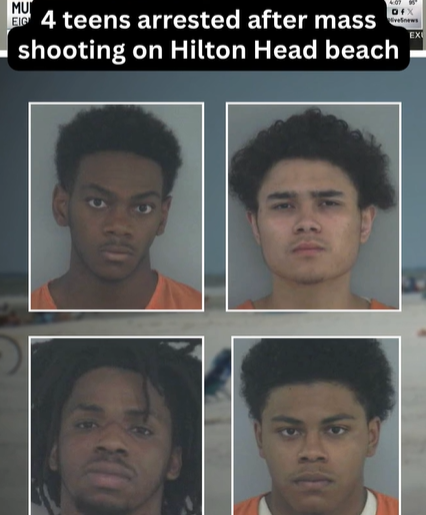
A popular stretch of Hilton Head Island’s shoreline became the centre of a major criminal investigation after a mass shooting disrupted what should have been a peaceful day at the beach. Authorities have now arrested four teenagers in connection with the incident, marking an important development in a case that alarmed residents, visitors and local officials. The arrests brought some relief to the community, but they also raised difficult questions about youth violence, public safety and how a disagreement could escalate into gunfire in a crowded recreational area.
Hilton Head Island is widely known as a quiet coastal destination where families gather to swim, relax and enjoy the natural beauty of South Carolina’s Lowcountry. Its beaches attract both residents and tourists, particularly during warm weekends and public holidays. That familiar image of calm was shattered when shots were fired near a busy section of the beach, sending people running for safety and leaving several individuals injured. What began as an ordinary gathering quickly turned into a frightening emergency, with beachgoers struggling to understand where the shots were coming from and whether the danger had ended.
Witnesses described a scene of confusion as people moved away from the area, called relatives and attempted to locate friends or family members who had become separated during the panic. Some visitors reportedly sought protection behind beach furniture and nearby structures, while others hurried toward parking areas or entered the water to create distance from the disturbance. Parents focused on shielding their children, and people who had only moments earlier been relaxing on the sand suddenly found themselves responding to an unpredictable and potentially life-threatening situation.
Emergency services were called to the scene, and law enforcement officers quickly began securing the beach. Their immediate responsibilities included helping the injured, identifying possible suspects and determining whether an active threat remained. The large number of people in the area made the response especially challenging. In a crowded public setting, officers had to separate reliable witness information from rumours spreading through frightened groups of visitors. They also needed to protect possible evidence that could easily have been disturbed by foot traffic, beach equipment, water or changing weather conditions.
Investigators began gathering photographs, mobile phone recordings and security footage from the surrounding area. Cameras installed near public spaces, businesses and beach access points can provide valuable information in cases where suspects disappear into a crowd. Video may reveal where individuals arrived, how they moved before the shooting and the direction in which they left afterward. Even footage that does not capture the shooting itself can help investigators build a timeline and connect different pieces of evidence.
Police also relied heavily on witnesses. In incidents involving many people, investigators may receive dozens of accounts that differ in small but important ways. One person may remember a particular item of clothing, while another may recall hearing an argument or seeing someone enter a vehicle. Each statement must be compared carefully with physical evidence and recorded images. Investigators cannot simply accept the first version of events they hear, especially when witnesses were frightened, distracted or viewing the scene from different angles.
The investigation eventually led authorities to four teenage suspects. Images released in connection with the arrests showed four young males, each facing serious allegations related to the beach shooting. Their arrests represented the result of a coordinated effort involving law enforcement agencies, investigators and members of the public who provided information. Police officials emphasised that locating the suspects required cooperation and careful investigative work rather than a single clue.
Although the suspects are teenagers, the accusations against them are extremely serious. A mass shooting in a public place carries consequences that extend far beyond the individuals directly involved. Gunfire in a crowded area can injure intended targets, innocent bystanders and even people who are some distance from the original conflict. Bullets do not remain limited to a disagreement between two groups, and one reckless decision can permanently affect many families.
Authorities indicated that the violence may have developed from a dispute involving young people at the beach. Investigators worked to determine who possessed firearms, who discharged them and whether others helped plan, encourage or conceal the actions. These distinctions matter because each suspect’s alleged role must be supported by evidence. Being present during a crime is not always the same as committing it, but individuals who knowingly assist violent acts may still face significant legal consequences.
The case now moves from the investigative stage into the court system, where prosecutors will examine the available evidence and decide how to proceed with each defendant. Because the suspects are young, legal questions may arise regarding whether they will be handled entirely within the juvenile justice system or whether some charges could be considered under procedures normally used for adults. These decisions depend on local law, the suspects’ ages, the specific allegations and the evidence connecting each person to the shooting.
An arrest does not establish guilt. Every suspect is entitled to due process, legal representation and a fair hearing. Prosecutors must prove their claims using admissible evidence, and defence attorneys have the right to challenge witness testimony, forensic findings and the methods used during the investigation. This principle remains essential even in cases that cause widespread public anger. The seriousness of an event makes a careful legal process more important, not less important.
At the same time, the presumption of innocence does not reduce the suffering caused by the shooting. Those injured may face medical treatment, emotional distress and financial hardship. Some victims may recover physically but continue to experience anxiety in crowded places. Others may avoid beaches or public events because ordinary sounds remind them of the gunfire and confusion. Children who witnessed the incident may need reassurance and support to understand that the frightening event was unusual and not something they should expect every time they visit a public space.
The emotional effects can also reach people who were not physically present. Residents may question whether familiar community spaces remain safe, while tourists may reconsider upcoming travel plans. Local businesses can experience cancellations or reduced activity after highly publicised violence. Workers in hotels, restaurants and shops may find themselves repeatedly answering questions about safety, even though they had no connection to the incident. In destinations that depend heavily on tourism, one violent event can damage public confidence and create economic pressure across the community.
Local officials therefore face the difficult task of responding honestly while avoiding unnecessary fear. They must acknowledge the seriousness of the shooting, explain what authorities are doing and remind the public that the incident does not define the entire area. Statements that dismiss public concerns can appear insensitive, but exaggerated warnings may deepen fear and harm businesses. Clear information, visible safety measures and transparent updates are often the most effective ways to rebuild trust.
The shooting has also renewed discussion about security at beaches and other open public areas. Unlike stadiums or ticketed venues, beaches usually have multiple entry points and no controlled perimeter. Visitors carry coolers, bags, chairs and umbrellas, making intensive screening impractical. Large crowds may spread across a wide distance, and law enforcement officers cannot be positioned beside every group. These realities create major challenges for preventing someone from bringing a firearm into the area.
Greater police visibility may discourage some misconduct, but patrols alone cannot eliminate every threat. Authorities may consider temporary observation points, improved surveillance cameras and stronger coordination with nearby businesses. Emergency access routes must remain clear so ambulances and police vehicles can reach injured people quickly. Public signs can provide location markers, helping witnesses explain exactly where an emergency is taking place along a long stretch of shoreline.
Technology can assist in investigations, but it also presents limitations. Cameras may be blocked by crowds or installed too far away to capture clear facial details. Mobile phone videos may begin only after the first shots are heard, leaving investigators without footage of how the conflict started. Online posts can spread rapidly, but they may contain edited clips, incorrect names or unsupported accusations. Police must verify digital evidence before relying on it, and the public should avoid sharing rumours that could interfere with the case or wrongly identify innocent people.
The age of the suspects has become one of the most troubling aspects of the story. When teenagers are accused of carrying firearms and participating in a public shooting, the case forces the community to examine how young people are gaining access to weapons. It also raises questions about conflict resolution, peer influence and the role of social media in escalating disagreements. An argument that once might have ended with people walking away can become far more dangerous when a firearm is available.
Young people may sometimes act impulsively, particularly when they feel pressured to appear fearless in front of friends. A minor insult, online dispute or perceived act of disrespect can grow quickly when others encourage retaliation. Social media can intensify this process by keeping arguments alive after the original encounter has ended. Messages, videos and public comments may make teenagers feel watched or challenged, causing them to prioritise reputation over safety.
This does not excuse violence, but understanding the pattern is necessary for prevention. Communities cannot rely only on punishment after shootings occur. Schools, families, youth organisations and local leaders must help teenagers develop ways to handle anger and disagreement without weapons. Programmes that teach communication, emotional control and decision-making can give young people practical alternatives during tense situations. Trusted adults can also intervene before conflicts become violent, particularly when warning signs appear online or among peer groups.
Firearm storage is another important part of the discussion. Adults who own guns have a responsibility to keep them secured and inaccessible to children or unauthorised users. A weapon left in an unlocked vehicle, drawer or bag can be taken within seconds. Teenagers may underestimate the danger, carrying a gun for status or protection without understanding how quickly the situation can become irreversible. Secure storage cannot prevent every shooting, but it can reduce easy access and create an additional barrier between impulsive anger and deadly action.
Parents and guardians may struggle to recognise when a young person is becoming involved in dangerous behaviour. Changes in friendships, unexplained possessions, threats, fear of retaliation or repeated references to firearms may require careful attention. Adults should avoid assuming that such behaviour is simply a phase. Direct but calm conversations can reveal whether a teenager feels threatened, is being pressured by others or has access to a weapon.
Schools can also play a role by making reporting systems accessible and confidential. Students frequently know about conflicts before adults do, but they may stay silent because they fear being labelled as disloyal or becoming targets themselves. Reporting options should be designed to protect students while ensuring that serious concerns receive prompt attention. Responses must also be proportionate, because students will stop using reporting systems if every minor disagreement results in extreme punishment.
Community organisations can provide positive spaces where young people develop relationships with coaches, mentors and other adults. These connections matter because teenagers are more likely to seek help from someone they trust. Sports, arts, employment programmes and volunteer opportunities give young people a sense of purpose and belonging. Such activities are not a complete solution to violence, but they can reduce isolation and offer alternatives to peer groups that encourage dangerous conduct.
The justice system will determine the legal accountability of the four suspects, but the wider community must address the conditions that allow youth conflicts to become armed confrontations. Focusing only on the individuals arrested may create the impression that the problem has been solved. In reality, arrests answer one question—who may have been involved—but they do not fully explain why firearms were present or why the confrontation reached such a dangerous point.
Investigators will continue examining the sequence of events before, during and after the shooting. They may review communications between suspects, vehicle records, digital locations and additional video. Firearms recovered during the investigation could undergo testing to determine whether they were discharged at the scene. Shell casings and other ballistic evidence may help connect a weapon to particular shots. These methods require specialised analysis and can take time, which is why cases may continue developing after initial arrests are announced.
More charges could potentially follow if evidence identifies additional participants or shows that crimes occurred before or after the shooting. Authorities may also revise charges as forensic results become available. Early reports often contain incomplete information because investigators must balance public interest with the need to protect the integrity of the case. Releasing too much detail could alert other suspects, influence witnesses or create problems during future court proceedings.
The public should therefore distinguish confirmed information from speculation. Social media users frequently attempt to solve cases using limited images or short clips, but such efforts can create serious harm. Incorrect accusations can place innocent people in danger and distract investigators. Sharing the suspects’ officially released images may assist law enforcement, but adding unsupported claims about motives, relationships or criminal histories is irresponsible.
News organisations also carry a responsibility to report carefully. Coverage should explain what happened without turning the accused teenagers into celebrities or presenting rumours as facts. Repeatedly displaying dramatic footage can increase fear and cause distress for people who were present. At the same time, responsible reporting keeps attention on public safety concerns and encourages witnesses to provide information.
For the victims and their families, the legal process may be lengthy. Court hearings, delays and repeated media attention can make it difficult to move forward. Victim support services can help with counselling, medical costs and communication with prosecutors. Families deserve timely updates, but investigators may not always be able to share every detail while the case remains active.
Beachgoers who witness future emergencies can take several basic steps to protect themselves. They should move away from the source of danger, avoid gathering to record the incident and follow instructions from police or emergency personnel. Once safe, witnesses can write down what they remember before details fade. Videos and photographs should be preserved in their original form and provided directly to investigators rather than heavily edited before being posted online.
People should also avoid returning to an active crime scene to retrieve belongings. Beach chairs, bags and other property can be replaced, but entering an unsecured area may expose someone to continuing danger or interfere with evidence. Families visiting crowded locations may benefit from agreeing on a meeting point in case they become separated. Children should know the full name and phone number of a trusted adult, while adults should remain aware of nearby exits and emergency access routes.
These precautions should not turn an ordinary trip to the beach into an experience dominated by fear. Public spaces are essential to community life, and people should be able to enjoy them without expecting violence. Safety awareness is most effective when it becomes a calm habit rather than a source of constant anxiety.
The arrests may help Hilton Head Island begin restoring a sense of security. Residents can see that authorities treated the shooting seriously and continued working until suspects were located. Visitors may also feel reassured by the visible response and increased attention to safety. However, confidence will depend on what happens next, including the fairness of the court process, support for victims and efforts to prevent another incident.
Police departments often describe public cooperation as one of the most valuable tools in major investigations. Witnesses who share clear information, businesses that preserve surveillance footage and residents who report suspicious behaviour can all contribute. This cooperation must be built on trust. People are more likely to assist law enforcement when they believe their information will be handled professionally and that officers will communicate honestly with the community.
Trust is especially important when teenagers are involved. Families may hesitate to provide information if they fear that their children will be treated unfairly or placed in danger. Authorities must protect witnesses and explain how information will be used. Community leaders can serve as a bridge, encouraging cooperation while ensuring that residents’ concerns are heard.
The shooting also demonstrates how quickly a local event can gain wider attention. Video clips and images can circulate nationally within hours, shaping public perception before authorities provide a complete account. The phrase “mass shooting” carries enormous emotional weight, and viewers far from Hilton Head may form an image of the community based solely on one incident. This is another reason accurate updates matter.
Behind every headline are real people. Those injured are more than statistics, the arrested teenagers are more than mugshots, and the witnesses are more than background figures in a news report. Each person has a family, a history and a future affected by what happened. Recognising this human dimension does not minimise accountability. Instead, it prevents the case from becoming entertainment and keeps attention on the true cost of violence.
For the accused teenagers, the consequences may follow them for years. Serious criminal charges can disrupt education, employment and family relationships. Even if some allegations are later reduced or dismissed, online images and reports may remain permanently searchable. This reality reinforces why young people must understand that a decision made in a few seconds can shape the rest of their lives.
For the victims, the goal is not simply to return to the physical condition they were in before the shooting. Recovery may involve rebuilding confidence, processing fear and accepting changes caused by injury. Friends and relatives can help by listening without pressuring victims to move on quickly. Trauma does not follow a fixed schedule, and people may react differently to the same event.
The broader lesson from Hilton Head is that community safety requires both immediate enforcement and long-term prevention. Police must respond to violent crimes, collect evidence and arrest those believed to be responsible. Courts must determine guilt fairly and impose appropriate consequences. At the same time, families and institutions must work to prevent firearms from reaching teenagers and stop disagreements from escalating.
No single programme, law or police strategy can eliminate youth violence. Effective prevention requires several efforts working together: responsible firearm storage, strong family communication, accessible mental and emotional support, school-based intervention, community mentoring and accountability for those who commit crimes. Each approach addresses a different part of the problem.
As the four teenagers face the next stages of the legal process, Hilton Head Island continues to recover from a day that transformed a familiar beach into a crime scene. The arrests provide progress, but they cannot erase the fear experienced by those who heard the gunshots or searched desperately for loved ones. Nor can they reverse the injuries caused by the violence.
The community’s response will determine whether the incident becomes only a painful memory or also a reason for meaningful improvement. Officials can strengthen emergency planning, organisations can invest in young people and families can have difficult conversations about weapons and conflict. Residents can continue supporting victims while refusing to spread rumours or glorify those accused.