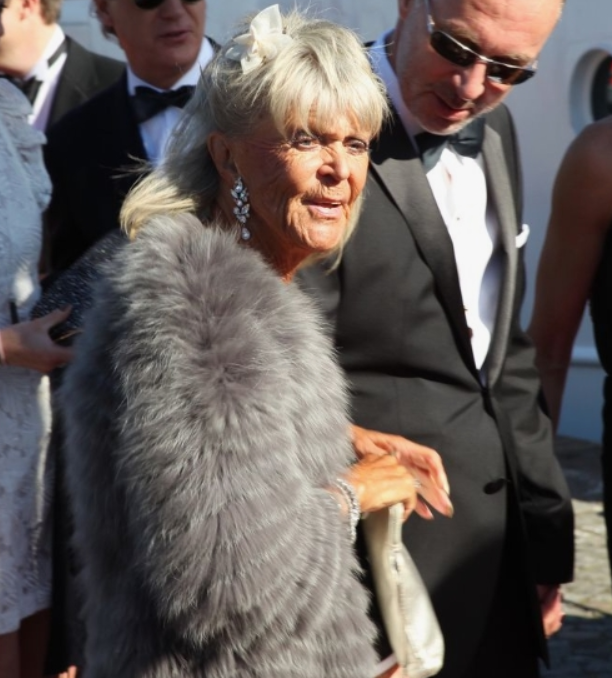
A striking photograph of an elegantly dressed older woman connected to one of Europe’s most respected royal families has once again captured public attention. With her confident expression, glamorous appearance, and unmistakably regal presence, she looked entirely comfortable in front of the cameras. Yet many people seeing the image for the first time may not immediately recognize her. She was not a queen, nor was she one of the younger royals whose public appearances regularly dominate international headlines. The woman was Princess Birgitta of Sweden, the older sister of King Carl XVI Gustaf and one of the most independent and memorable personalities in modern Swedish royal history.
The photograph often associated with renewed interest in the princess was taken during the celebrations surrounding the 2015 wedding of her nephew, Prince Carl Philip, and Sofia Hellqvist. At the time, members of royal families from across Europe gathered in Stockholm for a weekend filled with formal dinners, ceremonies, elegant clothing, historic jewels, and carefully observed royal traditions. Even in such distinguished company, Princess Birgitta stood out. She appeared confident, expressive, glamorous, and noticeably less restrained than many of the people around her.
For those familiar only with the most visible members of Sweden’s royal family, Princess Birgitta’s identity may come as a surprise. She belonged to an earlier generation of royals and spent much of her later life outside Sweden. As a result, she was photographed less frequently than King Carl XVI Gustaf, Queen Silvia, Crown Princess Victoria, Prince Daniel, Prince Carl Philip, Princess Sofia, Princess Madeleine, and other active members of the royal household. Her appearances could therefore feel unexpected, particularly to international audiences.
However, Birgitta was never a minor figure within the family. Born Birgitta Ingeborg Alice on January 19, 1937, at Haga Palace near Stockholm, she was the second child of Prince Gustaf Adolf, Duke of Västerbotten, and Princess Sibylla of Saxe-Coburg and Gotha. She grew up with three sisters—Princess Margaretha, Princess Désirée, and Princess Christina—and a younger brother who would eventually become King Carl XVI Gustaf. The four sisters became popularly known in Sweden as the Haga Princesses, a name connected to their childhood home and the public fascination surrounding the young royal siblings.
Photographs from their early years presented an appealing picture of royal family life. The sisters were often shown playing together, wearing coordinated clothing, enjoying outdoor activities, or appearing at family occasions. To the Swedish public, they represented a youthful and relatable side of the monarchy during a period marked by major political and social change. Behind those cheerful images, however, the family experienced a devastating loss that permanently shaped their lives.
In January 1947, Birgitta’s father, Prince Gustaf Adolf, was killed in a plane crash near Copenhagen. Birgitta was only ten years old. Her sisters were also still children, while her brother Carl Gustaf had not yet reached his first birthday. The tragedy left Princess Sibylla to raise five children while also preparing her young son for the possibility that he would one day become king.
The death of their father placed greater emotional and symbolic pressure on the family. For Birgitta, it meant growing up with the expectations of royalty while carrying a deeply personal loss. Like her sisters, she learned how to perform public duties, behave during official occasions, and represent the monarchy. Yet she also developed a strong personality that did not always fit neatly into the quiet, restrained image traditionally expected of royal women.
Birgitta was energetic, sociable, sporty, and direct. Before marriage transformed her role, she trained in physical education and worked as a gymnastics teacher. This background distinguished her from the more ceremonial image often associated with princesses. She was interested in movement, exercise, competition, and outdoor life. Golf later became one of her greatest passions and remained an important part of her public identity for decades.
Her path toward marriage began when she moved to Germany to study the language. There, she met Prince Johann Georg of Hohenzollern, known within his family as Hansi. He belonged to the German princely House of Hohenzollern, a dynasty with a long and complicated place in European history. Their relationship connected the Swedish royal House of Bernadotte with one of Germany’s best-known aristocratic families.
Their engagement was announced in December 1960, and the couple married in 1961. Because Birgitta was Lutheran and Johann Georg was Roman Catholic, their wedding involved religious and royal considerations. They first married in a civil ceremony at the Royal Palace in Stockholm, followed by a religious ceremony in Germany. The celebrations united two royal traditions and attracted considerable attention.
Birgitta’s marriage also affected her position within the Swedish monarchy. Unlike some princesses who married men without royal status, she retained her royal title because she married a prince. She became known as Princess Birgitta of Sweden and Hohenzollern. This made her circumstances different from those of some of her sisters, whose titles and official roles changed after their marriages.
The couple had three children: Prince Carl Christian, Princess Désirée, and Prince Hubertus. Birgitta therefore balanced several identities at once. She was a Swedish princess, a member of the Hohenzollern family, a wife, a mother, a sister to Sweden’s future king, and a woman who increasingly wanted to live according to her own preferences.
Although royal marriages are often presented as perfect unions, Birgitta and Johann Georg eventually lived largely separate lives. They remained legally married until his death in 2016, but their relationship evolved over time, and they spent many years in different places. Birgitta created an independent lifestyle for herself, particularly on the Spanish island of Mallorca, where she spent much of her later life.
Mallorca became central to the public image she developed outside Sweden. The island’s warm weather, relaxed atmosphere, golf courses, social life, and coastal scenery were very different from the colder climate and formal environment of the Swedish court. Birgitta appeared to embrace that contrast. She became associated with sunshine, sport, colorful clothing, an active social circle, and a direct way of speaking that often made her more accessible than distant.
Her move to Mallorca was more than a change of address. It symbolized the independence that defined much of her life. Although she remained deeply connected to her royal relatives and Swedish heritage, she did not build her entire existence around palace life. She attended important family occasions and royal ceremonies, but she also maintained a world of her own.
This balance helped explain why sightings of her could attract such curiosity. She was undeniably royal, yet she was not constantly visible. She belonged to the king’s immediate family, but she lived far from the daily rhythm of the Swedish court. When she appeared at a wedding, anniversary, memorial, birthday celebration, or other major gathering, the public was reminded of a princess who had been part of the monarchy’s story for generations.
Her appearance at Prince Carl Philip and Sofia Hellqvist’s pre-wedding dinner in June 2015 was a perfect example. The wedding itself was one of the most anticipated royal events of the year. Prince Carl Philip, the only son of King Carl XVI Gustaf and Queen Silvia, was marrying Sofia, whose journey from private citizen to princess had been widely followed by the media.
The evening before the ceremony, family members and guests gathered for a formal dinner. Sofia wore an elegant blue gown, while other royals arrived in carefully selected evening attire. Photographers documented the procession of guests, creating a visual record of European royal society in one place.
Princess Birgitta, then 78 years old, did not disappear among the younger and more frequently photographed attendees. Her appearance communicated confidence and personality. She had spent her entire life around formal events, photographers, royal protocol, and public observation. Rather than seeming overwhelmed, she looked experienced and self-assured.
That confidence was part of what made images of her so compelling. In photographs, she often appeared animated rather than carefully rehearsed. Her expressions could be warm, amused, bold, or thoughtful. She gave the impression of someone who understood royal expectations but had never allowed them to erase her individuality.
The idea that she was simply a mysterious, rarely seen royal does not fully explain her importance. Princess Birgitta represented a bridge between different eras of the Swedish monarchy. She was born when her great-grandfather, King Gustaf V, was still on the throne. Her grandfather later became King Gustaf VI Adolf. Her younger brother succeeded to the throne in 1973. She lived long enough to see a new generation of royal children, including Crown Princess Victoria’s daughter, Princess Estelle, become part of the monarchy’s future.
During Birgitta’s childhood, the royal family operated under far more traditional expectations. Public communication was controlled, official appearances were formal, and royal women generally had narrower roles. By the later decades of her life, the Swedish monarchy had adapted to television, digital media, changing attitudes toward marriage, and growing demands for openness.
Birgitta’s personality sometimes appeared better suited to this more open era. She spoke candidly, enjoyed attention, and did not always present herself with the cautious neutrality expected from senior public figures. For supporters, her honesty was refreshing. She felt human rather than carefully manufactured. For critics, some of her remarks and lifestyle choices could seem unconventional. Either way, she remained difficult to ignore.
Her enthusiasm for golf became one of her most recognizable interests. She participated in and supported golfing events and was closely connected with royal golf organizations. The sport gave her a social community beyond ceremonial royal life and helped anchor her years in Mallorca. It also reflected the physically active identity she had developed as a young woman.
Unlike working royals whose schedules are dominated by charitable engagements, official visits, diplomatic receptions, and public ceremonies, Birgitta’s later life was comparatively private. This did not mean that she had abandoned her family. She returned for important occasions and remained a beloved sister and aunt within the royal circle. However, she was not expected to maintain the constant public schedule carried by the king, queen, crown princess, and other central representatives of the monarchy.
That difference is essential when considering why a photograph of her could be described as rare. Royal families are large, and not every relative holds the same responsibilities. Some perform regular duties and are photographed almost weekly. Others appear mainly at weddings, funerals, jubilees, birthdays, national celebrations, and private family events. Birgitta belonged increasingly to the second group.
The phrase “rare paparazzi sighting” may create the impression that she was hiding from the world. In reality, she simply lived away from the central royal spotlight. She could be seen in Mallorca and attended selected events, but international celebrity media did not follow her every movement. When an old photograph resurfaced online without clear context, many readers naturally asked who the distinctive woman might be.
Her style also helped fuel the mystery. Birgitta did not always follow the understated fashion approach associated with Scandinavian minimalism. She often preferred noticeable colors, glamorous details, carefully styled hair, and a sun-kissed appearance connected to her Mediterranean life. Her clothing and presentation communicated energy rather than invisibility.
Royal fashion is frequently treated as a coded language. Every dress, jewel, color, and accessory is examined for hidden meaning. Birgitta seemed less interested in disappearing behind those interpretations. She wore clothes that suited her personality and appeared comfortable being seen. Even in later life, she could project the confidence of someone entering a room with no intention of being overlooked.
Her place in the Swedish family was also emotionally significant. King Carl XVI Gustaf grew up surrounded by his four older sisters, who helped care for and support him after their father’s death. Because he was the only son and future heir, his childhood path differed from theirs, but the bond between the siblings remained important.
When their grandfather, King Gustaf VI Adolf, died in 1973, Carl Gustaf became king at only 27 years old. His sisters had already entered adulthood, married, and developed separate lives. They represented a link to his childhood, his parents, and the shared history of the Haga family.
Birgitta’s relationship with royal tradition was therefore complex. She respected the institution because it was inseparable from her family, upbringing, and identity. At the same time, she resisted allowing it to determine every aspect of her personal life. Her years in Spain demonstrated that a princess could remain royal without living permanently inside a palace or restricting herself to a ceremonial role.
This independence made her part of a broader transformation among European royal women. Earlier generations often had little control over where they lived, whom they married, or how they appeared in public. By Birgitta’s adulthood, those expectations were beginning to loosen, though they had not disappeared. She navigated that transition in her own distinctive way.
Her marriage into the Hohenzollern family further broadened her perspective. She moved between Sweden, Germany, and Spain, crossing cultural and religious traditions. Her children were connected to both Swedish and German royal history. Yet the life she eventually chose in Mallorca was less about dynastic symbolism and more about personal comfort and freedom.
That choice contributed to her reputation as a slightly rebellious princess. The word “rebellious” should not be misunderstood as a rejection of her family. Birgitta did not renounce her title or publicly campaign against the monarchy. Her rebellion was more personal and practical. She chose warmth over cold weather, independence over constant court life, and directness over carefully managed royal mystery.
Those qualities made her especially interesting to the press. Royal coverage often depends on contrast: duty versus freedom, tradition versus modernity, public image versus private personality. Birgitta embodied all of these tensions. She was born into one of Europe’s most established royal houses but built a lifestyle that often felt informal and individual.
Public fascination with older royal women has also grown as audiences search beyond the most famous kings, queens, princes, and princesses. Social media frequently brings forgotten images back into circulation. A photograph taken years earlier may suddenly appear before millions of people with little explanation. Viewers then begin asking questions, comparing clothing, identifying faces, and researching family connections.
In Birgitta’s case, an image from the 2015 wedding celebrations could easily reach people who know the British royal family well but are less familiar with Scandinavian royalty. Her confident appearance invites curiosity. She looks important, but not immediately recognizable. The answer reveals a royal life stretching across nearly nine decades of European history.
The 2015 celebration itself represented family continuity. Prince Carl Philip was the son of Birgitta’s younger brother. His marriage marked the beginning of a new chapter for the Bernadotte dynasty. Birgitta’s presence connected that modern love story to the family’s earlier generations.
Sofia Hellqvist officially became Princess Sofia after the wedding on June 13, 2015. She and Prince Carl Philip later welcomed four children. The family has since taken its place within the modern Swedish monarchy, combining public duties with efforts to protect their children’s private lives.
Seen from that perspective, the pre-wedding photographs show more than fashionable guests arriving for a glamorous dinner. They capture different generations of one royal family gathered at a moment of transition. Birgitta represented the king’s generation and memories of the Haga Princesses. Carl Philip and Sofia represented the monarchy’s present and future.
Princess Birgitta continued living in Mallorca after the wedding. Although her appearances became less frequent as she grew older, public interest in her never completely disappeared. Her birthday, family connections, health, and occasional comments could still generate coverage in Sweden and other European countries.
Sadly, any recent article describing her as still enjoying retirement in Mallorca needs an important correction. Princess Birgitta died on the island on December 4, 2024, at the age of 87. The Swedish Royal Court officially announced her death, and King Carl XVI Gustaf released a personal statement remembering his sister as a colorful and straightforward person who would be deeply missed. h marked a significant moment for the Swedish royal family. She was the first of King Carl XVI Gustaf’s siblings to pass away. For the king, her death meant losing not only a sister but also one of the few people who had shared his earliest childhood experiences, including the loss of their father and their upbringing at Haga Palace.
Princess Birgitta’s funeral was held privately in December 2024. She was laid to rest at the Royal Cemetery in Haga Park, returning in death to the place most closely associated with her childhood and family history. Her burial near other members of the Swedish royal family gave her life a deeply symbolic conclusion. The princess who had spent so many years beneath the Mediterranean sun returned to the grounds connected to the young Haga family she had once been part of.
Her husband, Prince Johann Georg, had died in 2016. Birgitta was survived by their three children and their extended family. She also left behind her brother, sisters, nieces, nephews, and generations of royal relatives whose major milestones she had witnessed over the decades.
The resurfacing of her photographs now carries a different emotional weight. What may initially appear to be a lighthearted celebrity mystery is also an opportunity to remember a woman who lived through enormous changes. She experienced royal childhood, personal tragedy, international marriage, motherhood, separation, independence, and life across several countries.
She saw the Swedish monarchy evolve from the formal institution of her youth into a smaller and more modern royal household. She watched her little brother become king, marry Queen Silvia, raise three children, and welcome grandchildren. She attended royal weddings, anniversaries, funerals, and national celebrations while maintaining a separate identity of her own.
Her story also reminds us that royal families contain many figures who do not fit familiar categories. Birgitta was neither a reigning queen nor an unknown private citizen. She was close to the center of monarchy but often physically distant from it. She carried a historic title while living a relatively relaxed life in Spain. She understood royal formality yet was remembered for her openness and strong character.
That combination explains why she continued to attract attention. She represented glamour without appearing controlled by it. She had status without needing to appear constantly in public. She could stand beside kings, queens, crown princes, and future princesses while projecting an identity entirely her own.
The woman in the rare photograph was therefore much more than an unidentified wedding guest. She was Princess Birgitta of Sweden, one of the famous Haga Princesses, an older sister of King Carl XVI Gustaf, a member of the House of Hohenzollern through marriage, a mother of three, a devoted golfer, and a royal who chose to spend much of her life in Mallorca.
Her confident appearance at the 2015 pre-wedding dinner captured the qualities for which she would be remembered: warmth, glamour, boldness, independence, and an unmistakable ability to command attention. In a room filled with celebrated royal figures, she remained entirely herself.
Years later, that image continues to make people pause and ask who she was. The answer opens the door to a remarkable royal history—one shaped not only by crowns and ceremonies, but by family devotion, personal freedom, loss, resilience, and a lifelong determination to live on her own terms.