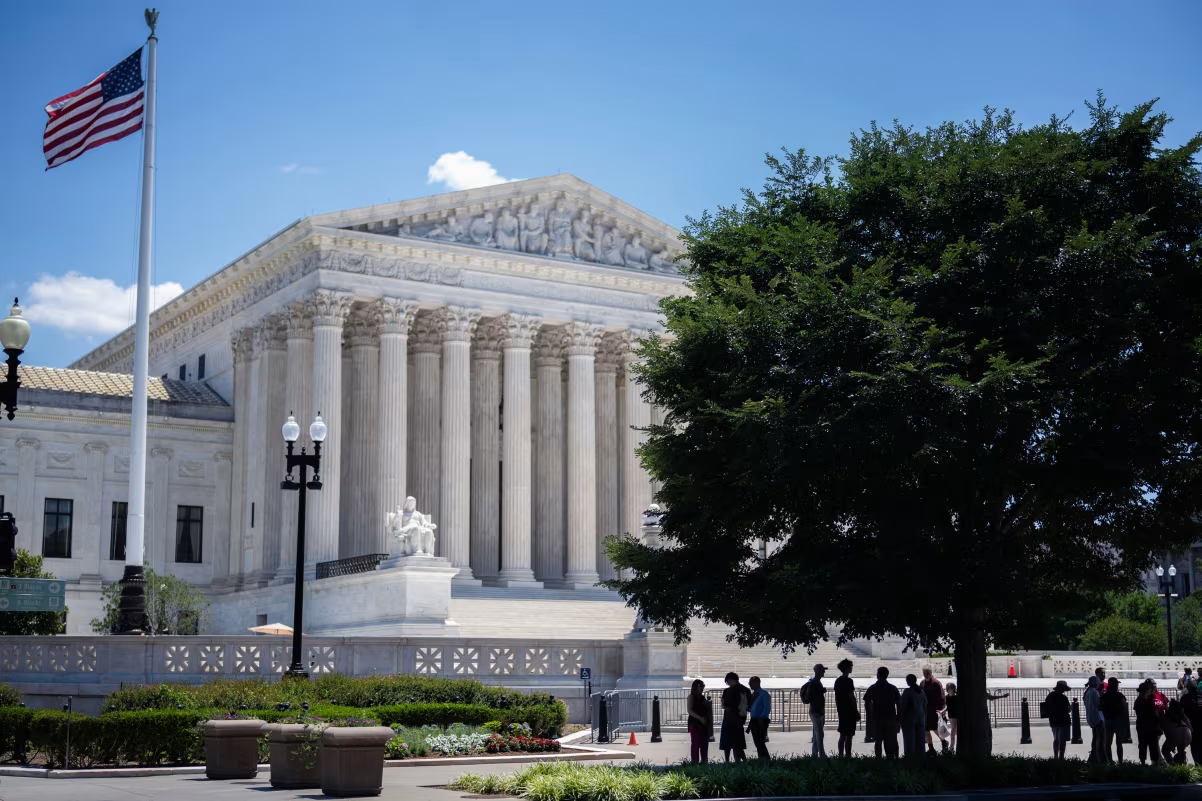
Hundreds of thousands of immigrants who had built lives in the United States under Temporary Protected Status awoke to a dramatically different legal reality after the Supreme Court cleared the way for the federal government to end protections for Haitians and Syrians. For many of the people directly affected, the ruling was not an abstract disagreement about legal language or executive authority. It immediately raised questions about jobs, homes, children, marriages, pending immigration applications and whether returning to countries still facing serious instability could be avoided. For immigrants from other nations covered by the same humanitarian program, the decision carried an equally unsettling message: legal challenges that had temporarily protected them from losing status may now be far more difficult to sustain.
The decision involved two combined cases challenging the Trump administration’s efforts to end Temporary Protected Status, commonly known as TPS, for people from Haiti and Syria. The Court’s conservative majority ruled that the law establishing TPS largely prevents judges from reviewing the government’s decisions about whether a country’s designation should be terminated. It also rejected, at the preliminary stage of the litigation, the argument that the termination of Haiti’s protection was unlawfully motivated by race.
The ruling reversed lower-court decisions that had temporarily blocked the terminations while lawsuits moved forward. Those earlier decisions had allowed Haitian and Syrian TPS holders to retain protection from deportation and authorization to work while judges examined whether the Department of Homeland Security had followed proper procedures and considered the actual conditions in the affected countries.
That legal protection has now been seriously weakened.
The immediate consequences reach more than 350,000 Haitians and approximately 6,100 Syrians. The wider consequences could reach far beyond those two communities because the administration has moved to end or restrict TPS for numerous countries. Legal advocates estimate that approximately 1.3 million people held TPS across 17 national designations before the recent series of terminations began.
The Court did not issue removal orders against every TPS holder. It did not decide the individual immigration case of each person affected. It did not rule that every beneficiary must leave the United States immediately. What it did was remove a major legal obstacle that had prevented the government from allowing the terminations to take effect.
That distinction is important, but it offers limited comfort to families whose ability to remain and work may soon depend on rapidly changing deadlines, pending applications and individual legal histories.
TPS was created by Congress in 1990 as a temporary humanitarian protection for people already in the United States when conditions in their home countries made safe return impossible or dangerously uncertain. The secretary of homeland security may designate a country because of an ongoing armed conflict, an environmental disaster or extraordinary temporary conditions.
People generally cannot use a new TPS designation as a way to enter the United States. To qualify, they normally must already have been physically present by dates established for the country. They must apply, pass security checks and continue renewing their status during designated registration periods.
TPS provides two central protections. Beneficiaries are shielded from removal based on their immigration status, and they can obtain authorization to work legally. Some may also receive permission to travel and return, although travel can involve separate requirements and risks.
TPS does not automatically provide a direct path to permanent residency or citizenship. A person may live in the United States under TPS for years while remaining dependent on repeated extensions of the country designation. Some beneficiaries may qualify separately for asylum, family-based immigration, employment-based status or other relief. Others have no clear alternative once TPS ends.
That temporary structure became central to the Supreme Court’s reasoning.
The majority emphasized that Congress gave the executive branch broad authority over TPS designations and included language restricting judicial review of decisions to designate, extend or terminate them. Writing for the Court, Justice Samuel Alito concluded that the restriction covered not only the final decision but also many challenges to the process leading to it.
The plaintiffs had argued that they were not simply asking judges to substitute their own policy judgment for that of the homeland security secretary. They said officials had failed to follow legal requirements, including meaningful consultation with other government agencies and adequate consideration of conditions in Haiti and Syria.
Lower courts found those claims serious enough to justify interim protection.
The Supreme Court disagreed. The majority interpreted the statute broadly and concluded that the challenges under administrative law were barred from judicial review. In practical terms, that interpretation gives the Department of Homeland Security significant freedom to terminate TPS designations with limited court supervision.
The Haitian plaintiffs also argued that the decision was influenced by racial discrimination. Their lawyers pointed to statements by President Donald Trump and former Homeland Security Secretary Kristi Noem concerning Haitians and immigrants from predominantly nonwhite countries.
The majority acknowledged that some of the public language surrounding Haiti and Haitian immigrants had been heated. However, it found the evidence insufficient, at this stage, to show that race was a motivating factor in the termination decision. The Court said a race-neutral explanation was available: the administration broadly opposed the way previous administrations had operated the TPS program and had moved to end every designation that came up for review.
Justice Elena Kagan, joined by Justices Sonia Sotomayor and Ketanji Brown Jackson, strongly disagreed.
The dissent argued that the administration had not complied with legal requirements and that the majority was allowing serious procedural failures to escape review. Kagan also concluded that evidence supporting the Haitian plaintiffs’ discrimination claim was substantial enough to justify continued protection while the case developed.
The disagreement between the majority and dissent was about more than TPS. It reflected a wider struggle over how much authority courts possess to examine executive immigration decisions, particularly when Congress has included language limiting review.
For the government, the ruling represented a major victory. The Department of Homeland Security has repeatedly argued that TPS was intended to be temporary and had become a form of long-term immigration status without congressional authorization. Administration officials say allowing designations to continue for many years undermines the structure created by Congress and discourages home countries from improving conditions.
Haiti was first designated for TPS after the devastating 2010 earthquake. The disaster killed or injured hundreds of thousands of people, destroyed homes and infrastructure and worsened already severe economic and political instability.
The protection was repeatedly extended and later redesignated as conditions changed. The reasons expanded beyond the original earthquake. Government reports cited political instability, gang violence, human-rights abuses, poverty, limited healthcare, food insecurity and additional natural disasters.
Many Haitian beneficiaries have now lived lawfully in the United States under TPS for more than a decade. During that time, they have worked, paid taxes, created businesses, married and raised children. Some arrived as young adults and are now middle-aged. Others have U.S.-citizen children who have never lived in Haiti and may not speak Haitian Creole or French fluently.
The Trump administration argued that certain areas of Haiti were suitable for return and that continuing the designation conflicted with American national interests. It also raised concerns about visa overstays, unauthorized immigration and the Haitian government’s ability to provide reliable information about its nationals.
Immigration advocates strongly dispute the idea that Haiti is safe for large-scale returns. Armed groups control significant territory, political institutions remain unstable and violence has disrupted transportation, healthcare, schools and access to food. The U.S. government itself has continued warning citizens against travel to Haiti.
That contradiction has become a central talking point for critics. They question how the government can describe a country as dangerous for American travelers while requiring longtime residents to return there.
Administration officials respond that travel warnings and TPS standards serve different legal purposes. A warning advises Americans about risk, while TPS requires a formal determination under a specific statute. The government maintains that a country can remain dangerous without continuing to satisfy the legal conditions for a nationwide TPS designation.
Syrians face a different but equally serious history.
Syria received TPS designation during the civil war that began in 2011. The conflict killed large numbers of people, displaced millions and produced accusations of war crimes, torture, chemical attacks and mass detention. Although political and territorial conditions have changed, significant security and humanitarian concerns remain.
The administration determined that Syria’s designation should end, arguing that the circumstances supporting TPS had changed sufficiently. Syrian beneficiaries challenged that conclusion, saying officials had not properly evaluated conditions or consulted other agencies.
The Court’s decision means the judiciary may have very limited authority to examine those objections.
For individual families, the legal theory quickly becomes practical.
A TPS holder may have a valid employment authorization document connected to the designation. When protection ends, that document may expire immediately or after a transition period identified in official guidance. An employer may then be unable to continue legally employing the person.
The loss of work authorization can affect more than the worker. It can remove a family’s health insurance, rent money and ability to pay for food, transportation or childcare. Businesses can lose experienced employees with little time to replace them. Hospitals, construction firms, hotels, restaurants, factories, schools and home-care providers may be affected in communities with large TPS populations.
Employers also face compliance questions. They must follow federal verification requirements but avoid unlawful discrimination. A company cannot assume that every Haitian or Syrian employee lacks authorization. Some may hold green cards, citizenship, asylum, another visa or employment authorization based on a different immigration category.
The same individual complexity applies to TPS holders themselves.
A person whose TPS ends may still have a pending asylum case. Another may be married to a U.S. citizen and pursuing permanent residency. Someone else may have a petition filed by an employer or adult child. A crime victim may qualify for a special visa, while another person may have no available immigration option.
Even people with pending applications can face uncertainty. Filing an application does not always provide protection from removal, and eligibility can depend on how someone entered the country, previous immigration violations, criminal history, travel and other circumstances.
The ruling therefore creates what many lawyers describe as a scramble rather than one uniform outcome.
People are being urged to obtain individualized legal advice from qualified immigration attorneys or accredited nonprofit representatives. The urgency creates opportunities for fraud. Unlicensed individuals may promise guaranteed status, charge large fees or submit applications that place immigrants at greater risk.
The fear is especially intense for people who have provided extensive personal information to the government through repeated TPS renewals. Their addresses, fingerprints and employment records are already within federal systems. Some worry that the same records used to grant protection could make them easier to locate if they become removable.
Families with U.S.-citizen children face painful decisions.
A parent may consider leaving the country and taking the children to a place they have never known. Another may leave children with relatives in the United States. Some may remain without authorization and live with the threat of detention or removal.
A child’s citizenship does not automatically give a parent lawful status. U.S.-citizen children generally cannot petition for parents until they reach adulthood, and even then approval may depend on the parents’ immigration history and other legal requirements.
The result is that children who are fully American under the Constitution may still experience a parent’s loss of status as a direct disruption to their own lives.
Schools may see students become anxious, distracted or absent. Families may avoid medical appointments, public programs or contact with authorities because they fear immigration consequences. Children may begin carrying emergency phone numbers or instructions about who should collect them if a parent does not return home.
Community organizations have already spent years preparing families for the possible end of TPS. Workshops often encourage parents to update identification documents, organize financial records, create guardianship plans and discuss emergency contacts.
These preparations do not make separation less painful. They show how long uncertainty has shaped everyday life for TPS communities.
The economic effects could reach beyond the families directly involved.
TPS holders participate in the legal workforce and contribute taxes. Many work in industries facing labor shortages. Removing work authorization from hundreds of thousands of experienced workers could disrupt employers and local economies.
Supporters of termination argue that immigration enforcement should not be determined by economic dependence. They say businesses should not assume that temporary humanitarian protection will become permanent simply because workers and employers have built reliance over time.
Critics answer that the government repeatedly renewed the designations while beneficiaries made decisions based on lawful status. People bought homes, opened businesses and raised families under government-issued documents. Ending those protections after many years creates consequences that the word temporary does not fully capture.
The political debate often presents TPS as a choice between temporary protection and permanent settlement. The real population includes people in many different circumstances.
Some arrived recently. Others have lived in the United States for decades. Some entered legally and later received TPS. Others entered without authorization. Some have separate immigration cases. Others depend entirely on TPS.
This diversity makes broad statements about the group incomplete.
The Supreme Court’s ruling also affects pending lawsuits involving other countries. Lower courts had blocked or delayed several terminations based on arguments similar to those rejected in the Haitian and Syrian cases. The administration is expected to use the new decision to ask judges to lift those protections.
The Court said that the current administration had terminated every TPS designation that had reached review, 13 in total. Those actions have included countries affected by conflict, authoritarian rule, economic collapse and natural disaster.
Immigrant advocates say the pattern shows that the administration is attempting to dismantle the program rather than conduct country-specific evaluations. They argue that the Supreme Court has now made it nearly impossible to challenge that strategy through ordinary administrative law.
The government says the pattern shows consistency. It argues that previous administrations allowed supposedly temporary designations to remain in place long after the original emergencies and that the current administration is restoring the law’s intended limits.
Both sides now look toward Congress.
Because TPS exists through federal law, lawmakers could change the statute. Congress could allow broader judicial review, provide longer transition periods or create pathways to permanent residence for people who have held TPS for many years.
Bills offering permanent status to certain TPS holders have been introduced repeatedly but have not become law. Immigration legislation is politically difficult because humanitarian relief, border enforcement, legal immigration and citizenship often become tied together in wider negotiations.
Supporters of permanent status say people who have lived legally in the United States for many years should not remain dependent on short extensions. Opponents say granting residency would encourage future temporary programs to become permanent and reduce incentives for beneficiaries to return.
Without congressional action, each administration can change TPS policy significantly. A Democratic administration may extend or redesignate countries, while a Republican administration may terminate them. Immigrants can therefore experience major changes in legal security after elections.
The Court’s ruling strengthens executive control over that process.
It does not completely eliminate constitutional challenges, but the majority’s rejection of the Haitian discrimination claim demonstrates how difficult those cases may be. Plaintiffs would need strong evidence that an action violated constitutional rights, and preliminary protection may be harder to obtain.
The ruling may also encourage legal challenges to shift toward individual cases. Instead of attacking the termination of an entire country designation, immigrants may pursue asylum, withholding of removal, protection under international anti-torture rules or other forms of relief.
Those options are narrower than TPS.
TPS is based on conditions affecting a country or group. Asylum generally requires a person to show a particular fear of persecution connected to protected grounds such as race, religion, nationality, political opinion or membership in a particular social group. General violence or poverty may not be enough.
Applications are also subject to deadlines, evidentiary requirements and complex legal standards. People who lived in the United States for years under TPS may face obstacles if they did not apply for asylum earlier.
Protection from removal to a country where someone may be tortured has its own demanding requirements. Even successful applicants may receive less stable status than permanent residents.
Voluntary departure is another possibility for some people, allowing them to leave without a formal removal order. But leaving can trigger barriers to returning, especially for those who accumulated unlawful presence before receiving TPS.
Every option depends on individual facts, which is why broad social-media advice can be dangerous.
The administration has encouraged people losing protection to depart voluntarily and use government programs that may provide travel assistance. Officials say voluntary departure offers a more orderly alternative to arrest and removal.
Advocates caution that accepting such assistance can have legal consequences and may not be appropriate for people with pending cases or possible relief. They argue that families should not make irreversible decisions based on fear or deadlines they have not confirmed through official sources.
The timing after the Supreme Court decision remains critical.
The Court reversed the lower-court judgments and sent the cases back for further proceedings. Government agencies and lower courts must implement the ruling, and official employment and immigration guidance may be updated.
TPS holders should therefore pay close attention to notices from the Department of Homeland Security and U.S. Citizenship and Immigration Services. Outdated social-media posts can be particularly harmful because work-authorization dates and court orders can change quickly.
A person who assumes protection ended immediately might unnecessarily leave a job. Another who relies on an old extension notice could continue working after authorization expires.
The legal confusion can also affect state agencies, licensing offices, universities and employers that use federal databases to verify status. Systems do not always update at the same time, leading to inconsistent responses.
Even before formal implementation, the psychological consequences are immediate.
For years, TPS holders have lived between safety and uncertainty. They could work, but their protection was temporary. They could build lives, but every extension carried an expiration date. Court rulings sometimes offered relief, only for appeals to restore the threat.
The Supreme Court decision narrows the space in which those communities could hope that procedural challenges would keep protections alive.
A Haitian healthcare worker who spent years caring for American patients may now be asking whether she can renew her employment document. A Syrian shop owner may be reviewing the immigration status of every family member. Parents may be checking passport validity for children who have never traveled abroad.
The scale is large, but the choices are intensely personal.
Some families will discover another lawful path. Some may receive temporary protection through separate litigation or new policies. Others may depart. Some may remain without authorization despite the risk.
The Court did not decide which of those futures awaits any particular person.
It decided who has the power to make a central part of the policy and how limited the courts are in reviewing that power.
For the administration, the ruling restores control that it says Congress intentionally placed in the executive branch. For opponents, it removes judicial safeguards at the moment they are most needed.