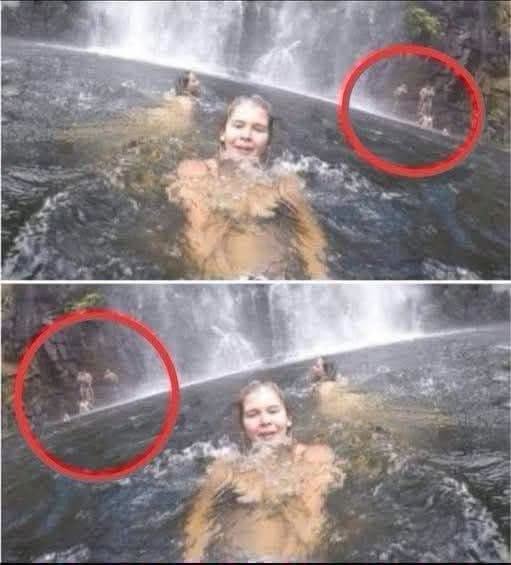
A simple image can appear to reveal almost nothing. At first glance, it may look like an ordinary photograph, drawing, landscape, room, face or collection of shapes. The viewer recognizes the main subject quickly, decides what the picture represents and prepares to move on. Then someone asks a question: What did you miss? Suddenly the image no longer feels simple. The eyes return to the screen, moving more slowly across areas that seemed unimportant moments earlier. A shadow begins to resemble a figure. Empty space forms an outline. A familiar object appears in an unexpected place. A second face emerges from the arrangement of lines. Nothing in the image has changed, yet the experience of seeing it has changed completely.
That transformation reveals something important about human perception. Seeing is not the same as recording. The eyes do not operate like a camera that captures every detail equally and stores a perfect copy for later inspection. People select, organize and interpret what they see. Attention moves toward some elements and away from others. The brain recognizes familiar patterns, predicts what probably belongs in the scene and constructs a coherent impression from incomplete information. Most of the time, this process works so smoothly that people do not notice it happening.
A visual puzzle interrupts that confidence. It demonstrates that an object can be directly in front of someone without becoming part of their conscious experience. The missing detail may be obvious after it has been pointed out, creating the strange feeling that it appeared from nowhere. The viewer wonders how it could have remained invisible when it was present the entire time.
The answer often begins with attention.
Every visual scene contains more information than a person can examine carefully at once. Even a simple room includes surfaces, colors, reflections, objects, distances, edges, textures and movement. A busy street contains far more. If the brain treated every visible detail as equally important, ordinary life would become overwhelming. Attention solves part of this problem by prioritizing information connected to current goals.
A person searching for a friend in a crowd may focus on height, clothing or hair. Someone crossing a road attends to vehicles, signals and movement. A reader follows letters and words while barely noticing the shape of the page around them. The selected information becomes clear while much of the remaining scene receives limited attention.
This selection is useful, but it produces blind spots. An unexpected detail can remain unnoticed even when the eyes pass over it. Looking directly toward something does not guarantee conscious recognition. The mind must also treat it as relevant enough to process.
That is why a hidden-image challenge often begins by controlling expectations. If viewers are told to find an animal, they search for features associated with animals. If they are asked to count objects, attention becomes fixed on quantity. If they are simply shown the image without instructions, they may accept the most obvious interpretation and stop searching.
The first interpretation becomes a frame. Once the brain decides that the image shows a tree, for example, irregular branches are processed as parts of that tree. A face formed by those same branches may remain hidden because the viewer is no longer asking whether another interpretation is possible. The image has been classified, and classification reduces uncertainty.
This is one reason first impressions are efficient. People cannot begin every visual encounter by questioning every shape. A chair is usually a chair. A door is usually a door. Quick recognition allows immediate action. Problems arise when speed becomes certainty.
The human brain is especially skilled at finding patterns. Faces are among the most powerful examples. People can recognize face-like arrangements in clouds, buildings, food, shadows and natural formations. Two marks may become eyes, while a line beneath them becomes a mouth. This tendency can create playful illusions, but it also shows how perception depends on organization rather than individual details alone.
The same marks may appear meaningless until they are grouped in a particular way. Once the pattern is recognized, it becomes difficult not to see it. The viewer may wonder how the image ever looked like random shapes.
Hidden-image puzzles often exploit the relationship between figure and background. The figure is the part of a scene treated as the main object, while the remaining area becomes the background. Yet the same lines can sometimes support two different figures. A light region may form one object, while the dark space around it forms another.
When attention changes, the visual hierarchy reverses. What seemed like empty background becomes meaningful. What seemed like the main object becomes supporting space. The image demonstrates that background is not truly empty. It was only assigned a lower priority.
This has consequences far beyond puzzles. In everyday life, people often focus on the most noticeable person, object or event and treat everything else as context. Important information may remain in the edges: an expression on another person’s face, a warning sign behind a larger advertisement, a small change in a familiar environment or a detail that does not fit the expected story.
A simple picture can therefore become a lesson in intellectual humility. It reminds viewers that confidence is not proof of completeness. A person may accurately see one part of a scene while missing another part entirely.
The most interesting visual challenges do not merely hide tiny objects. They reveal how assumptions guide attention. A hidden detail does not always need to be small. It may occupy a large section of the image but remain unnoticed because it does not match the viewer’s expectation.
Imagine a photograph of a family standing outdoors. Most viewers will look at the faces first. They may notice expressions, clothing and relationships between the people. A large shape in the background could remain unseen if it is interpreted as part of a tree or shadow. Once the shape is identified as an animal or another person, its size becomes surprising. The viewer did not miss it because it was physically insignificant. The viewer missed it because attention had been directed elsewhere.
Visual familiarity can make this effect stronger. When people believe they know what a scene contains, they inspect it less carefully. A kitchen is expected to contain counters, cabinets, appliances and dishes. If an unusual object is placed among those familiar items, the brain may still produce the general conclusion “kitchen” without examining every component.
This is efficient pattern recognition. It is also a possible source of error.
The mind frequently uses context to interpret incomplete visual information. A partially hidden shape is identified based on what normally belongs nearby. A person does not need to see an entire cup to understand that a curved handle beside a round container belongs to one object. Context helps build stable perception from limited input.
However, context can also create the wrong answer. If a shape resembles two possible objects, the surrounding scene may push the viewer toward one. A dark curve in a forest might be read as a branch, while the same curve in a living room might be read as a cable. Expectations influence what the object becomes.
Artists and designers use this knowledge deliberately. They can guide the eye through contrast, color, position, size and direction. A bright object against a dark background attracts attention. A face pulls the viewer toward a particular area. Lines can direct the gaze inward or outward. Repetition creates rhythm, while interruption creates surprise.
A hidden detail may be placed where viewers are least likely to look. The center of an image often receives attention first, so the important element may sit near an edge. Strong colors may distract from quieter shapes. A dramatic foreground object may hide a meaningful background arrangement. The viewer’s attention is not random; it can be predicted and influenced.
Advertising uses many of the same principles. A product, face or emotional symbol may dominate the viewer’s awareness, while conditions, qualifications or secondary messages remain less noticeable. The information may technically be visible but visually subordinate.
Social media intensifies this process because images are viewed quickly and surrounded by constant competition. Each post has only a brief opportunity to capture attention. Bold colors, dramatic expressions and large text are used to stop scrolling. Once the viewer pauses, the content still competes with notifications, comments and the expectation of the next post.
The result is a viewing style based on rapid recognition. People ask, often unconsciously, “What is this?” rather than “What exactly is here?” The first question can be answered in a fraction of a second. The second requires patience.
A visual puzzle changes the goal. It tells the viewer that the first answer is incomplete. This instruction alone can alter what becomes visible. The eyes begin scanning corners, boundaries, negative spaces and repeated forms. Instead of confirming the original interpretation, the viewer searches for contradictions.
This is a valuable mental habit. Many errors survive because people search only for information that supports what they already believe. Once they form an interpretation, they notice details that fit it and overlook details that challenge it. A hidden-image puzzle offers a harmless demonstration of the same tendency.
The lesson is not that first impressions are always wrong. Often they are accurate. The lesson is that they are usually partial.
A person can test this by observing how memory changes after a short glance. Look at a complicated image for several seconds, then turn away and describe it. The main subject may be remembered clearly, but details such as object positions, colors, background items or clothing features may be uncertain. The mind often preserves the meaning of the scene more effectively than its complete visual structure.
Someone may remember that a family was eating dinner without remembering the number of plates. They may remember a street scene without knowing the color of the parked car. They may remember a person smiling without remembering what was behind them.
This does not necessarily mean memory failed after perception. Some details may never have been fully attended to in the first place. They were visible but not deeply encoded.
That difference matters in situations where visual accuracy is important. Eyewitnesses may feel confident about a scene while having focused on only part of it. Drivers may fail to notice an unexpected pedestrian or cyclist because attention is directed toward other traffic. Professionals may overlook a warning on a familiar display because they expect the routine pattern they have seen many times before.
A puzzle cannot reproduce the seriousness of those situations, but it makes the mechanism understandable. The viewer experiences a small, safe failure of awareness and then recognizes how natural that failure felt.
The emotional response is often laughter or disbelief. People say, “How did I not see that?” The question reflects the assumption that anything physically visible should automatically become consciously visible. The puzzle proves otherwise.
After the hidden detail is found, the brain reorganizes the image. The new interpretation may become dominant. In some illusions, the viewer can switch between two readings but cannot hold both equally at the same moment. One figure comes forward as the other recedes.
This switching reveals that perception is active. The image does not force one permanent experience. The viewer’s attention and interpretation participate in producing what is seen.
Language can influence this process as well. A caption may prepare the brain to recognize a particular object. Without the label, an ambiguous pattern may remain confusing. After the object is named, its form becomes clear.
This is why hints in visual puzzles are powerful. A statement such as “look near the lower-left corner” narrows the search area. A stronger hint such as “find the sleeping animal” narrows both location and category. The viewer begins matching shapes to the expected object.
Once found, the object may feel undeniably present. Yet the same visual information existed before the hint. The words did not change the picture. They changed the viewer’s search strategy.
The influence of labels extends into daily life. Describing a person as angry, nervous, confident or suspicious may shape how others interpret the same facial expression. Calling an event a protest, disturbance or celebration changes which visual details seem important. Words can frame images before viewers inspect them independently.
That is why captions should be treated as claims rather than automatic truth. A photograph can be real while its description is false. An old image may be presented as current. A training exercise may be labeled as an emergency. A person’s neutral expression may be described as evidence of fear or guilt.
Careful viewing requires separating what the image visibly establishes from what the caption asks the viewer to believe.
A simple visual challenge can teach this distinction. First describe only what is directly visible: shapes, colors, positions and objects. Then consider the interpretation. This slows the movement from observation to conclusion.
For example, “a person has one hand raised” is an observation. “The person is admitting defeat” is an interpretation. “Several people are standing close together” is visible. “They are members of the same family” may require outside information.
People often move between these levels without noticing.
Perspective also affects what becomes visible. A close-up hides context. A wide shot hides fine detail. A photograph taken from one angle may make objects appear connected when they are separated in space. Shadows can alter shape, and distance can change apparent size.
An image is always a selection. It includes what fits inside the frame and excludes everything beyond it. This does not make photographs unreliable by nature, but it means they are never complete representations of an event.
The person taking the image chooses where to stand, when to press the button and what to leave outside the frame. Later, an editor may crop, brighten, darken or enlarge certain areas. A viewer sees the final selection without necessarily seeing the choices that produced it.
Hidden-detail challenges usually use this limitation playfully. News, advertising and political content may use it persuasively.
A crowd can appear large in a tightly framed image and small in a wide aerial view. A damaged object can dominate the frame while the undamaged surroundings remain unseen. A speaker can appear isolated if nearby people are cropped away.
The image itself may be authentic while still encouraging a misleading impression.
This is another reason careful observation matters. Viewers should ask not only what appears in the frame but what information would be necessary to understand the scene. Where was the camera? What happened before and after? Is the image cropped? Does another angle exist? Who supplied the caption?
These questions turn passive viewing into active analysis.
The linked page’s broad message—that people may miss details when they move too quickly—is valuable, but the strongest version of that lesson goes beyond finding a hidden face or animal. It applies to how people process information generally.
Speed encourages simplification. A headline becomes the full story. A photograph becomes proof of a motive. A short clip becomes evidence of an entire event. A familiar visual symbol becomes a substitute for cultural, political or historical context.
Slowing down creates room for uncertainty.
The viewer may realize that they do not know who took the photograph. They may notice that the article does not identify its source. They may discover that the image and headline do not match. They may observe that a supposed hidden-detail test never actually explains what should be found.
This kind of attention is not the same as suspicion toward everything. It is disciplined curiosity. The goal is not to assume deception but to distinguish between what is shown, what is suggested and what is verified.
A useful method is to look at an image in stages. Begin with the whole scene and identify the dominant subject. Then inspect the edges. Look at the background, spaces between objects and areas of low contrast. Notice repeated shapes, unusual shadows and lines that continue across different objects. Finally, reconsider the first interpretation and ask whether the same visual elements could form something else.
This method works for puzzles because designers often use predictable gaps in attention. It also develops a broader habit of observation.
Another useful technique is to change the viewing conditions. Increase or reduce the image size. Step farther away. Rotate it. Cover the obvious subject and examine the remaining space. Some hidden patterns become clearer when detail is reduced, because the brain can recognize the larger shape. Others appear only when enlarged.
Different viewers may find different elements first. This does not necessarily reveal fixed personality traits, despite the many online quizzes claiming that the first object seen proves someone is logical, emotional, independent or romantic. Such personality interpretations are often unsupported and broad enough to fit almost anyone.
What a viewer notices first may be influenced by contrast, screen size, visual experience, expectations, instructions and where the eyes happened to land. It should not automatically be treated as a psychological diagnosis.
The puzzle can still reveal something real: attention varies. Two people looking at the same scene may not have the same conscious experience. One notices the face, another notices the animal, while a third sees only the landscape.
This difference helps explain why disagreements about images can feel so sincere. People may believe others are ignoring what appears obvious, without realizing that “obvious” often becomes obvious only after attention selects it.
Once one interpretation is known, it is difficult to return completely to the earlier state of not seeing it. Knowledge changes perception. The hidden object becomes easier to detect each time, and eventually it may seem more prominent than the original image.
This effect can make explanations frustrating. Someone who already knows the answer points directly to the object and says it is impossible to miss. But before attention was guided there, the image was organized differently.
Understanding this can make people more patient when communicating. Information that seems obvious to one person may genuinely be outside another person’s attention. Clear directions, labels and context can help bring it forward.
At the same time, viewers should remain aware that attention can be manipulated. A person who tells the audience where to look may be helping them see an important detail, or distracting them from another one. A dramatic circle or arrow on an image creates immediate focus. Everything outside that mark becomes less likely to receive examination.