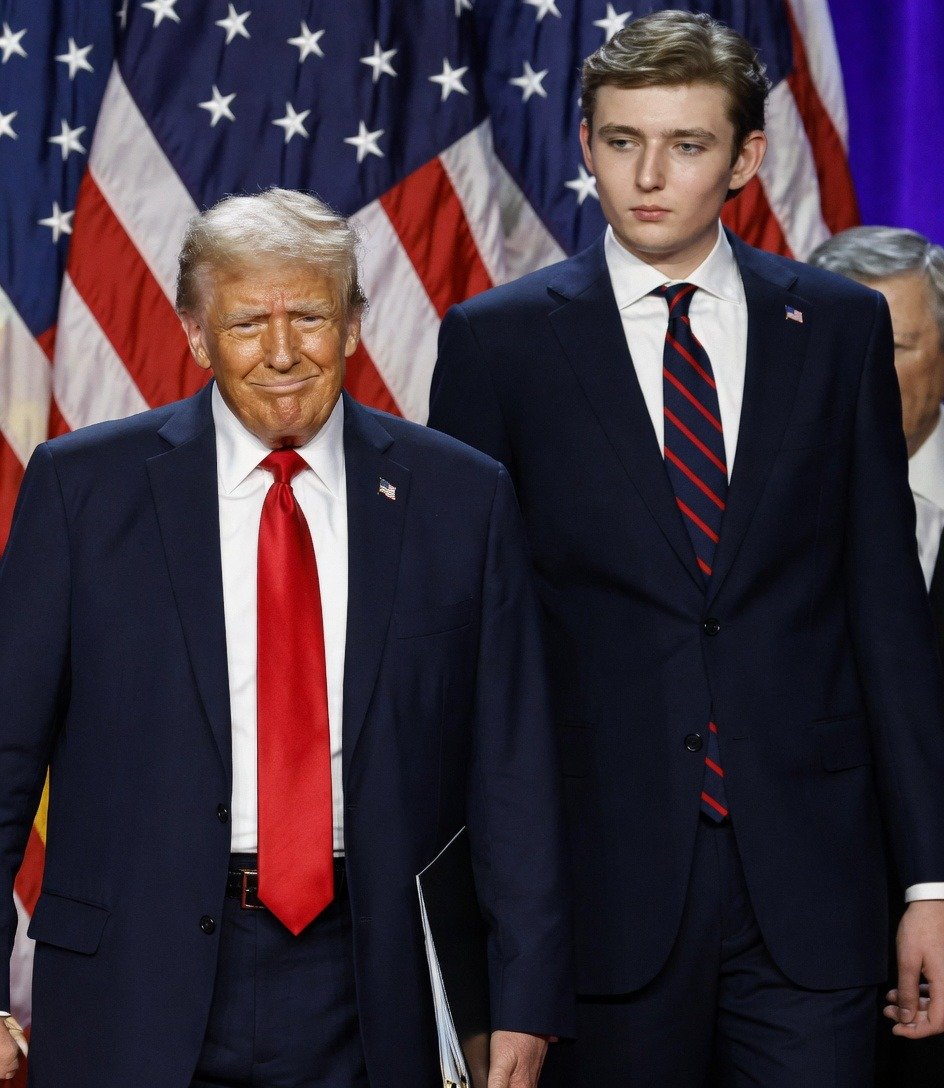
A dramatic headline began circulating online claiming that Barron Trump had finally admitted what everyone had supposedly suspected. The wording promised a major revelation from one of the most private members of America’s most famous political family. It implied that, after years of silence, the youngest son of Donald and Melania Trump had personally confirmed a secret, addressed a rumor, or revealed something important about his life. Yet the linked article contained no confession, no interview, no direct quotation, and no identifiable statement from Barron at all. Instead, it offered a short, emotional description of a young man who had grown up under intense public attention while being carefully protected from it. The article spoke about privacy, discipline, family pressure, and the possibility that he might someday enter business or politics, but it never revealed what he had supposedly admitted. The headline created a mystery that the article did not solve because there was no documented admission to explain.
The most basic detail in the headline was already outdated. Barron Trump was born on March 20, 2006. He turned 18 in March 2024, 19 in March 2025, and 20 in March 2026. An article published in May 2026 still presenting him as 18 was therefore not describing his current age. The use of “18” appears designed to revive a moment when public curiosity about him increased after he reached adulthood. For years, many media organizations had limited their coverage because he was a minor. Once he turned 18, websites and social-media pages began treating him as a more acceptable target for speculation, even though becoming a legal adult did not automatically make every aspect of his private life public information.
The headline uses several familiar clickbait techniques at once. “Finally” suggests that readers have been waiting for a statement. “Admits” implies secrecy, reluctance, or possible wrongdoing. “What we all suspected” invites the audience to imagine its own theory before opening the article. Different readers may suspect entirely different things, but the headline does not need to identify any of them. It only needs to create the feeling that a shared secret exists.
This wording is effective because it turns vagueness into personal involvement. The reader is not simply being offered news about Barron Trump. The reader is told that they already suspected the truth. Opening the article becomes a way of confirming their own instincts. The headline flatters the audience by suggesting that it has noticed something hidden from ordinary view.
But what exactly was suspected?
The linked page never says.
Barron does not admit that he plans to enter politics. He does not announce a business venture. He does not discuss his relationship with his father or mother. He does not address rumors about school, friendships, dating, family life, or future ambitions. No speech, recording, interview, court document, social-media message, or verified representative is cited.
The body of the article is instead written like a cinematic character profile. It describes a boy born into wealth and controversy, watched by cameras and protected by a mother who valued privacy. It presents his quiet public behavior as a deliberate survival strategy. These observations may sound meaningful, but they are mostly interpretations. A reserved expression in a photograph cannot prove a person’s emotions, upbringing, ambitions, or private beliefs.
The article states that Barron learned to remain silent and composed while history unfolded around him. This is poetic language rather than documented reporting. It may reflect a reasonable impression based on his limited public appearances, but the reader is not shown evidence that Barron described himself in those terms. He has not been quoted saying that silence was a survival skill or that he intentionally disappeared from public life.
There is an important difference between observing that someone rarely gives interviews and claiming to understand why. Barron Trump has spent much of his life near political power, but he has usually remained outside the public conversation. That absence creates an information vacuum. When someone famous says very little, people begin interpreting photographs, body language, family comments, and anonymous claims as though they reveal an entire personality.
Silence becomes a blank screen onto which audiences project their expectations.
Supporters of Donald Trump may imagine Barron as a future political leader, a technology expert, or the natural heir to a family movement. Critics may imagine tension, disagreement, or discomfort behind his reserved expression. Celebrity pages may focus on his height, appearance, clothing, or social life. Business-oriented accounts may describe him as an ambitious future entrepreneur. None of these narratives necessarily comes from Barron himself.
The public knows him mainly through other people’s descriptions.
His father has occasionally spoken about his intelligence, interest in technology, education, and political awareness. His mother has discussed protecting his privacy and supporting his schooling. Journalists have reported on his appearances, graduation, and university attendance. But statements made about a person should not be transformed into admissions made by that person.
This distinction disappears in viral content because “Barron’s father praised his technological abilities” sounds less dramatic than “Barron finally admits the truth.” One is a limited report that can be attributed to a known speaker. The other promises personal revelation.
The page’s writing gives the impression of knowledge while remaining difficult to verify. It says Melania Trump chose silence and structure for her son and wanted him treated as a child rather than a political prop. That broad idea is consistent with her long-established public protectiveness, but the article does not provide a new interview or source. It packages familiar impressions into dramatic prose and presents them as though they explain Barron’s inner life.
The sentence suggesting that his future may involve business, politics, or something far from the Trump world is not news. Those possibilities cover nearly every direction his adult life might take. The article can therefore appear insightful without making a prediction specific enough to be tested.
If Barron enters business, the piece can be described as accurate. If he enters politics, it can be described as accurate. If he avoids both, it can still be described as accurate because it included the possibility of doing something else. This flexible writing is common in viral personality stories. It creates the feeling of revelation while avoiding a clear factual commitment.
The article also benefits from the extraordinary public interest surrounding the Trump family. Donald Trump’s political career, legal disputes, business history, presidency, campaigns, and divisive public profile have generated enormous attention. His adult children have participated publicly in politics, business, media appearances, and campaigns. Barron has followed a different path, appearing mostly at major family or official events.
That contrast naturally generates curiosity. People want to know whether he shares his father’s ambitions, political beliefs, communication style, and interest in business. They wonder whether he will eventually seek public office or prefer a private career. Since Barron has not answered most of those questions publicly, websites answer them for him.
Privacy becomes treated as evidence of hidden significance.
A quiet person in an ordinary family may simply be described as private. A quiet person in a presidential family is often presented as mysterious, strategic, secretly influential, or preparing for a major entrance. Every absence becomes part of a developing legend.
The claim that he “finally admits” something is especially misleading because it reverses the actual situation. The linked page contains no evidence that Barron broke his silence at all. The publisher is effectively speaking in his place while using a headline that attributes the revelation to him.
This can be understood as a type of false authority. Readers are more likely to click on a personal confession than on an anonymous writer’s speculation. By implying that the subject supplied the information, the headline gives the article an importance it has not earned.
Fabricated celebrity admissions often follow the same formula. A well-known person “finally reveals the truth,” “breaks their silence,” “confirms what fans believed,” or “admits the rumor was true.” After clicking, readers find recycled biography, unsupported emotional writing, or unrelated facts. Sometimes the article includes a genuine quotation that does not support the headline. In other cases, as here, there is no quotation at all.
The word “admits” is also loaded. People admit mistakes, secrets, hidden feelings, or facts they previously denied. It carries a suggestion of pressure, guilt, or reluctant honesty. Even when the supposed revelation is harmless, the word creates tension.
If the headline had said, “A Look at Barron Trump’s Private Upbringing,” it would more accurately describe the article. It would also probably attract fewer clicks. Accuracy is sacrificed because uncertainty is more profitable.
The age error adds another sign that the page may be reusing or adapting older viral content. Barron’s 18th birthday in 2024 led to a wave of articles about his adulthood, high-school graduation, potential political involvement, and university plans. A headline written around that moment could continue circulating long afterward because pages frequently recycle successful material.
Social-media algorithms do not always care whether a headline is current. A two-year-old story can appear new when reposted with a fresh image, publication date, or introductory caption. Users encountering it may assume it refers to something Barron said recently.
The publication date on a webpage can also be misleading. A page posted in 2026 may contain text based on claims or templates created much earlier. The age in the title may reveal that the content was not carefully updated. If the writer cannot correctly state how old the subject is, readers should be cautious about accepting deeper claims about his life.
The page provides no explanation for this inconsistency. It does not say that it is discussing something Barron said when he was 18. It claims that at 18 he finally made an admission, but then fails to identify a statement from that age.
Because Barron Trump is a presidential family member, misleading claims about him can move beyond entertainment gossip. They may influence political narratives. A fake quotation could be used to suggest support for a policy, candidate, movement, or controversial individual. A fictional admission could be presented as evidence of conflict or agreement within the first family.
This risk is not theoretical. False statements have previously circulated under Barron Trump’s name. In one widely shared example, social-media users attributed a political-sounding quotation to him through an account that was not officially connected to him. A spokesperson denied that he made the statement.
The existence of fake accounts makes verification particularly important. A profile may contain Barron’s name, photograph, or a verification-like symbol while having no connection to him. Fan pages, satire accounts, political supporters, impersonators, and engagement-farming operations can all post statements that are later copied without the original context.
A screenshot is not proof that a public figure posted something. Readers should locate the original account, check whether it is authentic, and look for confirmation from reliable reporters or representatives. Screenshots can be edited, accounts can change names, and deleted posts can be falsely reconstructed.
Barron’s limited public online presence makes impersonation easier. When a celebrity posts frequently through an established account, false messages can be compared against a known record. When someone has little or no verified public presence, almost any statement may seem possible.
The responsible conclusion is not that every claim about him is false. It is that claims supposedly coming directly from him require identifiable evidence.
That evidence might include a recorded public appearance, an authenticated account, a statement distributed by a representative, a court record, or a direct interview with a trustworthy publication. The linked page provides none of these.
Its emotional language should not be mistaken for sourcing.
Phrases about a “tower of gold,” a world “sharpening its knives,” and a boy “taught to disappear” create a dramatic narrative of pressure and survival. They may be effective writing, but they are not quotations or confirmed memories. The author is constructing a symbolic version of Barron’s childhood.
The phrase about being born in a tower of gold presumably refers to his early life at Trump Tower and the family’s wealth. The claim that the world sharpened its knives suggests public hostility toward his parents. These images are intended to make the reader feel sympathy for a child raised inside political conflict.
It is reasonable to recognize that growing up in a presidential family brings unusual scrutiny. Barron was photographed and discussed from childhood because of his father’s fame and political career. He was also mocked at times by online users despite being a minor, drawing criticism from people who argued that children of politicians should remain outside partisan attacks.
But acknowledging that pressure does not justify inventing his thoughts. Sympathy should not become another excuse to take control of his story.
Privacy means allowing the person to decide when and how to speak. A flattering fictional narrative can still violate that principle. Presenting Barron as exceptionally disciplined, emotionally strong, grounded, or destined for leadership may seem positive, but those claims remain external character assignments unless he has expressed them himself.
Positive misinformation is still misinformation.
People are often less cautious about claims that praise someone. A fake scandal is recognized as potentially harmful, while an invented story about kindness, intelligence, humility, or charity may be shared without concern. Yet false praise can create expectations, political mythology, and public pressure.
Imagine a young adult repeatedly described as a future president before deciding whether he wants a public life. The flattering narrative could make an ordinary choice to remain private appear like disappointment or failure. It could also make future actions seem preplanned when they were not.
Barron may eventually choose politics, business, technology, charity, or another field. He may become highly public or continue limiting his appearances. Those decisions belong to him.
The public can discuss confirmed events without pretending to know his destination.
His enrollment in university, attendance at official family events, and participation in publicly documented activities are legitimate subjects of factual reporting. Speculation should be clearly labeled as speculation rather than introduced as confession.
The distinction matters even more because Barron entered adulthood after spending most of his life as a protected minor. The shift did not suddenly make his private communications, relationships, and personal choices available for unrestricted invention. Legal adulthood affects many rights and responsibilities, but it does not erase the ethical value of privacy.
The headline’s promise rests on the assumption that audiences are owed an explanation from him. “Finally” suggests he has delayed providing an answer that the public deserved. But Barron has no obligation to satisfy rumors created by strangers.
Public figures may choose silence for many reasons. They may value privacy, focus on education, avoid misquotation, follow family advice, or simply have no desire to discuss themselves. Silence is not automatically suspicious.
The culture of viral media often treats refusal to participate as a puzzle. If someone does not speak, publishers create anonymous-source stories. If they avoid social media, fake accounts fill the gap. If they attend few events, every appearance is analyzed intensely.
This can produce a distorted cycle. Scarcity makes each image more valuable, encouraging more intrusive attention, which may give the person even more reason to remain private.
Barron’s physical appearance has frequently dominated coverage, particularly his height. Photographs of him standing beside relatives generate viral comparisons, commentary, and jokes. While those discussions may seem harmless, they demonstrate how little verified information is available. When a person says almost nothing publicly, even basic visual details become news.
The linked page attempts to turn that visual familiarity into psychological familiarity. Readers recognize his face and family, so the writer’s description of his inner character may feel credible. But seeing someone in photographs does not mean knowing them.
Body language analysis is especially unreliable in this context. A neutral facial expression during a ceremony might reflect concentration, fatigue, discomfort, boredom, or nothing meaningful. A photograph captures a fraction of a second. Selecting one image from hundreds can support nearly any narrative.
Websites may use a serious image to imply sadness or conflict and a smiling image to imply confidence or approval. The subject did not choose the interpretation.
The same caution applies to family dynamics. Barron’s relationships with his parents and siblings are private except where they or credible sources have discussed them. Public appearances can show that relatives attended an event together, but they cannot establish every emotional detail behind those appearances.
The linked article portrays Melania as the primary architect of his privacy. She has publicly been associated with protecting him from excessive exposure, making that general description plausible. Yet the article turns the family’s private decisions into a fully developed emotional strategy without showing where the information came from.
The difference between a supported inference and invented certainty should be visible to readers.
A careful article might say that Barron has maintained a relatively limited public profile and that his mother has previously emphasized his privacy. It would then stop unless additional evidence existed. The viral page describes the restraint as a deliberate survival skill and claims it will shape his future.
That may be an appealing interpretation, but it is not an admission.
The misleading headline also weakens trust in genuine reporting. When readers repeatedly encounter promises that lead nowhere, they may become cynical about all news. They may assume that every headline is manipulative or that factual corrections are merely competing opinions.
This environment benefits misinformation. If audiences believe no source is trustworthy, fabricated claims can survive by appealing to emotion and identity rather than evidence.
The solution is not to reject every article about a political family. It is to evaluate each claim according to its support.
Does the headline describe what the article contains?
Is there a direct quotation?
Can the original statement be found?
Is the subject’s age and basic biography accurate?
Are sources named?
Does another reliable outlet confirm the claim?
In this case, the answers are largely negative.
The headline says Barron admitted something. The article provides no admission.
The headline presents him as 18. He was 20 when the page was published.
The body describes his personality and upbringing. It does not identify interviews supporting those descriptions.
The ending speculates broadly about business, politics, or another path. It does not report a decision.
That does not mean every sentence is false. Some portions are general observations about his private upbringing and limited public profile. The problem is the transformation of those observations into a nonexistent confession.
A headline can mislead even when the body contains no clearly fabricated event. The deception lies in the promise.
This type of content is often difficult to label because it sits between biography, commentary, creative writing, and news. It uses real people and familiar facts but arranges them into an emotional story without clearly stating that it is interpretation.
Readers may remember the headline more strongly than the body. Days later, someone might say, “Barron Trump admitted something about his family,” while being unable to recall what it was. The vague impression survives even though no actual information was provided.
That is the hidden power of an incomplete claim. It does not need to establish a specific belief. It only needs to create suspicion that a revelation exists.
Political misinformation frequently operates through impressions rather than explicit falsehoods. A dramatic question, suggestive photograph, or unfinished sentence can shape attitudes without making a claim precise enough to disprove easily.
“What we all suspected” is nearly impossible to fact-check because “we” and “what” are undefined. The audience performs the final step.
One reader may believe Barron secretly wants a political career. Another may believe he dislikes publicity. Another may believe he is preparing to take over family businesses. The article seems to confirm all of them because it remains broad.
Responsible writing should reduce confusion, not profit from it.