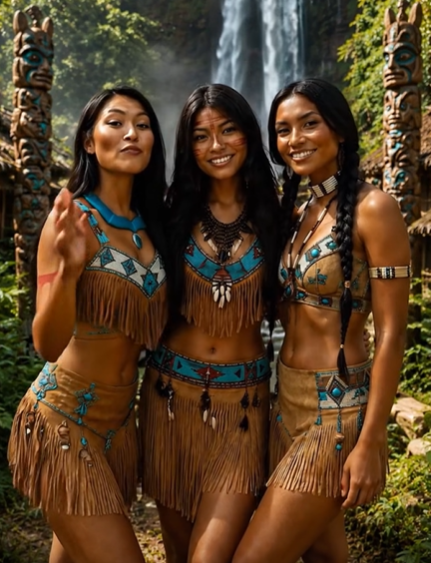
The three young women stood close together on a narrow forest path, smiling into the camera while a tall waterfall poured down the cliff behind them. Sunlight passed through the trees in thin golden beams, touching the water, the leaves, and the turquoise patterns decorating their brown fringed clothing. The sound of the waterfall filled the clearing, so they leaned toward one another whenever they spoke, laughing when the rushing water swallowed part of a sentence. At first, they tried to stand calmly and introduce themselves one at a time, but their excitement made seriousness impossible. One pointed playfully toward the woman beside her, another interrupted with a joke, and the third smiled as though she already knew exactly what her friends were about to say. Before long, they moved closer to the camera, filling the frame with bright expressions, long dark hair, painted markings, beadwork, feathers, and hands raised in greeting. To anyone watching only those few seconds, the moment might have appeared effortless: three friends enjoying a beautiful day near a waterfall. None of the viewers could see how far they had walked, how many memories lived in that place, or why standing together in front of the falling water meant so much to them.
The woman on the left had suggested making the video. She had recently returned to the valley after several years away and had spent much of the morning trying to capture the waterfall from different angles. Every recording seemed incomplete. A wide view showed the height of the falls but made the people disappear. A close view captured the mist and clear pool but hid the surrounding forest. A slow shot of the path looked peaceful, but it could not communicate the way the ground vibrated slightly when the water was at its strongest. Finally, she turned the camera toward her two closest friends and told them that the place needed voices, not another silent landscape.
They had known one another since childhood. Their families lived in neighboring parts of the same riverside settlement, and the girls had grown up moving freely between the three homes. They ate meals together, slept on one another’s floors, borrowed clothing without asking, and shared responsibilities whenever one family needed help. Their personalities were different enough to cause regular arguments, but their disagreements never lasted long. The woman on the left was restless and curious, always imagining places beyond the mountains. The woman in the center listened more than she spoke and remembered details others forgot. The woman on the right was direct, energetic, and unable to hide what she was thinking. Together, they formed a balance none of them could have created alone.
The waterfall had been part of their friendship from the beginning. When they were small, adults brought children there during the hottest months. The walk followed the river through gardens, over smooth stones, and beneath trees so dense that daylight appeared green. The youngest children were carried through difficult sections while older ones raced ahead until someone called them back. Families brought food wrapped in leaves or packed inside woven bags. They spent hours near the pool, talking in the shade while children entered the shallower water.
The three girls were warned repeatedly not to approach the strongest current. They promised to obey, then moved as close as they believed they could without being noticed. The waterfall seemed to pull their attention upward. Water appeared from between the trees at the top of the cliff, dropped through open air, and exploded into white mist against the rocks below. They could never understand how it continued without becoming empty.
One afternoon, the center girl asked her grandmother where all the water came from. Her grandmother pointed toward the mountains and described rain sinking into the forest floor, gathering beneath roots, and emerging through countless streams. The waterfall was not created in one place, she explained. It was the result of water traveling from across the entire mountain.
The girls immediately began searching for its beginning. They followed tiny streams, believing one of them might lead to a hidden opening where the mountain released the river. Adults allowed them to explore nearby but stopped them whenever they climbed too far. For years, the imaginary source of the waterfall became part of their games. Sometimes they believed it came from an underground lake. Sometimes they said a sleeping animal guarded it. During one especially imaginative season, they decided the water carried every story ever spoken in the valley and repeated them in a language only the forest could understand.
As they grew older, they stopped searching for a magical beginning, but they never stopped treating the waterfall as a place where important conversations happened. They went there after arguments with family, before major celebrations, and whenever one of them needed to make a difficult decision. The noise gave them privacy. They could speak loudly, cry, or remain silent without worrying that someone farther along the path would hear.
The woman on the left had told her friends beside that pool when she decided to leave for school in a distant city. The announcement did not surprise them. She had spoken about the outside world for years, collecting photographs of cities and asking every visitor what existed beyond the mountains. Still, the reality of her departure changed the mood between them.
The woman on the right accused her of acting as though life in the valley was not enough. The woman in the center said little, but her silence felt heavier than anger. The future they had always imagined together suddenly divided into separate directions.
“I am not leaving you,” the first woman insisted.
“You are leaving the place where we are,” her friend replied.
Neither statement was entirely wrong.
The final weeks passed quickly. Their families prepared food and small gifts for the journey. Neighbors offered advice, much of it contradictory. Some praised her ambition. Others warned that young people who left rarely returned with the same values. The three friends spent their last afternoon together at the waterfall, but the conversation remained uncomfortable. No one knew how to say goodbye without making the separation feel permanent.
Before leaving, the young woman took a photograph of the three of them beside the pool. They wore ordinary walking clothes, their hair wet from swimming, and none of them looked toward the camera at the same moment. The photograph was imperfect, but she kept it near her bed throughout the years away.
City life was more difficult than she had imagined. The streets were crowded, transportation confusing, and every task required money. She missed the ease of entering a relative’s home without calling first. In the valley, food could come from gardens, rivers, and shared work. In the city, nearly everything arrived with a price and packaging.
The city also gave her things the valley could not. She studied communication, environmental science, and digital media. She met people from many regions and learned how communities used video to protect land, teach languages, and correct false stories. She saw how a short recording could travel farther than any person and how quickly an image could be separated from its original meaning.
She also discovered how outsiders imagined places like her home. Classmates described forest communities as isolated or untouched. Travel advertisements showed mountains and waterfalls without identifying the people who cared for them. Fashion pages copied traditional-style designs while giving no credit to their sources. Videos labeled every brown-skinned person wearing feathers or beadwork with the same vague cultural terms.
When she explained where she came from, people often asked whether her community still lived “the old way.” The question confused her. At home, families used phones, tools, solar electricity, engines, and modern medicine whenever available. They also grew food, spoke local languages, created traditional artwork, and followed responsibilities passed through generations. Life had never stopped changing.
She realized that many outsiders viewed tradition as a performance. They expected people to wear ceremonial clothing constantly, reject technology, and remain separated from modern society. If a community changed, outsiders declared that its culture had disappeared. If it protected older practices, they described the people as trapped in the past.
The young woman began creating videos to challenge these ideas. Her first recordings were simple. She discussed language, food, environmental issues, and the difference between daily clothing and garments made for celebrations. She avoided claiming to speak for every Indigenous or traditional community. She could describe her own experiences, but she knew that different nations possessed distinct histories and customs.
Some videos attracted respectful questions. Others were copied and reposted with false captions. One image of her in traditional-style clothing was used to promote a fictional story about an “ancient forest princess.” Another account claimed she belonged to a completely different community. She asked for corrections, but the invented versions often traveled faster than the truth.
Each experience made her more determined to return home with the skills needed to help local people control their own representation. After completing her studies, she packed her belongings and traveled back through the mountains.
Her friends were waiting when she arrived.
For several seconds, the three women stood awkwardly in front of one another. Years of messages and occasional calls had kept them connected, but those forms of communication could not reproduce physical presence. Then the woman on the right stepped forward, accused her of taking too long, and pulled her into an embrace. The center woman joined them, laughing and crying at the same time.
Their friendship had changed while she was away. They were no longer girls who spent entire days moving without responsibility between houses and riverbanks. The woman in the center had become a teacher. She worked with children and recorded stories from older community members. The woman on the right helped operate a small cooperative that sold locally created clothing, jewelry, and artwork. She was also involved in discussions about tourism near the waterfall.
They quickly discovered that adulthood had not changed everything. They still interrupted one another, remembered different versions of the same events, and laughed hardest at jokes no outsider would understand. Yet each had developed a life that required the others to learn her again.
The reunion video at the waterfall was supposed to introduce a larger project. The three women wanted to create a community-controlled digital series about the valley. Instead of allowing visitors to present the area as an empty paradise, local residents would describe the river, forest, work, celebrations, environmental challenges, and everyday life in their own words.
The woman who had returned would handle recording and editing. The teacher would organize interviews and ensure that information shared by elders was treated appropriately. The cooperative worker would speak with artists and explain how traditional designs were created, owned, and sold.
Their first challenge involved the waterfall itself. Images of the site had begun spreading online, and the number of visitors increased every season. Tourism provided income to guides, food sellers, drivers, and craftspeople. However, some guests left waste, entered private spaces, damaged plants, or ignored warnings about strong currents. Several commercial pages advertised the waterfall without contacting the community.
The women did not agree on the best response. The returning woman believed clear online education could improve visitor behavior. The teacher worried that more videos would attract even larger crowds. The cooperative worker wanted a formal access system that required local guides and contributed money to conservation.
Their discussions became tense. At one meeting, the woman on the right accused the returning friend of still thinking like an outsider.
“You believe everything becomes safer when it is explained through a camera,” she said.
The comment hurt because part of it was true. The young woman had returned with knowledge and enthusiasm, but she sometimes assumed that her education gave her the clearest solution. Her friends possessed years of experience living with the immediate effects of tourism. They had cleaned rubbish, helped lost visitors, and attended long community meetings while she was away.
The disagreement followed them to the waterfall. They sat on the rocks without speaking, surrounded by the same noise that had protected their childhood conversations. Finally, the woman in the center reminded them of the lesson her grandmother had given years earlier.
“The waterfall does not begin here,” she said. “It is created by everything above it.”
Their project needed the same kind of thinking. No single video, rule, or person would solve the problem. Responsible tourism depended on visitors, guides, local leadership, environmental monitoring, businesses, families, and the condition of the entire forest.
The three women developed a shared plan. They would create content, but the exact location would not be promoted carelessly. Visitors would be encouraged to travel with approved local guides. The community would establish limits during sensitive seasons and direct part of the income toward trail repair, waste collection, and water protection. Videos would show not only beauty but also rules and responsibilities.
The short recording of the three friends standing together was designed as an introduction. They wore coordinated garments created with the cooperative and several older artists. Brown fringed material formed the base of each outfit, while turquoise, black, red, and cream patterns gave every piece a related but individual design. Necklaces, feathers, beadwork, armbands, and painted markings completed the appearance.
The clothing was chosen for the project, not because they dressed that way every day. Each woman had a different daily routine requiring practical clothes. The teacher spent hours in a classroom. The cooperative worker moved materials, met customers, and traveled between homes. The returning woman carried camera equipment through mud and rain. Their cultural identity did not depend on wearing decorative garments continuously.
They expected some viewers to misunderstand. Online audiences often treated cultural clothing as proof that a person existed outside ordinary modern life. Comments focused on appearance while ignoring the speaker’s actual message. The women decided to address that problem directly in later videos.
During the first recording, however, they simply wanted to enjoy being together.
The camera began with all three standing in a line. The woman on the left tried to deliver the planned introduction, but she became distracted when her friend whispered something. She pointed toward the center woman as if blaming her for the interruption. The center woman smiled broadly, while the woman on the right leaned closer and added another comment.
They attempted the introduction again.
This time, the woman in the center spoke. Her calm voice carried surprisingly well over the waterfall. She welcomed viewers and explained that the series would share stories from the valley. Halfway through, the woman on the right reacted dramatically to something she said, causing all three to laugh.
The recording no longer resembled the serious introduction they had imagined.
The returning woman considered stopping and beginning again, but she allowed the camera to continue. The natural interaction communicated something the prepared words could not. It showed that culture was not only ceremony, historical pain, or environmental struggle. It also contained friendship, teasing, fashion, confidence, and joy.
Representations of Indigenous and traditional communities often moved between two extremes. Some presented people as tragic victims defined only by violence and loss. Others romanticized them as mystical figures living in perfect harmony with nature. Both approaches removed ordinary humanity.
The three friends wanted viewers to see them as complete people. They cared deeply about land and community, but they also disagreed, made mistakes, enjoyed dressing beautifully, used social media, and laughed at one another. Joy did not make their concerns less serious. In many ways, joy was part of what they were working to protect.
The woman on the right eventually took control of the camera, pulling it closer so their faces filled the frame. The wide waterfall became a blurred strip of white and green behind them. She began speaking rapidly, and her friends leaned inward to remain visible. They looked less like formal presenters and more like relatives sending a message to someone they loved.
At the end, all three raised their hands and waved.
That final gesture became the most widely shared part of the video. Viewers responded to the warmth of their expressions even when they did not understand the words. Messages arrived from people in different countries saying that the women looked happy, strong, and united.
Many comments were respectful, but others revealed familiar misunderstandings. Some users attempted to identify their nation based only on clothing. Others asked whether the women lived near the waterfall permanently or whether the scene had been generated by artificial intelligence. A few accounts reposted the clip with labels the women had never used.
The friends responded by publishing a longer explanation. They clarified that the short video was a creative introduction, that the garments were made for a special project, and that the waterfall belonged within a living community landscape. They asked viewers not to assign random identities or describe the area as undiscovered.
Their honesty attracted a smaller but more thoughtful audience. Teachers requested permission to share the videos in classrooms. Travelers asked about community guidelines before visiting. Young people from other rural regions described similar struggles with tourism and misrepresentation.
The women continued recording.
They filmed the teacher working with children who were learning local plant names. They visited artists preparing materials and explaining why cheap copied designs harmed community creators. Farmers discussed rainfall and soil. Guides demonstrated safe routes near the river. Elders described how the forest had changed during their lifetimes.
Not every recording was released publicly. Some stories belonged only within families. Certain cultural details could not be shared with strangers. The women established a review process so that every participant understood where a video would appear and how it might be used.
This slowed production, but it protected trust.
The returning woman had learned in the city that media projects often treated consent as a single signature. She now understood that meaningful consent continued after recording. A person might agree to an interview but object to a title, advertisement, or shortened edit that changed the meaning. Community members needed the ability to review and withdraw material.
The women’s friendship made this accountability impossible to avoid. If one of them handled a story carelessly, she would face the people affected at meetings, celebrations, and family gatherings. Digital work remained connected to real relationships.
Months later, the first waterfall video continued to receive views. The women watched it occasionally and laughed at their failed attempt to remain serious. It had become a record of more than the project’s beginning. It captured their reunion and the moment their separate skills turned into shared work.
The woman who had returned no longer felt that she had to choose between the valley and the wider world. Her life moved between both. She used tools learned elsewhere to support work shaped locally. Her friends challenged her whenever outside habits caused her to move too quickly or assume too much.
The teacher became the project’s memory. She remembered promises, names, and details mentioned during interviews. Her calm approach helped nervous speakers feel comfortable. She also insisted that children appear as learners and contributors rather than decorations in cultural content.
The cooperative worker became its strongest public defender. She negotiated payments, challenged companies using designs without permission, and refused offers that treated the women as exotic performers. Her directness occasionally frightened potential partners, which the other two considered useful.
Their differences, once a source of conflict, gave the project resilience.
One rainy season, a landslide damaged part of the route to the waterfall. Tourism stopped, and several families lost income. The three women used their platform to explain the situation without encouraging visitors to enter unsafe areas. They helped organize local fundraising and documented community repairs.
Videos showed residents carrying materials, stabilizing the path, redirecting water, and replanting exposed ground. The work was slow and physically demanding. It attracted fewer views than the beautiful introduction, but it showed the reality behind accessible landscapes.
A waterfall did not maintain its own trail. A forest destination did not remain clean without labor. Visitors often experienced only the final beauty, unaware of the people repairing damage before sunrise or carrying waste away after crowds left.
The project made that work visible.
When the trail reopened, new signs explained safety rules and cultural expectations. Guided group sizes were reduced. A portion of visitor fees supported maintenance and emergency preparation. The system did not solve every problem, but it gave the community greater control.
The three friends returned to the original filming spot one year after making the introduction. They brought the same garments, though each had been repaired or altered. The turquoise decoration on one skirt had been replaced after a piece came loose. New beads were added to a necklace. The fringe showed signs of use.
They positioned the camera in nearly the same place.
This time, they managed to deliver a complete message. They spoke about the year’s work, thanked the people who had listened, and reminded viewers that visiting a beautiful place created obligations. Their words were organized, clear, and serious.
After finishing, they looked at one another.
The woman on the right made a joke.
The teacher laughed first, and within seconds the formal ending collapsed into the same joyful confusion as the original video. They moved closer to the camera and waved while the waterfall continued behind them.
The returning woman kept both versions.
One showed what they had learned to communicate. The other showed why the work mattered.
The waterfall had carried their childhood voices, their arguments, their plans, and their laughter. It had remained present while they left, changed, and found their way back to one another. Yet the women knew that no landscape was guaranteed to remain unchanged. Water depended on forests, climate, care, and decisions made across the mountains.
Friendship required similar attention. It could survive distance, but not neglect. It could endure disagreement, but only when people were willing to listen and change. Shared history created a foundation, but daily choices kept the relationship alive.
As the three women walked home after the second recording, the waterfall disappeared behind the trees. Its sound followed them for several minutes, gradually becoming softer until it blended with insects, birds, and the river.
The woman in the center stopped and asked whether they remembered the childhood belief that the water carried every story spoken in the valley.
The other two smiled.
They remembered.
Perhaps the idea had not been entirely childish. Water carried soil, leaves, seeds, and traces of every place it passed. Why could it not carry memory too? Not as words that someone could hear, but as connections moving between people and land.
Their stories had traveled through the waterfall and far beyond the mountains, carried now by screens rather than rivers. Once released, the stories could be misunderstood, copied, or changed. But they could also reach people willing to listen.
The women could not control every interpretation. They could continue speaking clearly, supporting one another, and refusing to let strangers define them completely.
Near the final bend in the path, they stopped once more and turned toward the distant sound of the falls. Sunlight had moved behind the mountain, leaving the forest cooler and darker. The day’s visitors were gone. The valley belonged again to evening routines, family voices, cooking fires, and the steady movement of water.
The three friends continued home together.
Behind them, the waterfall repeated no names that a human ear could understand.
Still, it remembered every one.