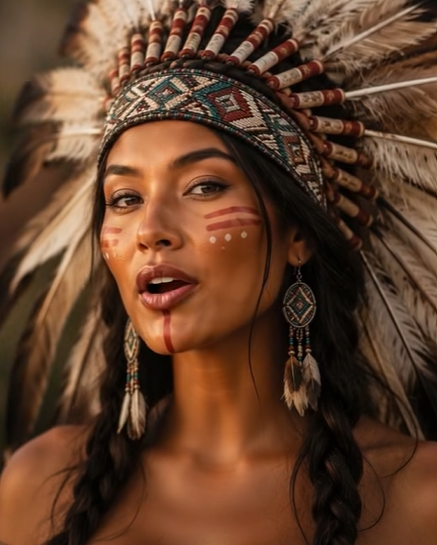
A woman stands directly in front of the camera, framed tightly from the waist upward, while warm natural light falls across her face. Her dark hair is arranged in two long braids, decorative markings appear across her cheeks and chin, and a large feathered headdress rises behind her head like a carefully constructed crown. Her clothing includes patterned material, fringe and matching accessories that create a highly stylized traditional appearance. She speaks confidently, changing her expression as she addresses the viewer, and near the end of the brief clip she extends one hand toward the camera as though inviting the person watching to listen, respond or come closer. The entire video lasts only a few seconds, yet it is designed to make an immediate impression. There is no introduction, no visible location and no written explanation identifying who the woman is or what community she may represent. All the viewer receives is a face, a voice, a collection of recognizable cultural symbols and a direct connection created through the camera.
That lack of context makes the video visually powerful but also complicated. The woman’s appearance may immediately cause many viewers to describe her as Native American or Indigenous, but the clip itself does not identify a specific nation, tribe or cultural tradition. Her clothing appears to combine elements that popular media has taught audiences to associate with Indigenous peoples, especially the large feathered headdress, braids, face paint, patterned fabric and fringe. However, such visual clues are not enough to make a reliable cultural identification. Indigenous nations are not interchangeable, and traditional clothing varies greatly between communities, regions, families, ceremonies and historical periods. A headdress meaningful within one nation may have no connection to another. Certain items may be associated with leadership, responsibility, achievement, spirituality, gender roles or ceremonial participation. Without accurate information, it would be irresponsible to assign the woman a specific identity simply because her appearance matches a familiar image.
The video therefore raises a question that has become increasingly important in the digital age: how do viewers respond to cultural imagery when the image arrives without a source? Social media encourages people to react quickly. A person sees a striking face, watches a few seconds of movement and immediately decides what the video represents. Some may view it as a celebration of Indigenous beauty and tradition. Others may see it as a costume inspired by stereotypes. Some may assume it comes from a film, a cultural event or a real community. Others may suspect that it was digitally generated or heavily edited. The clip offers no answers, yet its polished appearance encourages viewers to accept the image before questioning its origin.
The woman’s direct eye contact is central to the video’s effect. She does not appear to be observed from a distance. Instead, she faces the viewer and speaks as though the person holding the phone is standing directly in front of her. This transforms the clip from a simple portrait into a personal encounter. Her facial expressions shift quickly, moving from seriousness to playfulness and then toward a warm smile. Her extended hand strengthens the invitation. Although the exact words may not be clear to every viewer, the visual language communicates confidence, openness and command. She knows that attention is focused on her, and she uses that attention deliberately.
In traditional filmmaking, a character might first be introduced through a wide shot showing the environment, community or event around them. This video does the opposite. It removes almost all context and places the individual at the center. The blurred outdoor background gives only a vague suggestion of nature. There are no other people visible, no buildings, no ceremonial objects and no clear geographical clues. Everything has been arranged to make the woman’s face and clothing the complete story. This approach is highly effective on social media, where creators often have only seconds to stop someone from scrolling. A dramatic headdress fills the top of the vertical frame, the patterns and fringe create visual detail, and the woman’s expression provides movement. The image is immediately understandable even before the viewer hears a word.
Yet visual clarity is not the same as historical accuracy. Popular culture has spent generations creating a simplified image of Indigenous identity. Western films, advertisements, Halloween costumes, cartoons and commercial artwork frequently reduced hundreds of distinct nations into a small collection of symbols. Feathered headdresses, tipis, face paint, buckskin clothing and braids became a visual shortcut used to represent every Indigenous person, regardless of geography or culture. Once repeated often enough, the shortcut began to feel authentic to audiences who had never been taught the differences between individual nations.
This history matters when examining a video like this because the image may be interpreted through stereotypes even when the creator intends respect. A person may choose the clothing because it looks powerful, beautiful or meaningful, but viewers may still receive a distorted lesson about Indigenous culture. They may begin to believe that all Indigenous women traditionally dressed in the same way, that every feathered headdress served the same purpose or that cultural identity can be recreated by combining decorative elements. The visual may celebrate an imagined idea while ignoring the real communities connected to those traditions.
Respectful cultural representation requires more than creating an attractive image. It requires attention to origin, meaning and authority. Who designed the clothing? Which community’s traditions inspired it? Was the creator part of that community? Were cultural experts or artists involved? Were certain elements used with permission? Is the clothing ceremonial, historical, fictional or simply inspired by popular imagery? These questions do not always have simple answers, but asking them helps viewers distinguish between appreciation, artistic interpretation and appropriation.
Cultural appreciation begins with recognition. It identifies the people who created a tradition and treats their knowledge as valuable. It supports artists, craftspeople, historians and cultural educators from the community. It avoids pretending that sacred or earned items are merely decorative. Appropriation, by contrast, often removes an item from its cultural meaning and uses it for entertainment, fashion or profit. The difference is not always visible in a ten-second clip. That is exactly why context is so important.
The large feathered headdress is the strongest symbol in the video and therefore deserves particular caution. In several Plains Indigenous cultures, certain feathered war bonnets are traditionally connected to respected male leaders and to honors earned through significant actions or community service. Practices vary, and women may also hold important ceremonial and leadership roles, but a general fashion version of a headdress should not automatically be treated as culturally accurate. Commercial photography has often used such headpieces simply because they look dramatic. That use can turn an item of honor into a costume and disconnect it from the people who gave it meaning.
The woman in the clip may be wearing a fictional design rather than a replica of a specific ceremonial object. The repeated geometric patterns, coordinated accessories and theatrical face markings suggest that the image may have been designed to create an overall fantasy-inspired look. That does not make the scene worthless. Fiction can explore identity, history and symbolism. However, fictional imagery should be understood as fiction rather than accepted as a documentary view of real culture.
The growing ability of artificial intelligence to generate realistic human figures makes this distinction even more difficult. A person can now produce a convincing video of a character wearing detailed clothing without hiring an actor, designer or cultural consultant. The character may blink, smile, speak and move naturally enough to appear real. AI systems are trained on enormous collections of existing images, including films, artwork, costumes and photographs. When asked to create an “Indigenous woman” or “Native American princess,” the system may combine the most frequently repeated visual stereotypes rather than accurately represent a specific nation. It can generate a polished image that looks culturally detailed while having no genuine cultural foundation.
The video’s highly symmetrical face, smooth lighting and stylized costume may lead some viewers to wonder whether it was generated or digitally enhanced. Without information from the creator, that possibility cannot be confirmed. Still, the uncertainty itself is important. Modern viewers must learn to ask not only whether an image is beautiful or convincing, but also whether it is authentic, staged, fictional or synthetic. The more realistic digital creation becomes, the more careful people must be about drawing conclusions from appearance alone.
A generated character can influence real-world understanding. Someone who repeatedly sees AI-created images of Indigenous people wearing invented clothing may begin to treat those images as historical evidence. Search engines and social platforms can then circulate the same visual patterns again, reinforcing the stereotype. Future AI systems may train on those generated images and reproduce the inaccuracies at an even larger scale. A fictional design can slowly transform into what appears to be cultural truth simply because it has been repeated thousands of times.
Creators therefore carry responsibility when working with cultural themes. They should research the traditions they reference, avoid combining sacred elements casually and clearly describe fictional or AI-generated material. When possible, they should work with people from the represented communities. Consultation does not limit creativity. It usually makes the work richer, more specific and more original. A real cultural tradition contains details far more interesting than a generic stereotype.
The same responsibility belongs to audiences. Viewers should resist the urge to identify someone based only on clothing or facial appearance. They should not assume that an individual represents an entire population. Even when the person in the clip is genuinely Indigenous, their identity would still be personal and nation-specific. One woman cannot stand for hundreds of communities. Her voice, clothing and experience would belong to her own background.
The video also demonstrates how quickly femininity and cultural imagery can become intertwined online. The woman is presented as visually glamorous, confident and carefully styled. Her makeup, jewelry, clothing and posture create an idealized character rather than an ordinary documentary portrait. Social media frequently turns cultural identity into an aesthetic. Users adopt visual themes because they are dramatic, mysterious or attractive. Indigenous imagery is especially vulnerable to this treatment because popular culture has long romanticized Indigenous women as symbols of nature, freedom, beauty or spiritual wisdom.
These romantic images may seem positive, but they can still be harmful. A stereotype does not become accurate simply because it appears flattering. Describing Indigenous women only as exotic, spiritual, wild or naturally connected to the earth reduces them to a fantasy created for outsiders. It ignores their individual personalities, careers, political beliefs, families and modern lives. Indigenous women are teachers, lawyers, artists, athletes, scientists, parents, activists, business owners and community leaders. They cannot be understood through a costume or a single poetic idea.
The direct confidence shown by the woman can be appreciated without assigning her an imagined personality. She appears comfortable in front of the camera and uses expression effectively. Her smile suggests friendliness, while her steady gaze suggests authority. These qualities make the video engaging. They also reveal why short-form content can be so persuasive. People naturally respond to faces. When someone looks directly at us, we feel noticed. When they smile or reach forward, we may experience a sense of personal connection even though the interaction is recorded and one-sided.
Social media creators often rely on this effect to build engagement. A speaker addresses the viewer as “you,” makes eye contact and uses a hand gesture that seems to cross the boundary of the screen. The audience is encouraged to feel included. The technique can be used for entertainment, advertising, storytelling or education. In this clip, the woman’s gesture may be interpreted as welcoming, questioning or inviting. Because the video is so short, viewers fill in the meaning themselves.
This openness can help a video travel widely. Content with a simple emotional message crosses language barriers more easily than detailed information. A smile, a surprised expression or an open palm can be understood almost anywhere. The cultural costume adds curiosity and visual novelty, making people more likely to pause. In only ten seconds, the clip creates enough mystery for the viewer to wonder who the woman is and what she is saying.
Mystery, however, should not be confused with depth. The video suggests a story but does not actually provide one. There is no information about the woman’s family, community, traditions or purpose. The audience receives an image of identity rather than the substance of identity. This difference is common online. Platforms often reward what can be recognized immediately, while genuine cultural understanding requires time. A traditional craft may take months to learn. A language may require years of study. A community’s history may stretch across centuries. None of that can be fully communicated through a few seconds of decorative imagery.
The clip can therefore serve as a starting point rather than a conclusion. A viewer interested in Indigenous cultures can look beyond generalized visuals and learn about specific nations. They can discover which Indigenous peoples have historically lived in their own region, how those communities describe themselves and which cultural institutions they operate. They can read books by Indigenous authors, watch films directed by Indigenous filmmakers and follow artists who explain the meanings behind their work. This moves curiosity away from fantasy and toward real voices.
Supporting Indigenous creators is especially important because outsiders have controlled representations of Indigenous life for a long time. Early photographers often staged portraits according to what non-Indigenous audiences expected to see. Film studios hired actors from one background to portray people from another and dressed them in generic costumes. Museums collected cultural objects while sometimes excluding the communities that created them from decisions about display and interpretation. Schoolbooks frequently described Indigenous people only in the past tense, as though they had disappeared.
Indigenous filmmakers, writers, designers and educators challenge these patterns by controlling their own stories. They show communities as living, changing and diverse. Their work may include traditional teachings, modern humor, political criticism, family conflict, romance, science fiction or everyday life. When audiences engage with these creators, they encounter individuals rather than symbols.
The woman’s visual presentation in the video is likely intended to feel timeless, but real Indigenous identity exists fully in the present. Traditional clothing may be worn during ceremonies, celebrations or cultural events, while everyday clothing may look no different from that worn by anyone else. Indigenous languages are spoken in homes, schools, radio programs and digital applications. Young creators use social media to teach vocabulary, challenge stereotypes and share jokes understood within their communities. Tradition does not require people to remain frozen in an imagined historical period.
This is one of the most persistent misunderstandings created by costume-based representation. Outsiders may expect Indigenous people to prove authenticity through appearance. A person wearing jeans or working in technology may be treated as less Indigenous than someone shown in ceremonial clothing. This expectation is unfair and historically distorted. Cultural identity is not a performance designed to satisfy an audience. It is built through family, community, citizenship, language, responsibility, history and self-understanding.
The video’s isolated setting contributes to the sense of timeless fantasy. The background is softly blurred and contains no obvious sign of modern life. There are no roads, vehicles, buildings or electronic devices. The woman seems separated from a particular year or place. This visual choice makes the portrait more dramatic, but it can also repeat the idea that Indigenous identity belongs only to nature or the distant past.
Nature is important to many Indigenous communities, but the relationship should not be simplified into a decorative background. Land can be connected to law, survival, spirituality, ancestry and political sovereignty. Contemporary disputes over land, water, mining, pipelines and environmental protection are not merely symbolic. They affect real communities and future generations. Using nature only to create a beautiful “tribal” mood can erase these serious realities.
At the same time, the video’s warmth and confidence offer an opportunity to discuss cultural pride. People from communities that have faced discrimination may use clothing, language and traditional design to reclaim visibility. Public expressions of heritage can challenge shame created by colonial policies. For generations, Indigenous children in various countries were punished for speaking their languages or practicing their traditions. Cultural items were taken, restricted or displayed without consent. Wearing traditional clothing today can therefore represent survival and strength.
The challenge is that an outsider cannot determine the meaning of the woman’s clothing from the image alone. It could be cultural pride, commercial styling, fictional costume or AI-generated fantasy. Each possibility changes the interpretation. An authentic cultural presentation deserves to be recognized on its own terms. A fictional design should not be mistaken for history. A commercial costume should be examined critically. A generated image should be clearly identified when possible.
Transparency allows art and respect to exist together. A creator might explain that a character is inspired by several fantasy traditions rather than claiming accuracy. A fashion photographer might credit Indigenous designers and identify the community connected to the work. A filmmaker might include cultural consultants. An AI creator might state that the image is synthetic and avoid presenting it as evidence of a real ceremony. These choices give audiences the information needed to understand what they are seeing.
The woman’s performance also reminds viewers that identity online is often carefully constructed. Every portrait involves decisions about clothing, lighting, camera angle and expression. The version of a person shown in a video may be only one part of who they are. Social media encourages users to create characters that can be understood quickly. Someone may become the warrior, the princess, the healer, the traditional beauty or the mysterious guide. These roles attract attention but can become limiting if the audience refuses to see anything beyond them.
The strongest response to the video is therefore not blind admiration or immediate criticism. It is thoughtful curiosity. The image can be recognized as beautiful and visually effective while still raising questions. Viewers can admire the craftsmanship suggested by the patterns and feathers without assuming cultural accuracy. They can respond to the woman’s confidence without turning her into an exotic fantasy. They can enjoy the performance while remembering that real communities deserve more than a few familiar symbols.
Her open hand near the end of the clip can be understood as an invitation to look closer. Looking closer means noticing what the video reveals and what it hides. It reveals a carefully designed character, direct expression and a powerful use of cultural imagery. It hides the source, identity, purpose and production method. Those missing elements are not minor details. They determine whether the scene is documentation, performance, tribute, marketing or digital invention.
In the past, audiences often had little ability to investigate the images shown to them. A film studio or magazine could present a stereotype, and many viewers accepted it as fact. Today, information is more accessible, but misinformation also travels faster. People can research a claim within seconds, yet many share content without checking it. A visually convincing video may reach millions before anyone asks where it came from.
Media literacy has therefore become a form of cultural responsibility. It involves examining captions, sources, creator profiles and production clues. It means recognizing when a video offers emotion rather than evidence. It means avoiding confident claims based on uncertain material. When cultural identity is involved, this care protects real people from being misrepresented.
The short clip does not need to carry the full burden of explaining Indigenous history. No single video could do that. The problem begins only when viewers treat the image as complete. A portrait can inspire interest, but it should lead toward deeper sources. A costume can tell part of a story, but it cannot replace the voice of a community. Beauty can open the door to attention, but understanding requires more work.