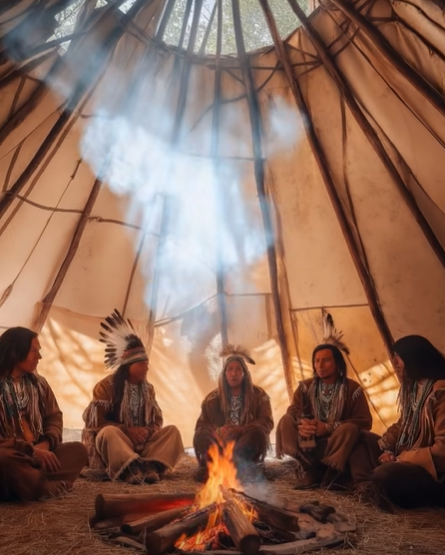
Smoke rises slowly toward the opening at the top of the lodge as a group of people sit together around a carefully built fire. The flames illuminate their faces, sending warm orange light across the circular interior and revealing the wooden poles that meet high above them. No one appears to be in a hurry. Their bodies are still, their attention focused, and the gathering carries the quiet importance of a moment that has happened many times before. At the center is not simply a source of heat, but a living point of connection. Around it, people listen, observe and remember. As the camera moves closer to one of the men, the larger circle begins to disappear from view, yet the meaning of the gathering remains present in his expression. He looks directly ahead with confidence and warmth, as though preparing to share something that must not be forgotten.
The short scene suggests a world in which knowledge is not stored only in written documents, museums or formal classrooms. It can also live in voices, gestures, songs, memories and gatherings. A lesson may begin with people sitting close to one another while a respected speaker talks. A story may carry the history of a family, explain the meaning of a tradition or remind listeners of the responsibilities they have toward their community. The setting makes the act of listening feel just as important as speaking. Everyone gathered around the fire becomes part of the moment, not only because they are physically present, but because they may later carry the words forward.
The central fire immediately draws the eye. Its flames rise between the people, changing shape every second while remaining firmly rooted in the same place. Fire has long played practical and symbolic roles in communities throughout the world. It provides warmth, cooks food, offers protection and creates light after darkness falls. It also brings people together. A fire naturally forms a circle around itself, encouraging those nearby to face one another rather than looking in different directions. In the video, this arrangement creates a feeling of equality and shared attention. Although one person appears to be speaking, the surrounding participants remain part of the story. Their presence gives the speaker an audience, a community and a reason for his words to matter.
The smoke drifting upward gives the scene a dreamlike quality. It moves through the beams of light before disappearing through the opening overhead. The lodge seems to breathe with the fire, holding warmth below while releasing smoke into the sky. This movement connects the enclosed gathering to the wider world outside. Even though the camera remains indoors, the viewer can sense the presence of open land, changing weather and the natural environment beyond the walls. The structure does not feel isolated from nature. Instead, it appears shaped to exist alongside it.
The clothing worn by the central figure is visually detailed. Fringed material hangs from his sleeves, while geometric patterns and layered adornments decorate the front of his clothing. A feathered headpiece frames his face, making him the immediate focus as the camera approaches. Other members of the circle also wear traditional-style garments and accessories. However, the video gives no information that would allow the viewer to identify a particular nation, community, era or ceremony with certainty. The safest way to understand the scene is as a cinematic depiction of an Indigenous gathering, presented through recognizable visual symbols. Those symbols create an atmosphere of tradition, but they should not be treated as proof of a specific historical event.
This distinction matters because Indigenous cultures are not one single culture. Across North America and the wider world, Indigenous nations possess distinct languages, governments, histories, artistic traditions, spiritual practices and relationships with the land. Clothing that is meaningful in one nation may not belong to another. A ceremony from one community may have different rules and purposes from a gathering elsewhere. Popular films and digital media have often blended these differences into a simplified image. A respectful viewer should therefore appreciate the message of the scene without assuming that every visual detail represents all Indigenous peoples.
What the clip communicates most clearly is a sense of continuity. The people seem gathered not for entertainment, but for connection. The man’s direct gaze suggests that his words are intended for more than the individuals sitting behind the fire. By looking toward the camera, he appears to address the viewer as well. The distance between the gathering and the audience briefly disappears. We are no longer merely watching people sitting in a lodge. We are placed in the position of a listener.
Listening is one of the most powerful themes suggested by the video. Modern life often rewards speed, interruption and instant reaction. People move from one message to another, reading only fragments before responding. The gathering presents a different rhythm. The participants sit quietly while one voice takes its time. The speaker is not competing with screens, alarms or a crowded public space. The fire crackles, smoke rises and attention remains centered. This slower atmosphere gives words weight. It suggests that meaningful knowledge cannot always be reduced to a headline or a short caption. Some truths require patience.
Oral storytelling has allowed countless communities to preserve knowledge across generations. Stories can carry genealogies, laws, moral teachings, geographical knowledge, survival skills and memories of important events. Their value is not limited to the information they contain. The way a story is told can also matter. Tone, timing, repetition, expression and the relationship between the speaker and the listeners may all shape its meaning. A written version can preserve the words, but it may not fully reproduce the experience of hearing them spoken in a familiar place by someone trusted by the community.
In the scene, the fire becomes part of that experience. Light moves across the speaker’s face as the flames shift. His expression changes subtly while he talks, moving between seriousness and a gentle smile. These small changes make the moment feel personal. He does not appear distant or unreachable. His authority seems to come from experience and connection rather than force. The people around him are not arranged like students in rigid rows. They form a shared circle, close enough to see one another clearly.
The circle itself carries an important visual message. It has no obvious beginning or end. Every person occupies a place around the same center. From the camera’s first view, the group appears connected by the fire and by their shared attention. No one is hidden far behind another. The arrangement encourages participation, observation and mutual recognition. Even without knowing the exact purpose of the meeting, the viewer can understand that belonging matters within this space.
Belonging is created through repeated actions. It is formed when people return to the same places, hear familiar stories, prepare food together, care for children, remember those who have died and teach younger generations how to carry responsibilities. A community is not maintained by symbols alone. It survives through daily choices. The visual beauty of traditional clothing may capture attention, but the deeper strength suggested by the clip lies in the people’s willingness to gather. They have made time to sit together. They have placed themselves within a circle of listening.
The scene can also be read as a reminder of resilience. Indigenous communities have endured colonization, forced displacement, violence, cultural suppression and policies designed to separate children from their families and traditions. Languages and ceremonies were targeted because colonial authorities understood that culture gives people identity, unity and strength. Yet Indigenous nations continue to protect, renew and celebrate their ways of life. Communities have worked to revitalize languages, recover historical records, teach traditional arts and rebuild connections interrupted by generations of harmful policies.
A gathering around a fire may therefore symbolize far more than nostalgia. It can represent survival. When a story is told again, it proves that the effort to erase it did not completely succeed. When young people learn words spoken by their ancestors, a damaged connection begins to heal. When cultural practices are carried out under the guidance of the communities to whom they belong, tradition becomes part of the present rather than an artifact from the past.
This is why it is important not to view scenes like this as images of a vanished world. Indigenous people are not figures who exist only in history books, western films or romantic stories about the past. Indigenous nations are living communities whose members work in every field, use modern technology, participate in contemporary politics, create new art and respond to present-day challenges. Tradition and modern life are not opposites. A person can protect ancient knowledge while using a smartphone, working in a city or producing digital media. Culture remains alive precisely because people adapt while deciding what must be protected.
The video itself is an example of tradition being represented through modern technology. The scene is framed vertically, designed for viewing on a phone. The camera begins with the entire lodge before moving toward the speaker’s face. This rapid transition transforms a communal gathering into a direct encounter. In only a few seconds, the viewer moves from observer to participant. The format may be modern, but the emotional power comes from an ancient human practice: sitting near a fire and listening to another person speak.
There is an interesting contrast between the length of the clip and the depth of the world it suggests. Ten seconds can be watched and forgotten almost immediately, yet the image invites much longer reflection. Who are the people in the circle? What is being discussed? Is the speaker telling a historical story, offering advice or welcoming someone? What happened before the camera began recording, and what will happen after it ends? The video does not answer these questions. Its power lies partly in what it leaves unseen.
That uncertainty also places responsibility on the viewer. When context is missing, imagination can quickly become misinformation. A person might assign the scene to a particular tribe based only on clothing or assume that it shows a sacred ceremony. Those claims would go beyond the available evidence. Respect begins with admitting what we do not know. The visual elements can be described, and the emotional themes can be explored, but specific cultural meanings should come from knowledgeable members of the represented community.
The man’s face becomes the strongest element as the camera draws near. He appears calm and expressive, speaking with energy rather than solemnity alone. At moments, his features suggest friendliness and even humor. This prevents the scene from becoming overly formal or distant. Tradition is often presented in media as something serious, silent and frozen. In reality, cultural gatherings can contain laughter, teasing, affection and ordinary conversation alongside moments of deep importance. Human warmth is part of continuity too.
His apparent smile suggests that knowledge does not always need to be delivered through fear. A person can teach by welcoming others into a story. A lesson can be memorable because it is filled with personality. Elders and experienced community members may be respected not only for what they know, but for how they make people feel while sharing it. A listener is more likely to remember words connected to a powerful emotional experience.
The other people remain partly visible as the camera moves closer. Their reduced presence does not make them less important. In fact, they represent the larger community supporting the speaker. No storyteller speaks alone. The language used, stories remembered and values expressed have been shaped by many previous voices. Behind every speaker stand parents, grandparents, teachers and ancestors. Around every listener may be future generations who will inherit what is learned.
This chain of transmission can be fragile. Knowledge disappears when there are no opportunities to practice it or when younger people are made to feel ashamed of their heritage. It grows stronger when communities have control over education, cultural representation and access to their lands. A story told in the right setting can become an act of restoration. It tells young listeners that their identity has value and that the experiences of their people deserve to be remembered.
The lodge contributes strongly to the feeling of protection. Its walls curve around the gathering, creating a defined space separate from the outside world. Light passes through the material, giving the interior a warm glow. The structure feels both strong and flexible, supported by poles that lean toward one another and meet overhead. Each pole contributes to the stability of the whole. This can be viewed as a metaphor for community. Individual people may have different roles, but strength comes from connection.
At the top of the lodge, the poles form a pattern around the opening. The viewer’s eye naturally follows them upward toward the smoke and sky. The central fire below and the opening above create a vertical line through the entire scene. Earth, people, flame, smoke and sky appear linked. Even without assigning a specific spiritual meaning, the composition encourages the viewer to consider the relationship between human beings and the natural world.
Many contemporary societies treat nature primarily as a collection of resources to be extracted. Land becomes valuable according to what can be removed, built or sold. Indigenous perspectives are diverse, but many emphasize relationships, obligations and reciprocity rather than ownership alone. Land can be connected to ancestry, identity, law and responsibility. Protecting it is not merely an environmental preference; it can be essential to cultural survival.
The fire in the clip depends on wood, air and careful attention. If ignored, it will eventually die. If handled carelessly, it can become destructive. Maintaining it requires balance. Cultural knowledge functions in a similar way. It must be cared for rather than simply admired. People need time, teachers, safe spaces and resources to continue practices. Outsiders also have responsibilities. They should avoid turning sacred or culturally specific elements into costumes, trends or commercial decorations without understanding or permission.
The clothing in the video highlights this issue. Feathers, beadwork, geometric designs and fringed garments are visually striking, which makes them common targets for imitation. Yet such items can carry community-specific meanings, and some forms of dress may be earned through service, leadership or participation in particular traditions. Wearing copied versions for amusement can remove them from their context and reduce living cultures to an aesthetic. Appreciation involves learning, crediting and supporting Indigenous creators rather than treating cultural identity as a costume.
At the same time, viewers should be cautious about assuming that every piece of media using traditional imagery is an accurate cultural representation. Digital content can be staged, fictionalized or created with artificial intelligence. The visual quality of the clip has a polished, cinematic appearance, and no source information is provided. It may depict real performers, digitally generated characters or a combination of techniques. Without further evidence, the origin cannot be confirmed. This uncertainty does not eliminate the themes inspired by the scene, but it does change how factual claims should be made.
Artificially generated cultural images raise new questions. Technology can create beautiful scenes within seconds, but it may also mix clothing, architecture and symbols from unrelated communities. The result can look convincing while being historically inaccurate. When viewers encounter such content, they may absorb the visual mistakes as truth. Creators therefore have a responsibility to conduct research, consult appropriate sources and clearly label fictional or AI-generated material where necessary.
Indigenous artists and filmmakers are especially important in this environment because they can tell stories from within their own cultures. Their work can challenge stereotypes and present communities with complexity. Instead of focusing only on historical suffering or romantic imagery, they can show contemporary family life, humor, political struggle, creativity and personal experience. Supporting these voices helps audiences move beyond simplified representations.
The short video may attract attention because of its striking imagery, but its greatest potential lies in encouraging curiosity. A viewer who is moved by the scene can choose to learn about the Indigenous nations in their own region, read works by Indigenous authors, watch films made by Indigenous directors and visit cultural institutions led by the communities they represent. Curiosity becomes meaningful when it leads to respectful learning rather than assumptions.
The central figure’s direct gaze can be interpreted as a challenge: will the viewer merely consume the image, or will they listen? Listening in this context means more than hearing sound. It involves recognizing that communities have the right to explain their own histories. It means accepting correction when familiar stories turn out to be incomplete. It requires patience when the truth is more complicated than the version taught in popular culture.
The gathering also reminds us that stories shape identity. Individuals understand themselves partly through the narratives they inherit. Families tell stories about where they came from, what hardships they faced and which values helped them continue. Nations do the same. Problems arise when powerful institutions control the story and exclude the voices of those most affected. Indigenous histories have frequently been written from colonial viewpoints, presenting expansion as progress while minimizing displacement and resistance. Restoring Indigenous perspectives does not erase shared history; it makes that history more honest.
Honesty can be uncomfortable, but it creates the possibility of better relationships. Acknowledging past and present injustice is not an attack on people living today. It is a step toward understanding why certain inequalities continue. Land disputes, language loss, health disparities and educational challenges did not appear without cause. They are connected to decisions, laws and institutions. Listening to community voices allows these issues to be understood through lived experience rather than statistics alone.
Yet Indigenous identity should never be defined only by hardship. The warmth of the fire, the beauty of the clothing and the man’s expressive face all communicate vitality. The scene contains strength, dignity and companionship. Survival is important, but so are celebration and joy. Communities are sustained not only by resisting harm, but by creating music, raising children, telling jokes, preparing food and spending time together.
The fire becomes brighter as the camera approaches, briefly filling the foreground before the speaker’s face dominates the image. This transition suggests that the flame and the voice are connected. Both provide light. Both draw people toward a shared center. Both require attention to remain alive. A fire can be passed from one piece of wood to another without losing its original flame. In the same way, knowledge can be shared without becoming smaller. It grows as more people learn how to carry it responsibly.
The speaker’s words are brief within the limits of the clip, but the visual message continues after the video ends. The viewer is left with the image of a person speaking from inside a circle shaped by firelight, smoke and community. It is a reminder that human beings have always gathered to make meaning together. Before libraries, cameras and digital archives, memory depended on people. Someone had to speak, and someone else had to listen.
That responsibility still exists. Technology can preserve thousands of hours of recordings, but preservation alone does not guarantee understanding. A story can remain stored on a device while its meaning is forgotten. Knowledge stays alive when it remains connected to people, places and relationships. It must be practiced, questioned and passed on with care.
Perhaps this is the most lasting idea contained in the short scene. Culture is not an object sitting behind glass. It is a living conversation between generations. It changes without losing every connection to the past. It survives through attention. The individuals around the fire do not appear to be looking backward with sadness. They seem fully present, gathered within a tradition that continues to create meaning now.
As the camera reaches its closest point, the speaker appears to address the audience personally. Behind him, the lodge’s warm walls remain visible, but the circle and fire have mostly moved beyond the frame. The community is no longer seen clearly, yet its influence remains. His clothing, expression and confidence all carry traces of the people around him. He stands visually alone without truly being alone.
The same is true of every person shaped by community. We speak with words learned from others. We carry habits taught by family. We inherit values, responsibilities and unfinished questions. Even when we appear individually before the world, countless relationships remain behind us. The gathering makes that invisible support visible for a moment.
When the brief video ends, the flame is still burning in the viewer’s imagination. The smoke continues to rise, the listeners remain seated and the speaker’s story seems unfinished. That incompleteness is fitting. Cultural stories rarely belong to a single moment. They continue whenever someone remembers, asks a question or chooses to listen with respect.
The fire at the center of the lodge therefore becomes more than a visual effect. It represents the fragile but enduring work of memory. Each generation must add something to keep it burning. They may contribute a story, a song, a language lesson, an act of protection or simply the patience to listen. No contribution stands alone. Together, they create enough light for people to recognize where they have come from and decide how they will move forward.
The scene does not reveal the speaker’s name or the exact words being shared. It does not identify the land beneath the lodge or the history carried by those sitting nearby. However, it offers a powerful invitation. It asks viewers to slow down, look beyond the surface and recognize the importance of stories held within communities. It reminds us that respect begins when we stop assuming we already understand.
Around the fire, the people sit close enough to feel its warmth. Above them, smoke finds its path toward the sky. Between earth and air, a voice continues speaking. The moment is brief, but its message is lasting: traditions live when people gather, memory survives when stories are shared, and a community’s light remains strong when each generation accepts the responsibility of keeping it alive.