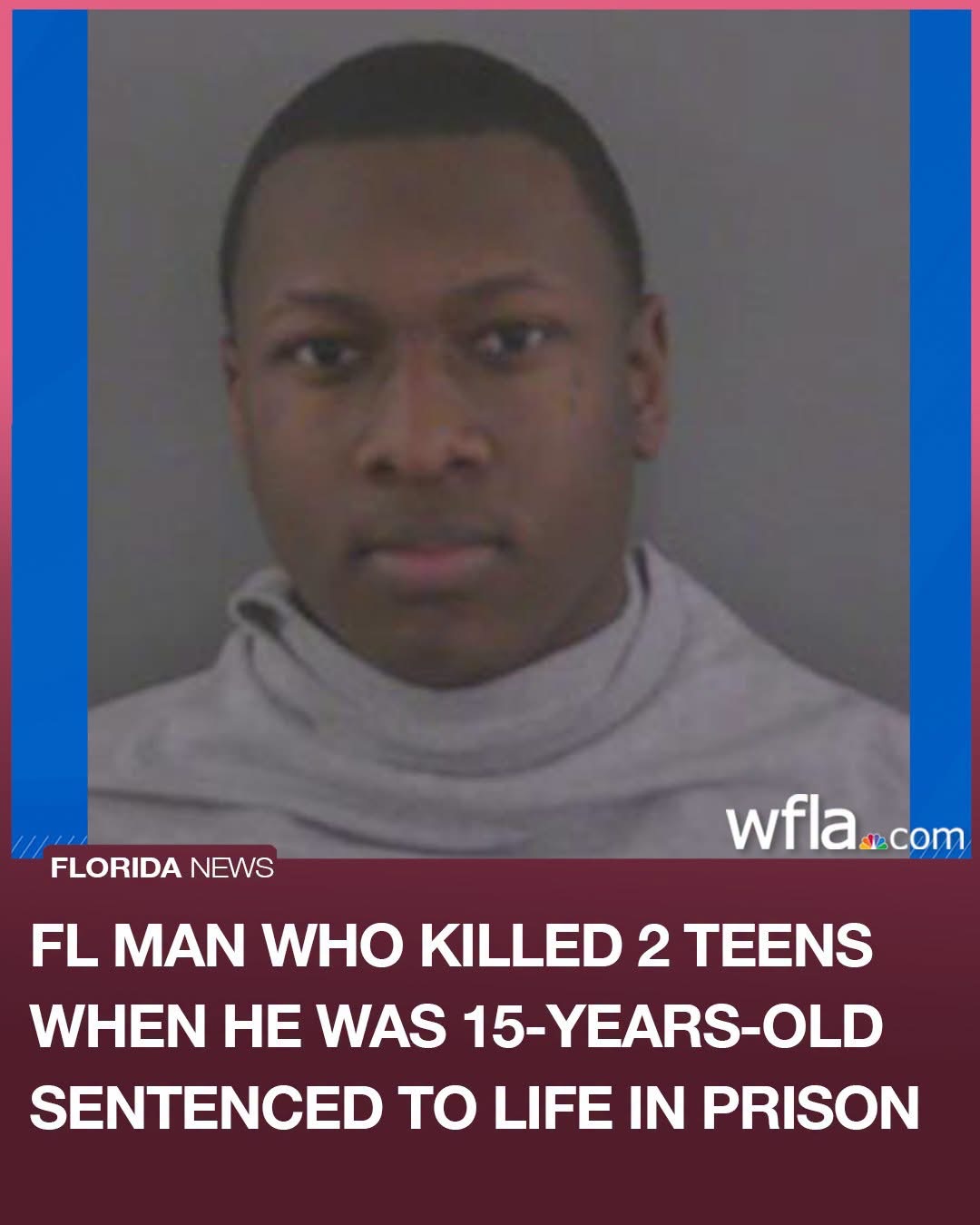
A Sumter County man has been sentenced to life in prison for the fatal shootings of two teenagers in 2021, bringing a major criminal case that deeply affected the local community to a conclusion. Clarence Patterson III, who was 15 years old at the time of the killings, received the life sentence after being convicted in connection with the deaths of 17-year-old Isaiah Nelson and 16-year-old Prestin Nixon. The case attracted significant attention not only because two young lives were lost, but also because the person held responsible was himself an adolescent when the crimes occurred.
According to the Office of the State Attorney for Florida’s Fifth Judicial Circuit, Patterson was convicted of two counts of first-degree murder with a firearm. He was also convicted of discharging a firearm in public from a vehicle and possession of a firearm by a delinquent. The convictions followed years of investigation and court proceedings arising from the discovery of Nelson and Nixon’s bodies on the side of a Sumter County road in May 2021.
The case began on May 12, 2021, when the Sumter County Sheriff’s Office received a report that two people were lying beside a roadway. Deputies responding to the location spoke with the person who had called 911. The witness, who was working his usual garbage collection route, reportedly told investigators that he noticed the two teenagers while passing through the area.
Concerned that the people beside the road might need assistance, the worker stopped his garbage truck and went to check on them. After noticing blood on both teenagers, he contacted emergency services. Deputies and other first responders arrived, but Nelson and Nixon were pronounced dead at the scene. Authorities determined that both teenagers had suffered apparent gunshot wounds.
The discovery created an immediate and urgent investigation. Detectives needed to determine where the shootings had occurred, who had last been with the victims and how the two teenagers had ended up beside the road. Investigators began collecting evidence, interviewing people connected with Nelson and Nixon and reviewing information about their activities before their deaths.
During the investigation, deputies received information about a vehicle parked behind a church. According to the State Attorney’s Office, the vehicle had visible bullet holes, a shattered window and blood inside. Those observations made the vehicle a critical part of the investigation and suggested that it could be connected to the violence that led to the teenagers’ deaths.
Detectives contacted the owner of the vehicle. The owner reportedly told investigators that his grandson, Isaiah Nelson, had been using the car the previous night. That information connected the damaged vehicle to one of the victims and provided detectives with an important point from which to reconstruct the events leading up to the discovery of the bodies.
Investigators then spoke with Nelson’s brother, who provided information about the last known movements of the two victims. According to the State Attorney’s Office, Nelson’s brother told detectives that Nelson and Nixon had last been seen in a vehicle with Clarence Patterson III. He also reportedly said that Patterson had been randomly firing a gun from the vehicle’s window.
The information placed Patterson with both teenagers before their deaths and raised serious questions about the firearm reportedly present inside the vehicle. Authorities took Patterson into custody and questioned him about what had happened. During his initial interview, Patterson confirmed that he had been with Nelson and Nixon, but he did not admit responsibility for their deaths.
The investigation continued as detectives compared statements with physical evidence and other available information. According to prosecutors, Patterson later changed his account and admitted that he had shot both teenagers. He claimed, however, that the shootings had been committed in self-defense.
A self-defense claim can become a central issue in a homicide prosecution because it requires the court to examine the circumstances surrounding the use of deadly force. Investigators and prosecutors must evaluate whether the available evidence supports the defendant’s version of events, including whether the defendant reasonably believed such force was necessary. In Patterson’s case, prosecutors proceeded with first-degree murder charges, indicating that the state believed the evidence supported allegations of intentional and premeditated killings rather than legally justified acts of self-defense.
The case moved through the criminal justice system for several years. Because Patterson was a juvenile at the time of the killings, his age added another complicated element to the proceedings. Cases involving young defendants accused of extremely serious crimes frequently require courts to balance several major considerations, including the severity of the offense, the defendant’s age at the time, legal rules governing juvenile sentencing and the lasting impact on the victims’ families.
The central facts remained devastating: two teenagers had gone out in a vehicle and did not return home alive. Their bodies were later discovered by a worker who happened to be traveling his normal route. The investigation linked their final known movements to Patterson, a damaged and bloodstained vehicle and a firearm that prosecutors alleged had been used in the crimes.
Patterson’s trial eventually began, allowing jurors to hear evidence gathered during the investigation. The prosecution’s case included a recorded statement from Patterson. According to the State Attorney’s Office, jurors heard that recording before a major development occurred midway through the trial.
On June 4, 2025, Patterson entered what authorities described as an open plea to the court. Unlike a negotiated plea agreement that guarantees or recommends a particular punishment, an open plea generally leaves the sentencing decision to the judge, subject to the law and the charges involved. Patterson’s plea came after the jury had already heard his recorded statement, meaning the trial had progressed to the point where key evidence had been presented.
Patterson was convicted of two counts of first-degree murder with a firearm, as well as the additional firearm-related offenses. The court later sentenced him to life in prison. The punishment reflected the extraordinary seriousness of the crimes and the permanent loss suffered by the families of Nelson and Nixon.
Bill Gladson, the State Attorney for the Fifth Judicial Circuit, said the case had a profound effect on Sumter County, a community he characterized as generally quiet and calm. Gladson said the deaths of the two teenagers were deeply upsetting and that the involvement of another adolescent made the circumstances particularly disturbing.
“No doubt this case has had a resounding impact on our quaint and calm community here in Sumter County,” Gladson said in a statement released by his office. “The tragic deaths of the two murdered teenagers are profoundly upsetting; however, it is particularly disconcerting that they were due to the actions of another adolescent. This aspect adds a troubling dimension to the complexity of a case of this magnitude.”
The statement highlighted one of the case’s most difficult realities. Three teenagers were at the center of the events: two who were killed and one who was ultimately sentenced to spend his life in prison. For the families, friends and classmates of Nelson and Nixon, the criminal proceedings could not restore what had been taken from them. A sentence may establish legal accountability, but it cannot erase the grief created by the sudden deaths of two young people.
The victims were 17 and 16 years old, ages normally associated with school, friendships, family milestones and plans for adulthood. Instead, their names became connected to a homicide investigation and years of court proceedings. Their families were left to face birthdays, holidays and other important moments without them, while repeatedly revisiting the circumstances of their deaths through hearings, evidence and legal arguments.
Violent crimes involving teenagers often affect a much wider circle than the people directly involved. Students may lose classmates, teachers may lose pupils, sports teams or community groups may lose members and parents throughout the area may become more concerned about the safety of their own children. The fact that the accused person was also a teenager can intensify those concerns by creating questions about how a young person came to possess a firearm and how a night involving several adolescents ended in two deaths.
The firearm-related convictions in the case underscore those concerns. In addition to the two murder counts, Patterson was convicted of discharging a firearm in public from a vehicle and possessing a firearm as a delinquent. The allegations that a gun was fired from a moving vehicle before the killings added to the prosecution’s account of dangerous behavior leading up to the deaths.
The investigation appears to have relied on several types of evidence working together. The discovery of the bodies established the immediate crime scene. The garbage worker’s report helped authorities determine when and where the victims were found. The damaged vehicle behind the church provided physical evidence and a connection to Nelson. Statements from Nelson’s brother helped identify who had last been seen with the victims. Patterson’s own statements then became an important part of the case, particularly after prosecutors said his account changed.
Changes in a suspect’s statement can become significant during a criminal investigation. Detectives often compare early explanations with later admissions, physical evidence and witness accounts. A defendant may dispute how those statements should be interpreted or may provide a legal explanation, such as self-defense. Ultimately, the prosecution must prove the charged crimes under the applicable legal standard, while the defense has the opportunity to challenge the evidence and present its own account.
Patterson’s recorded statement was evidently important enough to be played for the jury during his trial. His decision to enter an open plea after the jury heard the recording brought the trial itself to an end, but it did not eliminate the need for the court to decide the appropriate sentence. That responsibility rested with the judge, who had to consider the convictions, the circumstances of the crimes, the victims and the defendant’s age and background within the requirements of the law.
The life sentence marks the legal conclusion of a case that began with an ordinary worker making a horrifying discovery during a routine day. The garbage truck driver had no known connection to the violence. He was simply following his normal route when he saw two people lying beside the road. His decision to stop, check on them and call 911 brought law enforcement to the scene and began the official investigation.
From that initial call, detectives followed a chain of evidence. They identified the victims, located the damaged vehicle and spoke with its owner. They learned that Nelson had used the vehicle the previous night. They interviewed Nelson’s brother and obtained information placing Patterson with both victims. They questioned Patterson and examined his changing statements. Prosecutors then used the collected evidence to pursue charges that eventually resulted in convictions and a life sentence.
The passage of time between the May 2021 killings, the June 2025 plea and the eventual sentencing illustrates how slowly serious criminal cases can progress. Murder prosecutions often involve extensive evidence, legal motions, expert analysis, hearings and preparation by both sides. When the defendant was a minor at the time of the crime, the legal questions can become even more complex.
For the families of Nelson and Nixon, those years may have meant living with both grief and uncertainty while the case remained unresolved. Each court date could reopen painful memories. Each delay could postpone a sense of legal finality. The sentencing means that the person convicted of killing their children has now received a punishment, but the emotional consequences will continue long after the courtroom proceedings have ended.
The State Attorney’s Office described the case as one with a “resounding impact” on Sumter County. That impact is understandable in a community where the discovery of two teenage homicide victims beside a road would be unusual and deeply alarming. Residents may remember the law enforcement presence, the reports of the damaged vehicle and the news that another teenager had been arrested.
The circumstances also raise broader concerns about youth access to firearms. Although the publicly released account does not explain exactly how Patterson obtained the gun, his conviction for possession of a firearm by a delinquent establishes that he was legally prohibited from possessing it. The presence of the firearm turned a gathering involving teenagers into a fatal event with lifelong consequences for everyone connected to the case.
Firearm access among young people is often discussed in terms of prevention, supervision, safe storage, intervention and awareness of warning signs. This case demonstrates why those conversations matter. A firearm in the hands of an adolescent can produce consequences that cannot be reversed. Two families lost teenage sons, and a third young person entered the adult criminal justice system and received a life sentence.
It is important, however, not to reduce Nelson and Nixon solely to the circumstances of their deaths. Public criminal records naturally focus on evidence, charges and legal decisions, but victims’ lives are larger than the final events described in court documents. They were sons, relatives, friends and members of their community. The ages listed in the case—17 and 16—show how much of their lives remained ahead of them.
The sentencing does not provide every answer about why the shootings occurred or what led to the confrontation. Patterson claimed self-defense after initially denying involvement, but prosecutors pursued first-degree murder charges and secured convictions on both counts. The available account does not provide a full description of Patterson’s explanation or all the evidence used to reject it. What is established through the court outcome is that he was convicted of murdering both teenagers and was sentenced to life in prison.
Premeditated first-degree murder is among the most serious charges in the criminal justice system. It alleges that a killing was intentional and carried out after a conscious decision, rather than occurring accidentally or without prior intent. The firearm enhancement further reflects that a gun was used in the commission of the offenses.
Because Patterson was 15 when the killings happened, the case also invites difficult questions about adolescent judgment and responsibility. Scientific and legal discussions often recognize that teenagers are still developing in areas involving impulse control, risk assessment and long-term decision-making. At the same time, the justice system treats the intentional killing of two people as an exceptionally grave act requiring substantial accountability.
Those two realities can exist together. Patterson was young, but Nelson and Nixon were young as well. Any consideration of the defendant’s age must also acknowledge that the victims were denied the opportunity to grow older. Their families will never see them complete the milestones that normally follow adolescence.
Gladson’s statement reflected that tension by calling attention to the fact that the deaths were caused by another adolescent. Rather than making the case less serious, the ages of everyone involved made it more troubling. The violence did not arise from a conflict among older, hardened criminals. It occurred among teenagers, making the outcome especially difficult for the community to understand.
The sentencing may serve as a warning about the consequences of carrying and firing a gun. Patterson’s actions resulted not only in the deaths of Nelson and Nixon but also in the loss of his own freedom. What may have unfolded over a relatively short period produced consequences measured in lifetimes.
For law enforcement officers and prosecutors, the outcome represents the completion of a long investigation and prosecution. Detectives had to reconstruct events involving multiple locations, including the roadside where the bodies were found and the church where the vehicle was located. They had to preserve physical evidence, document statements and establish a timeline capable of supporting charges in court.
For the witness who found the teenagers, the experience may also have been deeply distressing. A person performing a normal public service job unexpectedly encountered a scene that would become the beginning of a double-murder investigation. By stopping and immediately contacting authorities, the worker ensured that law enforcement could respond and begin preserving evidence.
The damaged vehicle was another crucial part of the case. Bullet holes, a broken window and blood inside indicated that significant violence had occurred in or around it. Its ownership and use connected it directly to Nelson. The location behind a church may also have helped investigators establish where the vehicle had been left after the shootings.
The statement from Nelson’s brother then linked the victims with Patterson and the reported gunfire. Witness information of this kind can give detectives names and circumstances to investigate, but it must normally be examined alongside physical evidence and statements from the people involved. Patterson’s acknowledgment that he had been with Nelson and Nixon confirmed at least part of the account, even before he admitted shooting them.
His later self-defense claim changed the main legal dispute from whether he had fired the shots to whether the shootings were legally justified. Prosecutors evidently concluded that they were not. By pursuing two counts of premeditated first-degree murder, the state alleged that both killings were intentional and unlawful.
The open plea entered during trial meant Patterson accepted conviction without obtaining a predetermined sentence from prosecutors. Such a decision can involve many considerations, including the evidence already presented, the potential outcome if the trial continues and advice from defense counsel. The publicly available information does not state why Patterson chose to enter the plea at that precise stage, so any explanation beyond the timing would be speculation.
What is known is that jurors had heard his recorded statement shortly before the plea. Recorded interviews can be powerful evidence because they allow jurors to hear a defendant’s own words, tone and explanations instead of receiving the information only through another witness. Patterson’s recorded account likely provided jurors with direct insight into how his story developed during questioning.
With the sentence now imposed, Patterson will remain in prison under the court’s judgment. The exact rules governing his sentence, including any possible future review, would depend on the sentencing order and applicable Florida law. The announcement described the sentence as life in prison and did not provide additional details about release eligibility.
The case will likely remain part of Sumter County’s collective memory for years. Communities often remember crimes involving young victims because they challenge the expectation that children and teenagers should be protected while growing into adulthood. The fact that the person convicted was also only 15 makes the tragedy even more difficult to process.
For Nelson’s and Nixon’s families, public attention may fade even though their private grief does not. News reports will move on to other cases, but the absence of the two teenagers will remain present in family gatherings, photographs and memories. The sentence may bring a measure of accountability, yet it cannot deliver the outcome their loved ones would truly want: the return of the two boys.
The legal system’s role was to investigate the deaths, determine criminal responsibility and impose punishment. Through the work of the Sumter County Sheriff’s Office, prosecutors, witnesses and the court, Patterson was held legally responsible for both murders. The final sentence reflects the court’s judgment about the severity of taking two young lives through deliberate gun violence.
The case also stands as a reminder that decisions involving firearms can escalate with devastating speed. The reported behavior of firing randomly from a vehicle was dangerous even before the fatal shootings occurred. Once the weapon was used against Nelson and Nixon, there was no way to reverse the harm.
Community prevention efforts cannot change the outcome of this case, but they may help prevent future tragedies. Families, schools, youth organizations and law enforcement agencies all have roles in recognizing dangerous behavior, limiting unauthorized access to firearms and encouraging young people to seek help before conflicts become violent. Effective intervention requires attention before a crisis reaches the point of irreversible harm.
The story of this case began with three teenagers and ended with two deaths and a life sentence. Isaiah Nelson was 17. Prestin Nixon was 16. Clarence Patterson III was 15 when he killed them, according to the convictions entered against him. Those ages capture the magnitude of what was lost: two lives, decades of freedom and a community’s sense of security.
The sentencing closes the courtroom chapter, but it does not close the emotional one. Nelson and Nixon will continue to be remembered by the people who knew and loved them. Patterson’s name will remain tied to the crimes and the punishment imposed. Sumter County will continue to carry the memory of a case that transformed an ordinary roadside into a crime scene and three adolescent lives into a lasting warning about violence, firearms and choices that can never be undone.