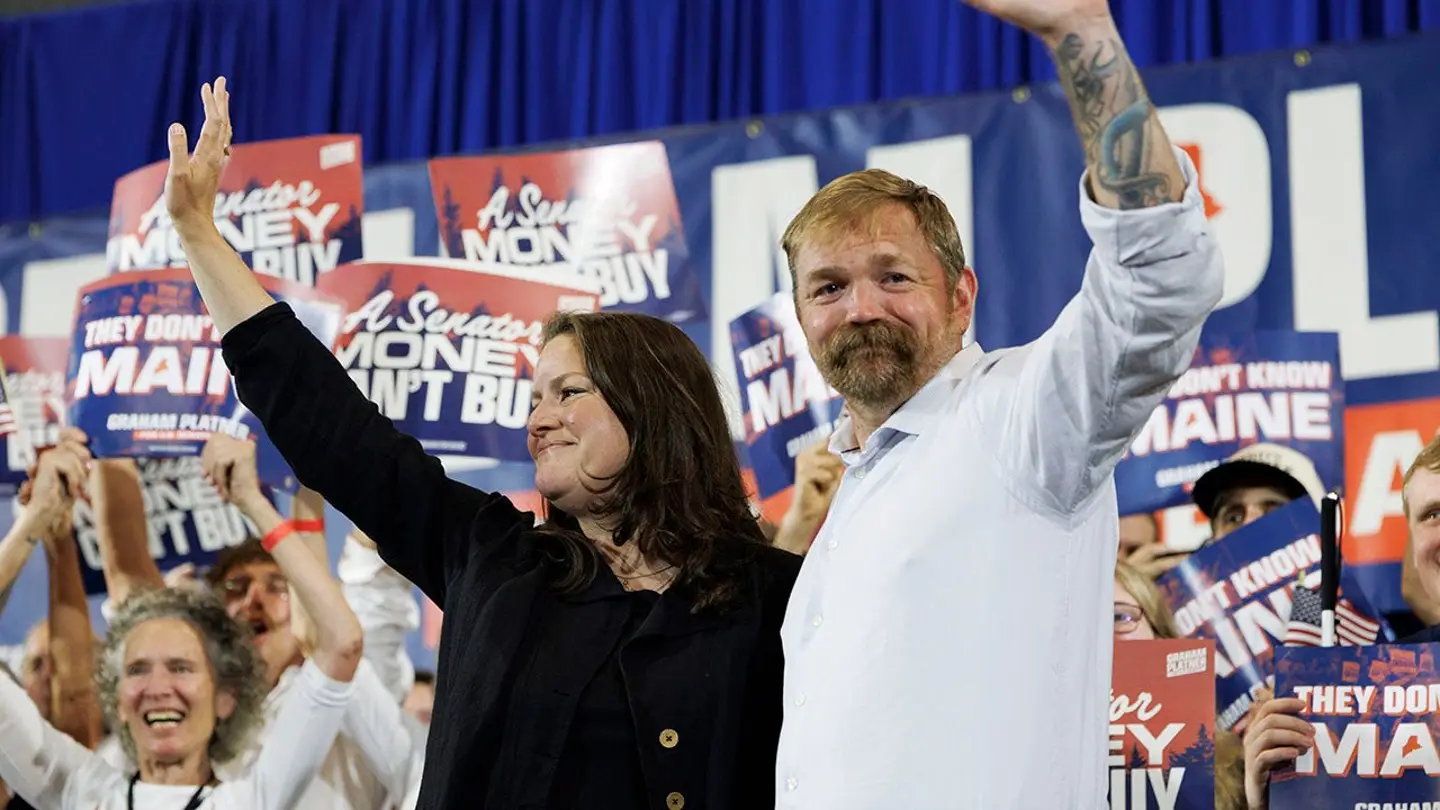
Maine Democratic Senate candidate Graham Platner is facing renewed scrutiny after an old social media comment resurfaced in which he referred to police officers as “opportunistic cowards.” The remark, written several years before his successful campaign for the Democratic nomination, has become the latest source of controversy surrounding a candidate now competing in one of the most closely watched Senate races in the country.
The comment dates back to June 2020, a period marked by nationwide protests, intense debate over policing, and widespread public anger following the killing of George Floyd in Minneapolis. Demonstrations took place in communities across the United States, including in Maine, as activists called for police reform and greater accountability. At the same time, law enforcement departments were preparing for the possibility of disorder, property damage, or confrontations during public gatherings.
Platner made the remarks while responding to an online discussion about the Hancock County Sheriff’s Department seeking approval to purchase riot-related protective equipment. He dismissed the request and mocked the idea that officers needed additional protection from local protesters. His post included insulting language directed at members of the department before concluding with the broad statement that police officers were “opportunistic cowards.”
The words have now returned to public attention as Platner campaigns for the United States Senate. Opponents argue that the comment was not simply criticism of a specific spending proposal but a sweeping attack on an entire profession. They say a person seeking federal office should be able to disagree with police policy without personally insulting officers or questioning their courage.
For law enforcement supporters, the wording is especially offensive because police officers are often required to respond to unpredictable and dangerous situations. They may be called to domestic disputes, serious accidents, violent crimes, mental health emergencies, public disturbances, or natural disasters. Critics of Platner argue that describing them collectively as cowards ignores the risks associated with their work and shows little respect for the individuals who serve local communities.
Republican officials have quickly used the resurfaced comment to challenge Platner’s judgment and temperament. They argue that the post provides another example of the candidate expressing extreme views online and then facing questions only after the statements become public. In a competitive Senate race, such material can easily become the foundation for television advertisements, campaign mail, online videos, and debate questions.
State Rep. Donald Ardell, a Maine Republican and former federal law enforcement officer, sharply criticized Platner’s remarks. Ardell argued that law enforcement departments must prepare for situations before they become dangerous rather than waiting for violence or disorder to occur. From his perspective, purchasing protective equipment does not necessarily mean officers expect to use it aggressively. It can instead reflect a responsibility to protect personnel if circumstances suddenly become unsafe.
That disagreement illustrates the larger dispute at the center of the controversy. Platner’s original post framed the proposed purchase as an unnecessary and exaggerated response to peaceful local demonstrators. His critics view the same request as ordinary preparation by a department responsible for public safety. The difference between those interpretations has become politically significant because it touches on competing views of policing, protest, government spending, and authority.
Platner’s defenders may point out that the comments were made during an emotionally charged national moment. In 2020, many Americans were using strong language while debating police conduct, racial injustice, protest tactics, and government responses. Some departments faced serious criticism over the use of force against demonstrators, while some officers were injured and businesses were damaged during unrest in certain cities.
However, the passage of time does not automatically remove political responsibility. Platner was approximately 35 years old when he made the comment, meaning opponents cannot easily dismiss it as the careless writing of a teenager. Voters may reasonably ask whether the language reflected his beliefs at the time, whether those beliefs have changed, and how he would now work with law enforcement agencies as a senator.
Candidates often argue that old posts should be understood in context, but context can work in more than one direction. The intense atmosphere of 2020 may explain why someone expressed anger so sharply. It can also remind voters that periods of national tension are precisely when leaders are expected to communicate carefully, avoid sweeping claims, and prevent disagreements from becoming personal attacks.
The controversy has also raised questions about the difference between criticizing policing and insulting police officers. Elected officials have the right to examine law enforcement budgets, training standards, disciplinary procedures, use-of-force policies, and equipment requests. Such oversight is an essential part of democratic government. Police departments, like all public institutions, use taxpayer money and should be accountable to the communities they serve.
At the same time, criticism becomes more divisive when it describes every member of a profession in the same negative way. There is a meaningful difference between arguing that a department does not need riot equipment and declaring that police officers as a group are cowardly. One is a policy position that can be debated using evidence. The other is a personal judgment that may make cooperation more difficult.
Platner’s campaign now faces the challenge of explaining what voters should understand from the remark. A clear response would likely need to address several questions. Does he regret the words? Does he still hold the same view? What specific concerns did he have about the equipment request? How does he currently view the role of local police? What reforms, if any, would he support in the Senate?
An apology alone may not satisfy all critics, especially because the controversy is part of a wider collection of resurfaced statements associated with Platner’s former online activity. Over the course of his political rise, old posts and recordings have repeatedly become public, creating an ongoing debate over whether they reveal a pattern or merely reflect a troubled period from which he has grown.
Platner has spoken publicly about struggles following his military service, including post-traumatic stress and difficulties adjusting to civilian life. Supporters argue that his experiences provide important context for some of his past anger and provocative behavior. They see his political story as one involving hardship, recovery, personal growth, and a desire to challenge a system he believes has failed working people and veterans.
Critics respond that personal struggles can explain behavior without excusing it. Many veterans and people experiencing trauma do not publicly insult police officers, soldiers, or other groups. They argue that a candidate seeking one of the most powerful elected positions in the country must take full responsibility for his words rather than relying too heavily on painful experiences as a defense.
This tension between explanation and accountability has followed Platner throughout his campaign. Some voters appreciate candidates who openly admit flaws and acknowledge difficult periods in their lives. They may view polished political figures with suspicion and see personal imperfection as evidence that a candidate understands ordinary people.
Other voters believe public office requires a higher standard. They worry that a long record of inflammatory statements may suggest poor judgment, unstable decision-making, or an inability to work respectfully with people who hold opposing views. For them, authenticity is not enough. They also want discipline, reliability, and respect for the institutions a senator may be asked to oversee.
Platner is not a conventional political candidate. Before entering the Senate race, he was known as a Marine veteran, oyster farmer, small-business owner, and local harbormaster. His campaign attracted attention by presenting him as an outsider who understood economic frustration in rural and working-class communities.
He has criticized political elites, concentrated wealth, expensive health care, housing costs, military intervention, and the influence of large corporations. His supporters see him as a populist willing to confront both Republicans and the Democratic establishment. That message helped him build a passionate following and eventually win the Democratic nomination.
His primary victory demonstrated that controversy had not prevented a large number of Democratic voters from supporting him. Some may have accepted his explanations, while others may have decided that economic and political issues were more important than his past statements. Some may also have viewed criticism of him as an attempt by establishment figures to weaken a progressive candidate.
The general election presents a different challenge. Democratic primary voters represent only part of Maine’s electorate. Platner must now appeal to independents, moderate Democrats, undecided voters, and possibly some Republicans dissatisfied with Collins. These voters may evaluate the controversies differently from the activists who supported him during the nomination contest.
Maine has a strong independent political tradition. Candidates often succeed by building personal credibility across party lines rather than relying only on loyal partisan voters. Susan Collins has benefited from that tradition throughout her long Senate career, presenting herself as a moderate willing to depart from her party on certain issues.
Platner’s campaign must therefore convince voters that his earlier statements will not prevent him from representing the entire state. A senator does not serve only people who share his political views. The office requires communication with police chiefs, sheriffs, federal agencies, military officials, local leaders, business owners, unions, activists, and residents with sharply different beliefs.
The resurfaced police remark gives Collins and Republican groups an opportunity to portray Platner as too extreme for Maine. They can argue that his language would make it harder for him to cooperate with law enforcement and that his nomination reflects a shift toward a more confrontational wing of the Democratic Party.
Platner may answer by focusing on his military background, public service, and policy priorities. As a combat veteran, he can argue that he understands danger, public duty, and the pressure faced by people working in high-risk professions. Yet that same biography may lead critics to ask why someone familiar with dangerous service used such dismissive language toward officers.
The issue could become especially important if police unions, sheriffs, or public safety organizations formally enter the race. Their endorsements and public comments could influence voters who place a high value on law enforcement. Even voters who support police reform may be uncomfortable with language they consider disrespectful or unnecessarily hostile.
Political campaigns frequently revive old social media posts because they offer short, emotionally powerful material. A complicated policy argument may require several minutes to explain, but a provocative sentence can fit into a headline, advertisement, or social media graphic. Once repeated often enough, the statement can become part of a candidate’s public identity.
This creates difficulties for voters trying to make fair judgments. A single sentence may not represent a person’s entire worldview, especially if it was written years earlier in response to a specific event. However, multiple similar statements can raise legitimate concerns about a pattern of behavior. Voters must decide how much weight to give past words and what evidence of genuine change they require.
The controversy also reflects the long-running national debate over public safety and police reform. Following the protests of 2020, some progressive activists supported reducing police budgets and redirecting money toward housing, mental health care, education, addiction treatment, and social services. They argued that police are often asked to handle problems that would be better addressed by trained specialists.
Opponents warned that reducing police resources could increase crime, slow emergency responses, and place both officers and communities at greater risk. The phrase “defund the police” became politically damaging in many areas because voters interpreted it as support for weakening or eliminating law enforcement, even when activists offered more detailed explanations.
Many Democratic politicians later distanced themselves from that slogan while continuing to support reforms such as body cameras, better training, independent investigations, and stronger accountability systems. They attempted to combine support for law enforcement with demands for fair treatment and constitutional policing.
Platner’s comment may make it harder for him to occupy that balanced position. Even if his current platform does not call for eliminating police departments, opponents can use his past words to argue that he possesses a deeper hostility toward officers. His task will be to demonstrate through specific proposals and direct communication that his approach is based on policy rather than personal contempt.
Law enforcement itself is not politically uniform. Police officers and their families hold a wide range of views. Some strongly support Republican candidates, while others vote Democratic or independent. Some officers support reforms and criticize misconduct within their own departments. Others believe political leaders often misunderstand the conditions under which officers must make rapid decisions.
A serious discussion should therefore avoid treating either police officers or protesters as a single group. Most of the people who joined demonstrations in 2020 were peaceful, though some events were accompanied by vandalism, looting, arson, or violent clashes. Most police officers perform their duties without becoming involved in nationally publicized misconduct, but serious abuses have occurred and require accountability.
Political language often removes that complexity. Activists may describe all police as dangerous, while opponents may portray all protesters as violent. Neither approach accurately represents the range of people and situations involved. Leaders have a responsibility to reduce this kind of generalization rather than encourage it.
The resurfaced post is damaging partly because it uses the kind of broad label that Platner’s campaign might normally criticize when directed at workers, veterans, rural residents, or marginalized communities. If politicians ask voters not to stereotype one group, they must apply that same principle consistently.
Platner could use the controversy as an opportunity to offer a more thoughtful position. He might acknowledge that his wording was unfair while still explaining why he opposed the equipment purchase. He could meet with officers, community activists, civil rights groups, and local officials to discuss what effective public safety should look like in Maine.
Such conversations would not erase the original statement, but they could provide voters with evidence of how he handles conflict today. Political growth is most convincing when demonstrated through action rather than simply claimed in a campaign statement.
Opponents would likely remain skeptical. They may argue that any outreach occurring only after negative publicity is politically motivated. That is a common problem for candidates confronted with old remarks: an apology made before a controversy appears more sincere than one made after public pressure begins.
Still, public accountability often occurs only after harmful words are uncovered. The important question becomes whether the response is specific, honest, and followed by changed behavior. Vague expressions of regret may sound calculated, while a direct acknowledgement of what was wrong can carry more weight.
Platner’s military service adds another layer to the debate. Veterans often play prominent roles in political campaigns because voters associate military experience with leadership, discipline, and commitment to country. Yet veterans are not required to hold identical political opinions, and military service does not prevent someone from speaking harshly or making mistakes.
His supporters may argue that his background gives him the right to criticize public institutions because he has personally experienced government decisions and their consequences. Critics may respond that service makes his insults toward other public servants more disappointing.
The Senate race is likely to attract enormous national attention because control of the chamber could depend on a small number of competitive states. Maine is considered an important opportunity for Democrats, while Republicans view Collins as an experienced incumbent capable of surviving difficult elections.
As a result, nearly every controversy involving Platner will be amplified by national political organizations. Republican groups will present him as evidence that Democrats have moved too far left. Progressive supporters will argue that conservative media and party operatives are using selective outrage to protect an established senator.
National attention can make it difficult for Maine voters to hear a discussion focused on local concerns. Issues such as housing affordability, health care access, fishing communities, energy costs, jobs, veterans’ services, reproductive rights, and rural infrastructure may compete with constant coverage of a candidate’s past statements.
However, character and judgment are also legitimate campaign issues. Senators vote on federal law enforcement funding, national security, judicial appointments, civil rights protections, and government oversight. Voters are entitled to examine how candidates speak about people who will be affected by those decisions.
The controversy is therefore not merely a distraction, though it should not become the only subject discussed. A fair campaign would allow Platner to answer for his words while also requiring both candidates to explain their plans for Maine and the country.
Collins will face her own record of votes, policy decisions, and political alliances. Platner’s controversies do not remove questions about her long tenure, her relationship with Republican leadership, or her positions on abortion, health care, taxes, judicial confirmations, and the Trump administration.
Likewise, criticism of Collins does not make Platner’s old comments irrelevant. Voters can examine both candidates at the same time. Political accountability should not depend on whether the person involved belongs to the preferred party.
The episode also highlights how digital records have transformed elections. Before social media, offensive statements might have been heard by only a few people and then forgotten. Today, old messages can be archived, copied, searched, and redistributed years later.
Anyone seeking public office can expect past online activity to be examined closely. Deleted posts do not always disappear, and anonymous usernames can sometimes be connected to real identities. Candidates may consider this unfair, but voters increasingly treat digital behavior as part of the public record.
There is still a danger in judging people only by their worst online moments. Social media encourages quick reactions, sarcasm, anger, exaggeration, and performance. People may write things they would never say in a formal speech or face-to-face conversation.
Yet the informality of a platform does not make words meaningless. In some cases, private or semi-anonymous writing may reveal attitudes that a person hides in professional settings. The challenge is determining whether a post represents a temporary emotional outburst, a repeated pattern, or a belief that remains unchanged.
Platner’s previous controversies make that question especially important. When several incidents emerge, each new revelation is interpreted through the others. A remark that might otherwise be treated as an isolated mistake can become evidence in a broader argument about character.
His supporters believe critics are attempting to freeze him permanently in the worst periods of his life. They emphasize his later work, community ties, military record, business experience, and willingness to discuss personal struggles. They argue that politics should allow room for rehabilitation and growth.
His opponents say forgiveness requires honesty and that public office is not something a person is automatically owed after changing. They distinguish between accepting that someone has improved and deciding that the same person should hold a Senate seat.