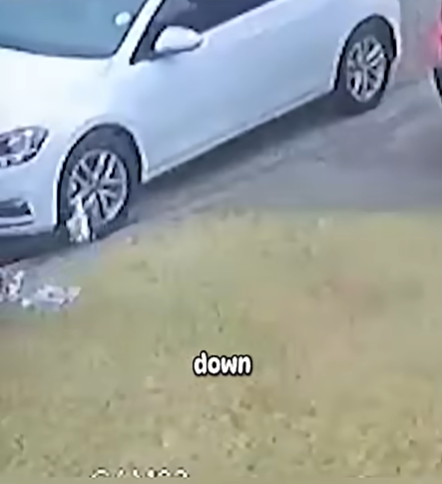
The video captures a frightening moment outside a family home, where an ordinary arrival turns into a sudden attack. A grandfather pulls up near a residential property in his SUV, likely expecting nothing more than to enter the driveway and continue with his day. Just inside the gate, his granddaughter is focused on opening the entrance, unaware that danger is unfolding only a short distance away. In a matter of seconds, the calm scene changes completely. A group of robbers ambushes the grandfather, pulls him from the vehicle, and tries to overpower him outside the property.
What makes the video so tense is the contrast between the granddaughter’s ordinary action and the danger happening nearby. She is inside the gate, occupied with the driveway, not yet fully aware of what is happening behind her. That detail gives the scene a painful sense of helplessness at first. The grandfather is outside the gate, surrounded by attackers, while the person who loves him is only steps away but not immediately able to stop it. The situation develops so quickly that there is barely time to understand it, let alone react calmly.
The attackers appear to rely on surprise. That is often how robberies like this unfold. The goal is to catch the victim off guard, create confusion, and act before anyone nearby can respond. A residential entrance can be a vulnerable place because people are often distracted when arriving home. They may be waiting for a gate to open, looking at the driveway, checking mirrors, or communicating with someone inside. The attackers seem to use that small window of vulnerability to make their move. For the grandfather, the attack must have felt sudden and terrifying.
But the robbers do not account for the family’s two guard dogs. While the granddaughter tries to manage the gate and keep the dogs inside, the dogs quickly notice the struggle. Their reaction changes the entire situation. They move from alert to action almost immediately, rushing past the granddaughter and out toward the street. In that moment, the animals become the strongest defense the family has. They do not hesitate, do not wait for instructions, and do not appear confused by the danger. They recognize that something is wrong and charge directly toward the attackers.
The dogs’ response is the turning point of the video. Until they rush out, the attackers seem to have control through numbers and surprise. Once the dogs enter the scene, that control collapses. One attacker is knocked down, and the others begin to retreat. The energy shifts from the grandfather being overwhelmed to the robbers trying to escape. The dogs do exactly what guard dogs are known for: they protect their family and territory when a real threat appears. Their speed, confidence, and instinct turn a terrifying ambush into a failed robbery.
The granddaughter’s role is also emotionally important. At first, she appears to be trying to close the gate, likely reacting out of panic and confusion. Her instinct may have been to keep the dogs contained or prevent the chaos from spreading. But the dogs force their way into the moment because they sense the danger more directly. That creates a powerful image: the granddaughter trying to control the gate while the dogs decide that protection matters more than staying inside. It is not that she is doing the wrong thing. She is scared and trying to respond in a chaotic moment. The dogs, however, act with pure protective instinct.
The video is powerful because it shows how quickly animals can understand danger through movement, sound, and emotion. Dogs are highly sensitive to changes in human behavior. They can detect panic, shouting, struggle, and unfamiliar aggression. In this case, the dogs appear to understand that the grandfather is in trouble before the situation can get worse. Their reaction is not casual barking from behind a fence. It is direct intervention. They run toward the threat and disrupt the attack at exactly the right time.
There is something deeply moving about the loyalty of dogs in situations like this. Families often love their dogs as companions, but moments of danger reveal another side of that bond. A guard dog is not only a pet sleeping in the yard or greeting family members at the door. It can become a protector when the family is threatened. The dogs in the video do not seem to calculate risk. They do not pause to decide whether the attackers outnumber them. They simply respond. That kind of loyalty is why stories of dogs protecting people resonate so strongly with viewers.
The grandfather’s rescue also highlights the importance of time. In an ambush, seconds matter. If help arrives too late, the outcome can become much worse. The dogs respond within that narrow window when the attackers still believe they have control. By rushing out immediately, they interrupt the robbery before it can fully continue. That quick intervention may have prevented serious harm, theft, or a prolonged struggle. Sometimes protection is not about overpowering every threat completely; it is about disrupting the attackers long enough for the victim to escape or for the attackers to lose confidence. That is exactly what appears to happen here.
The attackers’ reaction says a lot. Once the dogs charge, they do not remain in control. They scatter and flee. That response shows that their confidence depended on the victim being isolated and vulnerable. When the situation becomes unpredictable and dangerous for them, they choose escape. Many crimes of opportunity rely on speed and control. The moment that control is broken, the attackers often retreat. The dogs break that control instantly.
The scene also reminds viewers that homes can be vulnerable at the entrance. Gates, driveways, garages, and parking areas are transition spaces. People are not fully inside and protected, but they are also not fully alert to the street. This can create opportunities for criminals. The grandfather was outside the safety of the gate, while the granddaughter was inside, focused on opening access. It is a reminder for families to be alert during arrivals and departures, especially in areas where robberies or carjackings may occur. A few seconds of awareness can make a difference.
At the same time, the video should not be understood only as a crime warning. It is also a story about family, instinct, and protection. The granddaughter, the grandfather, and the dogs are all connected by the home they share. The attackers try to invade that sense of safety, but the dogs defend it. That is why viewers respond emotionally. The dogs are not protecting an object or a driveway. They are protecting a person. They recognize the grandfather as part of their family circle, and they act as if his safety is their responsibility.
The visual image of the dogs charging out is likely the most unforgettable part of the video. One moment, they are inside the gate. The next, they are in the street, moving with purpose. Their sudden entrance transforms the scene from helplessness into resistance. The robbers may have expected an easy target, but they did not expect two determined dogs. The dogs’ presence changes the emotional direction of the video from fear to relief. Viewers who begin the clip worried for the grandfather end it amazed by the animals’ courage.
There is also a strong lesson here about underestimating animals. People sometimes think of dogs mainly as cute companions, playful pets, or background members of the household. But dogs have instincts shaped by loyalty, territory, and social bonding. When properly cared for and connected to a family, they can become deeply responsive to danger. They may not understand crime in human terms, but they understand threat. They understand distress. They understand when someone who belongs to them is being harmed or frightened. That understanding can be enough.
The granddaughter’s panic is also understandable. In dangerous moments, people rarely respond perfectly. She may have been trying to close the gate because she feared the dogs could get hurt, feared they might run into traffic, or simply did not yet understand what was happening. Panic often makes people act on the first instinct available. The important point is that the dogs’ response ended up being exactly what was needed. Their movement past her was not disobedience in an ordinary sense; it was urgent protection.
The video also shows the difference between planned violence and instinctive defense. The attackers appear to approach with intention, choosing a vulnerable moment to strike. The dogs respond with immediate defense, not for gain but for protection. That contrast makes the dogs seem heroic. They are not acting for reward, status, or recognition. They are acting because a family member is in danger. This is why viewers often describe such animals as heroes. They do not need to understand the full story to do the right thing in the moment.
The aftermath, though not fully described, is important to imagine in a grounded way. The grandfather likely experienced shock and fear after being attacked so suddenly. The granddaughter likely felt shaken by how close the danger came. The dogs may have needed to be brought safely back inside and checked to ensure they were not injured. A family home that felt normal moments earlier may have suddenly felt exposed. Even when a victim is saved, the emotional impact of an ambush can last. People may become more cautious when opening the gate, pulling into the driveway, or arriving home at night.
The video also raises the question of safety planning. Families with gates, driveways, and pets may think about how to manage arrivals more carefully. This does not mean living in fear, but it does mean being aware. Looking around before opening a gate, keeping outdoor lighting strong, using cameras, avoiding long pauses outside the entrance, and communicating clearly between family members can help reduce risk. Guard dogs can be a powerful layer of protection, but they should not be the only plan. Safety works best when awareness, lighting, cameras, secure gates, and responsible pet handling all work together.
The role of the dogs also comes with responsibility. Guard dogs must be cared for, trained, and managed safely. Their protective instincts can be valuable during real danger, but families also need to make sure they are controlled around guests, neighbors, delivery workers, and children. In this case, the dogs appear to respond to a true threat. But responsible ownership means ensuring dogs understand their environment and are not placed in situations where they might harm innocent people. Protection and control need to exist together.
Still, in this particular moment, the dogs’ courage is what stands out. They saw their family member being attacked and rushed into danger. That is the kind of loyalty people remember. It is why stories of dogs saving owners, children, elders, and families continue to move people across cultures. Dogs live close to humans, watch them closely, and often respond emotionally to their distress. Their loyalty can be playful on ordinary days and lifesaving on dangerous ones.
The video also reminds viewers that criminals often look for easy targets, not difficult fights. The grandfather may have seemed vulnerable at first because he was outside the vehicle and near the gate. But the moment the dogs appeared, the situation was no longer easy. The robbers lost the advantage of surprise. They lost control of the scene. They faced an immediate threat they had not planned for. That sudden shift likely made escape seem like the only option. In that sense, the dogs did not only physically intervene; they psychologically broke the attack.
There is a deep emotional relief in seeing the robbers run away. The viewer begins with fear for the grandfather, then sees the dogs rush in, then watches the attackers retreat. That structure gives the video a strong sense of justice. The people who tried to harm an elderly family member are forced to flee by the very protectors they failed to notice. The family is saved not by luck alone, but by loyalty waiting just behind the gate.
The story also carries a powerful message about elders and vulnerability. Older family members can sometimes be targeted because attackers believe they will be easier to overpower. That makes the dogs’ intervention even more meaningful. They defend someone who may not have been able to fight back easily on his own. Families often feel a special protectiveness toward grandparents, and seeing animals step into that role touches something universal. The dogs become guardians not just of property, but of dignity and safety.
The granddaughter’s presence adds another layer of emotion because she is close enough to witness the danger and likely feel helpless for a moment. Seeing a loved one attacked can be terrifying, especially when it happens suddenly and there is no clear way to help. The dogs become the help she could not immediately provide. They rush into the space between her fear and her grandfather’s danger. That is why the moment feels so dramatic and emotional.
The video may also remind people that courage does not always look planned. Sometimes courage is instinctive. The dogs did not need a command. They did not need a strategy. They sensed danger and moved. Humans often think of courage as a conscious decision, but animals show another form of it: immediate protective action rooted in bond and instinct. That kind of courage can be just as powerful.
At the same time, it is important to remember that real-life confrontations are dangerous and unpredictable. The best outcome is always to avoid violence when possible, call authorities, and prioritize survival. The dogs’ intervention worked in this case, but people should not intentionally place animals or themselves in danger. The moment was extraordinary because it happened naturally and quickly. The safest response after such an event would be to secure the family, contact police, preserve any camera footage, and seek medical attention if needed.
In the end, the video is memorable because it turns a moment of fear into a story of rescue. A grandfather is ambushed outside his own family’s property. His granddaughter is nearby but initially unaware and then panicked. The attackers seem to have the advantage. Then the dogs notice. They charge out, confront the threat, knock one attacker down, and chase the rest away. In seconds, the balance changes completely.
The strongest takeaway is that loyalty can be powerful in ways people do not always expect. The family’s dogs were not just animals behind a gate. They were protectors who recognized danger and acted when it mattered most. Their response likely saved the grandfather from further harm and gave the family a chance to regain safety. The video is frightening, but it is also deeply moving because it shows courage arriving on four legs, without hesitation, at the exact moment it was needed.
Another important part of this story is how quickly the feeling of safety can disappear at the entrance of a home. Many people think of danger as something that happens far away, in unfamiliar places, or in clearly risky environments. But this incident shows that danger can appear in the most ordinary moments: coming home, opening a gate, pulling into a driveway, stepping out of a car. That is what makes the video so unsettling. The family is not doing anything unusual. The grandfather is simply arriving, and the granddaughter is helping open the property. The attackers choose that small moment of transition, when attention is divided and the vehicle is not fully secured inside the gate.
This is why the dogs’ reaction feels so powerful. They restore the boundary that the attackers tried to violate. The gate, at first, is not enough to protect the grandfather because he is still outside it. The granddaughter is not able to stop the attackers by herself because everything happens too quickly. But the dogs become a living barrier between the family and the robbers. They rush into the gap where safety has failed. In a few seconds, they turn the front of the home from a vulnerable entry point into a defended space.
The attackers likely expected fear and confusion to work in their favor. In many ambush-style robberies, criminals depend on speed. They want the victim to freeze, the witnesses to panic, and the entire event to end before anyone can organize a response. That plan falls apart when the dogs charge out. Animals do not react according to the attackers’ expectations. They do not negotiate, hesitate, or become intimidated by shouting. Their directness makes the robbers lose the advantage they thought they had. The attackers may have planned for a person, but they did not plan for two determined guard dogs.
The granddaughter’s attempt to close the gate also adds emotional complexity. She may have been trying to protect the dogs from danger or prevent them from running into the street. In many families, pets are loved deeply, and the instinct to keep them safe is strong. But the dogs clearly sensed that a family member needed help. Their choice to push past her is one of the most dramatic parts of the scene because it shows instinct overriding ordinary control. On a normal day, the gate keeps the dogs inside. In this moment, the dogs understand that the threat is outside, and outside is exactly where they need to be.
The grandfather’s position in the story makes the rescue even more emotional. Grandparents often represent care, history, and family roots. Seeing an older man attacked outside his own home creates a strong reaction because it feels especially unfair and cowardly. The robbers target someone who may be less able to defend himself physically, and that makes the dogs’ intervention feel like justice arriving at the perfect time. They protect the person who might have been most vulnerable in that moment.
The video also reminds people that security is not only about technology. Cameras, alarms, gates, and lights are important, but living protectors can respond in a way machines cannot. A camera can record. An alarm can make noise. A gate can slow entry. But the dogs actively intervene. They read the situation, move toward the threat, and force the attackers to flee. That does not mean every family should rely only on dogs for protection, but it shows why trained, well-managed guard dogs can be such a powerful part of home security.
Still, the most touching part of the story is not aggression; it is loyalty. The dogs are not chasing strangers for entertainment. They are responding to distress. They recognize the grandfather as one of their own. That bond turns them from pets into protectors. On ordinary days, they may play, rest, eat, and follow the family around the yard. But when danger appears, that same bond becomes courage. The dogs do not need praise or explanation. They simply act.
For the family, the emotional aftermath may be intense. Relief can arrive together with shock. The grandfather may be grateful to be safe but shaken by how suddenly he was attacked. The granddaughter may feel fear, guilt, or disbelief because she was only steps away when everything happened. The dogs may be praised as heroes, but the family may also worry about what could have happened to them. A moment like this can change the way a family approaches the gate, the driveway, and arriving home. They may become more alert, install more lighting, review cameras, or change their routine.
In the end, this rescue stands out because it shows love in action without words. The dogs see danger and run toward it. They do not wait for the perfect moment. They do not need to understand the full situation. They know enough: someone they love is being attacked. That is why the video is both frightening and inspiring. It begins with a grandfather in danger and ends with the family’s loyal protectors chasing that danger away. It is a reminder that courage sometimes appears suddenly, fiercely, and on four legs.