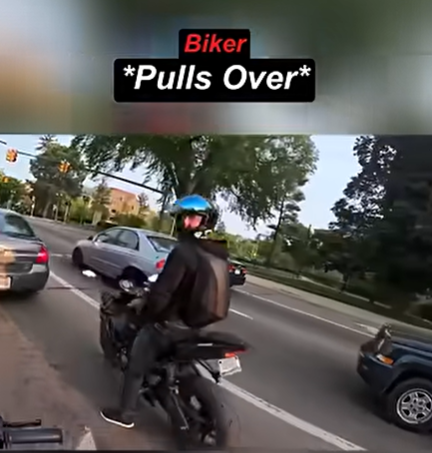
The city streets were bustling with the usual weekday traffic, a cacophony of engines, honking horns, and the distant hum of urban life. On this particular day, however, a singular encounter would transform an ordinary stretch of road into a stage for escalating conflict and human volatility. At the center of this unfolding drama were two people: a motorcyclist, calm and composed, and a driver in a silver car, whose anger quickly escalated into violence.
It began with a moment that could have been dismissed as an ordinary traffic annoyance, yet quickly escalated into aggression. The motorcyclist had pulled over momentarily, maneuvering safely to allow the flow of vehicles to continue. From behind, the silver car’s driver began shouting insults, his voice cutting sharply through the ambient noise of the city. As the verbal barrage intensified, it became clear that the remarks were not merely complaints about traffic, but included racial slurs and personal attacks, aimed directly at the motorcyclist. The motorcyclist, maintaining a steady composure, responded with an unexpected calmness. With a gentle tone, he wished the driver a wonderful day, expressed goodwill, and urged him to continue moving so as not to obstruct traffic. His words were measured, almost meditative, serving to defuse tension rather than escalate it.
But the driver’s anger did not abate. Rather than absorbing the motorcyclist’s calm demeanor, he appeared further provoked. In a sudden surge of aggression, he followed the motorcyclist down the street, attempting to make physical contact while both vehicles were still in motion. The motorcyclist, demonstrating a combination of awareness and composure, kept moving safely, seeking to avoid confrontation while navigating city traffic. Still, the driver’s actions were increasingly erratic, signaling an escalation from verbal aggression to physical intent.
Eventually, the chase led them onto a side street, where the motorcyclist attempted to engage the driver verbally once more, making a light-hearted comment: “Say hi!” It was a disarming attempt at defusing the tension, perhaps a final effort to redirect the encounter toward civility. The response, however, was the opposite of conciliatory. The driver reached out and struck the motorcyclist in the back, a sudden, unprovoked act of violence that left the biker momentarily stunned. The motorcyclist, realizing the situation’s severity, immediately sought a safe resolution. Scanning his surroundings, he noticed the presence of two police officers stationed on a nearby city street.
Acting quickly, the motorcyclist pulled over and explained the situation to the officers. His voice conveyed urgency and clarity as he described the earlier verbal and physical attacks, pointing out the driver’s aggressive behavior and indicating that he was heading directly toward the police presence. The officers listened attentively, recognizing the seriousness of the threat and the immediacy of the potential danger. Their training and experience allowed them to respond quickly, assessing the scene and preparing to intervene before the situation escalated further.
Despite the officer’s presence, the driver approached aggressively, this time on foot. He loudly denied any wrongdoing, proclaiming that the motorcyclist was lying about the altercation. His voice carried a mixture of indignation and defiance, yet his actions betrayed the intensity of his anger. In a rapid motion, he struck the motorcyclist again, knocking the recording camera from the biker’s hands as the officers moved to intervene. The physicality of the assault, combined with the verbal aggression, underscored the dangerous volatility of the situation.
The officers, acting swiftly, moved between the two individuals, creating a buffer and attempting to de-escalate the confrontation. Their presence introduced a layer of authority, enforcing order and attempting to prevent further injury. The driver’s resistance and continued aggression, however, complicated the scene. The motorcyclist remained vigilant, ensuring his own safety while providing information to the officers and avoiding additional contact. The dynamics of fear, aggression, and authority intertwined, creating a tense tableau where every movement and word carried significant weight.
Bystanders, observing the incident unfold, were drawn into the intensity of the moment. The sound of shouting, combined with the sudden escalation from verbal abuse to physical violence, created an atmosphere of heightened alertness. Some individuals recorded video footage, capturing the confrontation from multiple angles. These recordings would later become critical in reconstructing the sequence of events, analyzing the behavior of both parties, and providing evidence for law enforcement and legal proceedings.
Psychologically, the encounter highlighted the interplay between emotional impulse and calculated response. The motorcyclist, despite being the target of aggressive behavior, maintained composure, demonstrating emotional regulation and situational awareness. His calm responses served as both a protective strategy and an attempt at diffusing the driver’s aggression. The driver, conversely, exhibited a failure to regulate emotion, allowing anger and perceived provocation to dictate his actions, escalating the situation from verbal insult to physical attack.
The presence of law enforcement acted as both a mitigating factor and a trigger for further aggression. While the motorcyclist sought protection and validation through the officers, the driver’s arrival on foot, loud denial, and physical aggression demonstrated how authority can simultaneously restrain and provoke. The officers’ interventions became critical in preventing further harm, highlighting the importance of timely and measured response in situations of spontaneous urban violence.
As the scene unfolded, it became clear that the incident would extend beyond the immediate physical altercation. Video footage of the event circulated on social media, sparking discussions about road rage, accountability, and public safety. Viewers analyzed the actions of both the motorcyclist and the driver, debating the appropriateness of responses, the proportionality of aggression, and the responsibilities of civilians in confrontational scenarios. The viral dissemination of footage transformed the encounter into a public discourse, extending its impact beyond the physical moment into broader societal reflection.
Legal implications were imminent. The driver’s actions—striking another individual multiple times, aggressive pursuit, and refusal to cease behavior in the presence of law enforcement—created grounds for potential charges including assault, reckless endangerment, and disorderly conduct. The motorcyclist’s actions, while calm and defensive, provided critical testimony and evidence, documenting the aggression through recorded video. The interplay of eyewitness accounts, recorded evidence, and police reports would form the basis for legal proceedings, illustrating the intersection of spontaneous human behavior and the justice system.
The urban environment itself contributed to the dynamics of the encounter. Narrow streets, vehicular traffic, pedestrian presence, and nearby intersections created constraints and influenced movement. Each participant’s actions were shaped by the environment: the motorcyclist navigated safely while maintaining awareness, the driver exploited gaps in traffic to pursue, and the officers positioned themselves strategically to intervene. These physical factors intertwined with psychological and social dynamics, creating a complex scenario where risk, perception, and spatial awareness dictated behavior.
Reflecting on the broader context, the incident serves as a vivid example of how ordinary urban interactions can escalate rapidly under emotional pressure. A minor traffic dispute transformed into a sustained sequence of aggression, pursuit, and physical violence. The interplay of fear, anger, authority, and self-protection underscores the fragility of civility in shared spaces, illustrating how personal emotions and social norms intersect with public safety mechanisms.
The motorcyclist’s composure throughout the incident provides insight into effective strategies for de-escalation in high-stress environments. His verbal calm, measured physical movements, and immediate engagement with law enforcement demonstrate an awareness of situational risk and an understanding of procedural safety. In contrast, the driver’s aggressive escalation, failure to regulate emotion, and direct confrontation highlight the dangers of impulsive behavior in public spaces.
Post-incident, the implications extend into social and psychological realms. The motorcyclist may experience heightened vigilance and stress responses, a common consequence of experiencing targeted aggression. The driver’s behavior, likely scrutinized through legal and social lenses, demonstrates the intersection of personal accountability, societal norms, and the consequences of impulsive aggression. Public reactions, amplified through media and social sharing, contribute to collective discussions about acceptable behavior, law enforcement efficacy, and individual responsibility.
Ultimately, this road rage incident illuminates the dynamics of human behavior, authority, and urban interaction under stress. It highlights the potential for ordinary situations to escalate into physical confrontations, the role of law enforcement in mitigating risk, and the importance of composure, awareness, and procedural adherence. Through the lens of this single incident, broader societal questions emerge: how individuals navigate conflict, the responsibilities of bystanders and law enforcement, and the balance between emotional impulse and rational action in the shared public space of the city.
The streets of the city, usually a place of mundane movement and fleeting encounters, had become a stage for an unrelenting drama of human emotion. From the first words exchanged to the final physical confrontation, the incident encapsulated the unpredictable volatility that can arise in everyday life. The motorcyclist, calm and measured despite the initial verbal assault, had demonstrated an extraordinary presence of mind. Yet even as he navigated the narrow streets, attempting to avoid further escalation, the driver in the silver car transformed simple anger into relentless aggression.
Initially, the verbal exchange might have seemed trivial to an outside observer. Yet the intensity of the insults, punctuated by racial slurs, conveyed deep-seated animosity. The motorcyclist, recognizing the potential danger, responded with a surprising level of composure. “I hope you have a wonderful day,” he said, his tone even, almost warm. “I love you, and I hope you keep moving so you don’t block traffic.” His words were intended to de-escalate, to offer a form of psychological counterbalance to the driver’s aggression. It was a calmness born not from fearlessness but from acute awareness, a strategic approach to avoid provoking further violence.
Despite the motorcyclist’s efforts, the driver’s reaction escalated. In a sudden burst of aggression, he pursued the motorcyclist, attempting to make contact while both vehicles were still moving. The chase itself was a study in human reaction under stress: the motorcyclist’s concentration was absolute, maintaining balance and awareness, his eyes scanning for obstacles, pedestrians, and potential escape routes. Every shift in speed, every tilt of the bike, was a calculated decision. The driver’s behavior, conversely, was reactive, impulsive, fueled by anger and a sense of perceived insult. The collision of these two mental states—calculated restraint and uncontrolled aggression—set the stage for the physical encounter that would soon follow.
As the chase extended onto a quieter side street, the dynamics shifted yet again. Here, the motorcyclist attempted to inject levity, signaling with a playful remark: “Say hi!” It was an attempt to humanize the situation, to invite a moment of recognition of shared humanity, even in the midst of conflict. The response was immediate and violent. The driver reached out and struck the motorcyclist in the back, a physical manifestation of his inability to regulate emotion. The blow knocked the motorcyclist slightly off balance, and for a moment, the stability of the encounter was in jeopardy.
Recognizing the danger, the motorcyclist acted quickly. His awareness of surroundings became paramount, and he noticed the presence of two police officers on a nearby city street. Pulling over, he explained the situation with clarity and urgency. “He’s been chasing me,” he said, voice calm but insistent. “He just hit me in the back, and he’s coming toward you now.” The officers listened intently, absorbing not only the words but the tone, the urgency, and the implicit call for intervention. Their positioning on the street allowed for a strategic response, and they prepared to prevent further harm.
However, the driver’s aggression did not abate. Approaching on foot, he loudly denied his actions, attempting to discredit the motorcyclist’s account. “I didn’t touch you!” he shouted. “You’re lying!” The declarations, punctuated by his rapid movements, conveyed both defiance and an unwillingness to acknowledge accountability. Despite the officers’ presence, he struck the motorcyclist again, knocking the camera from the biker’s hands. The physicality of the assault, combined with the verbal aggression, escalated the encounter to a level requiring immediate intervention.
The officers moved in swiftly, placing themselves between the two individuals. Their actions were precise, informed by training in crowd and conflict management. The presence of authority acted as a moderating force, reducing the likelihood of further injury while allowing the driver to be restrained. The interplay between civilian aggression and law enforcement authority became the focal point of the incident, illustrating the delicate balance between compliance, self-protection, and procedural intervention.
Witnesses to the event provided an additional layer of observation. Pedestrians and nearby drivers paused to watch, their attention captured by the unfolding confrontation. Some recorded video footage, creating a record that would later serve as critical evidence. The impact of these observations extended beyond the immediate scene. The video footage, when disseminated online, transformed a local incident into a wider societal discussion about aggression, road rage, policing, and personal responsibility. The viral nature of social media amplified the reach and consequences, ensuring that the incident would be scrutinized by the public long after the initial event.
The psychological dimension of the encounter was profound. The motorcyclist displayed a level of emotional regulation that contrasted sharply with the driver’s impulsive aggression. His calm responses were strategic, designed to mitigate further confrontation, maintain physical control, and ensure that law enforcement could intervene effectively. The driver’s behavior, in contrast, demonstrated the consequences of unregulated emotional responses. Anger, when unchecked, transformed verbal conflict into physical violence, escalating both personal risk and public danger.
The urban environment itself contributed to the dynamics of the incident. Narrow streets, traffic conditions, and the presence of pedestrians all influenced movement and decision-making. The motorcyclist’s awareness of space, speed, and obstacles allowed for calculated maneuvering, while the driver’s pursuit reflected a disregard for these environmental constraints, prioritizing emotional satisfaction over safety. The cityscape, indifferent to human conflict, served both as a backdrop and a complicating factor, shaping the encounter in subtle yet significant ways.
Legal implications were imminent. The driver’s actions—chasing the motorcyclist, striking him multiple times, and approaching aggressively in the presence of law enforcement—constituted a series of criminal behaviors, including assault, reckless endangerment, and disorderly conduct. The motorcyclist’s testimony, coupled with video evidence and eyewitness accounts, provided a foundation for legal proceedings. The interplay of evidence and human behavior underscored the complexity of adjudicating incidents rooted in emotion and spontaneity.
Socially, the incident sparked debate. Viewers and commentators questioned the proportionality of the motorcyclist’s responses, the escalation of the driver’s aggression, and the broader societal factors that contribute to road rage. Discussions extended into questions of public safety, the psychological triggers of anger, and the effectiveness of law enforcement interventions in real-time conflicts. The narrative became a lens through which to examine both individual behavior and systemic social dynamics.
Beyond immediate legality and public discourse, the incident illustrated the human experience of conflict under stress. Both participants were influenced by physiological responses: adrenaline surges, heightened perception, rapid decision-making, and emotional reactivity. The motorcyclist leveraged these factors constructively, channeling awareness into safe navigation and communication with law enforcement. The driver’s responses, however, highlighted the dangers of succumbing to emotional impulses, illustrating how stress and perceived provocation can override rational judgment.
In the aftermath, the motorcyclist likely experienced continued psychological impact, including hyper-vigilance, stress responses, and reflections on the incident. The driver’s aggressive behavior, once subjected to legal and social scrutiny, would be analyzed for accountability, training deficiencies, and potential interventions to prevent future occurrences. The public, informed by video and narrative accounts, would engage with the incident as both a cautionary tale and a case study in human behavior.
The viral dissemination of video footage transformed the incident from a local conflict to a wider societal conversation. Analysts, commentators, and ordinary viewers dissected the events frame by frame, evaluating behavioral choices, environmental context, and social implications. The public debate emphasized proportionality, legal rights, and the psychological factors underpinning road rage. Each perspective contributed to a collective understanding of the complex interplay between individual emotion, social norms, and public safety mechanisms.
Ultimately, the incident highlights the unpredictable nature of human interactions in shared urban spaces. Minor conflicts, when amplified by emotional triggers, can escalate rapidly into physical confrontations, threatening both individual safety and societal order. The motorcyclist’s composure and strategic behavior provide a model for managing aggression, while the driver’s impulsivity underscores the risks inherent in unregulated emotional responses.
This confrontation, captured in vivid detail on video, serves as both documentation and educational material, illustrating the consequences of escalation, the importance of law enforcement presence, and the broader social implications of individual actions. It offers insight into human psychology, societal expectations, and urban dynamics, demonstrating how ordinary environments can become stages for extraordinary behavior.
Even as the officers moved to intervene, the physical and emotional tension of the incident lingered in the surrounding streets. Bystanders, who had paused to witness the escalating altercation, whispered to one another, some shaking their heads in disbelief, others narrating what they had seen for those who had arrived moments later. The scene had become a public tableau of urban conflict, a live demonstration of how quickly ordinary interactions can spiral into chaos. The motorcyclist, now on the side of the street with the officers, remained vigilant, his eyes scanning for any further movement from the driver, aware that another unpredictable action could reignite violence. His adrenaline remained elevated, and even after the physical contact had ceased, the tension in his muscles and the rapid rhythm of his heartbeat reflected the body’s ongoing response to perceived threat.
The driver, for his part, displayed a mix of defiance and frustration, amplified by the confrontation with law enforcement. His shouting, denials, and aggressive gestures underscored his unwillingness to accept accountability, and his earlier impulsivity had now compounded into a broader legal and social predicament. The officers’ presence introduced a stabilizing force, but also an immediate boundary that the driver could no longer ignore. His continued agitation, however, was emblematic of how emotionally charged situations can impair judgment, demonstrating the risks inherent in unregulated anger, especially in a public setting where legal and social consequences are immediate.
Nearby witnesses who had captured footage began to upload clips to social media platforms, extending the incident far beyond its original geographic confines. The videos depicted every stage of the escalation: the initial verbal abuse, the driver’s pursuit, the backhand strike, and the final physical confrontation with the motorcyclist on the sidewalk. The circulation of these clips prompted discussion across a variety of communities, from casual observers to legal analysts, and sparked widespread debate about road rage, the appropriate use of self-control, and the responsibilities of drivers in shared urban spaces. The incident had transformed from a personal altercation into a focal point for social reflection, providing insight into both human behavior and civic expectation.
From a psychological standpoint, the incident illustrates the stark contrast between controlled composure and impulsive reaction. The motorcyclist’s calm demeanor, even when faced with direct physical aggression, demonstrates an acute awareness of situational safety and emotional regulation. Conversely, the driver’s repeated acts of violence highlight the dangers of escalating anger, particularly when combined with the perceived anonymity of urban environments. These differing responses underscore the importance of situational awareness, the capacity for self-restraint, and the potential consequences when emotion overrides rational decision-making.
Finally, the incident underscores the critical role of law enforcement in mediating conflict and ensuring public safety. The officers’ timely intervention prevented further escalation, demonstrating both the necessity and complexity of managing spontaneous urban confrontations. The interplay between civilian actions, environmental factors, and police presence created a multifaceted scenario in which careful observation, rapid assessment, and controlled response were essential. As the immediate danger subsided, the incident provided valuable lessons on human behavior, public accountability, and the unpredictable nature of urban life, leaving all participants and observers with a lasting awareness of how quickly normalcy can give way to chaos when conflict is left unchecked.