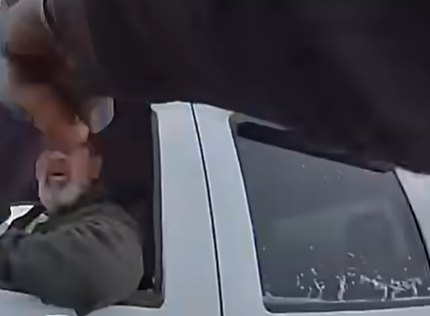
The video opens on a quiet suburban street, a calm afternoon suddenly disrupted by the flashing lights of a police cruiser conducting an active traffic stop. Beyond the immediate stop, a white pickup truck is parked behind the scene, belonging to a man who, moments before, had arrived simply to wait for his son. What begins as a routine encounter between law enforcement and a civilian quickly escalates into a tense and alarming confrontation, ultimately culminating in serious legal consequences.
From the outset, the interaction is fraught with tension. The officer approaches the parked pickup with a brisk, commanding gait. His voice carries a sharp edge as he orders the driver to leave the area immediately, asserting that there is no legitimate reason for him to be positioned behind an active traffic stop. The tone is accusatory, the demeanor aggressive, leaving the driver with little room for dialogue. Despite the officer’s intensity, the driver calmly explains his presence: he is waiting for his son, who has just been pulled over and is temporarily stranded. The pickup serves as a waiting spot, a practical necessity for a parent ready to provide his child a ride home.
The officer, however, appears unconvinced. He issues a strict five-second warning, demanding that the driver leave the scene immediately. The driver, understanding the instruction, begins to roll up his window and prepare to drive away. At this point, the encounter takes an abrupt turn: the officer changes his demands mid-action, yelling at the driver to stop the vehicle and remain in place. The sudden reversal is disorienting, the driver caught between compliance and conflicting instructions.
The escalation continues rapidly. Without warning, the officer opens the driver’s door, screaming at the man to exit the vehicle. The driver, still attempting to comply while processing the sudden aggression, is immediately met with the deployment of a taser. Sparks fly, the vehicle jolts, and the driver collapses partially outside the truck as the electrical charge incapacitates him temporarily. Other deputies arrive to assist in physically removing the man from the vehicle, handcuffing him with force as the confrontation reaches its apex. Witnesses, recording on phones and observing from nearby, capture the entire scene — a disturbing sequence of rapid escalation that transforms a routine traffic stop into a matter of public scrutiny.
The legal and social aftermath of the incident is significant. News coverage later reveals that the driver, the victim of excessive force, reached a $1.5 million settlement against the law enforcement agency. Both deputies involved in the tasing and arrest were terminated from their positions, illustrating the severity of the misconduct and the accountability measures that followed. The story became emblematic of larger societal debates over the appropriate use of force, civil rights protections, and the responsibilities of law enforcement officers to manage encounters professionally, especially when civilians are acting in good faith.
This incident underscores the delicate dynamics present in interactions between law enforcement and civilians. Even situations that appear routine — a parent waiting for a child during a traffic stop — can escalate dramatically when communication breaks down, commands are conflicting, and authority is exercised aggressively. The video serves as a case study in both procedural failure and human psychology, demonstrating how quickly confusion and fear can intersect with authority to produce extreme outcomes.
Furthermore, the encounter highlights the critical role of documentation and public oversight. The video, widely circulated, preserved an unalterable record of events that proved pivotal in legal proceedings. Such recordings not only inform the public but also provide essential evidence in holding institutions accountable, influencing policy, and ensuring that excessive force or misconduct does not go unchecked.
At its core, the incident is also a human story: a father attempting to ensure his child’s safe return, confronted by authority in a moment of misunderstanding and mismanaged aggression. The consequences — physical, legal, and emotional — reverberate far beyond the initial stop, prompting reflection on best practices in law enforcement, civil rights protections, and the importance of measured, proportional response in all encounters.
The settlement and subsequent firings signal both a corrective action and a broader societal statement: misuse of authority and excessive force have tangible consequences. The narrative serves as a stark reminder that authority carries responsibility, and that civilians — even in moments of compliance and calm — can be placed at risk when that responsibility is neglected or abused. The combination of procedural missteps, rapid escalation, and eventual accountability underscores the complexity of modern policing, the necessity of training and oversight, and the enduring relevance of civil rights protections in everyday interactions.