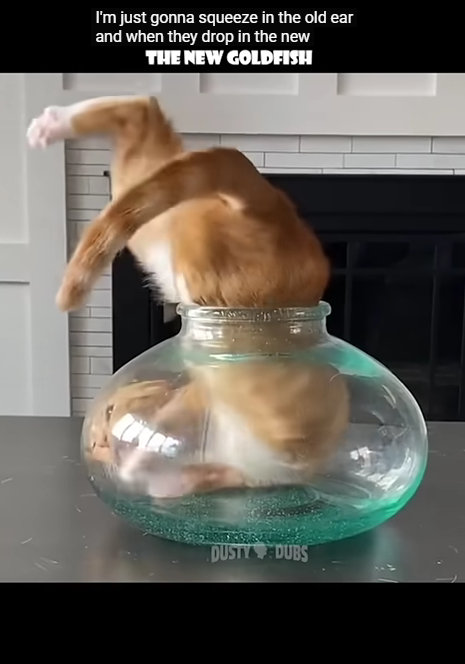
This short and humorous video captures a playful and imaginative moment featuring an orange and white cat engaging in one of its most iconic behaviors—squeezing itself into an unexpectedly small space. In this case, the cat manages to fit its entire body into an empty, round glass fishbowl. The visual alone is both amusing and impressive, as cats are well known for their ability to contort and adapt their bodies to fit into tight or unusual spaces. The transparency of the bowl adds an extra layer of comedy, making the cat fully visible while it attempts to settle into what appears to be an increasingly questionable hiding spot.
From the very beginning of the clip, the tone is lighthearted and playful. The setting is simple, likely an indoor environment where the fishbowl is placed within easy reach of the cat. There is no clutter or distraction in the background, allowing full focus on the cat’s behavior. As the cat approaches the bowl, its curiosity becomes immediately apparent. This sense of curiosity is a defining trait of feline behavior, as cats are naturally drawn to exploring containers, boxes, and enclosed spaces regardless of size or practicality.
What makes the video especially entertaining is the addition of a humorous voiceover presented from the cat’s perspective. This creative choice transforms the scene from a simple animal moment into a comedic narrative. Instead of just observing a cat sitting in a bowl, viewers are invited into the imagined thoughts of the cat itself. The voiceover gives personality and intention to the cat’s actions, making the entire sequence feel more like a short comedic skit rather than a spontaneous pet behavior clip.
In the voiceover, the cat humorously explains that now that the humans have left the room, it sees the perfect opportunity to execute its plan. According to the narration, the cat decides to hide inside the fishbowl in anticipation of a future event involving a goldfish. This playful interpretation adds a layer of imagination, suggesting that the cat is not just sitting randomly, but instead preparing for a carefully thought-out “ambush.” This anthropomorphic storytelling style is a common feature in viral pet videos, as it helps viewers emotionally connect with animals by attributing human-like thoughts and motivations to their actions.
As the cat settles deeper into the bowl, the humor of the situation becomes more apparent. The fishbowl is clearly not designed to accommodate a full-grown cat, yet the animal appears determined to make it work. Its body presses against the curved glass, creating a visually funny contrast between the cat’s size and the confined space. Despite the obvious discomfort that such a position might imply, cats often display a surprising level of contentment when they find a place they consider “secure,” even if it is impractically small.
The voiceover continues to build on this comedic narrative, describing the cat’s imagined strategy of waiting patiently for the arrival of a goldfish. This playful concept turns the cat into a mischievous character, one that sees itself as a stealthy hunter lying in wait. The humor lies in the exaggeration of natural feline instincts. While cats do have strong predatory instincts, the idea of plotting inside a glass bowl adds a humorous and absurd twist that makes the video entertaining for viewers of all ages.
Just as the cat appears fully settled and comfortable in its chosen hiding spot, the tone of the video shifts slightly with a sudden moment of realization. The cat’s expression changes, and the voiceover introduces a new thought: what if the humans do not bring a goldfish at all? Instead, what if they bring something far more unexpected or even intimidating, such as a snapping turtle or an electric eel? This abrupt shift from confidence to concern adds a comedic twist to the narrative, highlighting the cat’s exaggerated imagination.
This moment of realization is what gives the video its punchline. The contrast between the cat’s earlier confidence and its sudden doubt creates a humorous emotional reversal. In storytelling, this type of shift is often used to surprise the audience and enhance comedic effect. Here, it works perfectly because it plays on the idea that the cat, despite being a natural predator in many situations, suddenly fears something even more unpredictable than itself.
The mention of a snapping turtle or electric eel adds to the absurd humor of the situation. These are creatures far beyond the typical household fish scenario the cat initially imagined, making the fear both exaggerated and funny. It highlights the imaginative nature of the voiceover, which turns a simple pet moment into a miniature comedic story filled with unexpected possibilities.
Visually, the cat’s position inside the fishbowl continues to enhance the humor throughout this narrative shift. Its confined posture, combined with its expressive face, allows viewers to interpret a range of emotions—from confidence to sudden concern. Cats are particularly effective subjects for this type of content because their facial expressions and body language often appear surprisingly human-like, making it easy for audiences to project thoughts and emotions onto them.
The video also reflects a broader trend in online pet content where humor is created through narration rather than action alone. By adding a voiceover, creators can build entire imaginary worlds around simple animal behaviors. This transforms everyday pet antics into engaging short stories that resonate with viewers who enjoy both humor and animals. The combination of visual cuteness and comedic storytelling is one of the main reasons such videos often perform well on social media platforms.
As the clip continues, the cat remains inside the bowl, still processing its imaginary concerns. The humor lies in the contrast between the cat’s serious internal monologue and the absurdity of the situation itself. There is no actual danger present, yet the cat’s imagined scenarios elevate the moment into something comically dramatic.
In the end, the video leaves viewers with a light, amused feeling. It does not rely on complex storytelling or dramatic events but instead uses a simple scenario enhanced by creative narration. The cat’s decision to hide in a fishbowl, combined with its exaggerated thoughts about potential aquatic threats, creates a charming and memorable moment that is both funny and endearing.
Ultimately, the video showcases how creativity and perspective can transform even the simplest animal behavior into entertaining content. Through the combination of natural feline curiosity and humorous voiceover storytelling, an ordinary moment becomes a playful narrative that highlights the imagination both of the creator and, playfully, of the cat itself.
Beyond the immediate humor of the cat physically fitting itself into a glass fishbowl, the video also taps into one of the most recognizable patterns in feline behavior: the attraction to confined and enclosed spaces. Cats are naturally drawn to containers of all kinds, whether they are boxes, bowls, baskets, or even small gaps that appear far too tight for their bodies. This behavior is often linked to their instinctive need for security, warmth, and control over their environment. Even in domestic settings where they are completely safe, cats continue to seek out these compact spaces because they provide a sense of comfort and enclosure.
The fishbowl in this video represents an exaggerated version of this instinct. Unlike a cardboard box or a soft bed, a glass bowl is not designed for comfort or concealment, yet the cat treats it as if it were the perfect hiding spot. This contrast between practicality and instinct is part of what makes the scene so entertaining. It highlights how animals often prioritize instinctive comfort over logical suitability, resulting in situations that appear humorous to human observers.
The transparency of the fishbowl adds another layer to the comedic effect. Unlike typical hiding spots that conceal the animal, the glass bowl does the opposite, fully exposing the cat’s presence. Instead of being hidden, the cat becomes the center of attention, visible from every angle while still acting as if it is successfully concealed. This irony is subtle but highly effective, as it creates a visual contradiction that enhances the humor of the situation.
The voiceover further develops this contrast by giving the cat a completely confident and strategic inner monologue. From the cat’s imagined perspective, the fishbowl is not a cramped and awkward space but rather a carefully chosen hiding position designed for an important mission. This use of anthropomorphism allows viewers to interpret the cat’s actions as intentional and intelligent, even though the physical reality suggests otherwise. It is this gap between perception and reality that forms the core comedic structure of the video.
As the narrative continues, the idea of waiting for a goldfish introduces a playful sense of anticipation. In this imagined scenario, the cat is not simply resting but actively preparing for an opportunity. This transforms the moment into a comedic setup, where the cat sees itself as a patient observer waiting for the perfect timing. The humor arises from how seriously this imagined role is presented compared to the absurdity of the situation itself.
The sudden shift in tone when the cat considers the possibility of a snapping turtle or electric eel adds another layer of storytelling depth. It introduces a moment of exaggerated caution, almost as if the cat is reassessing its entire strategy. This comedic reversal works because it mirrors a familiar narrative structure: confidence followed by doubt. The cat begins with a bold assumption, only to question its safety in an increasingly exaggerated way. This escalation of imagined danger heightens the humor without requiring any actual change in the physical scene.
From a behavioral perspective, cats are known for being both curious and cautious animals. They often explore new environments boldly, only to quickly reassess and retreat when something feels uncertain. The voiceover exaggerates this natural tendency, turning a simple moment of curiosity into a dramatic internal debate about hypothetical aquatic threats. This creative interpretation is what makes the video feel more like a miniature story than a straightforward pet clip.
Another important aspect of the video is the contrast between stillness and imagination. Visually, nothing dramatic is happening—the cat remains inside the bowl, and the environment stays unchanged. However, through narration, the scene becomes dynamic and layered with meaning. This demonstrates how storytelling can transform even the simplest visual into something engaging and entertaining. The humor is not in movement or action, but in interpretation.
The cat’s facial expression also plays a significant role in reinforcing the comedic tone. Cats naturally have expressive eyes and subtle shifts in posture that can easily be interpreted as emotional reactions. In this case, the combination of the cat’s stillness inside the bowl and its slightly alert expression makes it easy for viewers to imagine an internal thought process unfolding. The voiceover then amplifies this perception, giving verbal form to what the viewer might already be imagining.
As the imagined fear of larger or more dangerous aquatic creatures enters the narrative, the humor becomes even more exaggerated. The idea of a cat worried about an electric eel or snapping turtle is deliberately absurd, and this absurdity is what gives the moment its comedic impact. It highlights how storytelling often relies on escalation—taking a simple idea and pushing it into increasingly unlikely territory to create humor and surprise.
The structure of the video also reflects a broader trend in internet humor, where everyday animal behavior is reinterpreted through creative narration. Instead of simply observing what the animal is doing, creators build entire internal dialogues that reshape the meaning of the action. This approach allows viewers to engage with the content on both a visual and imaginative level, making the experience more immersive and entertaining.
By the end of the video, the combination of visual simplicity and narrative creativity leaves a lasting impression. The cat remains inside the fishbowl, still occupying its unusual position, while the imagined storyline fades out. There is no resolution in the traditional sense, only the lingering humor of the situation itself. The viewer is left with the image of a confident yet slightly paranoid cat occupying a space that makes no logical sense but feels entirely appropriate within its own imagined world.
Ultimately, the video succeeds because it transforms a small, everyday moment into something playful and memorable. Through the combination of a simple visual setup, a humorous voiceover, and exaggerated imagination, it creates a miniature story that feels complete despite its simplicity. It demonstrates how even the most ordinary animal behavior can be reimagined into something entertaining when viewed through a creative lens.
Another interesting layer to this type of content is how it reflects the growing popularity of anthropomorphic storytelling in short-form media. By assigning human-like thoughts, emotions, and intentions to animals, creators are able to transform simple footage into something that feels narrative-driven. In this case, the cat is no longer just an animal sitting in a bowl—it becomes a character with plans, motivations, and even fears. This shift in perspective is what makes the video more engaging than a standard pet clip.
The humor also relies heavily on contrast between expectation and reality. From a purely physical standpoint, the situation is simple: a cat is sitting inside a glass bowl. However, through narration, the situation becomes far more complex and imaginative. The viewer is encouraged to see the cat not just as an object in space, but as a thinking entity preparing for an absurd mission. This contrast creates a layered comedic effect where the audience is simultaneously aware of the reality while also enjoying the fictional interpretation.
The fishbowl itself can also be seen as a symbol of limitation and overconfidence at the same time. On one hand, it is far too small and impractical for a cat, yet the cat treats it as a strategic position. This contradiction highlights a common comedic theme where confidence is not supported by logic. The cat’s belief that it has chosen the perfect hiding place despite obvious constraints mirrors human behavior in exaggerated form, which adds to the relatability of the humor.
The idea of waiting for a goldfish introduces a playful sense of purpose that elevates the scene beyond random behavior. It gives the cat a fictional goal, turning the moment into a staged “operation” rather than just a resting position. This imagined objective helps structure the narrative, giving viewers something to follow even though the actual action remains minimal. The humor comes from how seriously this imaginary plan is presented compared to how absurd it actually is.
When the narrative introduces the possibility of a snapping turtle or electric eel, it shifts the tone from confident planning to exaggerated anxiety. This sudden change acts as a comedic reversal, where the cat’s imagined control over the situation is disrupted by increasingly ridiculous threats. The escalation is important because it keeps the humor dynamic without changing the visual scene. Everything happens through narration, which shows how powerful storytelling can be even without physical action.
This kind of humor is particularly effective in short-form video content because it allows for quick emotional engagement. Viewers do not need context or backstory to understand the joke; they only need to see the visual and hear the narration. The simplicity of the setup makes it accessible, while the imagination-driven commentary makes it memorable. This combination is one of the reasons such videos often perform well on social media platforms.
From a behavioral standpoint, cats naturally lend themselves to this type of content because of their expressive body language and unpredictable behavior. A cat sitting inside a fishbowl already appears unusual, which immediately captures attention. When combined with a humorous voiceover, the behavior becomes even more entertaining because viewers can easily project personality traits onto the animal. This projection is what allows the joke to work so effectively.
The pacing of the video also contributes to its impact. There is no rush or excessive movement, which allows viewers to fully absorb both the visual and the narration. The stillness of the cat inside the bowl contrasts with the active imagination described in the voiceover, creating a balance between calm visuals and dynamic storytelling. This contrast helps maintain engagement without overwhelming the viewer.
Even after the video ends, the image of the cat inside the fishbowl tends to linger in the viewer’s mind. This lasting impression is often what defines successful short-form content. Rather than relying on complexity, it uses a single strong visual idea supported by creative narration. The result is a memorable moment that feels both humorous and oddly relatable.
Ultimately, the video demonstrates how creativity can transform even the simplest animal behavior into a complete comedic narrative. By combining visual charm, imaginative storytelling, and subtle exaggeration, it creates an experience that is both lighthearted and engaging. The cat’s fishbowl adventure becomes more than just a funny moment—it becomes a small story built entirely from perspective and interpretation.