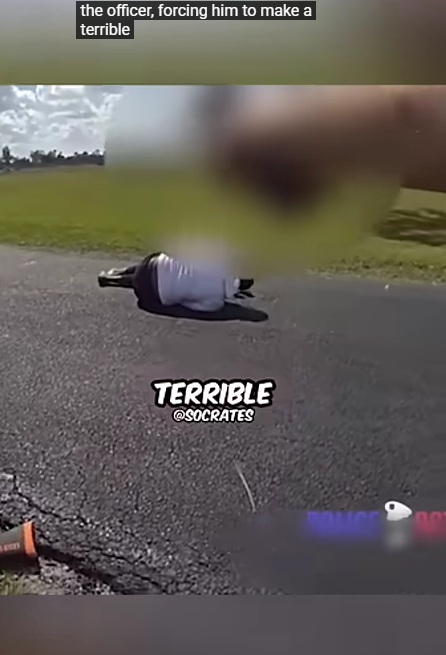
The video documents a tragic and emotionally intense police encounter involving officers attempting to arrest a 42-year-old man named Elroy Clark on an outstanding warrant for failing to appear in court. What begins as a routine warrant service gradually escalates into a chaotic and dangerous confrontation that ultimately ends in deadly force being used by police officers after repeated attempts to control the suspect fail. The footage captures not only the physical struggle itself but also the emotional aftermath, particularly the visible shock and distress experienced by the officer involved in the shooting. Rather than feeling triumphant or aggressive after the incident, the officer appears deeply shaken by the reality of what just occurred, highlighting the traumatic nature of lethal force encounters for everyone involved.
The situation begins when police officers are dispatched to locate and arrest Elroy Clark due to an outstanding warrant connected to a failure to appear in court. Warrants for failing to appear are relatively common in law enforcement because courts require individuals to attend scheduled hearings, and missing those appearances can trigger legal consequences regardless of the original charge. Officers tasked with serving warrants often expect resistance or tension because many people facing arrest feel fearful, angry, or defensive upon learning they are being taken into custody.
At the beginning of the encounter, the officers appear to approach the situation in a relatively standard manner. Their goal is straightforward: identify the suspect, confirm his identity, and take him into custody without unnecessary escalation. In many warrant arrests, suspects comply after brief conversations, allowing situations to end peacefully. However, officers are also trained to remain alert because even seemingly minor warrants can become unpredictable very quickly depending on the emotional state of the individual involved.
Almost immediately, tension begins developing during the interaction.
The man becomes argumentative and uncooperative with the officers. Rather than calmly responding to questions or complying with instructions, he begins challenging the officers verbally, accusing them of violating his personal space and refusing to acknowledge his identity. Denying identity during police interactions is a tactic officers sometimes encounter when suspects hope to delay or complicate arrests, especially when warrants are involved.
The verbal confrontation creates an increasingly unstable atmosphere. Police officers often attempt to de-escalate situations verbally first because maintaining calm communication can prevent physical confrontations from occurring. However, once individuals become emotionally charged, confrontational, or paranoid, conversations can deteriorate quickly.
The man’s behavior suggests that he is becoming increasingly agitated as the officers continue attempting to place him under arrest. His resistance does not appear passive or limited to verbal disagreement alone. Instead, the encounter gradually shifts toward physical confrontation as officers attempt to take control of the situation.
At this stage, officers likely recognize that the situation is becoming dangerous.
Police officers are trained to use force progressively depending on the level of resistance they encounter. In many cases, officers begin with verbal commands before escalating to physical restraint techniques, tasers, pepper spray, or other less-lethal methods if suspects actively resist arrest. The goal in most situations is to gain compliance while minimizing injury to everyone involved.
However, this encounter escalates rapidly.
When officers attempt to physically arrest the suspect, he reportedly begins threatening them and resisting aggressively. Resistance during arrests creates enormous tension because officers must make split-second decisions while balancing their own safety, the suspect’s safety, and public safety simultaneously.
The situation becomes even more chaotic when officers deploy a taser in an effort to stop the resistance.
Tasers are designed as less-lethal tools intended to incapacitate individuals temporarily through electrical pulses that disrupt muscle control. In many cases, tasers successfully stop violent resistance long enough for officers to secure suspects safely. However, tasers are not always effective. Factors such as clothing, body movement, intoxication, mental state, adrenaline, or improper probe placement can reduce their effectiveness significantly.
According to the summary, the suspect continues resisting despite being tased.
Officers then escalate further by using pepper spray, another less-lethal option commonly employed when suspects refuse commands or become combative. Pepper spray causes intense irritation to the eyes, skin, and respiratory system, usually forcing individuals to stop aggressive behavior temporarily.
Yet even after multiple attempts using less-lethal force, the suspect reportedly continues resisting aggressively.
This is the critical turning point where the danger level rises dramatically.
The summary states that the man ultimately charges toward one of the officers aggressively despite the taser and pepper spray deployments. From an officer’s perspective, rapidly advancing aggressive suspects create extremely high-pressure situations because officers must instantly determine whether they face a potentially deadly threat.
Police training emphasizes reaction time realities during violent encounters. Officers are often taught that individuals charging aggressively can close distances faster than people expect, leaving extremely little time to react. In chaotic confrontations, officers must assess threats within seconds while experiencing intense adrenaline and fear themselves.
According to the account, the officer ultimately fires his weapon as the suspect charges toward him.
This moment represents the tragic climax of the encounter.
Deadly force situations are among the most serious and traumatic incidents officers can experience because taking a life—even when legally justified—carries enormous psychological consequences. Contrary to action movie portrayals, real-life shootings are often chaotic, terrifying, and emotionally devastating for everyone involved.
The footage reportedly captures the immediate emotional aftermath as well, which becomes one of the most striking parts of the video.
Rather than reacting with anger or celebration, the officer appears visibly distraught and emotionally overwhelmed after the shooting occurs. His reaction reflects the reality that many officers involved in lethal force incidents experience shock, guilt, emotional trauma, and psychological distress afterward regardless of the legal justification for their actions.
The emotional collapse or visible distress seen after shootings is something many people outside law enforcement rarely witness. Public conversations about police shootings often focus heavily on legal or political debates, but the psychological impact on officers themselves is also significant. Many officers involved in shootings later struggle with anxiety, depression, nightmares, post-traumatic stress, or long-term emotional consequences.
In this case, the officer’s visible shock suggests he fully understood the gravity of what had just happened. Even when officers believe deadly force was necessary to protect themselves or others, the realization that a confrontation ended in death can be emotionally crushing.
The tragedy of the incident also lies in how many opportunities existed beforehand for the situation to end differently.
The original warrant was not for a violent crime itself but for failing to appear in court. Had the suspect cooperated initially, the arrest likely would have been processed routinely without anyone being injured. Instead, the situation escalated step-by-step through resistance, threats, physical confrontation, failed less-lethal interventions, and ultimately a deadly charge toward officers.
This escalation pattern is important because many police encounters become dangerous gradually rather than instantly. Small decisions compound over time. Verbal resistance turns into physical resistance. Physical resistance escalates into aggressive confrontation. Officers increase force responses accordingly. Eventually situations can spiral beyond anyone’s control within seconds.
The footage likely sparks intense emotional reactions among viewers because deadly police encounters are deeply complicated and tragic events. Some viewers may focus on the suspect’s repeated resistance and aggressive behavior toward officers. Others may focus on broader concerns surrounding use of force and policing generally. Videos like this often generate strong debate because they involve life-or-death decisions made under chaotic circumstances.
At the same time, the officer’s visible emotional breakdown afterward humanizes the complexity of the situation in ways many viral clips do not. The footage does not appear to portray an officer enjoying violence or behaving recklessly afterward. Instead, it reportedly shows someone grappling immediately with the emotional weight of having used lethal force.
That emotional response matters because it reminds viewers that real-life shootings are not clean, simple, or emotionally detached events. Even when officers survive dangerous encounters physically, the psychological aftermath can remain for years.
Another important aspect of the incident is the repeated use of less-lethal force before deadly force was employed. According to the summary, officers attempted both tasers and pepper spray multiple times before the shooting occurred. Those details become central because they suggest officers were attempting to gain control without lethal force initially.
Less-lethal tools are important precisely because officers generally prefer resolving confrontations without shootings whenever possible. However, less-lethal options are not guarantees. When those methods fail and suspects continue acting aggressively, officers may feel they have very limited choices remaining, especially if they believe immediate danger exists.
The chaotic nature of physical confrontations also complicates public analysis afterward. Videos often provide only partial perspectives, while officers involved experience rapidly unfolding events under intense stress and fear. Human reaction times, adrenaline, tunnel vision, and split-second threat assessments all influence decisions during violent encounters.
The encounter additionally highlights how emotionally unpredictable arrests can become when suspects refuse to cooperate. Officers approaching warrant situations rarely know exactly how individuals will react. Some comply immediately. Others panic, flee, or become combative. Even minor warrants can unexpectedly escalate into dangerous confrontations when emotions take over.
The tragedy extends beyond just the immediate violence itself. Families, officers, witnesses, and communities often continue feeling the emotional impact long after incidents end. Fatal encounters create lasting consequences for everyone connected to them.
The video’s ending, showing the officer in visible emotional distress, ultimately becomes one of its most powerful elements because it strips away simplistic narratives about violence. Instead of portraying a dramatic action scene, the footage reportedly reveals the devastating emotional reality that follows deadly force encounters. The officer appears less like a victorious figure and more like someone struggling to process a traumatic and life-altering moment.
In the end, the incident serves as a stark reminder of how quickly police encounters can spiral into tragedy when resistance, fear, aggression, and split-second decisions collide. What began as an attempt to arrest a man on an outstanding warrant escalated through repeated confrontation until officers believed deadly force was necessary to stop an advancing threat. The final moments, marked by the officer’s visible shock and emotional collapse afterward, reinforce the deeply human tragedy at the center of the encounter—a situation where multiple opportunities for peaceful resolution disappeared until the outcome became irreversible.