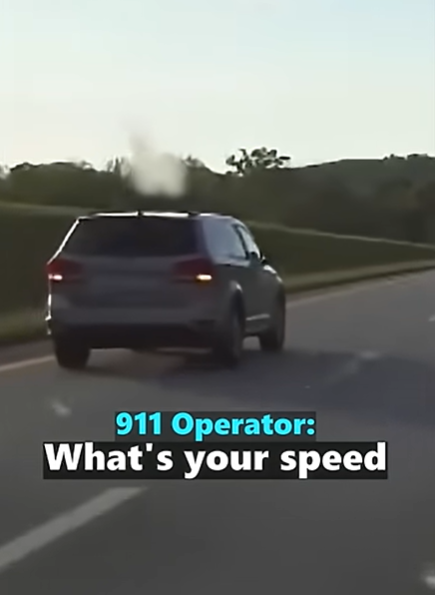
The video captures a frightening highway emergency that feels tense from the very first moment. It begins with a woman trapped inside a speeding vehicle, speaking to a 911 operator while trying to explain that her brakes are not working. Her voice is panicked, strained, and full of fear, because she understands the danger she is in. She is not simply dealing with a minor car problem or a warning light on the dashboard. She is moving at nearly 94 mph on a busy highway, surrounded by other vehicles, with no normal way to slow down. Every second matters, and every decision could make the difference between a safe stop and a devastating crash.
The situation is terrifying because the driver is still in traffic. She is not on an empty road with space around her. She is on a highway where cars, trucks, and semi-trucks are moving at different speeds in different lanes. With her brakes failing, she cannot control the vehicle the way a driver normally would. She can steer, but she cannot depend on the most important system needed to reduce speed. This creates a feeling of helplessness that is easy to understand. The driver is doing everything she can to stay calm enough to listen, but the fear in her voice shows how overwhelming the moment is.
The 911 operator becomes the driver’s lifeline. Through the phone, the operator tries to guide her step by step, giving her instructions while also trying to keep her focused. In emergencies like this, communication is critical. The operator cannot see the road through the driver’s eyes, but they can hear the panic, the urgency, and the danger. They have to ask questions, offer guidance, and keep the driver engaged without adding more stress. The driver, meanwhile, has to listen while steering through traffic at a dangerous speed. That combination makes the scene incredibly intense.
At first, the operator tells the driver to try using the brake pedal repeatedly. The driver attempts it, but she quickly responds that it is not working. Her panic rises because one of the few things that might have helped has failed. In most driving situations, pressing the brake is an instinctive reaction. When something appears ahead, when traffic slows, or when danger appears, the foot goes to the brake automatically. But in this moment, that familiar action does nothing. The driver is left with the terrifying realization that the car is still moving fast, and the normal solution is unavailable.
As the call continues, the driver’s fear becomes even more visible through her voice. She is trying to follow instructions, but she is also reacting to the road in real time. Cars are ahead of her. Traffic is moving around her. She is forced to weave and adjust quickly to avoid hitting other vehicles. Her screams are not exaggerated; they are the natural reaction of someone who can see danger directly in front of them and cannot slow down in the usual way. Each time she narrowly avoids another vehicle, the tension increases.
A police officer eventually locates the vehicle and begins following behind. The presence of law enforcement changes the situation, but it does not immediately solve the problem. The officer can help track her position, warn other responders, and stay close in case the vehicle stops or crashes, but the officer cannot simply make the car slow down. The driver is still the one inside the car, steering through the danger. The officer radios information about her lane position and speed, helping coordinate the response while staying close enough to monitor what is happening.
The police escort adds another layer of urgency to the video. Seeing an officer behind the vehicle confirms that this is not a misunderstanding or a small mechanical issue. It is a serious emergency unfolding on a public highway. The officer recognizes that the driver is stuck in the right-hand lane and unable to reduce speed. That means surrounding traffic becomes a major concern. Other drivers may not understand what is happening. To them, the vehicle may simply look like it is speeding or driving erratically. They may not realize the driver is fighting to avoid a crash.
One of the most stressful parts of the video is the moment when the driver has to navigate through heavy traffic. The highway is filled with vehicles, and at one point she comes dangerously close to other cars and even a semi-truck. Large trucks create an especially frightening obstacle because they take up more space and leave less room for error. At high speed, even a small mistake can become serious. The driver’s screams during these moments show how close the situation feels. She is not calmly watching traffic from a distance; she is making split-second decisions while terrified.
The video also shows how quickly an ordinary drive can turn into a life-threatening emergency. One moment, a person may be traveling normally, and the next, a mechanical failure can completely change the situation. That is part of what makes the video so gripping. The driver did not choose to speed or create chaos. She is caught in a crisis caused by a vehicle that will not stop. Her only goal is survival. She is trying to avoid hurting herself or anyone else on the road, even while her own fear is nearly overwhelming.
Throughout the emergency, the 911 operator continues trying to guide her. The operator’s role is difficult because they must remain calm even while hearing the driver panic. They have to think clearly and provide useful instructions. Their voice becomes a point of stability in a situation where everything else feels out of control. The operator cannot physically take control of the car, but they can help the driver focus on one action at a time. That matters because panic can make it harder to think, and a calm voice can sometimes help a person stay connected to what they need to do next.
Eventually, the operator suggests using the emergency brake carefully. This becomes the turning point in the video. The driver follows the instruction and begins to notice that the car is finally slowing down. That moment brings a shift in the emotional tone. The fear is still there, but now there is a small sign of hope. After feeling trapped at high speed, the driver finally has evidence that the vehicle is responding. The car starts losing speed, and the possibility of a safe ending becomes real.
The slowing down process feels like a release of tension. Until that point, the video has been building with fear, speed, and uncertainty. The driver is still shaken, but each reduction in speed makes the situation slightly less dangerous. The highway shoulder becomes the target, a place where the car can finally come to rest away from traffic. The police officer remains close, ready to help the moment the vehicle stops. It is a powerful example of coordination between the driver, emergency operator, and responding officer.
When the car finally comes to a halt on the shoulder, the sense of relief is enormous. The vehicle is no longer racing through traffic. The driver is no longer forced to steer at highway speed without reliable brakes. The immediate danger has passed. But emotionally, the driver is still in shock. That is clear when the state trooper approaches the vehicle, opens the door, and tells her to get out and relax. She is visibly shaken and crying, which is completely understandable after what she has just experienced.
The trooper’s response is direct and reassuring. His priority is to get her safely out of the vehicle and away from the terrifying space where she had just been trapped. For the driver, the car likely no longer feels like a normal vehicle. It feels like the place where she almost lost control of everything. Being told to step out, breathe, and relax helps mark the end of the emergency. The danger is over, and now she can begin to process what happened.
The emotional impact of the rescue is strong because viewers can feel the driver’s fear throughout the video. Her panic is not something distant or hard to understand. Anyone who has driven on a highway can imagine how horrifying it would be to press the brakes and realize the car will not slow down. The speed, the traffic, the noise, and the lack of control all combine into a nightmare scenario. That is why the ending feels so powerful. The driver survives, other motorists appear to avoid harm, and the emergency responders are able to bring the situation to a safe conclusion.
The video also highlights the importance of emergency dispatchers, whose work often happens behind the scenes. In many emergency videos, the focus is on police cars, fire trucks, or dramatic rescues. But here, the voice on the phone is one of the most important parts of the story. The operator stays with the driver during the most frightening moments, offering instructions and support. Their calmness becomes a form of rescue in itself. Without that steady guidance, the driver may have had an even harder time managing the situation.
At the same time, the police officer’s role is equally important. By locating the vehicle and following behind, the officer helps turn a chaotic situation into a coordinated response. The officer’s radio updates allow others to understand where the vehicle is and what is happening. The officer also provides immediate help once the car stops. In emergencies like this, every person involved has a role, and the video shows how those roles connect. The driver tries to maintain control, the operator gives guidance, and the officer provides on-road support.
The driver’s courage should not be overlooked. Even though she is terrified, she continues steering, listening, and responding. Panic does not mean weakness. In fact, the fact that she was frightened but still able to follow instructions shows remarkable strength. She had to keep her hands on the wheel, watch the road, communicate with the operator, and react to traffic all at once. That is an enormous amount of pressure for one person to manage. Her fear is visible because the situation is genuinely frightening, but she keeps going until the car finally stops.
The scene also reminds viewers that emergencies do not always look controlled or polished while they are happening. Real emergencies are messy. People scream. Voices shake. Instructions may need to be repeated. The road does not pause. Other drivers may not know what is happening. A safe ending can depend on quick thinking under imperfect conditions. This video feels real because it captures that chaos. It does not present the driver as calm and heroic in a movie-like way. It shows her as a real person in a terrifying moment, doing her best to survive.
Another important part of the video is the surrounding traffic. The other vehicles on the highway become part of the danger, even though their drivers may not be aware of the full situation. A brake failure at high speed is not only dangerous for the person inside the car. It creates risk for everyone nearby. The driver’s inability to slow down means every lane change, every slower vehicle, and every traffic cluster becomes a challenge. That is why the police response is so urgent. The goal is not only to save the driver but also to prevent a larger highway accident.
The moment involving the semi-truck is especially tense because it shows how little room there may have been for error. Semi-trucks are large, heavy, and difficult to maneuver around at high speed. When a smaller vehicle loses braking ability near a truck, the danger increases dramatically. The driver’s reaction in that moment reflects the fear of coming too close to something that could cause serious harm. Her screams make the viewer understand that she is not watching danger from afar. She is directly inside it.
The highway setting makes everything more intense because speed changes the nature of every decision. At low speeds, a driver may have time to react, pull over, or avoid obstacles. At nearly 94 mph, there is very little time. Distances close quickly. A car ahead can become an immediate danger within seconds. Steering movements must be careful because sudden changes can create new risks. The driver is operating in a narrow window of control, where she can guide the car but not slow it normally. That is a frightening balance to maintain.
The successful stop on the shoulder is therefore a major relief. A highway shoulder is not an ideal place to end an emergency, but compared to the moving lanes of traffic, it represents safety. Once the car stops there, responders can approach, the driver can exit, and traffic can continue moving past the scene. The shoulder becomes the line between danger and rescue. The state trooper’s quick approach shows that he understands the driver needs immediate reassurance and direction after such an intense experience.
The video may also make viewers think about the importance of vehicle maintenance and awareness. While the exact cause of the brake failure is not explained in the description, the situation shows how serious mechanical problems can become when they occur at highway speed. Most drivers trust that their vehicles will respond when needed. Brakes, steering, tires, and other systems are so familiar that people often do not think about them until something goes wrong. This video is a dramatic reminder that a vehicle’s safety systems are essential, and problems should never be ignored.
However, the main emotional message of the video is not technical. It is human. It is about a frightened driver who finds herself in a situation no one wants to experience, and the people who help guide her to safety. The fear in her voice, the calmness of the operator, the police officer’s pursuit, and the final rescue all create a story of crisis and relief. The video is powerful because it shows how quickly danger can appear, but also how training, communication, and teamwork can help prevent tragedy.
The driver’s tears at the end are one of the most understandable parts of the entire scene. After extreme fear, the body often reacts with shaking, crying, or emotional release once the danger has passed. During the emergency, she had to keep functioning. She had to steer and listen. Once the car stopped, all the fear she had been holding back came out. The trooper’s instruction to get out and relax is simple, but in that moment, it carries a lot of meaning. It tells her she is safe now. She no longer has to fight the vehicle. She no longer has to keep moving at terrifying speed.
For viewers, the ending provides the emotional payoff the video desperately needs. After watching or hearing such a tense chain of events, people want to know that the driver made it. They want to see the car stopped, the door opened, and the driver helped out. That final moment gives closure. It transforms the video from a terrifying highway emergency into a story of survival. It shows that even when the situation seems out of control, calm guidance and quick response can make a difference.
The video also demonstrates how emergency systems are designed to work together. A 911 call connects the person in danger to trained support. Dispatch can communicate with law enforcement. Officers can locate and follow the vehicle. Radio updates can help coordinate the response. Once the vehicle stops, a trooper can provide immediate physical assistance. Each part matters. No single person controls the entire outcome, but together, they create a chain of support that helps bring the driver safely through the crisis.
One of the most memorable aspects of the story is how long the emergency must have felt to the driver. Even if the actual event lasted only a few minutes, those minutes would feel much longer from inside the car. Time slows down in frightening situations. Every vehicle ahead, every lane movement, every failed brake attempt, and every instruction from the operator would feel intensely important. The driver was living second by second. That is why her emotional reaction is so strong. She was not just inconvenienced; she was trapped in a moving emergency.
The contrast between the operator’s calm voice and the driver’s panic adds to the intensity. It shows two sides of the same emergency. The driver is experiencing immediate danger, while the operator is trying to manage that danger from a distance. Both roles require focus. The driver must physically keep the car from crashing. The operator must mentally stay steady and guide the driver through options. Their connection over the phone becomes a lifeline, proving how important clear communication can be when someone is overwhelmed.
The officer following behind also likely faced pressure. Driving near a vehicle that cannot slow down is dangerous. The officer has to maintain a close enough distance to monitor and assist, but not so close that the patrol car becomes part of the danger. The officer also has to communicate clearly over the radio while watching traffic and anticipating what might happen next. The video may focus on the driver’s fear, but the responding officer is also making rapid decisions in a risky environment.
This kind of video often stays with people because it reveals how fragile normal routines can be. Driving is something many people do every day. Highways are familiar. Brake pedals are trusted. Traffic is ordinary. But when one essential system fails, the ordinary becomes frightening in an instant. The video takes a common activity and turns it into a high-stakes emergency, which is why it feels so intense. It reminds viewers that safety on the road depends on both technology and human response.
The fact that the driver survives without the situation turning into a major crash makes the video a remarkable example of crisis management. The driver did not give up. The operator did not lose focus. The police officer stayed with the vehicle. The final solution worked, and the car stopped safely. That outcome is not guaranteed in a situation like this, which is why the relief feels so strong. The video could have ended very differently, but instead it ends with the driver alive, safe, and supported.