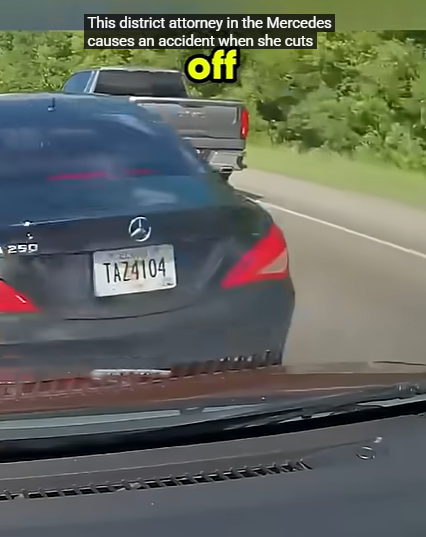
A road incident involving a Mercedes driver identified as a district attorney quickly turned into a much larger controversy after dashcam footage appeared to contradict her version of events. What began as a traffic collision became a tense roadside exchange involving delayed stopping, accusations of intimidation, conflicting claims, and video evidence that ultimately showed what had happened.
The incident starts when the Mercedes abruptly cuts off a vehicle equipped with a dashcam. The movement leaves the dashcam driver with little time to react, and the vehicles collide. From the perspective of the dashcam footage, the Mercedes appears to enter the other driver’s path in a way that directly causes the crash. The impact itself may not be the only issue, however. What happens afterward makes the situation far more serious.
After the collision, the Mercedes driver does not immediately pull over. Instead, she continues driving for a noticeable period of time. For the dashcam driver, this creates immediate concern. When someone is involved in a crash and does not stop right away, it can look like they may be trying to leave the scene. Even if the driver eventually stops, that delay can raise suspicion and frustration, especially for the person who was just hit.
The dashcam driver follows, likely trying to make sure the Mercedes does not disappear. In moments like this, the seconds after a collision can feel long and tense. The driver who was struck may be worried about damage, insurance, injuries, and whether the other person will accept responsibility. When the other vehicle continues moving instead of pulling over immediately, the situation becomes even more stressful.
Eventually, the Mercedes driver stops and gets out of the vehicle. But rather than calmly checking on the other driver or exchanging information, she immediately presents her government ID badge. The gesture appears to be an attempt to establish authority or intimidate the other driver. Instead of treating the crash like a normal traffic accident, she seems to bring her official position into the situation almost immediately.
That moment changes the tone of the encounter. A government badge can carry weight, especially when shown during a dispute. To the dashcam driver, it may have felt like she was trying to use her title to pressure him, silence him, or make him doubt his own account of the accident. In a normal crash, both drivers are expected to exchange information and wait for police if necessary. Showing a badge right away can make the interaction feel uneven and intimidating.
The Mercedes driver then begins shifting blame. According to the summary, she falsely claims that the dashcam driver caused the accident. She presents a version of events that does not match what the camera captured. Instead of acknowledging that she cut off the other vehicle, she appears to insist that the other driver was at fault. This creates a direct conflict between her verbal account and the recorded evidence.
The situation becomes even more serious when she later repeats those claims to responding officers. At that point, the disagreement is no longer just between two drivers on the roadside. It becomes part of a police response. If someone gives false information to officers after a crash, especially while holding a position connected to the justice system, it raises questions about honesty, accountability, and misuse of authority.
The dashcam footage becomes the key piece of evidence. While both drivers may tell different stories, the camera records the actual sequence of events. It shows the Mercedes cutting off the dashcam vehicle, the collision that follows, the delay before stopping, and the later interaction. Because of that, the footage prevents the situation from becoming a simple “he said, she said” dispute.
Without the dashcam, the other driver may have faced a much more difficult situation. A district attorney may be seen as credible because of her professional role. If she confidently claimed the dashcam driver was at fault, and if there were no recording, the responding officers or insurance companies might have had to rely heavily on statements, vehicle damage, and any available witnesses. The badge and official position could have made the dashcam driver feel outmatched.
But the video changes that balance. It provides a clear record that does not depend on memory or status. The dashcam captures the road, the movement of the vehicles, and the timing of the crash. It also captures the aftermath, including the Mercedes driver’s delayed stop and her decision to display her government ID. In a dispute where one person appears to be using authority and false claims, video evidence becomes especially powerful.
The incident stands out because the driver involved is not just any motorist. As a district attorney, she would be expected to understand the importance of truth, evidence, and responsibility. Her role would normally involve upholding the law, assessing facts, and holding others accountable. That makes the alleged behavior in the video more troubling. When someone in a legal position appears to deny responsibility or misrepresent what happened, public trust can be affected.
The attempted intimidation is one of the most striking parts of the summary. A badge is meant to identify a person’s official role, not to give them an advantage in a personal traffic dispute. If the badge was shown to pressure the other driver, it suggests an attempt to use government status in a situation where it should not matter. A crash should be handled based on facts, not on who has the more powerful job title.
The dashcam driver’s concern that she may have been trying to flee is also understandable. When a driver takes a long time to pull over after a crash, the person behind them may not know their intentions. They may wonder whether the driver is looking for a safer location, panicking, or trying to escape responsibility. The delay alone can create tension, even before the roadside conversation begins.
Once both vehicles are stopped, the interaction should ideally become straightforward. Drivers should check for injuries, exchange information, document the damage, and wait for police if needed. Instead, the situation becomes confrontational. The Mercedes driver’s badge display and blame-shifting make the encounter feel less like a routine accident and more like an attempt to control the narrative.
Her false claims to police are especially important because officers rely on accurate statements when documenting a crash. If one party lies about how an accident happened, it can lead to incorrect reports, unfair insurance outcomes, or even accusations against the wrong person. In this case, the dashcam footage helps prevent that from happening.
The incident also shows why dashcams have become so important for many drivers. A camera can capture the moments before, during, and after an accident. It can show lane positions, sudden movements, braking, traffic conditions, and driver behavior. In disputes where one person refuses to accept responsibility, footage can protect the other driver from being blamed unfairly.
For the dashcam driver, the footage likely provided reassurance. Instead of having to argue endlessly over what happened, he could point to the recording. The video did not just support his memory; it showed the event clearly. That matters because accidents happen quickly, and people involved may remember details differently. But in this case, the camera preserved the timeline.
The Mercedes driver’s decision to repeat false claims to police also raises questions about whether she believed she could convince others through confidence or authority. Some people involved in accidents may instinctively deny fault because they are afraid of consequences. But when someone continues to claim a false version after evidence exists, the behavior appears more deliberate.
The fact that the entire sequence was captured makes the situation harder to dismiss as a misunderstanding. The dashcam reportedly shows the initial cut-off, the collision, the delay, and the later statements. That full record matters because it gives context from beginning to end. It does not only show the crash; it also shows how the driver behaved afterward.
The official position of the Mercedes driver adds another layer of public interest. People expect government officials, especially those connected to law and prosecution, to act with integrity even in personal situations. A traffic accident can happen to anyone. Making a mistake behind the wheel is one thing. But trying to shift blame, display a badge, and give a false account is what turns the incident into a larger issue.
The roadside badge display may have been intended to make the other driver feel less confident about challenging her. If so, it failed because the dashcam driver had evidence. The camera reduced the power of intimidation by preserving the truth. No matter how forcefully someone presents themselves, video can show whether their words match their actions.
The responding officers were placed in a position where they had to sort through conflicting accounts. On one side was the Mercedes driver, who claimed the dashcam driver was at fault. On the other side was the dashcam driver, whose camera recorded the collision. Once footage is available, officers can compare statements to reality. If a statement is clearly contradicted by video, it damages the credibility of the person making it.
This kind of incident can also affect how the public views accountability. Ordinary drivers are expected to stop after crashes, tell the truth, and cooperate with police. When a public official appears to behave differently, people may feel there is a double standard. The dashcam footage becomes important not only for the crash itself, but also for showing that status does not change what happened on the road.
The delayed stop remains a key part of the story because it sets the tone before the confrontation even begins. If the Mercedes had pulled over immediately, the dashcam driver may have felt less suspicious. The delay made the situation feel evasive. Then, when the driver finally stopped and displayed a badge, the suspicion only grew. The sequence of actions made the entire encounter feel like an attempt to avoid or control responsibility.
The false claims afterward deepen that impression. A person who makes an honest mistake may say they did not see the other car or that they misjudged the lane change. But blaming the other driver when the footage shows otherwise is different. It suggests an effort to rewrite the incident.
The dashcam driver’s position is strengthened by the fact that the recording captures the crash from his vehicle’s point of view. The camera shows what he saw and how little time he had to avoid the collision. It also shows the Mercedes entering his path. In accident disputes, that kind of evidence can be decisive.
The incident also serves as a reminder that authority should never replace evidence. A badge, title, or official role does not determine fault in a collision. The road does not change based on someone’s job. Traffic laws apply to everyone. If the footage shows that the Mercedes caused the crash, then the driver’s professional status should not shield her from responsibility.
For viewers, the most frustrating part may be the combination of the crash and the denial. Accidents can happen, and many people are willing to forgive a mistake if the person accepts responsibility. But when someone causes a collision and then tries to blame the victim, frustration turns into outrage. The badge display makes that reaction even stronger because it appears to add intimidation to dishonesty.
The incident may also encourage more drivers to install dashcams. Many people only realize the value of a dashcam after they are involved in a dispute. In this case, the camera appears to have protected the driver from a false claim by someone with an official title. That is exactly the kind of situation dashcams are designed to document.
The video also shows how quickly a simple collision can become a credibility test. The Mercedes driver’s actions after the crash became just as important as the crash itself. Her delay in stopping, her badge display, and her statements to police all contributed to the final impression. The dashcam did not just record an accident; it recorded behavior.
If the footage had not existed, the outcome could have been very different. The dashcam driver may have had to fight against an official’s version of events. Insurance liability could have been disputed. Police might have had less clarity. The driver could have been blamed for something he did not cause. The recording prevented that uncertainty.
The case also illustrates why honesty after an accident matters. Even when someone is at fault, telling the truth can keep the situation from becoming worse. A driver can apologize, exchange information, and let insurance handle the damage. But lying can create additional consequences, especially if the lie is repeated to police. For someone in a legal profession, the expectation of honesty is even higher.
The district attorney’s alleged behavior, as described in the video summary, may leave viewers questioning her judgment. Cutting off another vehicle may have been careless. Taking too long to pull over may have looked suspicious. Showing a badge may have seemed intimidating. Blaming the other driver may have been dishonest. Repeating the claim to police may have made the situation worse. Each action built on the last.
The dashcam footage ultimately becomes the final word because it removes much of the uncertainty. It shows the sequence clearly and allows the truth to stand against false statements. In a situation where one person appeared to rely on status and confidence, the camera relied on facts.
The resolution of the incident is therefore not just about determining who caused the crash. It is about proving that the narrative presented by the Mercedes driver did not match reality. The dashcam driver did not have to rely only on his own testimony. He had a complete visual record that showed the cut-off, the collision, the delayed reaction, and the aftermath.
In the end, the road incident became a powerful example of why evidence matters. A driver with an official title allegedly caused a crash, delayed stopping, displayed a badge, and tried to shift blame. But the dashcam captured everything. The footage turned a potentially unfair dispute into a clear record of events and showed that no title or badge can overwrite what actually happened on camera.
The incident also shows how much pressure can arise after a crash, especially when the person who appears to be responsible refuses to accept what happened. For the dashcam driver, the collision itself was already stressful enough. He had been driving normally when the Mercedes suddenly moved into his path and caused an impact. But instead of the situation becoming a straightforward exchange of information, it turned into a longer and more frustrating encounter because the other driver’s response seemed evasive from the beginning.
The delay before the Mercedes pulled over likely made the dashcam driver feel that he had to remain alert and keep following. After a collision, most drivers expect the other vehicle to stop as soon as it is safe. When that does not happen, the person who was hit can feel anxious and suspicious. They may wonder whether the other driver is searching for a place to stop, confused about the crash, or deliberately trying to avoid responsibility. In this case, the delay created the impression that the Mercedes driver might be trying to flee, which immediately raised the seriousness of the situation.
Once the Mercedes finally stopped, the driver’s decision to show her government ID badge appeared to make the encounter even more uncomfortable. Instead of beginning with concern, an apology, or a normal exchange of insurance details, she seemed to lead with her official status. That matters because a roadside crash is not a courtroom or an official investigation. It is a civil traffic matter between drivers. Bringing out a badge in that context can feel like an attempt to gain control over the other person through authority rather than facts.
For the dashcam driver, that gesture may have been especially unsettling. He had just been hit, had followed a vehicle that did not immediately stop, and was now facing someone displaying a government credential. Even if the badge was not accompanied by a direct threat, the message could still feel clear: she wanted him to know who she was. In a stressful moment, that kind of display can make the other person feel pressured to back down or second-guess their own position.
The situation became more troubling when she allegedly began denying responsibility. If the dashcam footage clearly showed her cutting off the other vehicle, then her claim that the dashcam driver caused the accident would not simply be a misunderstanding. It would be a version of events that conflicts with what the recording captured. That is what turns the story from an ordinary road incident into a question of honesty.
A traffic accident can happen because of a mistake. Someone may misjudge a gap, fail to check a blind spot, change lanes too abruptly, or brake unexpectedly. Those mistakes can be frustrating, but they are not unusual. What makes this incident stand out is what happened after the mistake. Rather than accepting that her movement caused the collision, the Mercedes driver allegedly tried to shift the blame onto the person she cut off.
That kind of blame-shifting can have real consequences. If the dashcam driver had no video, he might have been forced to defend himself against a confident accusation. Insurance companies may have had to investigate conflicting stories. Police may have had to write a report based on statements and damage patterns. The other driver’s official title could have made the situation feel even more intimidating. The dashcam prevented that imbalance by preserving the truth before anyone could reshape it.
When she reportedly repeated her claims to the responding officers, the stakes became higher. Lying to another driver is one thing, but giving a false account to police during a crash investigation is much more serious. Officers rely on accurate information to determine what happened, who may have violated traffic rules, and how to document the incident. If someone knowingly provides a false version, it can interfere with the process and create unfair consequences for the innocent driver.
The dashcam footage appears to have stopped that from happening. It gave officers the ability to see the crash for themselves instead of relying only on the drivers’ statements. This is one of the biggest advantages of video evidence. It does not care about job titles, confidence, tone, or persuasion. It simply records the sequence of events. In this case, the footage reportedly showed the Mercedes cutting off the dashcam vehicle and causing the collision.