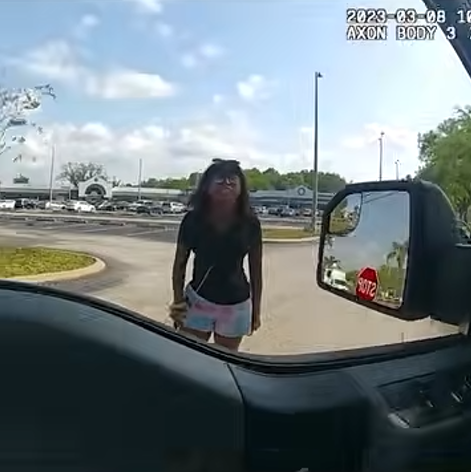
A tense roadside encounter captured on video has drawn widespread attention online after a driver with multiple suspended licenses repeatedly refused to cooperate with a police officer during a traffic stop that eventually ended in her arrest. The footage, originally shared by the channel “LEO On Duty,” documents the escalating confrontation as the officer attempts to explain the legal status of the driver’s license while repeatedly instructing her to remain inside her vehicle. What begins as a routine stop quickly transforms into a heated standoff filled with defiance, arguments, threats of arrest, and ultimately physical detention.
The video opens with the officer standing beside the driver’s vehicle while attempting to explain the situation calmly. According to the officer, the driver’s license is being returned to the state of Florida due to multiple suspensions attached to her driving record. The officer’s tone initially appears controlled and procedural as he tries to communicate the seriousness of the issue. However, from the beginning of the interaction, the driver appears combative and unwilling to follow instructions.
Almost immediately, tension begins to build when the officer repeatedly tells the driver to remain inside the car. Instead of complying, she openly challenges his authority and insists that she has the “right to do whatever I want.” Her refusal to obey basic commands becomes one of the central points of conflict throughout the encounter. The driver repeatedly argues that the officer is “not her boss,” signaling that she has no intention of quietly cooperating with the stop.
Traffic stops involving suspended licenses are often more complicated than routine citations because they can lead to vehicle impoundment, arrests, or additional criminal charges depending on the circumstances. Officers conducting these stops must verify driving records, confirm suspension details, and ensure that drivers do not attempt to flee or create unsafe conditions. In this case, the officer appears increasingly concerned not only with the license issue itself but also with the driver’s growing resistance and confrontational attitude.
As the conversation continues, the officer explains that the driver’s license has been suspended four separate times. He specifically references an FR suspension, commonly associated with financial responsibility requirements such as maintaining proper insurance coverage. Suspensions tied to financial responsibility issues can occur when drivers fail to provide proof of insurance, fail to pay penalties, or fail to comply with state motor vehicle regulations. The officer’s explanation suggests that the suspensions remain active despite the driver’s insistence that she recently paid money to resolve the issue.
The driver claims she paid more than $200 the previous day in an attempt to clear the suspension. From her perspective, the matter should already have been handled, and she appears frustrated that the officer’s records do not reflect the payment. Situations like this are not uncommon during traffic stops. Administrative delays, processing issues, or incomplete paperwork can sometimes result in discrepancies between what drivers believe has been resolved and what appears in law enforcement databases. However, officers are generally required to rely on the official records available to them at the time of the stop.
Despite the driver’s repeated claims that she had already addressed the issue financially, the officer maintains that the suspensions are still active in the system. The disagreement becomes increasingly heated as neither side backs down. The officer continues attempting to explain the legal reality of the situation, while the driver grows more argumentative and dismissive with each exchange.
One of the defining features of the encounter is the driver’s open hostility toward the officer’s authority. Rather than attempting to de-escalate the situation, she repeatedly interrupts, argues, and refuses to follow simple commands. At one point, she bluntly states that she “doesn’t give a f***,” a moment that clearly marks a turning point in the officer’s patience. Up until then, the interaction had remained mostly verbal despite the tension. However, the driver’s profanity and refusal to cooperate signal that the encounter is rapidly approaching a breaking point.
The officer then warns the driver that she is very close to going to jail if her behavior continues. Such warnings are common during escalating traffic stops, as officers often attempt to give individuals opportunities to comply before making an arrest. Verbal warnings can serve both as de-escalation attempts and as clear indicators that continued noncompliance may result in detention. In this case, the warning does little to calm the situation.
Instead of becoming more cooperative, the driver continues challenging the officer. Her body language and tone suggest growing frustration and anger, while the officer appears increasingly focused on maintaining control of the scene. Traffic stops are inherently unpredictable environments for law enforcement officers because they take place in public spaces where suspects may flee, resist, or act impulsively. Officers are trained to maintain control of movement and positioning during these encounters to reduce risk and ensure safety.
The driver’s refusal to remain inside the vehicle becomes especially significant because controlling a subject’s movements during a traffic stop is considered a key safety measure. When individuals repeatedly ignore instructions about where to stand or whether to remain in the vehicle, officers may interpret the behavior as potentially dangerous or indicative of further resistance. In this case, the officer repeatedly instructs the driver to stay put, but she continues disregarding those commands.
As tensions rise, the interaction becomes less about the suspended license itself and more about the escalating defiance taking place in front of the officer. The original legal issue remains important, but the driver’s behavior increasingly becomes the central concern. Many roadside encounters follow a similar pattern: what begins as a relatively minor violation escalates because of emotional reactions, refusal to cooperate, or confrontational behavior.
The officer’s frustration becomes more visible as the driver continues interrupting him and dismissing his authority. Nevertheless, he continues attempting to explain the legal situation while warning her about the potential consequences of her actions. At several points, it appears that the encounter could still be resolved without physical confrontation if the driver simply complied with instructions. However, the continued arguing keeps the situation tense and unstable.
The critical turning point occurs when the driver attempts to get back into the vehicle or move against the officer’s instructions. This action immediately escalates the situation from verbal confrontation to physical intervention. Officers are often trained to prevent individuals from re-entering vehicles during active traffic stops because doing so can create safety concerns, including access to weapons, opportunities for escape, or unpredictable movement.
The moment the driver moves toward the vehicle, the officer reacts quickly and decisively. He forcefully removes her from the car area and orders her to turn around and place her hands behind her back. The transition from argument to arrest happens rapidly, reflecting how quickly roadside encounters can shift once officers perceive a loss of control or increased risk.
The driver immediately begins protesting as the officer detains her. Like many suspects during physical arrests, she complains that the officer is hurting her while being restrained. Such statements are common during arrests involving handcuffing or physical control techniques. Being physically restrained can feel painful or frightening, particularly when emotions are already running high. Officers, meanwhile, are trained to use control methods designed to secure compliance while minimizing risk to themselves and others.
The video ends during the detention process, leaving viewers without further information about the final legal outcome. However, the dramatic confrontation captured on camera quickly became the focus of online discussion, with viewers debating both the driver’s behavior and the officer’s response. As with many viral police videos, public reaction became sharply divided.
Some viewers strongly supported the officer, arguing that the driver’s repeated refusal to follow instructions left him with little choice but to arrest her. Supporters emphasized that traffic stops require compliance for safety reasons and that openly defying commands only escalates situations unnecessarily. From this perspective, the officer demonstrated patience by repeatedly warning the driver before ultimately taking action.
Others focused more on the possibility of administrative confusion regarding the license suspension. Some viewers questioned whether the driver genuinely believed the issue had already been resolved after making the reported payment. They argued that frustration with bureaucratic systems may have contributed to her emotional reaction during the stop. Even so, many observers acknowledged that her aggressive attitude and refusal to comply significantly worsened the situation.
The incident also reflects a broader pattern seen in many viral police videos online. Traffic stops frequently escalate not because of the original violation itself, but because of emotional reactions during the interaction. Minor infractions can evolve into arrests when individuals refuse instructions, become confrontational, or challenge officers in emotionally charged ways. In many cases, legal experts point out that compliance during the stop followed by later legal challenges in court is generally safer and more effective than arguing roadside.
Another important aspect of the video is the role of authority and personal perception. The driver repeatedly insisted that the officer was “not her boss,” framing the encounter as a personal power struggle rather than a legal interaction. This mindset appeared to shape much of her behavior throughout the stop. Instead of viewing the officer’s commands as temporary legal instructions during an investigation, she treated them as challenges to her personal independence and autonomy.
This type of resistance is not uncommon during police encounters. Some individuals react emotionally when they feel controlled or restricted, especially in public settings where embarrassment and frustration can intensify emotions. Traffic stops can feel stressful and humiliating even under calm circumstances, and those emotions may become amplified when legal consequences such as suspensions or arrests are involved.
The mention of the four license suspensions also became a major talking point among viewers. Multiple suspensions often indicate ongoing issues related to compliance with state driving laws, whether involving insurance, unpaid fines, missed court appearances, or other administrative problems. For many viewers, the repeated suspensions undermined the driver’s credibility and reinforced the officer’s concerns about allowing her to continue driving.
Financial responsibility suspensions, specifically, are designed to ensure that drivers maintain valid insurance coverage and financial accountability on the road. States impose these requirements to protect other motorists and ensure that drivers can cover damages in the event of accidents. Driving with unresolved financial responsibility suspensions is often treated seriously because uninsured or improperly insured drivers create additional risks for the public.