When the Obvious Was Ignored: The Story of a Paralyzed Man Accused of Kicking Down a Door
Introduction
The video titled “Paralyzed Man Gets Accused Of Kicking Down Door” tells a shocking story about a man whose physical condition should have immediately raised serious doubts about the accusation against him. At the center of the case is Charles Read, a man who had been paralyzed for decades and used a wheelchair. Despite that, he became the subject of a criminal accusation that, on its face, appeared deeply questionable: he was accused of kicking in a woman’s door, attacking her, and then fleeing on foot.
The story is not only disturbing because of the accusation itself, but because of how authorities reportedly handled it. According to reporting from Atlanta News First, police arrested Read even though his disability created an obvious contradiction in the allegation. The case raises important questions about police investigation standards, probable cause, disability awareness, accountability, and the harm that can occur when officials fail to verify basic facts before taking away someone’s liberty.
What makes this case especially troubling is how avoidable the situation appears to have been. The accusation contained details that should have prompted immediate scrutiny. The alleged suspect was not a vague stranger. He was identified by name. His physical condition was not hidden from view once police encountered him. Yet the case moved forward far enough for an arrest to occur. The result was not just embarrassment for the department, but a frightening and humiliating experience for a man who had gone to the police station voluntarily because he believed the truth was obvious.
The Accusation That Started the Case
The case began with a complaint made to police in College Park, Georgia. A woman named Katherine Jensen accused Charles Read of breaking into her home, assaulting her, and leaving the scene on foot. According to Atlanta News First, the complaint was made in June 2024, and Jensen allegedly identified Read as the person responsible. The claim was serious: it involved a home invasion-style allegation and an assault accusation. These are not minor matters, and they naturally required police attention.
However, the details of the accusation were immediately unusual. Read had been paralyzed for 25 years. He used a wheelchair. The accusation that he had kicked in a door and fled on foot was therefore inconsistent with his physical condition. Read denied the allegation and said the actions described were not physically possible for him.
The situation became even more questionable because Jensen reportedly had known Read in the past. Read said they had dated at one time, though he also said they had not had contact for around 20 years. That history matters because it suggests the accusation was not simply a case of mistaken identity involving a stranger. If someone identifies a former acquaintance as a suspect, investigators should still verify the claim, especially when the accusation conflicts with basic facts about the accused person’s physical abilities.
The allegation also reportedly omitted a crucial detail: that Read used a wheelchair. According to body camera footage described by Atlanta News First, Jensen gave police Read’s name and date of birth and described him in general terms, but she did not mention that he was wheelchair-bound. Read’s attorney later argued that this omission was highly significant, because a wheelchair would be one of the most obvious identifying facts about a person accused of running away on foot.
A Basic Contradiction That Should Have Changed Everything
The central contradiction in this story is simple. A man who cannot walk was accused of doing things that typically require the use of his legs. He was accused of kicking in a door. He was accused of fleeing on foot. He was accused of committing a physical attack in a way that, according to his account and his condition, did not match what he was capable of doing.
That contradiction did not automatically mean police had to dismiss the report instantly. Investigators should take reports of violence seriously, and they must gather evidence before reaching conclusions. However, the contradiction should have changed the direction of the investigation. It should have led officers to ask basic questions. Could Read physically have done what was alleged? Was there surveillance video? Were there witnesses? Did the door show evidence consistent with being kicked in? Was there a medical or public record confirming Read’s disability? Did Read have an alibi? Had the complainant made similar reports before?
According to Atlanta News First, Read said officers did not call him, question him, or verify Jensen’s claims before charging him with aggravated assault. That is one of the most alarming parts of the case. A simple conversation with Read could have revealed the disability issue long before the case escalated. A basic review of available information could also have raised doubts. Instead, the process appears to have moved forward without the kind of careful verification that a serious accusation requires.
This is why the story became so widely discussed. The problem was not only that a false or mistaken accusation existed. False reports and mistaken identifications can happen. The deeper problem was that the system designed to test those claims apparently failed to do so early enough. When a person’s freedom is at stake, the government has a responsibility to do more than simply accept a claim at face value.
Charles Read’s Side of the Story
Charles Read denied the allegations. He said he was at a dinner party with friends when the alleged incident occurred. He also said he did not even know there was a warrant for his arrest for about nine months. According to Atlanta News First, he learned about the warrant only after the federal government alerted him during a passport renewal process.
That detail gives the story another layer of frustration. Read was not described as someone hiding from police. Instead, once he learned about the warrant, he contacted the College Park officer connected to the case and agreed to meet at the police department. His decision to go there voluntarily suggests that he believed the situation could be cleared up by explaining the obvious facts.
In many cases, a person accused of a crime might be afraid to approach police, even if innocent. Read apparently did the opposite. He went to the station because he believed his innocence was clear. He knew he used a wheelchair. He knew the accusation involved actions that did not match his physical abilities. He had an explanation of where he was. He expected officials to listen.
Instead, the encounter reportedly became the moment when he was arrested.
The Arrest Inside the Police Station
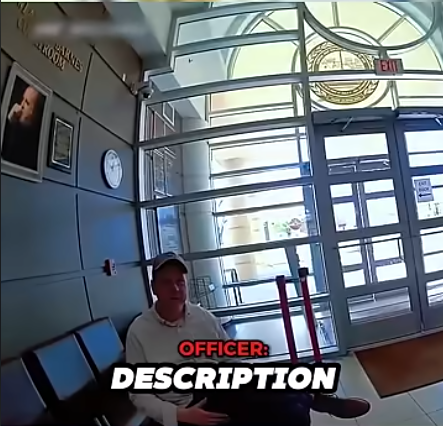
When Read arrived at the College Park Police Department, he was questioned and then arrested in the lobby. Body camera footage described by Atlanta News First showed Officer Markenley Bolette placing handcuffs on Read even though Read warned that handcuffing him could cause him to fall. Soon after, Read fell out of his wheelchair.
This part of the story is especially disturbing because it shifts the issue from investigative failure to physical treatment. A wheelchair user has specific safety needs. Handcuffing a person in a wheelchair can create balance problems, especially if the person relies on their arms for stability. If officers are going to arrest or detain someone with a disability, they must consider the person’s mobility limitations and avoid unnecessary harm.
According to the reporting, Read said officers watched him struggle on the floor. He later said he could have been seriously injured. Body camera footage also reportedly showed officers discussing whether his fall was genuine or some kind of attempt to avoid jail.
That reaction is one of the most painful elements of the case. Instead of immediately treating the fall as a medical and safety concern, some officials appeared to interpret it through suspicion. This is a common problem in disability-related encounters with authority: disabled people may be disbelieved, minimized, or treated as though their limitations are an act. In this case, that disbelief was attached to a man whose paralysis had reportedly lasted 25 years.
The Moment Doubt Entered the Room
Despite the troubling handling of the arrest, not everyone involved appeared fully convinced that the accusation made sense. Atlanta News First reported that one officer pushed back during the incident and suggested contacting the district attorney’s office because, if the door had been kicked in, Read did not appear physically capable of being the person who kicked it in.
That moment matters because it shows that the contradiction was visible even to people inside the department. The issue was not hidden. It was not a complex forensic mystery. It was a basic conflict between the accusation and the accused man’s physical condition. Someone recognized that conflict and voiced it.
Later, body camera video reportedly showed Bolette acknowledging that Jensen’s story was starting to look like a false report. That acknowledgment came after Read had already been placed in a deeply humiliating and potentially dangerous situation. It suggests that the doubts that should have been explored before an arrest were only being fully confronted after the damage had already begun.
This is one of the strongest lessons from the case: doubt is most useful before coercive action is taken. Once a person is arrested, handcuffed, physically endangered, publicly accused, or forced into the criminal justice process, the harm has already started. Police work is supposed to test claims before that point, not after.
The Role of the Original Complainant
The case also raises questions about Katherine Jensen’s role. According to Atlanta News First, records showed that Jensen had been arrested in 2023 in a separate case involving theft, forgery, and filing a false police report. Read’s attorney said that information was available in a statewide database but was not mentioned in the College Park incident report.
That does not automatically prove Jensen knowingly lied in Read’s case. But it was highly relevant information for investigators to consider. When a complainant has a documented history involving a false police report, and the new accusation contains obvious factual problems, investigators should be especially careful before relying on the claim. They should look for independent evidence. They should corroborate the accusation. They should examine whether the story is physically possible.
Atlanta News First also reported that Jensen later sent an email saying that her mental state and trauma had confused her and that she wanted to correct the information and clear Read’s name. Her mother reportedly said Jensen later acknowledged that Read did not attack her.
Even with that later acknowledgment, the damage to Read had already happened. He had been accused. He had lived for months with an unknown warrant. He had gone to the police station to clear his name and ended up arrested. The later correction may have helped resolve the criminal case, but it did not erase the fear, humiliation, or danger he experienced.
Charges Dropped After Public Scrutiny
After Atlanta News First aired its investigation, the Fulton County District Attorney’s Office dropped the charges against Read. According to a later Atlanta News First report, the DA’s office wrote that Read could not have been at the location on the date and time of the incident.
That outcome confirmed what Read had been saying: the case against him should not have stood. But the timing is important. The charges were dropped after investigative reporting brought public attention to the case. That raises a troubling question: would the charges have been dropped as quickly without media scrutiny?
The criminal justice system should not require a news investigation to correct an obvious mistake. Innocent people should not have to depend on journalists, viral videos, public pressure, or online outrage to receive basic fairness. When a case contains glaring contradictions, the system itself should catch them.
Read’s case demonstrates the power of public accountability, but it also reveals the weakness of internal safeguards. A case this questionable should have been stopped earlier. The fact that it took outside attention to force a correction suggests that the normal review process failed.
The Officer’s Resignation and Disciplinary History
The story did not end when the charges were dropped. Months later, Atlanta News First reported that Officer Markenley Belotte resigned in August after the investigation revealed the false arrest. College Park Police Chief Connie Rogers said Belotte resigned in lieu of termination.
The later reporting also revealed that Belotte had a disciplinary history. According to Atlanta News First, records showed that after being hired by College Park in July 2023, he was disciplined at least eight times in two years. The reported issues included falling asleep during an extra patrol job, being absent without leave while on duty, recording more time than he actually worked, and accidentally deploying a taser inside the department.
The same report said that Belotte had previously applied to work with the Atlanta Police Department in 2022 but was rejected after the city found he had been untruthful about employment information. Atlanta News First reported that this information had been shared with College Park Police before Belotte was hired.
These details make the case even more serious. If an officer has a pattern of disciplinary problems or hiring red flags, then a false arrest is not just an isolated mistake. It becomes part of a larger concern about hiring, supervision, training, and accountability. Departments have a responsibility not only to respond to misconduct after it happens, but to prevent foreseeable harm by carefully reviewing who they hire and how they supervise them.
Disability, Dignity, and Policing
One of the most important themes in this story is disability dignity. Disabled people often have to prove their limitations to others, especially when those limitations are misunderstood or invisible. In Read’s case, the disability was visible. He used a wheelchair. Yet he was still treated with suspicion when his body did not respond the way officers wanted.
That is why the case feels so upsetting to many viewers. The issue is not simply that police arrested the wrong person. It is that they appeared to disregard the reality of his disability. When Read fell, the immediate concern should have been his safety. Instead, the situation reportedly included suspicion that he was trying to avoid jail.
This reflects a broader problem. Law enforcement officers encounter people with many kinds of disabilities: mobility impairments, neurological conditions, mental health conditions, hearing impairments, chronic illnesses, and more. If officers are not trained to understand and respond appropriately, routine encounters can become dangerous. A disabled person may be seen as noncompliant when they are physically unable to comply. They may be seen as deceptive when their condition is unfamiliar. They may be treated as a problem rather than as a person with rights.
Read’s experience shows why disability training cannot be treated as optional. It must be part of basic policing. Officers need to understand how to safely detain wheelchair users, how to ask about medical limitations, how to avoid unnecessary force, and how to verify claims without humiliating or endangering disabled people.
The Importance of Basic Investigative Work
At its core, this case is also about basic investigative work. The facts reported by Atlanta News First suggest that several simple steps could have prevented the false arrest. Officers could have contacted Read before seeking or acting on charges. They could have asked for his side of the story. They could have checked whether he used a wheelchair. They could have looked for evidence that placed him at or away from the scene. They could have reviewed the complainant’s history. They could have questioned the physical possibility of the alleged crime.
None of those steps required advanced technology. None required months of investigation. They required curiosity, caution, and a willingness to test an accusation before treating it as fact.
That is why Read’s attorney described the case as one where innocence could have been established with very little work. The reported facts make that criticism difficult to dismiss. When a person is accused of kicking in a door and fleeing on foot, and the accused person has been paralyzed for decades, the investigation should not proceed as though nothing is unusual.
Good police work is not just about making arrests. It is about finding the truth. Sometimes that means building a case against a guilty person. Other times it means recognizing that an accusation does not hold up. The second responsibility is just as important as the first.
The Human Cost of a False Arrest
A false arrest is not a minor inconvenience. It can affect a person emotionally, physically, financially, and socially. For Read, the incident reportedly involved fear, humiliation, physical danger, and the stress of being accused of a violent crime he said he could not have committed. He also said the city had not apologized to him.
The human cost is important because official language can make these cases sound procedural. Words like “case,” “charge,” “warrant,” and “incident” can hide the personal reality. A person is taken from ordinary life and placed under state power. They may be handcuffed, searched, jailed, or publicly associated with violence. Even if the charges are later dropped, the experience can leave lasting damage.
For a disabled person, the risks may be even greater. Physical handling by officers can cause injury. A fall from a wheelchair can be serious. The loss of access to mobility equipment can be dangerous. A lack of medical understanding can turn an arrest into a health crisis. In Read’s case, he reportedly feared he could have suffered a severe injury when he fell.
This is why the case matters beyond one viral video. It is a reminder that errors in the justice system do not happen on paper. They happen to people’s bodies, families, reputations, and futures.
Accountability After the Fact
The later resignation of the officer involved may look like accountability, but the broader picture is more complicated. Belotte resigned in lieu of termination, according to Atlanta News First. However, the report also noted that the disciplinary actions listed in his record were not in response to Read’s false arrest. Jensen had not been charged in connection with filing a false report in Read’s case, and officials declined some interview requests about the department’s hiring practices and the decision not to charge her.
That leaves unresolved questions. Why was the case allowed to proceed in the first place? Who reviewed the warrant application? Who supervised the investigation? Why did no one catch the contradiction earlier? What changes were made to prevent similar incidents? Was anyone trained or disciplined because of how Read was treated? Why was there no apology, according to Read?
Accountability is not only about one officer leaving a department. It is about identifying every failure point and correcting it. If the only result is that one person resigns, the system may avoid examining deeper problems. Those deeper problems include hiring standards, supervision, internal review, disability training, and the culture that allowed officers to treat an obvious contradiction as if it did not matter.
Why the Story Went Viral
The story spread because it was immediately understandable. Anyone hearing the basic facts could see the absurdity: a man in a wheelchair was accused of kicking down a door and running away. That contrast made the story shocking, almost unbelievable. But beneath the viral appeal is a serious issue about justice.
Short-form videos often compress stories into a few dramatic moments. They highlight the most outrageous detail and invite viewers to react quickly. In this case, the short video title captures the central contradiction, but the full story is even more disturbing because it shows how many chances there were to stop the mistake before it harmed Read.
The viral nature of the story also shows the role that public attention now plays in accountability. Body camera footage, local investigative journalism, social media sharing, and online commentary can force institutions to respond. But public attention is uneven. Many wrongful arrests never become viral. Many people do not have a video, a lawyer, or a journalist willing to investigate. That makes the underlying failures even more concerning.
Read’s case became visible, but it likely represents a broader category of cases where people are accused, processed, and harmed because officials do not slow down and verify the facts.