When a Mistaken Ride Becomes a Police Encounter: A Look at the Viral Patrol Car Confrontation
Introduction
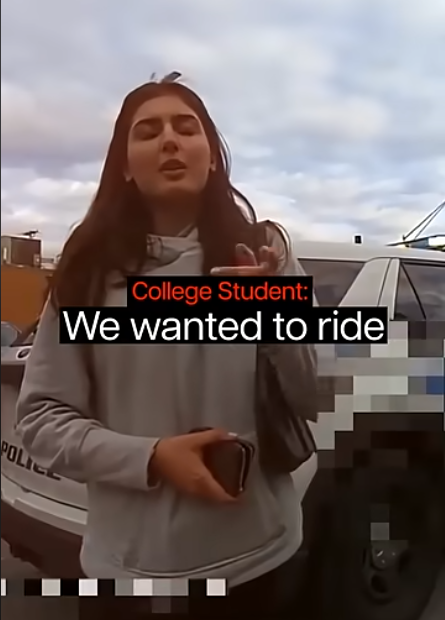
A video showing two college students mistakenly entering the back of a police patrol car has drawn attention because of the unusual, tense, and uncomfortable nature of the encounter. At first glance, the situation may sound like a strange misunderstanding: two young students, apparently believing they were getting into a taxi or ride-share vehicle, climbed into the back of what turned out to be a police car. What followed was not a simple correction or a brief moment of embarrassment. Instead, the interaction quickly became a confrontation between the students and the officer, with questions about judgment, accountability, public safety, police authority, and the consequences of careless decisions.
The scene begins with what appears to be a mistake. The students enter the back of the patrol vehicle and ask for a ride to a bar. Their behavior suggests they may not have fully understood where they were or whose car they had entered. The officer, however, reacts with shock and frustration. From his perspective, two people had entered a police vehicle without permission, treated it as if it were a private ride service, and placed themselves in a situation that could have created risk or confusion. The officer immediately orders them out of the car, demands identification, and begins questioning them about why they thought it was acceptable to open the door of a patrol car and get inside.
What might have started as a mistaken identity incident quickly escalates. The officer appears to consider potential charges, including criminal mischief, and eventually tells one of the students that since she wanted to ride in the back of a cop car, she would be going to jail. The student repeatedly apologizes and tries to explain herself, but the officer remains firm. He tells her that she can explain the situation to a judge. The exchange is striking because it captures the clash between youthful carelessness and the seriousness with which police officers may treat unauthorized contact with official vehicles.
This incident raises a number of questions. Was this simply a harmless misunderstanding, or did the students cross a line that justified a serious response? Did the officer react appropriately, or was the situation handled too harshly? What does the video reveal about how quickly an ordinary night out can turn into a legal problem? More broadly, the encounter serves as a reminder that police vehicles are not public transportation, that mistakes involving law enforcement can have consequences, and that apologies do not always erase the impact of a poor decision.
A Strange Mistake With Serious Consequences
The most unusual part of the video is the apparent mistake itself. Two college students entered the back of a police car, seemingly believing it was a taxi or ride-share vehicle. In modern nightlife settings, especially near college campuses, it is common for students to rely on ride-share apps, taxis, or designated drivers to travel safely between bars, restaurants, apartments, and campus areas. Late at night, when people are tired, distracted, or possibly impaired, confusion can happen. People may enter the wrong car, approach vehicles that look similar to the one they ordered, or fail to check the license plate before opening the door.
However, mistaking a police car for a ride-share vehicle is not an ordinary mistake. Patrol cars are usually marked, equipped with lights, cages or partitions, radio systems, and other visible indicators that separate them from regular vehicles. Even unmarked police vehicles often have features that distinguish them from ride-share cars. The fact that the students entered the back of the vehicle suggests either a serious lapse in attention or a level of confidence that made them ignore obvious signs. That is one reason the officer’s disbelief becomes a central part of the video.
From the students’ perspective, the event may have felt like an embarrassing misunderstanding. They may have thought they were getting into a car that had arrived to take them somewhere, and once they realized their mistake, they may have expected to apologize and walk away. But from the officer’s perspective, the situation was not so simple. A patrol car is a workplace, a law enforcement tool, and sometimes a temporary holding space for detained individuals. Unauthorized entry into such a vehicle can create security concerns. Officers may worry about damage, interference with equipment, attempts to access weapons or technology, or situations that could compromise safety.
The gap between these two perspectives is what makes the encounter so tense. The students appear to see the mistake as foolish but explainable. The officer appears to see it as reckless, disrespectful, and potentially criminal. The video captures the moment when those two interpretations collide. The students’ apologies do not immediately calm the officer because, in his view, the issue is not just that they made a mistake. It is that they entered a police vehicle without permission and treated the situation casually.
This is the point where the incident becomes more than a funny story. A person might laugh later about trying to get into the wrong car, but a police vehicle carries different meaning. The back seat of a patrol car is associated with detention, arrest, and official police action. Entering it voluntarily as a joke or by mistake may seem absurd, but it also places the officer in a position where he must respond. Whether his response was too harsh is open to debate, but the seriousness of the vehicle itself helps explain why the event did not end with a simple warning.
The Officer’s Immediate Reaction
The officer’s reaction is one of disbelief and irritation. He orders the students out of the vehicle and asks for their identification. His tone suggests that he cannot understand why anyone would think it was acceptable to enter the back of a police car and ask for a ride to a bar. To him, the action appears so unreasonable that he treats it as more than an innocent mistake. He demands answers, and the students are placed in the uncomfortable position of trying to explain something that sounds difficult to justify.
The officer’s response reflects a common theme in police encounters: officers often assess behavior not only by what happened, but by what could have happened. Even if the students did not intend harm, their action could have created confusion. If an officer is responsible for securing the vehicle, maintaining equipment, and ensuring public safety, unauthorized people entering the car may be seen as a violation of boundaries. Police officers are trained to think about threats, risks, and control of the scene. A person opening a police car door and getting inside is not necessarily interpreted as harmless.
At the same time, viewers may question whether the officer’s reaction matched the students’ intent. The students appear apologetic. They do not seem to be trying to flee, fight, or damage the car. Their mistake seems foolish rather than malicious. This creates the central tension of the video: should an officer respond based primarily on the potential seriousness of the action, or should the response be shaped by the apparent lack of harmful intent? Different viewers may answer that question differently.
Some may argue that the officer had every reason to be firm. A police vehicle is not a taxi, and entering one without permission is not a minor social mistake. In that view, the officer’s frustration is understandable because the students showed poor judgment and placed themselves in a situation that forced him to take action. Others may argue that the officer could have used the moment as a warning rather than an arrest. They may see the students’ repeated apologies as evidence that the lesson had already been learned.
The video does not show every possible detail, and viewers should be careful not to assume more than what is visible. However, the officer’s immediate reaction clearly shows that he viewed the situation as serious. His demands for identification and his questioning of the students establish the encounter as an official police matter, not merely an awkward misunderstanding. Once that happened, the students lost control over how the situation would end.
The Role of Alcohol, Nightlife, and College Culture
Although the video does not require viewers to know every detail about the students’ condition, the fact that they asked for a ride to a bar places the incident within the world of college nightlife. Many college towns have busy evening scenes where students move between dorms, apartments, bars, parties, and restaurants. Ride-share services are a major part of that culture, especially for students who do not want to drive after drinking or who do not have cars on campus. In that sense, asking for a ride to a bar is not unusual. What is unusual is asking a police officer from the back of his own patrol car.
College nightlife can create conditions where judgment is weakened. People may be distracted by friends, phones, music, crowds, or alcohol. They may assume that a car waiting nearby is the one they requested. They may move quickly without verifying details. Ride-share companies often warn passengers to check the license plate, driver name, and vehicle make before entering. This incident shows why that advice matters. Getting into the wrong car can be dangerous, embarrassing, or legally complicated.
There is also a broader cultural issue at play. Some young adults, especially in group settings, may treat unusual situations as jokes until authority becomes involved. What feels funny among friends can become serious when it crosses into someone else’s space, property, or professional environment. A patrol car is not just another parked vehicle. It represents legal authority and official responsibility. Entering it, even accidentally, changes the tone of the night immediately.
The students’ mistake may have been rooted in a casual assumption: a car is nearby, they need a ride, and they enter without thinking carefully. But the consequences show how fragile that assumption was. A single moment of inattention turned into a police confrontation. This is one reason the video resonates with viewers. Many people can imagine making a small mistake during a night out, but few imagine that mistake ending in handcuffs, charges, or a court appearance.
For college students, the incident is a warning about the importance of awareness. It is not enough to rely on friends or assume a ride has arrived. People must verify vehicles, respect boundaries, and understand that public safety environments are not casual spaces. A poor decision that lasts only a few seconds can affect a student’s record, reputation, school standing, and future opportunities.
Apologies and Accountability
One of the most human parts of the video is the student’s repeated apology. She appears to understand that she made a mistake and tries to express regret. Apologies are often the first response when someone realizes they have crossed a line. In everyday life, an apology can resolve many situations. A person who bumps into someone, enters the wrong room, or misunderstands instructions may simply say sorry and move on. But in legal or law enforcement contexts, an apology may not be enough.
The officer’s response suggests that he does not view the apology as a complete solution. He remains firm and tells the student that she can explain herself to a judge. This is a powerful moment because it shows the difference between social accountability and legal accountability. Social accountability may involve embarrassment, regret, and an apology. Legal accountability may involve detention, charges, court, and consequences decided by a formal system.
This distinction can feel harsh, especially when the person involved seems genuinely sorry. Many viewers may sympathize with the student because she appears frightened or regretful. They may think that once she apologized and explained the mistake, the officer could have allowed her to leave. Others may believe that apologies cannot replace consequences, especially when someone enters a police vehicle without permission. From that perspective, the officer is not punishing her for apologizing poorly; he is responding to the original action.
The incident raises an important question: when should remorse reduce the consequences of a mistake? In many areas of life, remorse matters. Judges, teachers, employers, and parents may all consider whether someone accepts responsibility. But remorse does not automatically erase the action. If a person causes damage, enters a restricted area, or interferes with official duties, an apology may be considered, but it does not guarantee that the matter ends there.
The student’s repeated apologies also show the emotional shift that happens when a person realizes the seriousness of a situation. What may have begun as confusion becomes fear. The student seems to understand that the officer is not treating the incident as a joke. Her words may be sincere, but by that point, the officer has already decided that the matter requires further action. This creates a painful lesson: the time to avoid consequences is often before the mistake is made, not after.
Why Entering a Police Vehicle Is Different
A key part of understanding the officer’s reaction is recognizing that a police car is not an ordinary car. It is government property, a law enforcement workspace, and a controlled environment. The back seat of a patrol car is often used to transport detained people. It may contain safety barriers, specialized locks, cameras, recording equipment, or other tools connected to police work. Unauthorized entry into that space can raise concerns that would not apply to a typical private vehicle.
Police officers are responsible for maintaining control of their vehicles. A patrol car may contain sensitive equipment, documents, radios, computers, and in some cases weapons secured in specific compartments. Even if the students never touched any equipment, their presence inside the vehicle may have been enough to cause concern. Officers often have to think about worst-case scenarios. They may not have the luxury of assuming that every unexpected action is innocent.
This does not mean every accidental entry must result in arrest. Police officers often have discretion, and discretion can lead to warnings, citations, or no action at all depending on the circumstances. But the presence of discretion also means the officer’s judgment becomes central. In this video, the officer appears to judge the conduct as serious enough to consider charges and jail. Whether viewers agree with that judgment depends on how they balance intent, risk, and authority.
The fact that the students asked the officer for a ride to a bar may have made the situation worse. To the officer, the request may have sounded disrespectful or absurd. Police officers do not operate as private chauffeurs, and a patrol vehicle is not a ride-share service. Asking for a ride to a bar from the back of a police car may have reinforced the officer’s belief that the students were not taking the situation seriously. Even if they were simply confused, their words could have made the encounter appear more careless.
This is an important lesson in how actions are interpreted. People are often judged not only by what they intended, but by how their behavior appears to others. The students may have intended no harm, but the officer saw unauthorized entry, a strange request, and a lack of judgment. In police encounters, appearance can matter greatly because officers must make quick decisions under uncertain conditions.
The Officer’s Use of Authority
The officer’s authority is central to the video. Once he orders the students out of the car and asks for identification, the encounter becomes official. The students are no longer just two people who made a mistake; they are individuals being questioned by law enforcement. The officer controls the scene, sets the tone, and determines whether the matter will end with a warning or proceed toward arrest.
Some viewers may see the officer’s authority as necessary. From this perspective, officers must respond firmly when people enter police vehicles without permission. A soft reaction could encourage others to treat police property casually. It could also create safety problems if people believe they can open patrol car doors without consequences. The officer’s firm stance may be viewed as a message that police vehicles are restricted spaces and must be respected.
Other viewers may see the authority as excessive. They may argue that the students were not threatening the officer, damaging the vehicle, or refusing to cooperate. If the mistake was genuine, they might believe a warning would have been enough. The officer’s statement that the student could explain herself to a judge may strike some viewers as unnecessarily severe for a mistaken entry. This divide in interpretation is common in viral police videos, where viewers bring different assumptions about law enforcement, personal responsibility, and fairness.
Authority can be lawful and still be debated. An officer may have the power to make an arrest, but the public may still question whether using that power was the best choice. Police discretion exists partly because not every situation requires the harshest possible response. At the same time, officers may believe that failing to respond firmly invites future problems. The video sits directly in this gray area.
The officer’s comment that the student wanted to ride in the back of a cop car and would now be taken to jail is especially memorable. It sounds like a sharp, almost ironic response to the student’s mistake. To some, it may seem like a fitting consequence for a reckless decision. To others, it may sound like anger shaping the outcome. The statement becomes one of the defining moments of the encounter because it turns the student’s mistaken request into the basis for her punishment.
The Student’s Position
The student at the center of the confrontation appears to be in a difficult position. She has made a mistake, she is confronted by an angry officer, and she is trying to apologize while facing the possibility of jail. Her repeated apologies suggest that she recognizes the seriousness of what happened, at least after the officer makes it clear. She may have believed that explaining the misunderstanding would help, but the officer does not appear persuaded.
For the student, the incident likely shifted from confusing to frightening very quickly. Entering the wrong vehicle may have seemed embarrassing at first. But once identification was demanded and jail was mentioned, the stakes changed. A college student facing arrest may worry about parents, school discipline, future employment, scholarships, or immigration status if applicable. Even a minor charge can create stress and uncertainty.
Her response also shows how difficult it can be to communicate during a police encounter. When a person is nervous, embarrassed, or afraid, they may repeat themselves, apologize too often, or struggle to provide a clear explanation. The officer may interpret this as evasive or insufficient. The student may feel that no explanation is being accepted. That communication breakdown can deepen the conflict.
It is also possible that the student underestimated the seriousness of entering the car until the officer reacted. Many people do not fully understand legal boundaries until they cross them. A person might assume that because no harm was intended, no major consequence should follow. But the law often considers actions, not just intentions. Even when intent matters, it may not fully protect someone from being detained or charged.
The student’s situation is a reminder that good intentions do not always prevent bad outcomes. A person can make a mistake without meaning harm and still face consequences. That does not mean every consequence is fair or proportional, but it does mean that regret after the fact may not be enough to undo the situation.