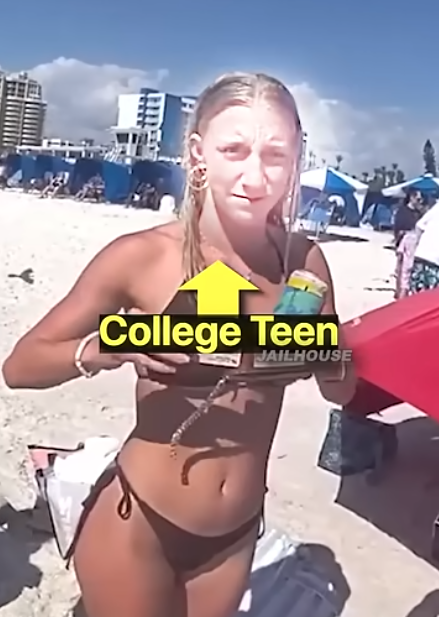
Beachside Clash Between College Students and Police Officer Highlights Underage Drinking, Vaping, and Accountability
Introduction
A video showing a confrontation between a group of college students and a police officer on a beach has drawn attention because of the way a routine law enforcement interaction quickly escalated into a tense and uncomfortable encounter. What begins as a conversation about underage drinking and possession of alcohol on the beach develops into a broader example of how attitude, communication, and decision-making can shape the outcome of an encounter with police.
The video centers on a police officer questioning a group of young people who appear to be spending time together on the beach. The officer’s primary concern is whether any of the students are under the legal drinking age and whether they are in possession of alcoholic beverages. He warns them that lying about their age could lead to jail and explains that each closed container of alcohol carries a fine. The interaction becomes more serious when one student responds dismissively and begins challenging the officer’s authority.
As the exchange continues, the officer also points out another violation: vaping on the beach. He confiscates a vape from one of the students and makes it clear that the group is not only dealing with an alcohol-related issue but also with beach rules regarding smoking or vaping. The situation becomes increasingly tense when one student makes sarcastic comments, threatens to call his mother, and mocks the officer. Eventually, the officer arrests the student, while the student continues to joke about the situation and even asks for a photo of himself in handcuffs.
The video ends with the officer expressing frustration over what he describes as “entitled college kids” who believe they are above the law. Whether viewers focus on the officer’s patience, the student’s behavior, or the broader social issue of young adults ignoring public rules, the video offers a clear reminder that small violations can become serious consequences when people refuse to take responsibility.
A Routine Beach Patrol Turns Into a Confrontation
The setting of the video is familiar: a beach where groups of young people gather to relax, socialize, and enjoy the day. Beaches often attract college students, especially during spring break, weekends, or warm-weather holidays. In many beach communities, police patrol these areas to enforce local laws related to alcohol, smoking, vaping, public disorder, and safety. These patrols are usually not unusual. Officers often check for open containers, underage drinking, illegal substances, and behavior that could disturb other beachgoers.
At first, the officer’s approach seems focused on determining who in the group is under 21. This is an important question because the legal drinking age in the United States is 21, and underage possession or consumption of alcohol can lead to fines, citations, court appearances, or even arrest depending on the circumstances. The officer makes it clear that honesty matters. He warns the group that lying about being underage could lead to jail, which immediately establishes the seriousness of the situation.
The officer also explains that the students may face fines for closed containers of alcohol. According to the description of the video, the fine is $118 for each closed container they possess. This detail is important because many young people assume that only open alcohol containers or active drinking can create legal problems. However, in many places, simply possessing alcohol while underage, or possessing alcohol in an area where alcohol is prohibited, can still result in penalties.
The interaction could have remained simple. The students could have answered honestly, accepted the warning or citation, and allowed the officer to do his job. Instead, the mood changes when one student begins to challenge the officer’s authority. His attitude shifts the situation from a basic enforcement issue into a personal confrontation.
The Officer’s Warning About Lying and Jail
One of the most important early moments in the video is the officer’s warning that lying could lead to jail. This statement is not just a scare tactic. When police are investigating a possible violation, giving false information can create additional legal problems. A person who might have initially faced only a citation can make the situation worse by lying about their identity, age, possession of alcohol, or involvement in the incident.
For college students, this is a lesson that is often learned too late. Many young adults believe that if they deny responsibility or act confident enough, they can avoid consequences. However, officers are trained to look for inconsistencies, check identification, and determine whether people are being truthful. If someone lies during an investigation, the officer may view that person as uncooperative, and the situation may escalate.
In the video, the officer appears to be giving the students a chance to be honest. His message is direct: tell the truth now, because lying will make things worse. That warning should have signaled to the group that cooperation was the safest option. Instead, one student appears to interpret the officer’s warning as a challenge.
The warning also shows how police interactions often depend on cooperation. An officer has discretion in many situations. That does not mean the officer can ignore the law, but it does mean that behavior can influence whether the result is a warning, a citation, or an arrest. Calm cooperation can reduce tension. Sarcasm and disrespect can increase it.
The Fine for Alcohol Containers
The officer’s explanation of the $118 fine for each closed alcohol container is another major point in the video. Many people do not realize that closed containers can still be illegal depending on local rules and the age of the person possessing them. A closed container does not automatically protect someone from being cited. If the beach prohibits alcohol, or if the person holding the alcohol is under 21, the container itself becomes evidence of a violation.
For a group of college students, this can become expensive quickly. If multiple containers are present, each one may carry a separate fine. What began as a casual beach outing can turn into hundreds of dollars in penalties. Beyond the financial cost, citations can also create stress for students, especially if they have to explain the situation to parents, schools, coaches, scholarship programs, or future employers.
The officer’s explanation seems intended to make the students understand the consequences before the situation gets worse. He is not just saying, “You are in trouble.” He is explaining what the rule is and what the fine could be. That kind of explanation gives the students information they can use to make better choices. They can cooperate, accept responsibility, and avoid further problems.
Instead, the conversation becomes more confrontational. One student appears less concerned with the fine and more focused on challenging the officer personally. This is where the situation begins to change from an alcohol-related violation into a conflict over respect and authority.
The Student’s Confrontational Attitude
The most memorable part of the video is the behavior of the student who tells the officer that his “badge talks a lot.” This comment is dismissive and insulting. It suggests that the officer is only powerful because of his badge, not because of the law he is enforcing. While some viewers may see the comment as an attempt at humor or confidence, in the context of a police interaction, it increases tension.
There is a major difference between asking questions and being confrontational. A person has the right to ask what law they are accused of violating, whether they are free to leave, or what the possible consequences are. Those questions can be asked respectfully. However, mocking an officer, insulting his authority, or trying to embarrass him in front of others is likely to make the situation worse.
The student’s attitude also affects the rest of the group. When one person becomes loud or disrespectful, the entire group may be treated as less cooperative. Police officers often have to manage group dynamics carefully, especially when alcohol may be involved. A single confrontational person can create uncertainty and make the officer more cautious.
The student later asks what they can do to avoid trouble. This could have been a productive question if asked sincerely. But because it comes after dismissive comments, the officer responds by clarifying that he has the authority to take them to jail. The officer appears to be reminding the student that this is not a negotiation between equals at a party. It is a law enforcement situation.
Vaping on the Beach Adds Another Violation
The interaction becomes more complicated when the officer points out that vaping is prohibited on the beach. He confiscates a vape from one of the students, adding another issue to the encounter. This moment is important because it shows that the students are not dealing with only one possible violation. They are facing multiple rules: underage drinking, possession of alcohol, and vaping in a prohibited area.
Many beaches have strict rules against smoking and vaping. These rules are often created to protect public health, reduce litter, prevent fire risks, and preserve a family-friendly environment. Vapes may seem harmless to some users, but local laws may treat them the same as cigarettes or other smoking devices. On public beaches, rules are often clearly posted, but visitors may ignore them or assume they will not be enforced.
The confiscation of the vape also reinforces the officer’s authority. He is not merely talking. He is actively enforcing the rules. For the students, this should have been another sign that the situation was serious. Instead of calming down, the student who had already been confrontational continues to escalate.
This part of the video also highlights a common problem among young adults in public spaces: the assumption that certain rules are minor and therefore do not matter. A vape on a beach, a closed container of alcohol, or a sarcastic comment may seem small on their own. But together, they create a pattern of disregard for the rules and for the person enforcing them.
Escalation Through Mockery and Defiance
The situation escalates further when the student threatens to call his mother to handle the situation. This moment stands out because it reflects a sense of dependence and entitlement. Rather than dealing with the officer directly and responsibly, the student suggests that his mother can intervene. To the officer, this may reinforce the idea that the student does not understand the seriousness of the situation.
Calling a parent is not automatically wrong. Young adults often call parents when they are scared, confused, or facing legal trouble. However, the way the student uses the threat appears dismissive, as if his mother’s involvement would somehow override the officer’s authority. That attitude can be interpreted as an attempt to avoid personal accountability.
The student also continues to mock the officer, calling him “entitled.” This accusation is ironic within the context of the video because the officer later describes the students as entitled. Both sides use the word, but they appear to mean different things. The student seems to view the officer as entitled because he has power and is using it. The officer seems to view the student as entitled because the student refuses to accept consequences and acts as if ordinary rules should not apply to him.
Mockery during a police encounter can be risky. While people have free speech rights, disrespectful behavior can still influence how an officer handles the situation, especially if the behavior interferes with the investigation or contributes to disorder. The student’s joking tone may be intended to entertain his friends or make himself look confident, but it also makes him appear unwilling to take the matter seriously.
The Arrest and the Student’s Reaction
The turning point of the video comes when the officer arrests the student. By this point, the interaction has moved beyond warnings and explanations. The officer has questioned the group, explained the alcohol-related fines, addressed the vaping violation, and responded to the student’s confrontational behavior. The student’s continued defiance appears to convince the officer that stronger action is necessary.
What makes the arrest especially striking is the student’s reaction. Instead of becoming quiet or concerned, he continues to mock the situation. He reportedly asks for a photo of himself in handcuffs because he thinks it “looks dope.” This response suggests that he may not fully understand the consequences of being arrested, or he may be trying to save face in front of his peers.
For many young people, especially in social settings, embarrassment can be a powerful motivator. A student who realizes he is losing control of a situation may try to turn it into a joke. By acting as if the arrest is funny or cool, he may be attempting to protect his image. However, this kind of reaction can make the situation look even worse. What may feel like a joke in the moment can later become a serious record, a legal problem, or a source of regret.
The arrest also sends a message to the rest of the group. The officer’s authority is not symbolic. It has real consequences. The students who may have thought the encounter was merely annoying now see that failure to cooperate can lead to someone being physically taken into custody.
The Officer’s Frustration With “Entitled College Kids”
At the end of the video, the officer expresses frustration with “entitled college kids” who believe they are above the law. This statement captures the emotional core of the encounter. From the officer’s perspective, he is dealing with young adults who are breaking rules, dismissing warnings, and acting as if consequences should not apply to them. His frustration is not only about alcohol or vaping. It is about attitude.
The phrase “entitled college kids” is strong, and it may be controversial. Some viewers may agree with the officer, seeing the student’s behavior as disrespectful and immature. Others may feel that officers should remain calm and avoid making general statements about young people. Still, the officer’s comment reflects a common frustration among law enforcement in beach towns and college areas. Officers often deal with groups of students who treat public spaces as party zones and then react with surprise when rules are enforced.
Entitlement in this context means expecting special treatment. It means believing that fines, laws, or police instructions are negotiable because of one’s social status, family background, school identity, or confidence. The student’s threat to call his mother may have contributed to that impression. So did his sarcastic remarks and his refusal to treat the situation seriously.
At the same time, the video also raises a broader question about how young people learn accountability. Many college students are living independently for the first time. They may be legally adults, but they may still rely on parents to solve problems. Encounters like this force them to confront the reality that adulthood includes consequences.
Public Beaches and the Importance of Shared Rules
Public beaches are shared spaces. Families, tourists, local residents, students, children, and older adults may all use the same area. Rules about alcohol, vaping, smoking, littering, and disorderly conduct are not created only to punish people. They are designed to keep the environment safe, clean, and comfortable for everyone.
Underage drinking on beaches can create several problems. Alcohol can contribute to fights, injuries, drowning risks, harassment, and unsafe driving after people leave the beach. Broken bottles, cans, and trash can harm wildlife and beachgoers. Large groups drinking in public can also make other visitors feel uncomfortable or unsafe.
Vaping rules are part of the same public-order framework. Even though vaping does not produce the same smoke as cigarettes, many communities restrict it in public recreation areas. Some people do not want to breathe vapor near children or families. Others object to discarded vape devices, which can become litter or environmental hazards.
When students ignore these rules, they are not just taking a personal risk. They are affecting the shared space around them. The officer in the video is not merely interrupting a group’s fun. He is enforcing rules that apply to everyone on the beach.
The Role of Respect During Police Encounters
One of the clearest lessons from the video is that respect matters during police encounters. Respect does not mean giving up rights. It does not mean admitting guilt if a person has not done anything wrong. It means remaining calm, listening carefully, asking clear questions, and avoiding insults or unnecessary confrontation.
A respectful response could have changed the entire outcome. If the students had answered honestly, complied with instructions, and avoided mocking the officer, the situation might have ended with citations, warnings, or confiscation of prohibited items. The arrest may have been avoided. The group may have left the beach frustrated but not facing the same level of consequence.
The student’s behavior shows how quickly tone can change everything. Words like “your badge talks a lot” may feel clever in the moment, but they rarely help. They put the officer on the defensive and signal that the person is not taking the matter seriously. Once an officer believes someone is uncooperative, the officer may become less willing to use discretion.
This does not mean police officers should be beyond criticism. Officers should be professional, calm, and accountable. Citizens have the right to question government authority. But there is a difference between exercising rights and provoking an unnecessary escalation.
Accountability and Young Adulthood
The video also reflects a larger issue: the transition from adolescence to adulthood. College students often live in a world between dependence and independence. They may be away from home, making their own decisions, but still relying on parents for financial support, emotional guidance, or problem-solving. This can create confusion when real-world consequences appear.
The student who threatens to call his mother represents this tension. On one hand, he may see himself as independent enough to drink, vape, party, and challenge authority. On the other hand, when consequences arrive, he reaches for parental intervention. That contradiction is common among young adults who have not fully accepted responsibility for their choices.
Accountability means understanding that actions have consequences even when those actions seem minor. Bringing alcohol to a prohibited beach, possessing alcohol while underage, vaping where it is banned, and mocking an officer are all choices. Each choice increases the chance of a negative outcome.
For college students, the lesson is simple but important: adulthood is not only about freedom. It is also about responsibility. Public behavior matters. Legal rules matter. The way a person speaks to others, especially during stressful situations, can affect what happens next.
Why the Video Resonates With Viewers
Videos like this often spread because they tap into strong emotions. Some viewers watch and feel sympathy for the officer. They see a public servant trying to enforce basic rules while being mocked by someone who refuses to cooperate. Others may watch and feel uncomfortable with the power imbalance between police and young citizens. Still others may focus on the student’s immaturity and see the video as a cautionary tale.
The reason the video resonates is that it is not only about one beach or one arrest. It reflects broader debates about law enforcement, youth culture, privilege, public behavior, and respect for rules. Many people have seen similar situations: young people acting careless in public, officers trying to maintain order, and small violations turning into larger conflicts because of attitude.
The video also invites viewers to ask what could have been done differently. The students could have followed the rules. They could have avoided bringing alcohol or vaping on the beach. Once approached by the officer, they could have answered respectfully. The confrontational student could have stopped talking before the situation escalated. The officer, for his part, had to decide when warnings were no longer effective and when arrest became necessary.
These questions make the video more than a simple viral clip. It becomes an example of how public interactions can either calm down or spiral out of control depending on the choices people make in real time.