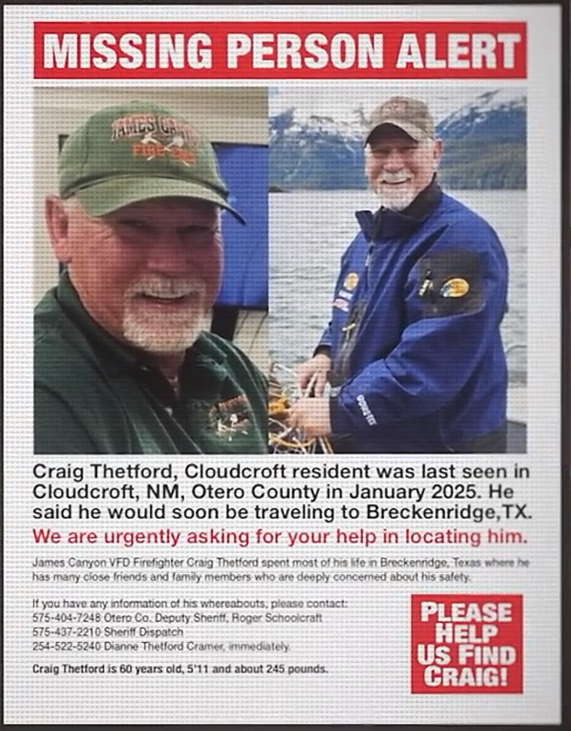
It began quietly, almost in a way that could have gone unnoticed if not for the growing concern of those closest to him. Months had passed without any sign of Craig, and what initially seemed like distance or personal space slowly turned into something far more alarming. By May 2025, friends and family could no longer ignore the silence. Four months without contact was not normal, not for someone with established relationships and a presence in people’s lives. The worry built gradually, until it reached a point where they felt compelled to act. Welfare checks were requested, not out of panic at first, but out of a need for reassurance. What they didn’t realize at that moment was that this simple request would unravel a case far more disturbing than anyone expected.
When authorities arrived and began asking questions, the first explanations came from Craig’s wife, Dena Thaxton. Her account, at least initially, seemed plausible enough to ease immediate concern. She claimed that Craig had filed for divorce and left, choosing to start a new life in Mexico with a younger woman. It was a narrative that fit a certain kind of story—relationships end, people walk away, and sometimes they do so without much explanation. But something about it didn’t sit right. As officers continued speaking with her and others, the story began to shift. To some people, she said Craig was in Mexico. To others, she insisted he had gone to Texas to care for his mother. The details didn’t align, and that inconsistency became one of the first signs that something deeper might be wrong.
Investigators began to take a closer look, not just at the disappearance itself, but at the people involved. As they dug into Dena’s background, a pattern began to emerge—one that raised serious concerns. Interviews with her ex-husbands painted a troubling picture. They described her as volatile, prone to heavy drinking, and capable of violent behavior. Some even claimed she had previously attempted to harm them. These accounts were reinforced by statements from her own daughter, who spoke openly about her mother’s instability. While these details did not directly prove anything about Craig’s disappearance, they provided important context. They suggested that the situation might not be as simple as a man choosing to leave his life behind.
At the same time, financial records began to tell a story of their own. Dena had claimed that Craig kept approximately $1.5 million in cash inside a safe at their home, and that she did not have access to it. But investigators quickly discovered evidence that contradicted this claim. In the months following Craig’s disappearance, she had spent large sums of money—purchasing new houses, acquiring vehicles, and making transactions that indicated significant financial control. The discrepancy raised immediate questions. If Craig had truly left and taken responsibility for his finances, how was she able to access and spend such large amounts of money? The more investigators looked into it, the clearer it became that something was not adding up.
Meanwhile, during early welfare checks, officers began noticing subtle but unsettling details at the property. There was a faint odor near the carport—not strong enough to immediately confirm anything, but noticeable enough to raise suspicion. At the same time, they observed Dena digging a large hole in the yard. When asked about it, she gave a simple explanation, saying it was for an above-ground garden. On its own, that might not have seemed unusual. People work on their yards all the time. But in the context of everything else—the missing husband, the conflicting stories, the financial inconsistencies—the detail stood out. It was noted, but at that stage, there was still no direct evidence to connect it to anything criminal.
The investigation continued to build slowly, piece by piece. Detectives gathered information, conducted interviews, and tried to create a timeline that made sense. But without concrete evidence, the case remained in a gray area—suspicious, but not yet provable. Then came the moment that changed everything. The breakthrough did not come from forensic analysis or surveillance footage. It came from within the family itself. Dena’s daughter, Leslie, came forward with information that shifted the entire direction of the case.
According to Leslie, her mother had confessed. What had once been a vague and inconsistent story now became something far more specific—and far more disturbing. She told investigators that Dena admitted to shooting Craig. The details she provided were chilling. She described how Craig’s body had been left inside the house, specifically in what was referred to as the “pool room,” for several days. This was not just an act of violence—it suggested a level of detachment that investigators found deeply concerning. The confession continued, revealing that Dena had used a tractor to move the body and hide it on the property.
With this new information, investigators returned to the property with a clear focus. The search concentrated on the detached carport—an area that had already drawn attention earlier in the investigation. This time, they conducted a thorough examination. What they found confirmed the worst fears. Hidden beneath a large pile of items—cardboard boxes, rugs, and bags of soil—was Craig’s body. It had been wrapped in plastic, concealed in a way that suggested an attempt to delay discovery for as long as possible. The location and condition of the body aligned with the details provided in the confession.
An autopsy was conducted, and the results left no doubt about the cause of death. Craig had been shot multiple times, including a fatal wound to the heart. With that confirmation, the case officially shifted from a missing person investigation to a homicide. The focus now turned entirely to locating Dena and bringing her into custody.
Authorities tracked her to Texas, where she was found at a hospital following what was reported to be a suicide attempt. The circumstances suggested that she was aware of the gravity of the situation and the likelihood of being held accountable. She was arrested and charged with first-degree murder, as well as tampering with evidence. The charges reflected not only the act itself but also the effort to conceal it and mislead those searching for answers.
As of March 2026, Dena remains in custody, awaiting trial. If convicted, she faces the possibility of life in prison. The case, however, continues to resonate beyond the legal proceedings. It raises questions about how warning signs are recognized, how patterns of behavior are understood, and how situations can escalate over time without clear intervention. What began as concern over a missing person evolved into a complex and deeply disturbing investigation—one that revealed not just a crime, but a sequence of actions and decisions that led to it.
For those who knew Craig, the outcome is a painful reality. The months of uncertainty, the conflicting stories, the gradual realization that something was wrong—all of it culminated in a truth that no one wanted to face. And yet, it also underscores the importance of persistence. It was the concern of friends and family, the decision to request a welfare check, and the willingness of Leslie to come forward that ultimately brought the truth to light. Without those actions, the story might have remained hidden much longer.
In the end, the case serves as a stark reminder that not all disappearances are what they seem. Sometimes, the answers are buried beneath layers of deception, waiting for someone to uncover them. And when they do, the reality can be far more unsettling than anyone imagined.
As the case moved beyond the initial discovery, the focus shifted from what had happened to how it had been hidden for so long without raising immediate alarm. Investigators began reconstructing the timeline in greater detail, working backwards from the moment Craig’s body was found to the earliest signs that something had gone wrong. Every interaction, every statement, and every action taken by Dena Thaxton was reexamined with a new perspective. What once appeared as confusion or inconsistency now carried a different meaning. The changing stories, the calm explanations, the casual references to Craig’s supposed whereabouts—all of it suggested a deliberate effort to maintain control of the narrative for as long as possible.
One of the most striking elements of the investigation was the amount of time that had passed before the truth was uncovered. For nearly four months, Craig’s absence was explained away with stories that, while inconsistent, were not immediately challenged with urgency. This raised difficult questions about how easily people can be convinced by partial explanations, especially when they come from someone in a position of trust. A spouse is often the first and most reliable source of information in cases like this, and that assumption can delay deeper scrutiny. In this situation, that delay allowed the reality of what had happened to remain hidden longer than it otherwise might have.
As detectives continued to analyze the financial records, the motive behind the crime began to take clearer shape. The large amount of cash that had been kept in the home became a central point of focus. While Dena initially claimed she had no access to it, the evidence told a different story. Significant purchases were made in the months following Craig’s disappearance, including real estate and vehicles. The spending pattern suggested not just access, but control. Investigators began to consider the possibility that financial gain played a major role in what had happened. The disappearance of most of the money from the safe further supported that theory, raising the likelihood that the crime was not only violent, but also calculated.
At the same time, the physical evidence at the property was examined more thoroughly. The carport, where Craig’s body had been concealed, became a key area of analysis. Investigators documented the way the body had been hidden—wrapped in plastic, covered with layers of materials, and placed in a location that was both accessible and easy to overlook. The use of everyday items to conceal something so significant demonstrated a level of planning that went beyond panic or impulse. It suggested an awareness of how to delay discovery, even if only temporarily. The earlier observations made by officers during welfare checks, including the faint odor and the activity in the yard, were now understood in a completely different context.
The role of Leslie in the case remained one of the most critical turning points. Without her decision to come forward, the investigation might have continued without direction for much longer. Her account provided not only a confession, but also specific details that guided investigators to the exact location of the body. That level of information is often the difference between suspicion and proof. It also highlighted the internal conflict that can exist in cases involving family members. Coming forward in a situation like this is not a simple decision. It involves confronting the reality of what has happened, as well as the consequences for someone close. In this case, that decision ultimately brought clarity to a situation that had been clouded by uncertainty.
As the case gained attention, it began to resonate beyond the immediate community. People followed the developments closely, trying to understand how such a situation could unfold in a way that allowed it to remain hidden for so long. The details—particularly the idea that Craig’s body had remained in the home for days before being moved—were difficult for many to process. It challenged assumptions about how crimes are committed and concealed, and it raised broader concerns about the signs that might be missed in similar situations.
Legal proceedings began to take shape as charges were formally filed. First-degree murder carries significant weight, reflecting the severity of the act and the belief that it was intentional. The additional charge of tampering with evidence addressed the efforts made to conceal the crime, emphasizing that the case was not just about what happened, but also about what was done afterward to prevent it from being discovered. As the case moved toward trial, both sides began preparing their arguments, with prosecutors focusing on the evidence and the timeline, and the defense likely examining the circumstances and any factors that could influence how the events were interpreted.
For those who knew Craig, the process of moving from uncertainty to confirmation brought a different kind of pain. The months of not knowing, of hoping for a simple explanation, were replaced by the reality of what had actually happened. Grief, in cases like this, is often complicated by the way the truth is revealed. It is not a single moment of loss, but a series of realizations that unfold over time. Each new detail adds to the understanding of the situation, but also to the emotional weight of it.
At a broader level, the case also serves as a reminder of how important it is to take concerns seriously, even when explanations are provided. The initial welfare checks were prompted by intuition—by the sense that something was not right. That instinct, combined with persistence, ultimately led to the discovery of the truth. It highlights the role that community and awareness play in situations where something may be hidden beneath the surface.
As the investigation continued and the legal process moved forward, the focus remained on ensuring that all aspects of the case were fully examined. Evidence was reviewed, statements were analyzed, and the timeline was refined to present a clear and complete picture of what had occurred. The goal, as in any case of this nature, was not only to establish what happened, but to ensure that it was understood in a way that allowed for accountability.
In the end, Part 2 of the story reveals how the case evolved from suspicion to confirmation. It shows how small details, when connected, can form a larger picture, and how the persistence of investigators and the courage of individuals willing to speak up can bring clarity to even the most concealed situations. It also underscores the complexity of cases involving personal relationships, where trust and familiarity can both obscure and reveal the truth.
As the case moved closer to trial, the focus shifted once again—this time toward accountability, consequences, and the lasting impact left behind by everything that had happened. What began as a missing person concern had evolved into a fully developed homicide case, supported by physical evidence, financial records, and a direct confession relayed through a family member. But even with those elements in place, the legal process required time, structure, and careful examination. Every detail had to be presented clearly, every step verified, and every claim supported in a way that could stand in court.
For Dena Thaxton, the situation had reached a point where there was no longer any separation between the narrative she had attempted to maintain and the reality uncovered by investigators. The shifting stories, the explanations about Craig being in different places, and the effort to create distance between herself and the truth were now part of the evidence itself. They were no longer just inconsistencies—they were indicators of intent, showing how the situation had been managed in the months following Craig’s disappearance.
As prosecutors began preparing their case, they focused on building a timeline that would leave little room for doubt. The sequence of events—from the last time Craig was seen, to the financial activity that followed, to the physical evidence found at the property—had to be presented in a way that clearly connected each element. The goal was not only to show what happened, but to demonstrate how each action led to the next. In cases involving concealment, this kind of structure becomes especially important. It helps establish not just the act itself, but the awareness and decisions that followed.
At the same time, the emotional weight of the case remained present. For Craig’s friends and family, the legal process was only one part of what they were experiencing. The loss itself, combined with the way it was revealed, created a sense of disbelief that is difficult to process. There is a difference between losing someone suddenly and discovering that their absence was the result of a prolonged deception. In this case, the months of uncertainty added a layer of complexity to the grief, turning what might have been a single moment of loss into a series of realizations that unfolded over time.
Community reaction also continued to grow as more details became public. People who followed the case were not only reacting to the crime itself, but to the way it had been hidden. The idea that something so serious could take place within a familiar environment, and remain undiscovered for months, challenged assumptions about what people notice and how they interpret behavior. It raised questions about how warning signs are recognized, and how easily they can be overlooked when explanations—however inconsistent—are accepted at face value.
As the legal proceedings progressed, attention also turned to the role of evidence in shaping the outcome. The discovery of Craig’s body, the autopsy findings, and the financial records all contributed to a narrative that pointed toward a deliberate act followed by an effort to conceal it. The use of the tractor to move the body, the placement under layers of materials, and the attempt to maintain a normal routine in the meantime were all factors that would likely be examined closely in court. Each detail added depth to the case, providing insight into both the act itself and the decisions made afterward.
For investigators, the case served as an example of how persistence and attention to detail can lead to resolution, even in situations where the initial evidence is limited. The early welfare checks, the observations made at the property, and the decision to continue looking deeper despite a lack of immediate proof were all critical steps. Without those efforts, the case might have remained unresolved for much longer. It was the combination of investigative work and the willingness of Leslie to come forward that ultimately brought clarity.
At the same time, the case highlights the importance of communication and awareness within families and communities. The fact that concern grew over time, leading to action, shows how important it is to trust instincts when something feels wrong. While not every situation leads to a criminal investigation, taking concerns seriously can make a significant difference in how quickly answers are found. In this instance, that awareness played a key role in moving the case forward.
As Dena awaited trial, the outcome remained uncertain, as it always does until a verdict is reached. The legal system requires that every aspect of the case be examined thoroughly, allowing both sides to present their arguments and ensuring that the process is fair. But regardless of the final decision, the facts that have already emerged have shaped how the case is understood. They have provided a clear picture of what happened and how it was handled in the months that followed.
For those affected, the process of moving forward will take time. Cases like this do not end when an arrest is made or when a trial concludes. The impact remains, influencing how people remember, how they process what has happened, and how they rebuild after such a significant loss. It is not something that can be resolved quickly, but something that unfolds gradually, much like the investigation itself.
In the end, this case is not just about the crime—it is about the sequence of events that led to its discovery, the actions that followed, and the lessons that can be drawn from it. It shows how quickly situations can change, how important it is to look beyond initial explanations, and how persistence can uncover truths that might otherwise remain hidden. It also serves as a reminder that behind every case are real people—individuals whose lives are affected in ways that extend far beyond the courtroom.
And as the legal process continues, one thing remains clear: what began as a simple request for a welfare check ultimately revealed a story that was far more complex, far more serious, and far more impactful than anyone could have imagined.