Traffic Stop Built for Humans Meets a Car That Doesn’t Think Like One
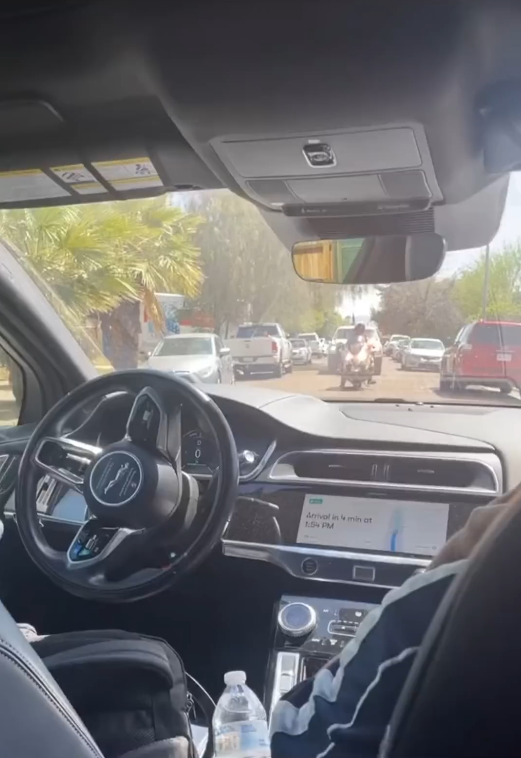
Some moments are memorable not because they are dangerous, but because they reveal how quickly modern technology can collide with systems that were never built for it. A traffic officer steps into the road, sees a taxi stopped in a blocked lane, and does what officers have done for decades—he starts giving directions. The expectation is simple. A driver sees the signal, understands the instruction, and responds.
But this time, there is no driver.
Inside the vehicle is not a confused tourist, a distracted commuter, or a nervous passenger behind the wheel. It is a self-driving taxi. The car is operating on software, sensors, route logic, and machine interpretation. It can detect movement, recognize obstacles, and respond to programmed road behavior. What it cannot do—at least not in the way a human can—is understand the improvisational body language of a police officer standing in traffic trying to wave it through.
That is where the moment becomes fascinating.
What begins as a completely ordinary traffic interaction suddenly turns into something stranger: a human officer using human signals on a vehicle that does not process the road like a human at all.
The Strange Comedy of Human Instinct vs Machine Logic
What makes the scene immediately compelling is how natural the officer’s response is—and how completely unnatural it is for the vehicle receiving it.
The officer is doing what traffic officers are trained to do. He reads congestion, sees a blocked path, steps in, and begins manually directing traffic. His gestures are clear, familiar, and designed for human interpretation. A person behind the wheel would instantly recognize the signals: stop, move, turn, go around.
But the self-driving car does not interpret gestures the way a human does.
It does not “read” the officer’s frustration. It does not infer intent. It does not process tone, urgency, or the social cues embedded in movement. It sees motion. It sees an object in the road. It sees conflicting variables. But what it does not do is understand the officer the way another person would.
That disconnect is what makes the moment feel almost surreal.
The officer is speaking the language of human traffic instinct.
The car is listening in software.
A System Designed for Rules, Not Improvisation
The deeper issue revealed in moments like this is not that the self-driving car is broken. It is that autonomous systems are built to function within rules, while traffic officers often operate through improvisation.
That difference matters more than it first appears.
A human driver can respond to formal traffic laws, but they can also adapt instantly to informal direction. If an officer waves them around a blocked lane, they do not need a detailed digital instruction set. They understand the situation socially and visually. They infer what the officer wants and act accordingly.
A self-driving car does not infer in the same way.
It relies on structured interpretation:
- lane mapping,
- obstacle detection,
- route logic,
- signal recognition,
- and behavior prediction.
That works well in standardized road environments. But traffic officers often create temporary exceptions to standard behavior. They override the expected flow. They improvise in real time. And that is where the self-driving system begins to struggle.
It is not failing to drive.
It is failing to interpret human improvisation.
The Officer’s Assumption Changes Everything
One of the most revealing parts of the moment is how long the interaction remains built on a false assumption. The officer approaches the situation expecting a human response. That assumption shapes everything he does.
He gestures because a driver should understand gestures.
He signals because a person should respond to direction.
He expects hesitation, then movement.
Instead, the vehicle remains caught between instruction and interpretation.
That is the moment where the scene shifts from routine to absurd.
Because the officer is not dealing with defiance.
He is dealing with absence.
There is no one inside making a judgment call. No one confused. No one refusing to comply. No one trying to interpret his commands and failing.
The problem is not noncompliance in the human sense.
The problem is that the “driver” is a system that does not understand informal authority the way people do.
Why the Car Freezes Instead of Adapts
To a human observer, the car’s hesitation can look simple: it seems confused. But what appears as confusion is more accurately a form of system caution.
Autonomous vehicles are built to prioritize safety when inputs conflict.
And in this moment, the inputs conflict everywhere.
The vehicle sees:
- a blocked route,
- an officer standing in traffic,
- hand gestures that may not match expected machine-readable behavior,
- and a roadway environment no longer following normal traffic logic.
For a human, that situation is easy enough to interpret through instinct.
For the car, it becomes a conflict between road rules and unclear override signals.
When autonomous systems face uncertainty they cannot confidently resolve, they often default to the safest possible option: hesitation.
That hesitation may look awkward.
But in machine logic, hesitation is often safer than guessing wrong.
The Gap Between Recognition and Understanding
One of the most important ideas exposed by this moment is the difference between recognition and understanding.
The car can likely recognize the officer.
It can identify a person in the road. It can detect motion. It can classify shape and movement.
But recognition is not the same as understanding.
Recognizing a traffic officer is one thing.
Understanding what that officer means in an improvised real-world context is something much harder.
That is the real limitation on display here.
The car is not blind.
It is uncertain.
And uncertainty in autonomous systems often looks less like failure and more like paralysis.
A Glimpse Into the Limits of Artificial Judgment
What makes this moment more than just funny is that it quietly exposes one of the central limitations of self-driving technology: artificial judgment still struggles with human unpredictability.
Roads are not only systems of lines and rules.
They are also systems of negotiation.
Humans improvise constantly:
- officers override lanes,
- drivers wave each other through,
- construction crews redirect traffic,
- pedestrians behave unpredictably,
- and real-world movement often depends on informal social understanding.
This is where autonomous systems remain limited.
They can process structure.
They struggle with improvisation.
And traffic officers, by nature, are often agents of improvisation.
That is what makes this moment so revealing.
The Quiet Humor of a Machine That Can’t Read the Room
There is also something undeniably funny about the scene—not because anyone is in danger, but because the interaction exposes such a deeply human mismatch.
The officer is trying to direct traffic.
The car is trying to solve a logic problem.
The officer expects compliance.
The car expects structured input.
Both are functioning exactly as designed.
And that is precisely why neither one understands the other.
That disconnect gives the scene its humor. It is not chaos. It is miscommunication between two systems operating on completely different assumptions.
One uses instinct.
The other uses code.
A Small Moment That Says Something Bigger
What makes the clip memorable is not just the confusion. It is what the confusion represents.
This is not only a funny traffic moment.
It is a glimpse into the awkward transition between human systems and autonomous ones.
The roads were built for people.
Traffic enforcement was built for people.
Hand signals were built for people.
And now those same systems are beginning to interact with machines that move through the world differently.
That transition will create more moments like this.
Not necessarily dangerous ones.
But moments that reveal how much of modern life still depends on informal human understanding.
A Future That Still Doesn’t Fully Speak Human
In the end, what makes this moment so compelling is how ordinary it begins—and how strangely futuristic it becomes.
A traffic officer tries to direct a taxi.
The taxi does not understand.
And suddenly, a completely normal traffic interaction becomes a perfect snapshot of the modern road in transition.
Not because the technology failed entirely.
But because it revealed something more subtle.
The car could see the officer.
It just could not understand him.
And that small gap between recognition and understanding may be one of the clearest signs yet that the future has arrived—but still does not fully speak human.
The Collision Between Human Authority and Machine Interpretation
What makes this moment so fascinating is that it captures something much larger than a traffic misunderstanding. On the surface, it is a simple scene: an officer is trying to direct traffic, a taxi is not responding the way it should, and confusion takes over. But underneath that moment is a deeper and more important collision—one between human authority and machine interpretation.
For generations, traffic systems have depended on something more flexible than rules alone. They have depended on human recognition of authority. A driver sees a police officer in the road and understands immediately that the normal logic of traffic has changed. The officer’s presence becomes the new rule. The driver does not need to analyze a formal legal exception or calculate alternate route logic. They simply understand: this person is now directing the flow.
That understanding is deeply human.
It depends on context, instinct, and social recognition.
And that is exactly what the self-driving car lacks.
The vehicle may recognize a person. It may even classify that person correctly as an officer. But recognizing authority is not the same as understanding how authority functions in a fluid, improvised human environment.
That is the deeper failure in this moment.
The officer is not just giving directions.
He is exercising human authority in a way the machine can detect—but not fully interpret.
Why Human Drivers Instantly Understand What the Car Cannot
A human driver in this exact situation would likely respond in seconds. Not because the officer’s signals are perfectly standardized, but because people are remarkably good at interpreting incomplete information in social environments.
A human does not need a perfectly structured command set to understand what the officer wants.
They process instantly:
- the officer’s position in the road,
- the blocked traffic pattern,
- the urgency in the gestures,
- the expectation of movement,
- and the fact that normal road behavior has been temporarily suspended.
That is not rule processing in the strict sense.
That is social interpretation.
Humans are constantly reading context beyond formal instruction. They infer meaning from posture, urgency, tone, and shared expectations. They understand that a traffic officer waving them around an obstruction is not creating confusion—they are resolving it through improvisation.
The self-driving car does not make that leap naturally.
It sees a set of signals.
A human sees intention.
That difference is everything.
The Limits of Autonomous Common Sense
One of the clearest lessons in this moment is that autonomous systems still struggle with what humans casually think of as common sense.
Common sense is difficult to define because it often feels invisible when it works. Humans do not consciously think through every social interpretation they make. They simply make them. That is what makes common sense so powerful and so difficult to replicate in machines.
A human driver sees an officer gesturing in front of a blocked road and immediately understands the practical reality: the officer is temporarily overriding the normal system and manually creating a new one.
That conclusion takes a person seconds.
For an autonomous system, that same moment becomes much more complex.
The car must reconcile:
- mapped lane behavior,
- route legality,
- object classification,
- motion prediction,
- traffic anomalies,
- and conflicting environmental signals.
What a human resolves through intuition, the machine must attempt to resolve through layered computation.
And when the system cannot reach confidence, it hesitates.
That hesitation is not stupidity.
It is the limit of artificial common sense.
Why the Car Appears Confused When It Is Actually Being Cautious
To human observers, the vehicle’s behavior can look almost comical. It appears confused, uncooperative, or incapable of understanding a very simple situation. But what looks like confusion is often something more technical and more revealing: caution without confidence.
This distinction matters.
The car is not “failing” in the same way a distracted human might fail.
It is pausing because the environment no longer matches the kind of certainty autonomous systems are designed to prefer.
The car is likely detecting:
- an obstructed roadway,
- a person in its path,
- nonstandard traffic movement,
- conflicting motion signals,
- and a breakdown of the expected road pattern.
For a human, this is manageable.
For the car, this creates ambiguity.
And ambiguity in autonomous systems often triggers the safest available response: stop, wait, and avoid making an unverified assumption.
To people, this can look ridiculous.
To the machine, it is caution.
The Officer Is Solving a Human Problem With Human Logic
One of the most interesting parts of the interaction is that the officer is doing exactly what he should be doing—if the road is populated by human drivers.
He sees a blockage and begins solving it through real-time human logic.
That means:
- stepping in,
- overriding the normal pattern,
- creating temporary order,
- and using hand signals to move traffic through an irregular situation.
This is how traffic control often works in practice. It is not always rigid. It is adaptive. It depends on quick social coordination and shared assumptions about how people interpret authority and movement.
The officer is solving a human problem with a human toolset.
And under ordinary conditions, that works perfectly.
The problem is not that the officer is wrong.
The problem is that the vehicle is not human.
So the officer is communicating in a language the road has always understood—just not this new participant in it.
A Machine Can Detect Motion Without Understanding Meaning
One of the most revealing technical ideas in this moment is the difference between detecting movement and understanding meaning.
The self-driving taxi can almost certainly detect the officer’s gestures.
It can see motion.
It can track the arm movements.
It can classify a person standing in front of the vehicle.
But motion alone is not enough.
The real challenge is semantic interpretation—understanding what the motion means in context.
A human driver does not merely see a raised hand. They understand:
- stop,
- wait,
- go around,
- move left,
- follow me,
- or hold position.
That meaning is inferred socially and instantly.
For the autonomous vehicle, the physical signal may be visible, but its meaning may remain uncertain unless the system has high confidence in what that gesture specifically instructs it to do.
This is where the machine stalls.
It sees the motion.
It cannot confidently interpret the meaning.
Why Improvisation Is Still One of the Hardest Problems in Autonomy
Autonomous systems are strongest in environments built on consistency. Lane markings, predictable traffic flow, mapped routes, and standardized signals all work well because they create structure.
But real roads are not purely structured environments.
They are full of improvisation.
And improvisation remains one of the hardest problems in autonomy.
Drivers improvise.
Pedestrians improvise.
Construction crews improvise.
Emergency responders improvise.
Police officers improvise constantly.
This matters because improvisation often overrides the very systems autonomous vehicles are designed to trust most.
The officer in this moment is not reinforcing road rules.
He is temporarily replacing them.
That is natural for human traffic systems.
It is deeply difficult for machine logic.
Because improvisation requires not only seeing what is happening, but understanding what everyone is now expected to do despite the rules no longer matching the moment.
That is still a profoundly human skill.
The Humor Comes From Watching Two Systems Misread Each Other
Part of what makes the clip so memorable is that it is funny in a very specific way. The humor does not come from danger or recklessness. It comes from watching two highly functional systems fail to communicate because each is operating correctly within a different logic model.
The officer is behaving rationally.
The car is behaving rationally.
That is what makes the mismatch so strange.
The officer assumes:
- visible authority,
- clear gestures,
- and immediate compliance.
The car assumes:
- environmental certainty,
- structured interpretation,
- and validated decision-making.
Neither one is malfunctioning.
They are simply speaking incompatible operational languages.
That is what makes the scene funny.
And that is also what makes it important.
A Small Traffic Moment That Reveals a Bigger Future Problem
What makes this moment worth paying attention to is that it is not just amusing. It is predictive.
It shows a real and growing friction point in the future of autonomous systems: human authority is often informal, adaptive, and socially understood, while machine behavior is formal, structured, and confidence-dependent.
That mismatch will matter more as autonomous systems become more common.
Because roads are not only governed by rules.
They are governed by exceptions.
And exceptions are where humans rely most heavily on instinct.
That is exactly where autonomous systems remain least comfortable.
This moment is not a major failure.
It is something more useful.
It is a small demonstration of where the future still struggles to translate the human world.
The Road Is Changing Faster Than Its Language
In the end, what makes this clip so memorable is not just the confusion. It is the strange clarity hidden inside it.
The technology is here.
The roads are changing.
The vehicles can drive themselves.
But the language of the road—the unwritten, improvised, human part of it—has not yet been fully translated into machine understanding.
That is what this moment exposes so clearly.
The car can navigate traffic.
It can detect obstacles.
It can move through the city.
But when a human steps into the road and replaces the normal system with instinct, authority, and improvisation, the machine still hesitates.
And that hesitation says something important.
The future may already know how to drive.
But it is still learning how to understand people.
And that may be the clearest takeaway from all of it: the hardest part of autonomous driving is not movement, mapping, or navigation. It is interpretation. Roads have always been social spaces as much as physical ones, and until machines can understand the improvised human language that governs those spaces, moments like this will remain the clearest reminder that automation can imitate driving long before it fully understands the people directing it.