The Echo of a Lash: Analyzing the Complex Layers of the Texas Neighborhood Dispute
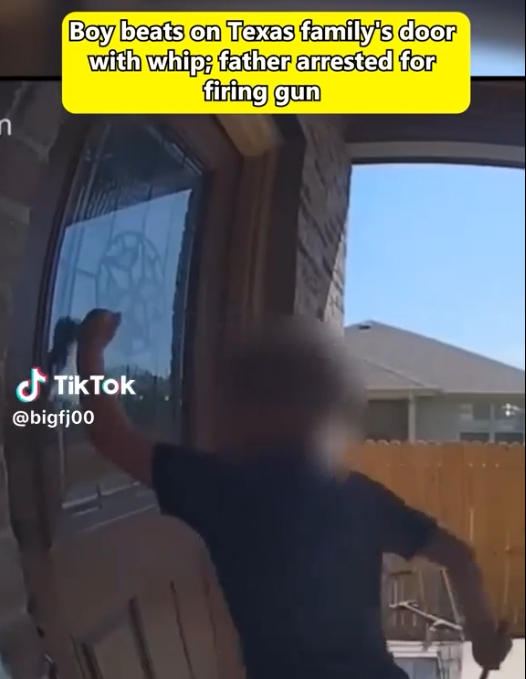
When a doorbell camera captures a nine-year-old boy striking a neighbor’s door with a whip, the resulting footage is more than just a suburban disturbance; it is a catalyst for a nationwide conversation on race, parenting, and the legal limits of self-defense. The video titled “Texas Neighborhood Dispute Sparks Outrage” documentation of a 2022 incident has resurfaced as a viral touchstone, forcing viewers to confront uncomfortable questions about historical symbols, childhood accountability, and the consequences of reactive violence.
The scene is deceptively simple: a suburban driveway, a brick facade, and a young boy in a black t-shirt. However, the weapon in his hand—a leather whip—carries a weight far heavier than its physical mass. As he repeatedly lashes the door of his Black neighbors, he isn’t just damaging property; he is invoking a traumatic historical imagery that resonates deeply within the American psyche. What follows is a tragic escalation that resulted in the arrest of the homeowner, leaving the community and the internet divided on who holds the ultimate responsibility for the day’s outcome.
To understand the intensity of the public reaction, one must first address the symbol at the center of the conflict. In the context of American history, the whip is inextricably linked to the era of chattel slavery and the systemic oppression of Black individuals. When a white child brings that specific object to the home of a Black family, it is impossible to view the act as a mere “childish prank.” For the family inside the house, the sound of the whip against their door was likely not just a noise, but an alarm. It represents a targeted form of harassment that taps into generational trauma. While a child of nine may not fully grasp the historical significance of their actions, the impact on the victims remains the same. This disconnect between a child’s intent and the adult reality of the situation is where the primary tension of this case lies.
Escalation and the Law: The Father’s Response
The most controversial aspect of the video is not the boy’s actions, but the response of the homeowner. According to reports, the father of the Black family, feeling threatened by the boy’s aggression and the potential presence of the boy’s parents, fired a gun. While no one was struck by the bullet, the act led to his immediate arrest. Texas is known for its “Stand Your Ground” laws, which generally allow individuals to use force if they reasonably believe it is necessary to protect themselves or their property. However, the legal system often draws a strict line when it comes to the level of force used. Firing a weapon in response to a child with a whip is a legal gray area that has sparked intense debate.
Many argue that the father was acting out of a justified fear for his family’s safety, especially if he perceived the boy’s actions as part of a larger, coordinated harassment campaign. Others contend that the use of a firearm against a minor is an excessive escalation that endangers the entire neighborhood. The arrest of the father has become a focal point for those who believe that the justice system often penalizes victims of harassment when they choose to defend themselves. This creates a secondary trauma for the family—not only are they harassed at their doorstep, but they are then separated and legally entangled for trying to end that harassment.
The concept of a “castle doctrine” is meant to provide peace of mind to homeowners, ensuring they have the right to feel secure within their own walls. Yet, in this instance, that security was breached long before a shot was fired. The psychological toll of having an aggressive individual—regardless of age—repeatedly strike your home with a weapon cannot be ignored. When the victim becomes the defendant, it sends a confusing message to the public about where the line of “reasonable fear” truly lies.
Parenting and Responsibility: The Roots of Aggression
The video poses a haunting question at the end: “Should the boy’s parents be held responsible for his actions?” This is the question that has dominated social media threads. In many jurisdictions, parents can be held civilly liable for the “willful or malicious” property damage caused by their minor children. But the moral question goes deeper. How does a nine-year-old gain access to a whip, and what motivates them to use it against a specific neighbor? These are the questions that point toward the home environment. Behavioral experts suggest that children at that age are mirrors of their surroundings.
If a child perceives that certain neighbors are “targets” or if they are exposed to rhetoric that devalues others based on race, they are likely to act out those beliefs. The fact that the boy was able to walk to a neighbor’s house and repeatedly strike their door with a weapon suggests a significant lapse in supervision. In the eyes of the public, the parents’ failure is twofold: a failure to monitor their child’s actions and a failure to instill a basic sense of respect for others. By the time the situation escalated to a gunshot, the “neighborhood dispute” had already been failed by the adults who should have intervened much earlier.
Furthermore, we must consider the message sent when such behavior is not immediately corrected by the child’s guardians. If a child believes they can harass others without consequence, that behavior often scales as they grow older. This incident is seen by many as a “pre-cursor” event—a glimpse into the development of an individual who may grow up to believe that their biases justify their aggression. The outcry for parental accountability is not just about punishment; it is about the necessity of breaking the cycle of learned prejudice before it matures into adult violence.
The Social Media Verdict: Outrage and Advocacy
As the footage spread across TikTok and Facebook, it became a lightning rod for advocacy. The “Black Lives Matter” movement and various civil rights groups pointed to this incident as a clear example of how Black families are often harassed in their own homes and then penalized by the legal system when they react. The “Karen” phenomenon—the idea of white individuals using their perceived social standing to harass people of color—is often applied here, with the child seen as an extension of that dynamic. The outrage is not just about the whip; it is about the systemic feeling that certain families can act with impunity while others must live in a state of constant vigilance.
The digital community’s reaction also highlights the power of the “witness” in the 21st century. Without the doorbell camera, this story might have been reduced to a simple “dispute between neighbors” with no clear evidence of the provocation. The video allows the public to see the raw aggression of the child and the immediate terror of the family. This visual evidence is what fuels the demand for a re-evaluation of the charges against the father. It forces the viewer to ask: “What would I do if someone was whipping my front door and I didn’t know who else was outside?”
Social media platforms have acted as a secondary courtroom where the evidence is weighed by the masses. While this can lead to “mob justice,” it also provides a platform for those who feel ignored by traditional legal structures. The viral nature of this video has ensured that the incident cannot be swept under the rug. It has become a permanent part of the digital record, serving as a cautionary tale for those who believe that suburban harassment is a victimless crime or a private matter.
The Hidden Costs of Suburban Hostility
When we talk about neighborhood disputes, we often overlook the long-term mental health impacts. For the family in this video, their home—once a place of refuge—has become a site of conflict. The sound of a knock at the door may now trigger a trauma response. The children in that household may now view their neighborhood as a hostile environment rather than a playground. This “theft of peace” is a significant injury that is rarely addressed in a criminal court but is central to the community’s outrage.
Suburban neighborhoods are built on a fragile social contract of mutual respect. When that contract is violated, the damage spreads like a virus. Other neighbors may become fearful or polarized, taking sides and further fracturing the community. The presence of a whip, a gun, and an arrest at a single address changes the character of the entire street. It serves as a reminder that the “American Dream” of a quiet, safe suburb is only as strong as the people living in it.
The incident also highlights the need for better conflict resolution and community intervention programs. If there was a pre-existing tension between these families, were there resources available to help them navigate it before it reached the point of weapons and arrests? Often, these situations simmer for months or years before a boiling point is reached. By the time a doorbell camera captures a viral moment, it is usually the result of a long chain of unaddressed grievances and systemic failures.
Moving Toward Accountability and Healing
The Texas neighborhood dispute is a tragedy with no winners. A nine-year-old has been placed at the center of a national scandal, a father has faced criminal charges for defending his home, and a neighborhood’s sense of security has been permanently altered. To move forward, there must be an honest accounting of the factors that led to this moment. It requires a commitment to addressing the racial undertones of suburban conflict and a rigorous look at how we protect families from harassment without resorting to lethal force.
Parental accountability must be more than just a talking point. It needs to be a standard that is upheld through both social expectations and legal frameworks. If a child is capable of using a weapon to harass a neighbor, the guardians must be held to account for how that situation was allowed to develop. At the same time, the legal system must show more nuance in how it handles those who react to harassment. A father who feels his family is under siege deserves a fair evaluation of his state of mind and the threats he perceived.
The footage remains a painful, essential piece of evidence in the ongoing American struggle to define what it means to be a “neighbor” in a divided time. It challenges us to look at our own biases and our own parenting. It asks us to consider the power of symbols and the weight of history. Most importantly, it reminds us that the safety of our communities depends on our ability to see each other as human beings deserving of respect, rather than targets for our anger or our historical prejudices.
As this article circulates, let it be a reminder that “neighborly love” is not just a polite suggestion; it is a foundational requirement for a functioning society. Every time a child picks up a whip or an adult reaches for a gun, it is a sign that we have failed to communicate, to educate, and to protect one another. Let us hope that the lessons learned from this driveway in Texas lead to more empathy, better parenting, and a legal system that truly protects those under siege. The road to healing is long, but it begins with a refusal to look away from the uncomfortable truths captured in this shocking footage.
The Psychological Toll of Racialized Harassment in the Suburbs
When we look beyond the initial shock of the video, we must confront the psychological erosion that occurs when a family’s sense of safety is compromised. For a Black family in a predominantly white or mixed suburban space, their home is often viewed as the ultimate sanctuary from a world that can be fraught with systemic challenges. When that sanctuary is breached by a neighbor—especially a child wielding a symbol as historically charged as a whip—the damage is not just to the front door, but to the mental well-being of every person inside. This is a form of “environmental trauma” that lingers long after the police have left and the viral news cycle has moved on to the next story.
The repetition of the lashing against the door is particularly significant. In behavioral psychology, repetitive aggressive actions toward a fixed target signal a high level of intentionality. This wasn’t a passing moment of frustration; it was a sustained effort to intimidate. For the children inside the home who may have witnessed this, the message is clear and terrifying: you are not safe in your own house, and your neighbors are people to be feared. This early exposure to racialized hostility can shape a child’s worldview for decades, contributing to chronic stress and a diminished sense of belonging within their own community.
The Legal Paradox: Self-Defense vs. Excessive Force
The arrest of the father brings to light a massive legal paradox that many families of color face. The law often asks individuals to remain perfectly calm and logical in moments of extreme, illogical threat. When the father saw a boy with a whip and potentially anticipated the arrival of the boy’s parents, his brain likely entered a state of “hyper-arousal.” In this state, the survival instinct takes over. The legal debate then becomes: is it reasonable to fire a warning shot when your home is being struck by a weapon?
Critics of the father’s arrest point out that “reasonableness” is often a subjective term influenced by cultural and racial biases. If the roles were reversed, would a white father firing a warning shot at a perceived intruder be treated with more leniency? This case forces the Texas judicial system to examine its own consistency. If the “Castle Doctrine” is meant to protect the sanctity of the home, does it apply equally to all citizens, or is it a privilege reserved for those who fit a certain demographic profile? The public’s demand for the charges to be dropped is a demand for a legal system that recognizes the reality of being under siege in one’s own neighborhood.
The Historical Echo: Why We Cannot Ignore the Whip
We must dive deeper into why the whip is not just “another object.” In the American South, the whip was the primary tool used to enforce the labor and submission of enslaved people. It is a symbol of absolute power and absolute dehumanization. When a white child uses this tool against a Black family in 2022 or 2026, they are—knowingly or unknowingly—stepping into a historical role that carries a legacy of blood and tears. This is why the community’s reaction is so visceral; the act feels like a literal attempt to pull the family back into a dark chapter of history.
Ignoring the racial subtext of the whip is a form of “colorblindness” that does more harm than good. To treat this as a simple property damage case is to ignore the profound psychological assault being committed. True justice requires an acknowledgment of history. If the legal system fails to recognize the weight of the symbol used, it fails to understand the true nature of the crime. The public discourse surrounding this video is an education for many who may not have understood why a “toy” or a “piece of leather” could cause such a massive social explosion. It is a reminder that symbols have power, and that power can be used as a weapon just as effectively as a bullet.
The Failure of the “Good Neighbor” Ideal
For decades, the American suburb has been marketed as a place where people look out for one another—where neighbors borrow sugar and keep an eye on each other’s kids. This video represents the total collapse of that ideal. Instead of a community of care, we see a community of conflict. The failure of the boy’s parents to intercept him before he reached the door is a breakdown of the social fabric. It suggests a lack of communication and a lack of shared values between the two households.
When neighborhoods become polarized, the “commons”—the sidewalks, the parks, the driveways—become contested territory. This incident shows how a single family’s failure to supervise or educate their child can have a “contagion effect,” turning an entire block into a zone of tension. The solution isn’t just found in a courtroom; it is found in community-building efforts that bridge racial and social divides. However, as long as one side feels targeted and the other side feels entitled to harass, the “Good Neighbor” ideal will remain a myth.
The Burden of Forgiveness and the Reality of Resentment
In many of these viral cases, there is an eventual call for “healing” and “forgiveness.” But for the family who was whipped and then saw their father arrested, forgiveness is an immense burden to ask for. The reality of resentment is a natural response to being mistreated by the very people you live next to. The emotional labor required to “move on” from an event like this is exhausting. It involves daily interactions with the same neighbors, seeing the same driveway, and passing the same house where the aggression originated.
True healing can only begin with a genuine admission of wrongdoing from the boy’s family and a systemic correction from the legal authorities. Without accountability, “forgiveness” is just a way for society to sweep an uncomfortable incident under the rug. The viral nature of the footage ensures that this won’t happen easily. The internet acts as a collective memory, reminding us that until the father is exonerated and the root causes of the boy’s behavior are addressed, the “dispute” is far from over.
As we conclude this deep dive into the Texas neighborhood dispute, the takeaway is clear: we must move toward a state of radical empathy. We must be able to put ourselves in the shoes of a family being harassed in their own home and understand why they would react with such desperation. We must also look at the children in our lives and ask what we are teaching them—both through our words and our silences.
This video is a mirror held up to the cracks in the American dream. It shows us that as long as we carry the baggage of our past into our suburban driveways, we will never truly be at peace. Justice for this family, and for all families facing similar harassment, lies in our collective refusal to accept this as “normal.” We must demand better parenting, fairer laws, and a culture that values the safety of a three-year-old or a nine-year-old as much as it values the dignity of their parents. Only then can we hope to see a day where a doorbell camera captures nothing but the arrival of a friend, rather than the echo of a lash.